
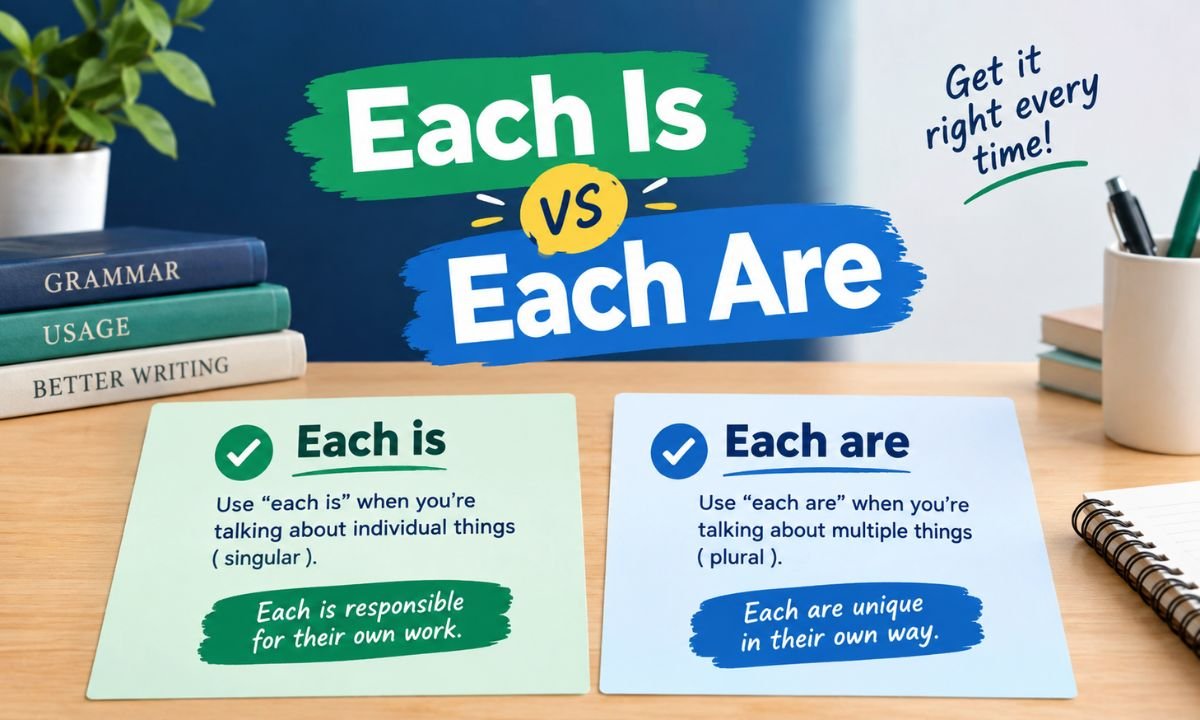
If you’ve ever paused mid-sentence wondering whether to write “each is” or “each are,” you’re not alone. This tiny word trips up native speakers and English learners alike, mostly because it often sits next to plural nouns that pull the verb in the wrong direction.
The short answer: “each is” is the grammatically correct form in standard American English, every time. The longer answer — the one that actually helps you remember why, and helps you handle trickier sentences — is what this guide covers.
By the end, you’ll know exactly how “each” behaves with singular nouns, plural nouns, collective nouns, pronouns, and even relative clauses like “who” and “whom.” You’ll also see real examples, common mistakes, and a quick-reference table you can bookmark for later.
Understanding What “Each” Really Means in American English
“Each” is a distributive pronoun. That word “distributive” is the key to everything else in this article, so it’s worth sitting with for a second.
Distributive means the word splits a group into individual, separate units instead of treating them as one block. When you say “each player scored a goal,” you’re not describing the team as a whole — you’re describing one player at a time, individually, even though there might be eleven of them on the field.
Because “each” always points to one item at a time, English grammar treats it as singular, no matter how large the group behind it actually is. This is different from a word like “all,” which treats a group as a single collective mass. That contrast is where most of the confusion starts.
Key points
- “Each” refers to individual members of a group, one at a time.
- It functions as a singular subject, even when the group it describes is large.
- It pairs with singular verbs: is, has, does, goes, wants.
- It can appear before a noun (“each student”) or before “of” plus a plural noun (“each of the students”).
- The rule holds in formal writing regardless of how the sentence sounds in casual speech.
Mini Example
Picture five laptops lined up on a desk before a shipment goes out.
- Correct: Each laptop is tested before packaging.
- Incorrect: Each laptop are tested before packaging.
Even though there are five laptops, “each” isolates them one by one, so the sentence needs a singular verb.
Why “Each Is” Is Grammatically Correct
The rule comes down to subject-verb agreement, one of the oldest and most consistent principles in English sentence structure. A singular subject needs a singular verb. A plural subject needs a plural verb. “Each” is classified as singular in every reputable grammar reference, so it locks in “is,” not “are.”
Think of “each” as a shorthand for “each one” or “every single one.” If you mentally expand the sentence that way, the correct verb becomes obvious:
- “Each of the workers is trained” reads naturally as “each one of the workers is trained.”
- Nobody would say “each one are trained,” so the shortened version shouldn’t take “are” either.
Why the grammar rule is strict
Some grammar debates have gray areas. This one mostly doesn’t. Style guides, dictionaries, and academic writing handbooks agree that “each” governs a singular verb, whether it stands alone or introduces a longer phrase. The strictness exists because “each” isn’t just implying singularity — it’s built on the concept of one unit at a time. Loosening the rule would blur a distinction that the word exists to make.
That said, you’ll find occasional notes in usage guides admitting that plural verbs show up in real-world writing when “each of” is followed by a plural noun. Those notes describe what happens in casual usage, not what formal grammar recommends. For anything you’re submitting, publishing, or sending professionally, “each is” remains the safe and correct choice.
Why “Each Are” Sounds Wrong in Standard English
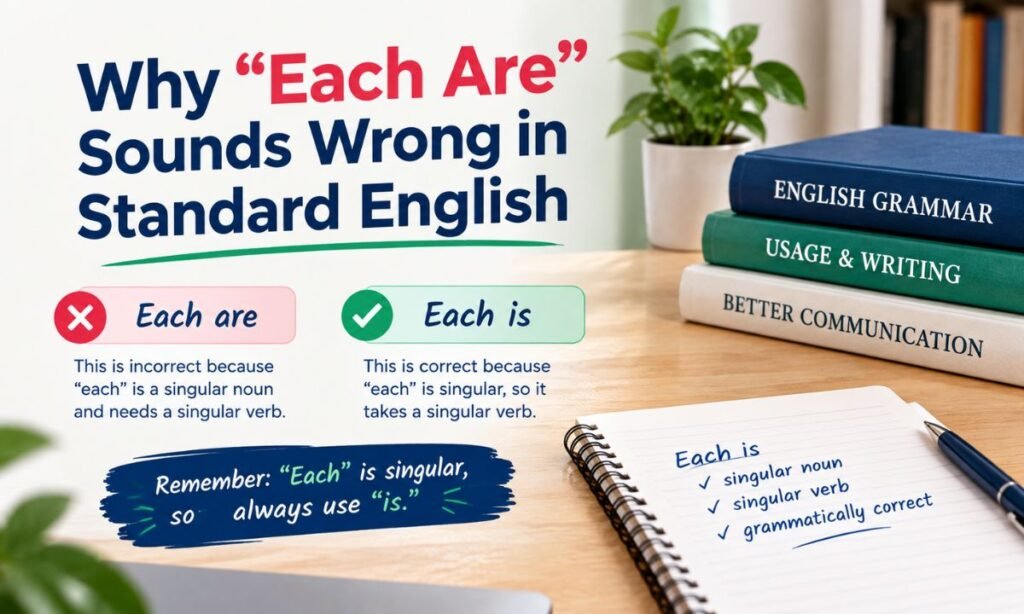
Say “each are” out loud, and if you have a decent ear for English rhythm, something probably feels off — even before you can explain why. That instinct is grammar doing its job. “Each” and “are” simply don’t belong together in a properly agreeing sentence, because one is singular and the other is plural.
Why do people make this mistake?
The error almost always comes from proximity, not logic. Speakers glance at the noun sitting closest to the verb rather than the actual subject of the sentence. In a phrase like “each of the students,” the word “students” sits right next to where the verb goes, and plural nouns have a pull on plural verbs. Writers unconsciously match “students” with “are,” skipping over the fact that “each” — not “students” — is the true subject.
Fast speech makes this worse. Nobody is diagramming sentences while chatting with a coworker, so “each are” slips out because it matches the rhythm of the sentence, not because it’s correct.
Example
- Common speech error: Each of the interns are working on the project.
- Correct written form: Each of the interns is working on the project.
Read the second version aloud a few times. Once your ear adjusts to matching “each” with “is,” the correct pattern starts to feel just as natural as the incorrect one used to.
“Each” with Singular and Plural Nouns
“Each” shows up in two common structures, and both take a singular verb — even though one of them is built entirely around a plural noun.
Pattern 1: Each + Singular Noun
This is the simpler pattern. “Each” sits directly before a singular noun, and the verb matches that singular noun.
- Each employee receives a badge.
- Each recipe includes a nutrition label.
- Each classroom has its own supply closet.
Pattern 2: Each of + Plural Noun
Here, “each” is followed by “of” and then a plural noun or pronoun. This is where most errors happen, because the plural noun sits closer to the verb than “each” does.
- Each of the employees receives a badge.
- Each of the recipes includes a nutrition label.
- Each of the classrooms has its own supply closet.
Notice that the verb didn’t change between the two patterns. That’s the entire point: “of the employees” is a prepositional phrase describing which group “each” is pulling from — it isn’t the subject.
| Structure | Example Sentence | Correct Verb |
|---|---|---|
| Each + singular noun | Each ticket is checked at the gate. | is |
| Each of + plural noun | Each of the tickets is checked at the gate. | is |
| Each + singular noun + has | Each device has a warranty. | has |
| Each of + plural noun + has | Each of the devices has a warranty. | has |
Why do these take singular verbs?
Because in both patterns, “each” — not the noun that follows it — is the grammatical subject. The noun after “of” simply tells you the pool that “each” is drawing individuals from. Once you identify “each” as the subject, the singular verb choice stops feeling like a rule you memorized and starts feeling like the only logical option.
“Each Of”: Singular or Plural?
This exact phrase, “each of,” generates more grammar questions than almost any other construction involving “each.” The confusion is understandable: “of” is almost always followed by a plural noun in this pattern, and English speakers are trained to match verbs to whatever noun sits nearby.
But “each of” is still singular. Always. The “of” phrase is descriptive, not the subject.
Why does “each of” still need a singular verb?
Try a simple substitution test. Replace “each of the [plural noun]” with “each one of the [plural noun],” and the correct verb becomes obvious because nobody instinctively says “are” after “one.”
- Each one of the drivers is licensed. (not “are”)
- Each one of the reports is finished. (not “are”)
If “each one” clearly needs “is,” then the shortened form “each” needs it too, since “each” and “each one” mean the same thing.
Examples with correct verbs
- Each of the doctors is on call this week.
- Each of the phones has a two-year warranty.
- Each of the answers was reviewed twice.
- Each of the paintings belongs to a private collector.
What about pronouns?
The same rule applies when a pronoun follows “each,” and it extends to any pronoun that refers back to “each” later in the sentence. Those pronouns should also stay singular in formal writing.
- Each of us is responsible for our own section.
- Each of them has submitted his or her form. (Formal)
- Each of them has submitted their form. (Common in modern usage — more on this below)
Using “Each” with Collective and Group Nouns
A collective noun names a group that functions as one unit — team, committee, staff, jury, family. These nouns already cause their own subject-verb agreement debates, so pairing them with “each” is worth a separate look.
When “each” refers to individual members within a collective noun’s group, it still behaves the same way: singular.
- Each member of the committee is expected to vote.
- Each department of the company has its own budget.
- Each player on the team has a personal locker.
Why not plural?
It would be tempting to think that because “committee” or “team” describes many people, “each” borrows that plurality. It doesn’t. “Each” is still isolating one member at a time from within that group, regardless of how the group noun itself behaves elsewhere in the sentence.
Advanced example
Instead of: Each of the members of the international advisory committee are present.
Use: Each member of the international advisory committee is present.
The second version is both grammatically correct and cleaner to read, since it removes an unnecessary “of the members of” chain.
Informal Speech vs Formal Writing
Spoken English bends rules that written English holds firm on, and “each” sits right at that boundary.
In casual conversation, you’ll hear sentences like:
- “Each of the kids are doing their homework.”
- “Each of us are trying our best.”
Nobody stops a conversation to correct this. Speech moves fast, follows rhythm more than logic, and native speakers process meaning without pausing over verb agreement. In that setting, “each are” communicates the idea just fine, even if a grammar teacher would wince.
But in writing?
Formal writing — essays, reports, emails to clients, books, articles, resumes — holds a different standard. Editors, teachers, and professional readers expect subject-verb agreement to be followed precisely, and “each is” is the version that meets that expectation. A grammar slip that nobody notices in a hallway conversation can undercut credibility in a cover letter or a business proposal.
Practical rule
Speak however feels natural to you. Write “each is.” That single guideline resolves almost every situation you’ll run into with this word.
American vs British Tendencies
Both American and British English classify “each” as a singular pronoun, and both expect a singular verb in formal contexts. The rule itself doesn’t change across the Atlantic.
Where the two dialects diverge slightly is with collective nouns in general — not with “each” specifically. British English is more relaxed about treating group nouns like “team” or “government” as plural (“the team are playing well”), while American English almost always keeps them singular (“the team is playing well”). That flexibility with collective nouns occasionally bleeds into how comfortable British writers feel bending agreement elsewhere, but it doesn’t officially extend to “each.” In both varieties of English, “each is” remains the standard, correct form.
| Feature | American English | British English |
|---|---|---|
| “Each” + verb | Always singular (each is) | Always singular (each is) |
| Collective nouns (team, staff) | Usually singular (the team is) | Often plural (the team are) |
| Formal writing standard | Strict singular agreement | Strict singular agreement |
“Each” with Pronouns and Modern Language
Modern English has shifted toward gender-neutral pronouns, and “they/them” is now widely accepted as a singular pronoun when someone’s gender is unknown or unspecified. This creates an interesting overlap with “each,” since “each” is grammatically singular but “they” looks plural on the surface.
- Each employee should bring their laptop.
- Each guest can choose their own seat.
Why this works
“They” used this way is called the singular “they,” and it has a long history in English, even predating some of the stricter grammar rules taught in twentieth-century classrooms. Pairing “each” with “their” doesn’t break the singular rule for “each” itself — the verb still stays singular (“each employee should bring,” not “each employees should bring”). It simply reflects a pronoun choice that avoids specifying gender.
Examples
- Each person is responsible for their own belongings.
- Each student should submit their assignment by Friday.
- Each participant will receive their certificate at the end.
If a style guide requires strictly traditional agreement, “his or her” remains the more formal alternative, though it reads as more dated in everyday writing.
Relative Clauses with “Each”
Sentences get more complex once “each” is followed by a relative clause — a clause that starts with “who,” “whom,” “that,” or “which.” The core rule doesn’t change, but knowing where to place the singular verb takes a little more attention.
Common structures
- Each of the candidates who applied was interviewed.
- Each employee, who was notified in advance, arrived on time.
- Each of the items that arrived was inspected.
Key rule
Inside the relative clause itself, the verb agrees with whatever the relative pronoun is standing in for — which is often the plural noun. But once the sentence returns to describing “each” as the main subject, the verb goes back to singular.
- Each of the candidates who were qualified was invited back. (were agrees with candidates inside the clause; was agrees with each as the main verb)
When to use “whom”
Use “whom” when the pronoun functions as an object within the clause — receiving the action rather than performing it.
- Each of the applicants, whom the committee reviewed carefully, received a response.
When to use “who”
Use “who” when the pronoun functions as the subject within the clause — performing the action.
- Each of the applicants who submitted a portfolio received a response.
Real Examples from Literature and Media
Professional writers rely on the same rule, even in stylistically rich or emotional sentences. Consider how “each” holds its singular verb across very different tones and contexts:
- “Each star is a story waiting to be told.”
- “Each moment is a memory in the making.”
- “Each of the gems is worth over ten thousand dollars.”
- “Each musician in the quartet is a virtuoso.”
Notice that even in poetic or descriptive writing, where sentence rhythm matters as much as meaning, “is” never gets swapped for “are.” That consistency is a good signal of just how firmly this rule holds across registers.
Common Mistakes and How to Avoid Them
Mistake 1: Matching the verb to the plural noun
Writers see “each of the students” and instinctively pair the verb with “students” instead of “each.” Fix this by covering up everything between “each” and the verb, then reading the sentence with just those two words together.
Mistake 2: Thinking “each” and “all” follow the same rules
“All” often takes a plural verb because it treats a group collectively (“all students are welcome”). “Each” does the opposite — it separates the group into individuals. Confusing the two leads to inconsistent agreement across a paragraph.
Mistake 3: Overthinking long sentences
The longer a sentence gets, the easier it is to lose track of the actual subject. When a sentence stretches across a relative clause, a list, or multiple prepositional phrases, pause and ask: what word is “each” actually referring back to at the main clause level? That word — “each” — is always singular.
Mistake 4: Using plural verbs because it “sounds natural” in speech
Speech habits carry over into writing more than people realize. If a sentence “sounds right” with “are” because that’s how you’d say it out loud, double-check it against the “each one” substitution test before finalizing written work.
Mistake 5: Confusion with “every,” “any,” and “either”
“Every,” “any,” and “either” behave similarly to “each” in many contexts, but they’re not identical twins. “Every” also takes singular verbs (“every student is present”). “Either” typically does too, though it can shift depending on sentence structure. Treating all of these words as interchangeable can lead to inconsistent patterns across a document, so it helps to check each one individually rather than assuming the same rule covers all of them automatically.
Quick Reference: When to Use “Each Is”
| Situation | Use “Each Is”? | Example |
|---|---|---|
| Each + singular noun | Yes | Each book is on the shelf. |
| Each of + plural noun | Yes | Each of the books is on the shelf. |
| Each + collective noun member | Yes | Each member of the team is ready. |
| Each in a relative clause (main verb) | Yes | Each of the students who applied is qualified. |
| Casual/spoken sentence | Optional, but “is” is still technically correct | Each of us is trying our best. |
| Formal writing, emails, essays | Always | Each of the applicants is under review. |
If you remember nothing else from this guide, remember the substitution trick: replace “each” with “each one,” and the correct verb will almost always reveal itself.
Frequently Asked Questions
What to use with each is or are?
Use “is” with “each” in standard and formal English. “Each” is a singular pronoun, so it always pairs with a singular verb.
Is “each” singular or plural?
“Each” is grammatically singular, even when it refers to members of a large group, because it addresses individuals one at a time.
Which is correct, each of them is or each of them are?
“Each of them is” is the grammatically correct form. “Each,” not “them,” is the true subject of the sentence.
How to use each correctly?
Pair “each” with a singular verb (is, has, does) and, when needed, a singular pronoun. Test it by mentally replacing “each” with “each one” to check the agreement.
Conclusion
“Each” is a small word that carries a surprisingly firm rule: it’s singular, full stop, regardless of how many items or people it refers to. Whether it stands alone before a noun, introduces a phrase with “of,” connects to a collective noun, or sits inside a relative clause, the verb that follows should match “each” itself — not the plural noun that might be sitting closer by.