
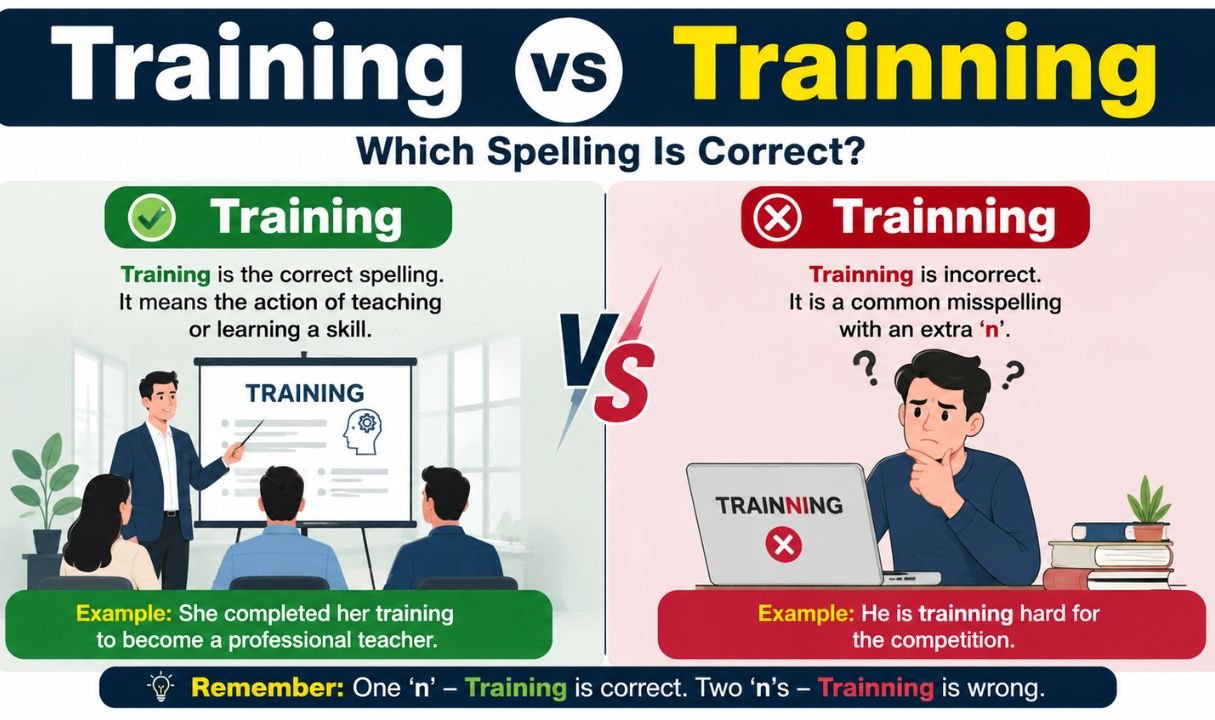
Training is the correct spelling. Trainning is not a real word in standard English, no matter how often it shows up in resumes, emails, and social posts. If you remember nothing else from this guide, remember that one rule.
Quick Answer
- Correct: training
- Incorrect: trainning
- The base word is train, and it takes -ing with no letter doubled.
Simple examples:
- She finished her sales training yesterday.
- We offer training to every new hire.
- He is training for a half marathon.
Why Training Is Right and Trainning Is Wrong
The confusion starts with a spelling rule most people half remember from school: sometimes you double the last letter before adding -ing, and sometimes you don’t. Train falls into the “don’t” category, and there’s a clean reason why.
The Base Word
Start with train. Add the suffix -ing. That’s it.
train + ing = training
No extra letters get inserted anywhere in that process.
Why We Don’t Double the N
English doubles a final consonant before -ing only when three things line up at once: the word is a single stressed syllable, it ends in a single consonant, and that consonant follows a short vowel sound. Think run → running or sit → sitting. Train doesn’t meet that last condition, so the rule simply doesn’t apply to it.
You May Also Like
Seeing or Seing: Which Spelling Is Correct?
The Spelling Rule, Explained in Depth
When Consonants Actually Get Doubled
The doubling rule shows up constantly in English, so it’s worth locking down properly:
| Condition | Example | Doubled? |
|---|---|---|
| One syllable, short vowel, ends in consonant | run → running | Yes |
| One syllable, short vowel, ends in consonant | plan → planning | Yes |
| Two-vowel combo before the consonant | train → training | No |
| Silent e before the consonant | hope → hoping | No |
Why Train Skips the Doubling
Train ends in n, but that n follows the vowel pair ai, not a single short vowel. That vowel pair produces a long vowel sound, and long vowel sounds block the doubling rule entirely. Swap the spelling to “trainning” and you’re breaking a pattern that governs dozens of similar words.
Why This Mistake Happens So Often
Nobody types “trainning” because they think it looks elegant. A few specific habits cause it.
- Pattern borrowing: Writers see “running,” “planning,” and “swimming” everywhere and assume every short verb doubles its last letter before -ing.
- Muscle memory from typing fast: An extra tap on the N key is an easy slip, especially on mobile keyboards.
- Second-guessing under pressure: People proofreading a resume or cover letter sometimes overcorrect a word that was already right, because uncertainty makes “training” look unfamiliar for a second.
- Autocorrect gaps: Not every spell-checker flags “trainning” instantly, especially in messaging apps with looser dictionaries.
- Never learning the rule explicitly: Most native speakers absorb spelling by exposure, not by rule, so an unusual case like this one never gets corrected consciously.
Training in Everyday Use
Workplace
- The team completed compliance training this quarter.
- New managers go through leadership training in their first month.
Fitness and sports
- She’s in training for the marathon.
- Strength training twice a week improves recovery.
Education
- Teacher training programs run for two years in most states.
- Medical residents complete years of hands-on clinical training.
Online learning
- The platform sells self-paced training modules.
- Corporate training software is a growing SaaS category.
Across every one of these contexts, the spelling never changes. There’s no version of the word that legitimately doubles the N.
You May Also Like
Appendices vs Appendixes: Which Plural Is Actually Correct
Training Centre, Course, Program, and Day

A few related phrases show up constantly in searches and deserve a direct answer:
- Training centre / training center: a physical or dedicated location where instruction happens, spelled with “-re” in British English and “-er” in American English, but always with one N.
- Training course: a structured set of lessons or sessions with a defined start and end.
- Training program: a broader, often ongoing plan that may include multiple courses.
- Training Day: a proper noun referring to the 2001 film, capitalized when used that way and unrelated to the spelling question.
British vs American English
This is one of the rare cases where the two dialects agree completely. British English writes training. American English writes training. Neither variant doubles the N, and no English-speaking country recognizes “trainning” as a valid alternative spelling.
Common Mistakes and Corrections
| Wrong | Right |
|---|---|
| She finished her trainning last week. | She finished her training last week. |
| We provide staff trainning. | We provide staff training. |
| He is trainning the new hires. | He is training the new hires. |
| Personal trainning sessions available. | Personal training sessions available. |
Words That Follow the Same Pattern
Words That Don’t Double
These all contain a long vowel sound or vowel pair before the final consonant, so they behave exactly like train:
- rain → raining
- gain → gaining
- explain → explaining
- complain → complaining
- maintain → maintaining
Words That Do Double
These have a short vowel sound sitting right before a single final consonant:
- run → running
- sit → sitting
- swim → swimming
- plan → planning
- stop → stopping
Once you see the two lists side by side, the pattern stops feeling arbitrary. It’s about vowel sound, not about how the word looks.
The Deeper Grammar Logic
English spelling tracks pronunciation more closely than people give it credit for. A doubled consonant after a vowel signals “keep that vowel short.” Since train already has a long vowel sound built into the ai spelling, there’s nothing left for a doubled consonant to protect. Adding one would actually misrepresent how the word sounds.
Training in Professional Writing
A misspelled word rarely sinks an application on its own, but it does register. Recruiters and hiring managers read hundreds of resumes, and small errors like “trainning” stand out precisely because the correct spelling is so common elsewhere in the same document. The same logic applies to:
- Company websites and service pages, where “trainning” undercuts perceived professionalism.
- LinkedIn summaries and headlines, which get scanned quickly and judged on polish.
- Client-facing proposals, where spelling errors can read as a lack of attention to detail.
Running a spell-check pass before sending anything formal catches this instantly, since “trainning” isn’t in any standard dictionary.
Training vs Trainning in Sentences
Simple
- He needs training.
- She completed training.
Medium
- The company runs leadership training for new supervisors.
- Online training courses fit around a full-time job.
Formal
- The organization has expanded its employee training program to include quarterly refreshers.
- Proper training remains central to workplace safety compliance.
Practice Exercises
Fill in the blanks
- She is attending safety ______. (training)
- The gym offers personal ______ sessions. (training)
- He completed his pilot ______ last year. (training)
- Our team needs additional customer service ______. (training)
Choose the correct word
- (Training / Trainning) starts on Monday. → Training
- She loves fitness (training / trainning). → training
- New staff receive onboarding (training / trainning). → training
- The course offers online (training / trainning). → training
Frequently Asked Questions
Which is correct, “training” or “trainning”?
Training is correct. Trainning is a common misspelling and isn’t recognized in any standard English dictionary.
Why training not trainning?
Because the base word train has a long vowel sound from the ai pair, which blocks the usual doubling rule that applies to short-vowel words like run or sit.
What is traning?
Traning is another misspelling of training, this time missing the I. The only correct spelling is training.
Is a training a meeting?
Not exactly. A training is typically an instructional session focused on building a specific skill, while a meeting is broader and can cover updates, decisions, or discussion without any teaching component.
Is trainning ever correct?
No. There’s no dialect, region, or formal context where trainning is an accepted spelling.
Why does training have only one N?
Because the doubling rule only applies after a short vowel sound, and train’s ai spelling creates a long vowel sound instead.
Is training a noun or a verb?
It works as both. As a noun, it names the activity (“the training was useful”). As part of a verb phrase, it shows an ongoing action (“she is training for a race”).
Does pronunciation change if someone writes trainning?
No, the pronunciation stays the same. Trainning is purely a spelling error, not an alternate pronunciation.
Is there any country where trainning is correct?
No. Every major English-speaking country, including the US, UK, Canada, and Australia, uses training exclusively.
Conclusion
Train plus -ing equals training, with no exceptions and no regional variants. The mistake usually comes from pattern-matching against short-vowel words like running or planning, but train’s long vowel sound puts it in a completely different category. Once that distinction clicks, the spelling stops being something you have to think about.