
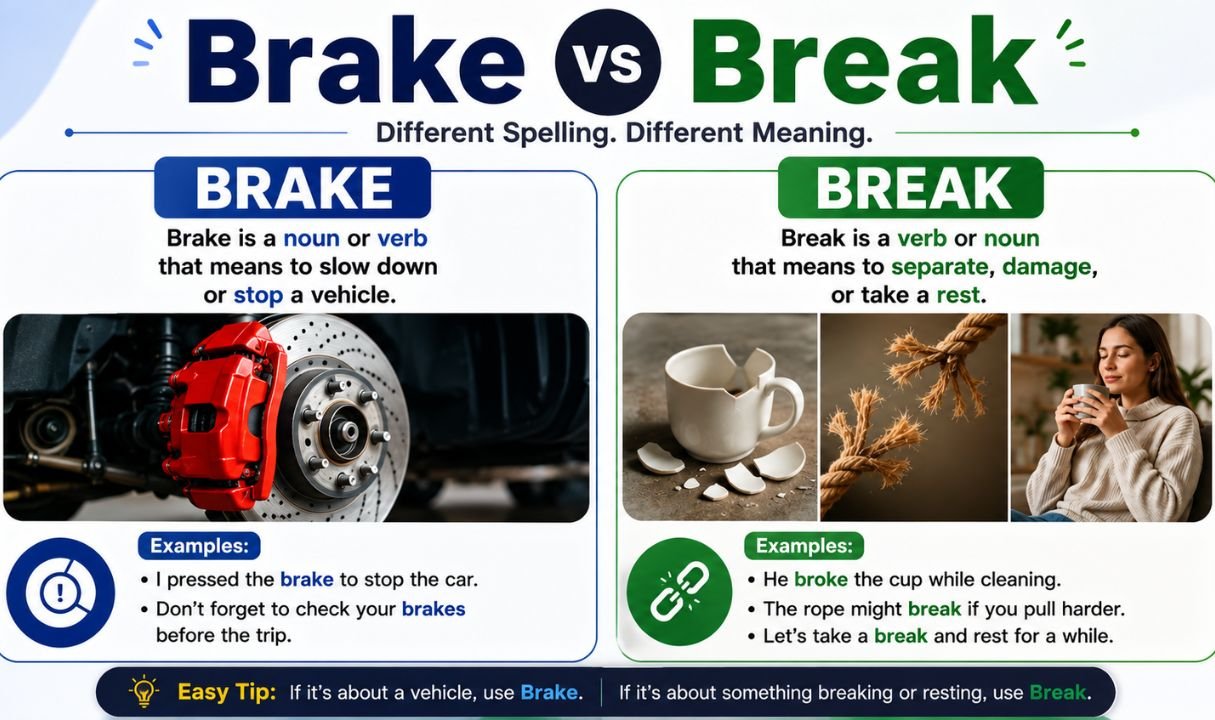
Brake means to slow down or stop a moving vehicle, and it’s also the name of the part that does this job. Break means to damage something, split it apart, interrupt an activity, or take a pause. They sound identical, but they never mean the same thing.
Quick Answer
If you’re talking about a car, bike, train, or anything that needs to stop moving, the word is brake. If you’re talking about damage, a pause, or splitting something into pieces, the word is break.
Simple Examples
| Sentence | Correct Word |
|---|---|
| She slammed on the ______ to avoid the dog. | brake |
| Let’s take a ten minute ______. | break |
| He ______ the antique vase while dusting. | broke |
| The mechanic replaced the ______ pads. | brake |
Brake vs Break Meaning Explained
These two words look almost the same on paper but carry completely different jobs in a sentence. Knowing what each one actually does removes the guesswork.
Brake
A brake is a mechanism built to reduce speed or bring motion to a stop. It’s mostly a noun for the part itself, though it also works as a verb describing the action of slowing down.
- Noun: The brake on her bicycle squeaked loudly.
- Verb: He braked hard when the light turned red.
Break
Break covers a wider range of meanings than most people realize. It can mean to fracture or damage an object, to separate something into pieces, to interrupt something in progress, or to stop working for rest.
- Damage: The window broke during the storm.
- Interruption: They took a break in the middle of the meeting.
- Separation: She broke the chocolate bar into four pieces.
You May Like
Manuel or Manual: Which One Is Correct? Meaning, Uses, and Key Differences
Brake vs Break at a Glance
| Brake | Break | |
|---|---|---|
| Part of speech | Noun, verb | Noun, verb |
| Core meaning | Stop or slow movement | Damage, split, pause, or interrupt |
| Common contexts | Cars, bikes, trains, planes | Rest, objects, routines, rules |
| Past tense (verb) | braked | broke |
| Past participle | braked | broken |
Key Idea
If the sentence involves stopping motion, reach for brake. If it involves rest, damage, or dividing something, reach for break. Vehicles brake. Everything else usually breaks.
Where the Words Come From
The Origin of Brake
The vehicle sense of brake grew out of an older meaning tied to tools that crushed or restrained material, such as devices once used to work flax or crack grain. As mechanical transportation developed in the 1800s, engineers borrowed the word for any part built to slow a wheel or a moving mechanism. That’s why the noun still feels tied to machinery rather than everyday speech.
The Origin of Break
Break traces back to Old English brecan, a verb meaning to shatter or fracture, shared with other Germanic languages. Over centuries the word stretched to cover interruptions, pauses, and divisions, which is why it now shows up in phrases about rest, rules, habits, and news just as often as it does in sentences about broken objects.
Why People Mix Up Brake and Break
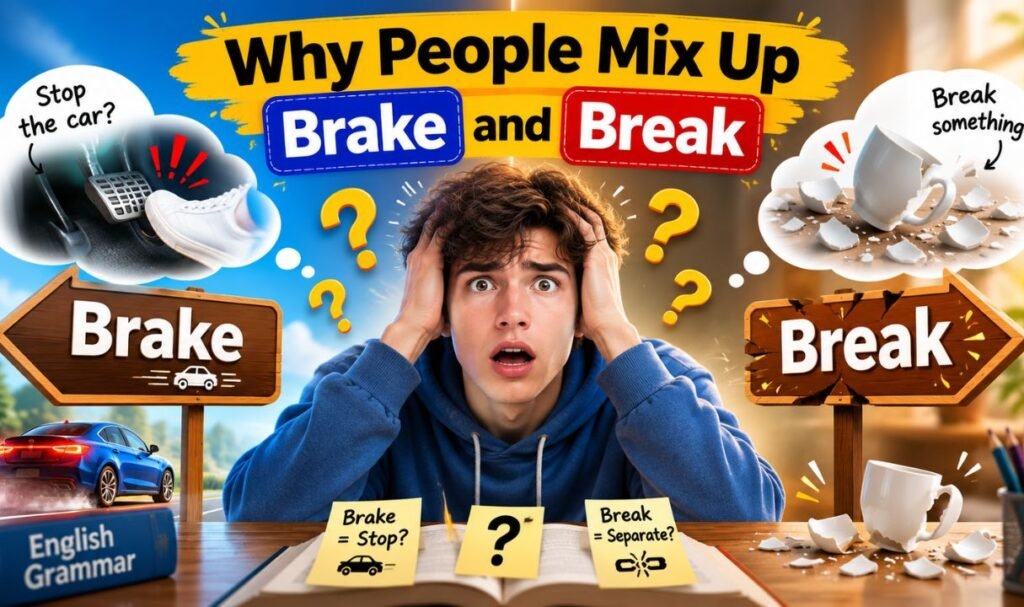
Same Pronunciation
Both words are pronounced exactly alike, which makes them classic homophones. Spoken English gives no clue about which spelling to use, so the choice depends entirely on context and memory.
Break Is the More Common Word
Break appears far more often in daily conversation because it covers so many situations, from broken phones to broken promises. That frequency trains people’s fingers to type “break” by habit, even in sentences that actually call for brake.
Autocorrect and Typing Habits
Phone keyboards and autocorrect tools often assume the more common spelling is intended. Typing quickly on a phone, especially in texts or social captions, makes it easy to send “brake” or “break” without noticing the swap.
You May Like
Seeing or Seing: Which Spelling Is Correct?
Grammar Rules for Brake and Break
Brake
Brake functions as a regular verb, so its past tense and past participle both take -ed.
- Present: I brake gently on wet roads.
- Past: I braked gently on wet roads.
- Present participle: I am braking gently.
Break
Break is an irregular verb, and its forms shift completely: break, broke, broken.
- Present: They break the rules constantly.
- Past: They broke the rules yesterday.
- Past participle: They have broken the rules before.
Mixing up “break” as a noun with the irregular verb forms is one of the most common grammar slips learners make, so it helps to memorize break, broke, broken as one set.
Real-World Usage of Brake
Driving
Drivers rely on brakes constantly, whether easing to a stop at a light or reacting to sudden traffic.
- She tapped the brake as the car ahead slowed down.
Cycling
Bicycles use hand-operated brakes, and checking them before a ride is a basic safety habit.
- Always test your brakes before riding downhill.
Aviation
Aircraft use braking systems on the runway after landing, working alongside reverse thrust to slow the plane safely.
- The pilot applied the brakes as soon as the wheels touched down.
Real-World Usage of Break
Rest or Pause
This is the most common everyday use, covering everything from coffee breaks to school recess.
- We’re taking a fifteen minute break before the next session.
Damaging Objects
Anything that cracks, shatters, or stops functioning has broken.
- The screen broke when it slipped off the counter.
Interrupting Activities
Break also describes something cutting into an ongoing process, like a signal disruption or a pause in routine.
- A power outage broke the livestream mid-sentence.
Brake vs Break in Example Sentences
- The truck’s brakes failed on the steep hill.
- I need a mental break after this deadline.
- She broke her arm during the game.
- Check the brake fluid before a long road trip.
- The company broke its own sales record this quarter.
- He braked just in time to avoid the cyclist.
Brake vs Break in Professional and Technical Writing
Transportation Reports
Incident and maintenance reports depend on precise wording, since brake failure implies a mechanical cause while break would suggest something else entirely.
- The inspection found early wear on the rear brake rotor.
Workplace Communication
HR documents and shift schedules use break constantly when describing rest periods.
- Staff receive a paid fifteen minute break every four hours.
Safety Instructions
Manuals for vehicles, machinery, and equipment use brake whenever describing stopping mechanisms.
- Do not operate the forklift if the brake system shows warning lights.
Brake vs Break in Texting and Social Media
Casual writing is where these words get swapped most often, since people type fast and rarely proofread captions or texts.
- “need a brake from this app fr” should read “need a break.”
- “car brakes are squeaking so bad” is correct as written.
Getting it right in casual posts still matters, since spelling errors can make a message look rushed or careless even when the meaning is clear.
Common Mistakes with Brake and Break
| Incorrect | Correct |
|---|---|
| I need a quick brake from studying. | I need a quick break from studying. |
| The driver slammed the break. | The driver slammed the brake. |
| She braked the plate while washing dishes. | She broke the plate while washing dishes. |
| Give me a moment to catch my brake. | Give me a moment to catch my break. |
A fast way to catch these errors: read the sentence and ask whether a vehicle is involved. If not, break is almost always correct.
Related Words and Expressions
Words Related to Brake
- Decelerate
- Halt
- Slow down
- Skid (when brakes fail to fully stop motion)
Words Related to Break
- Shatter
- Interrupt
- Pause
- Fracture
- Split
Common phrases built on break include “break the ice,” “break a habit,” “break even,” and “give me a break,” none of which have anything to do with vehicles.
Simple Tricks to Remember Which Word to Use
- Brake has an A, and so does automobile. Cars need brakes.
- Break shares its EA with rest, a rough visual match for its meaning of pausing.
- Ask yourself: is something moving that needs to stop? If yes, it’s brake.
- If the sentence involves an object cracking, a schedule pausing, or a rule being violated, it’s break.
Brake vs Break in Modern English Usage Patterns
Corpus data on English usage consistently shows break appearing far more often than brake, simply because it covers so many unrelated situations, from broken hardware to broken records. Brake, by contrast, stays fairly flat in frequency since it’s tied almost entirely to vehicles and machinery. That imbalance is exactly why writers default to “break” out of habit, even in sentences describing a car slowing down.
Practice Exercises
Exercise 1: Choose the Correct Word
- The cyclist checked the ______ before the race. (brake)
- We’re due for a coffee ______ soon. (break)
- The old chair finally ______ under his weight. (broke)
- Always test your ______ before driving in the rain. (brakes)
Exercise 2: Correct the Sentence
- “I need a brake after this exam.” → I need a break after this exam.
- “The train’s break system was inspected.” → The train’s brake system was inspected.
- “She brake the plate by accident.” → She broke the plate by accident.
Frequently Asked Questions
Is it taking a break or brake?
It’s take a break. This phrase always refers to rest or a pause, never to a vehicle part.
How do you use brake and break correctly?
Use brake for slowing or stopping movement, especially vehicles, and use break for damage, interruption, division, or rest.
Is it break a leg or brake a leg?
It’s break a leg, a theater expression wishing someone good luck before a performance.
Is it “break pause” or “brake pause”?
Neither is a standard phrase, but if you mean a pause in an activity, the correct word is break, as in “take a break” or “a short break.”
Conclusion
Brake and break sound exactly the same, but they never do the same job in a sentence. Brake is about stopping or slowing motion, and it shows up almost entirely in the context of vehicles and machinery.
Break, on the other hand, covers a much wider range of situations, from damaging an object to pausing an activity to splitting something apart.