
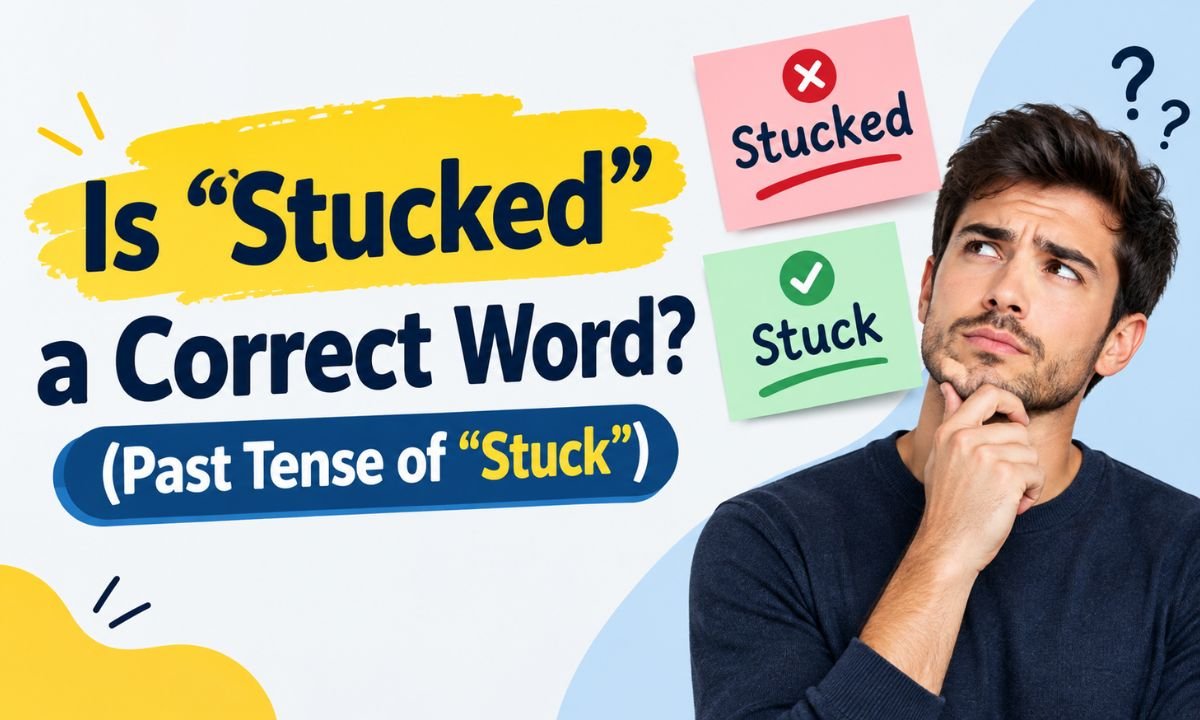
You are typing a message, and your fingers write “I stucked in traffic.” Something looks off. You delete it, retype it, stare at it, and still can’t decide.
That hesitation is healthy. “Stucked” is not a correct English word. The verb is “stick,” and its past tense and past participle are both “stuck.” Nothing else needs to be added.
This guide explains why “stucked” feels natural, where it comes from, how “stuck” works in every tense, and how common the mistake really is. You will also find a set of professional alternatives for the times you want to say you’re stuck without sounding stuck.
Is “Stucked” a Correct Word?
No. Standard English dictionaries do not list “stucked,” and no major style guide accepts it. The correct form is “stuck.”
The short verdict
Here is the rule in one line: stick → stuck → stuck.
- Present: I stick the label on the box.
- Past: I stuck the label on the box yesterday.
- Past participle: I have stuck the label on the box.
If you write “stucked” in an essay, a cover letter, or an email to your manager, readers will notice. Most will still understand you, but the word can make your writing look careless. One grammar site points out that small verb errors chip away at a writer’s credibility, and that is a fair warning for anyone who writes for work. The verb “stick” has “stuck” as its only correct past tense and past participle, so “stucked” should never appear in a sentence.
Why “stucked” feels right
Most English verbs are regular. You add -ed to the base form and you get the past tense. Walk becomes walked. Jump becomes jumped. Your brain learns this pattern early and applies it everywhere.
Linguists call this overregularization. Small children do it constantly (“goed,” “runned,” “breaked”), and adult learners do it too. When you hear “stuck,” it sounds like it might be a present-tense word, so the mind reaches for the -ed ending to make it “past.”
There is a second reason, and it is a clever one. Some sources explain that “stucked” assumes “stuck” is a present form, which would create a double past tense, and English does not build past tenses that way. The word “stuck” already carries the past. Adding -ed is like putting a second coat of paint on a wall that is already finished.
The mistake also has friends. Jakub Marian, a language blogger, compares it to saying a glass of water was “drunked” or that a shirt “shrunked.” The error is caused by the fact that the past participle of “stick” ends in a consonant other than d, t, or n, which is unusual even among irregular verbs. In other words, your instinct is following a very reasonable pattern. It just happens to be the wrong pattern for this verb.
Is “stucked” ever acceptable?
In formal writing, never. In casual speech, you will hear it from young children, second-language speakers, and sometimes native speakers who are tired or in a hurry. Some people use it jokingly, the way others say “I brang” or “he don’t.” That is a stylistic wink, not a grammar option.
A few related forms deserve a mention so you don’t confuse them:
- “Sticked” is also nonstandard for the everyday verb. It shows up occasionally in narrow technical settings or dialect, but you should not use it for ordinary “stick” meanings.
- “Stucking” is wrong. The correct -ing form is “sticking.”
- “Unstuck” is correct. It means free from something that held you in place, as in “Our plan came unstuck.”
What Is the Past Tense of “Stuck”?
Here is where a small clarification helps. “Stuck” is the past tense of “stick,” but “stuck” itself is not a base verb that needs its own past tense. People often ask, “What is the past tense of stuck?” The honest answer is that “stuck” is the past tense. If you want to talk about the past, you use “stuck” (or “was stuck,” “had been stuck,” and so on, depending on the meaning).
Stick, stuck, stuck
“Stick” is an irregular verb. Its three main forms are:
| Base form | Simple past | Past participle | -ing form |
|---|---|---|---|
| stick | stuck | stuck | sticking |
Because the simple past and the past participle look the same, there is only one word to remember. That helps.
Simple past versus past participle
The two uses look identical on the page, but they work differently in a sentence.
Simple past describes a finished action at a definite time:
- She stuck the poster above her desk last week.
- The key stuck in the lock, so we called a locksmith.
- He stuck to his budget all year.
Past participle appears after helping verbs such as have, has, had, or be:
- She has stuck the poster above her desk.
- By noon, the door had stuck so badly that nobody could open it.
- The van was stuck in the mud.
Notice the difference in the last example. “Was stuck” is often a state, not an action. Nobody performed the “sticking.” The van was simply in a condition of being unable to move. That leads us to the next point.
“Stuck” as an adjective
“Stuck” is also a full adjective. Dictionaries list it separately because it describes a condition: unable to move, unable to progress, or attached firmly.
- The zipper is stuck.
- I feel stuck in my current job.
- The lid is stuck, so pass me the towel.
When “stuck” works as an adjective, it can follow verbs like be, get, feel, seem, remain, or become. “Get stuck” and “be stuck” are both extremely common, and neither ever takes an -ed ending.
The many meanings of “stick”
The verb has several senses, and all of them use “stuck” in the past:
- To attach or adhere: The tape stuck to my sleeve.
- To place or put: She stuck her head through the window.
- To pierce: He stuck the fork into the potato.
- To stay committed: They stuck with the plan.
- To be unable to move: The car stuck in the snow.
- To endure or tolerate (informal): I couldn’t stick that noise any longer.
Whichever sense you pick, the past form does not change.
What Are the Different Tenses of “Stuck”?
Since “stick” is the base verb, its tenses use stick / sticks / sticking / stuck. The table below covers all the common English tenses with a fresh example for each.
| Tense | Form | Example sentence |
|---|---|---|
| Simple present | stick / sticks | The label sticks to glass really well. |
| Present continuous | am/is/are sticking | I am sticking the notes on the board now. |
| Present perfect | have/has stuck | We have stuck to the timetable so far. |
| Present perfect continuous | have/has been sticking | She has been sticking flyers on poles all morning. |
| Simple past | stuck | He stuck the stamp on the envelope. |
| Past continuous | was/were sticking | They were sticking posters when it started to rain. |
| Past perfect | had stuck | The lid had stuck, so I used a spoon to pry it open. |
| Past perfect continuous | had been sticking | The drawer had been sticking for weeks before it jammed. |
| Simple future | will stick | This glue will stick to almost any surface. |
| Future continuous | will be sticking | I will be sticking to the plan tomorrow. |
| Future perfect | will have stuck | By Friday, we will have stuck every label. |
| Future perfect continuous | will have been sticking | By June, he will have been sticking to that diet for a year. |
Present forms
Use stick with I, you, we, and they. Use sticks with he, she, and it. That’s the whole story for the simple present.
- The tape sticks. (it)
- Mud sticks to my boots. (mud is treated as “it”)
- Good habits stick when you repeat them. (plural noun)
For actions happening right now, use sticking: “The drawer is sticking again.”
Past forms
For a single completed action, use stuck. If you want to stress that an action was ongoing, use was/were sticking. If you need the earlier of two past events, use had stuck.
- I stuck my hand in my pocket. (simple past)
- I was sticking the tags on when the phone rang. (past continuous)
- I had already stuck three tags on before I spotted the mistake. (past perfect)
Future forms
“Stuck” does not appear in the simple future at all, because the future uses the base form after will. It only returns in the future perfect: “By evening, we will have stuck every sticker in place.” Many learners mistakenly write “will stucked,” which stacks two errors together.
Passive voice and “get stuck”
The passive is where “stuck” appears most often:
- The truck was stuck in the snow for two hours.
- Several passengers got stuck in the elevator.
- Nobody wants to be stuck behind a slow driver.
Here “stuck” is still the same word. You never say “was stucked,” “got stucked,” or “been stucked.” Every one of those is incorrect.
Quick example set: right and wrong
| Incorrect | Correct |
|---|---|
| I stucked in the elevator. | I got stuck in the elevator. |
| She stucked the paper on the wall. | She stuck the paper on the wall. |
| We have stucked to our goals. | We have stuck to our goals. |
| The bus was stucked in mud. | The bus was stuck in mud. |
| The lid is stucked. | The lid is stuck. |
How Prevalent Is the Use of “Stucked”?
Short answer: very low, and never accepted. Longer answer: it is more common than you might expect for a word that does not exist.
What the Ngram data shows
Google’s Ngram Viewer measures how often a word appears in a huge collection of published books. A recent grammar guide ran “stucked” through it and found that usage has climbed over the past century, yet it remains very close to zero. “Stuck,” in contrast, grew slowly until 1980, then rose steeply and was used about 200% more in 2010 than in 1980, before showing a downward trend beginning around 2016.
That pattern tells us two things. First, published books almost never contain “stucked,” which is what you would expect, since editors catch it. Second, the slight upward creep probably reflects wider printing of dialogue, forums, and informal text, where speakers’ errors get recorded as they are.
Keep in mind that Ngram data is limited to books, so it under-counts speech, texting, and social posts. Everyday spoken use is certainly higher than the chart suggests.
Who uses it most
The mistake clusters in a few groups:
- Young children who are still learning which verbs are irregular
- English learners, especially those whose first language has fewer irregular verbs
- Speakers typing fast in chats and comments
- Social media posts that mimic casual speech
It is a good example of how the language changes at the edges without changing at the center. Irregular verbs sometimes become regular over generations. “Dived” and “dove” now compete, and “learnt” has lost ground to “learned” in some regions. However, “stuck” has been firmly settled for centuries, and nothing suggests that it is about to switch.
Are experts still warning against it?
Yes, and the warnings are current. Language learning sites published fresh explainers in March 2026 that state the same rule. One notes that most listeners would understand “stucked,” but the word sounds unusual and can make people pause. That is a fair way to put it. Communication does not collapse, but your credibility takes a small hit.
Does it matter if people understand you?
Sometimes it does not, and that is worth admitting. Between friends on a phone call, nobody will correct you. But in a job application, a school essay, an IELTS or TOEFL response, or a client email, small verb slips can send the wrong signal. If you want your writing to read as polished, fixing “stucked” is one of the cheapest upgrades available.
Why English Has Irregular Verbs Like “Stick”
Understanding the history helps the form stick (yes, that was intentional).
“Stick” goes back to Old English stician, which meant to pierce or stab. The past tense changed the internal vowel instead of adding an ending. That pattern, in which the vowel shifts from i to u, is called ablaut, and it is inherited from very old Germanic verbs.
Over a thousand years, most English verbs shifted to the simple -ed pattern. A few hundred did not. The ones that survived tend to be common, everyday words, because frequent words resist change. You use “stick” and “stuck” so often that speakers reinforce the old form every day.
Verbs that follow the same pattern
Once you see the pattern, “stuck” starts to look like family:
| Base | Past | Past participle |
|---|---|---|
| stick | stuck | stuck |
| dig | dug | dug |
| swing | swung | swung |
| sting | stung | stung |
| cling | clung | clung |
| spin | spun | spun |
| strike | struck | struck |
| hang | hung | hung |
| string | strung | strung |
| win | won | won |
If you would never say “dugged,” “stinged,” or “spinned,” you already understand why “stucked” is wrong. These verbs share a vowel change and no added ending.
Common Mistakes With “Stick” and “Stuck”
Beyond “stucked,” a handful of related slips appear over and over. Here are the ones editors see most.
- “I sticked it.” Should be “I stuck it.”
- “I am sticking in traffic.” Should be “I am stuck in traffic.” “Sticking” describes an action, while “stuck” describes a condition.
- “We stucked with the plan.” Should be “We stuck with the plan.”
- “The window is sticked.” Should be “The window is stuck.”
- “He is stuck to the rules” in place of “sticks to the rules.” Both are grammatical but mean different things. “Sticks to” is a choice, while “is stuck to” implies physical attachment or a lack of freedom.
- Mixing “stuck” and “stack.” One is about being unable to move, the other about piled-up items.
Also watch for “stuck up,” a separate idiom meaning snobbish, and “stuck on,” which can mean fixated on something or unable to solve it.
Easy Ways to Remember “Stuck”
Grammar rules stay in memory better when they are attached to something vivid. Try one of these.
- Picture the vowel change. Stick has an i. Stuck has a u. Nothing else changes.
- Remember the rhyme family. Stick, stuck. Dig, dug. Sting, stung. All of them swap the vowel and stop.
- Ask the “double past” question. Before you add -ed to a word, ask whether it already sounds like a past form. If it does, leave it alone.
- Read it aloud. “I was stuck” sounds smooth. “I was stucked” sounds like a hiccup, and your ear will tell you.
- Write short sentences using the word in the past, the present perfect, and the passive. Repeat the exercise for a week, and the correct form becomes automatic.
Professional Ways to Say “Stuck”
Sometimes the problem is not the past tense at all. Telling your team “I’m stuck” is honest, but in a formal setting it can sound vague or a little helpless. Here are more precise ways to say it.
| Situation | Professional phrasing |
|---|---|
| You cannot move a task forward | “I’ve hit a roadblock on the reporting task.” |
| You depend on someone else | “I’m waiting on input from finance before I can continue.” |
| Progress has stopped | “Progress has stalled while we wait for approval.” |
| You need help | “I could use guidance on how to approach this.” |
| You’re weighing options | “I’m at a decision point and would like a second opinion.” |
| A process is blocked | “The deployment is blocked by a failed test.” |
| You are stuck in a meeting or delay | “I’ve been delayed and will join in ten minutes.” |
| A project has lost momentum | “The project has plateaued, and we need to reassess.” |
| A disagreement is unresolved | “We’ve reached an impasse on the pricing terms.” |
| You are stuck emotionally or creatively | “I’m having difficulty moving forward with this draft.” |
Tips for using these phrases well
- Name the block. “I’m stuck” tells your manager nothing. “I’m blocked by missing access to the analytics dashboard” gives them something to fix.
- Offer a next step. Pair the problem with a proposal: “I’ve hit a snag with the data export, so I’ll try the manual method while IT looks at it.”
- Match the audience. With teammates, “I’m blocked” is fine. With clients, “we are resolving a dependency” sounds calmer.
- Avoid dramatic words. Saying you are “trapped” or “helpless” in an email is rarely helpful and can raise unneeded worry.
Alternatives by meaning
Different kinds of “stuck” call for different words:
- Physically fixed: jammed, lodged, wedged, immobilized, fastened
- Delayed by circumstances: held up, delayed, detained, stranded
- Making no progress: stalled, at a standstill, bogged down, at an impasse
- Attached: adhered, bonded, affixed, glued
- Emotionally or mentally: discouraged, at a loss, unable to move forward
Selecting the closest word makes your writing sharper and shows that you actually thought about the situation.
Putting It All Together: A Short Practice Set
Try correcting these sentences before you look at the answers.
- “I stucked my card in the machine.”
- “They have stucked to their deal.”
- “My car got stucked in the sand.”
- “She was sticking in a long queue for hours.”
- “We were so stucked with the report that we asked for extra time.”
Answers:
- I stuck my card in the machine. (Or: My card got stuck in the machine.)
- They have stuck to their deal.
- My car got stuck in the sand.
- She was stuck in a long queue for hours.
- We were so stuck on the report that we asked for extra time. (Or, more formally: We had reached an impasse with the report.)
If you got four or five right, you have this one down.
Frequently Asked Questions
Is there a word called “stucked” in English?
No. “Stucked” is not a recognized English word. The correct past tense and past participle of “stick” is “stuck.”
Is it correct to say “I sticked” or “I stuck”?
“I stuck” is correct. “I sticked” is nonstandard because “stick” is an irregular verb that does not take -ed.
How do you say “stuck” in the past tense?
“Stuck” already is the past tense of “stick.” Say “I stuck the note on the door” or “I was stuck in traffic,” and never “stucked.”
How do you say “stuck” in a professional way?
Use precise phrases such as “I’ve hit a roadblock,” “Something is blocking me,” “I can’t move forward,” or “I need input on…”. Naming the specific obstacle sounds more capable than simply saying you’re stuck.
Conclusion
“Stucked” is not a correct word. The verb “stick” is irregular, and its past tense and past participle are both stuck. Adding -ed creates a double past that English does not use, and it puts you in the company of “drunked,” “shrunked,” and other well-meaning mistakes.