
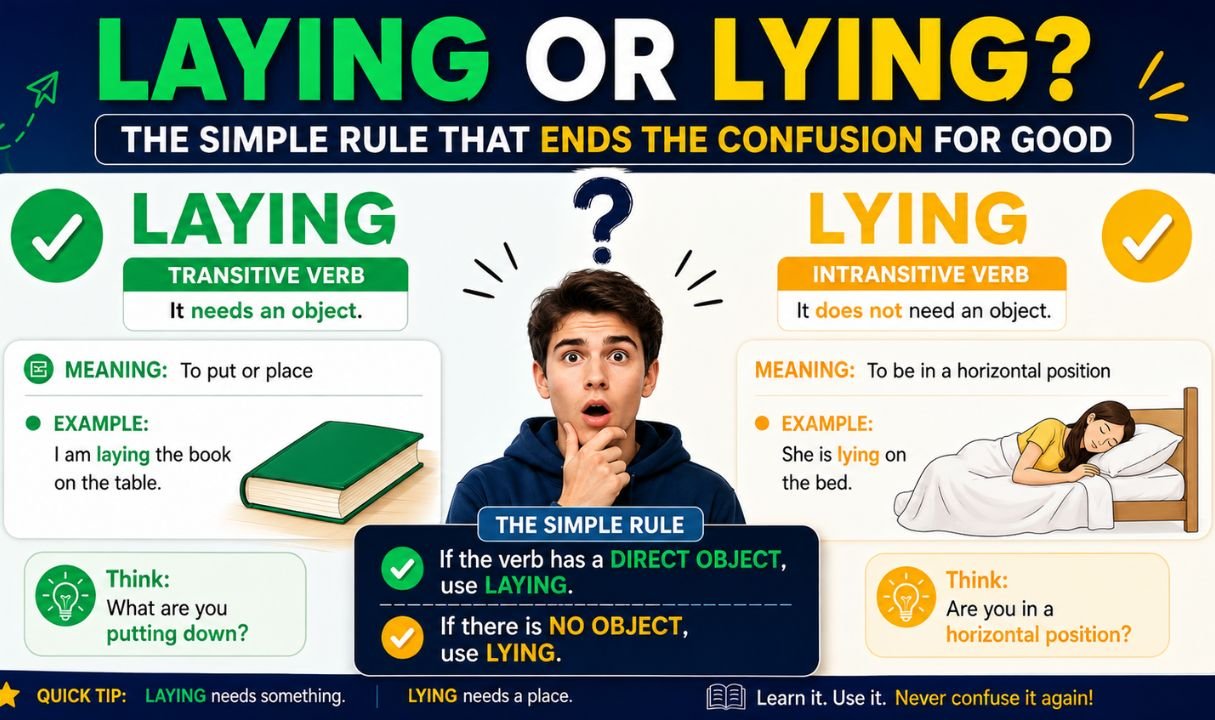
Lying means resting or reclining, and it never takes an object. Laying means placing something down, and it always takes an object. If you’re putting an item somewhere, use laying. If you or someone else is resting, use lying.
That one distinction solves almost every mix-up between these two words. But the reason people keep getting it wrong runs deeper than a simple definition, so let’s unpack the whole picture.
Quick Answer
- Lying = resting, reclining, or being in a horizontal position. No object needed.
- Laying = placing, setting, or putting something down. Always needs an object.
Examples:
- She is lying on the couch. (She herself is resting.)
- He is laying the book on the table. (He is placing something: the book.)
- The dog is lying in the shade.
- She is laying the baby in the crib.
Quick test: Ask “is something being placed down?” If yes, use laying. If no, and someone is simply resting, use lying.
You May Also Like: Employer Name Meaning: What It Really Means and How to Fill It In Correctly
Why This Pair Trips Up Even Confident Writers
Laying and lying come from two separate verbs, lie and lay, that happen to share overlapping forms. That overlap is the actual source of the confusion, not laziness or poor grammar instinct. Once you see where the overlap happens, the words stop feeling random.
The Verb Lie (to Rest)
Lie describes a state of resting, reclining, or being situated somewhere. It’s an intransitive verb, meaning it never acts on an object.
| Form | Word |
|---|---|
| Present | lie |
| Present participle | lying |
| Past | lay |
| Past participle | lain |
- I lie down for twenty minutes every afternoon.
- She is lying on the sofa with a book.
- Yesterday, he lay on the grass and watched the clouds.
- He has lain in that hammock for hours.
The Verb Lay (to Place)
Lay describes the act of putting or placing something somewhere. It’s transitive, so it always needs a direct object receiving the action.
| Form | Word |
|---|---|
| Present | lay |
| Present participle | laying |
| Past | laid |
| Past participle | laid |
- I lay the keys on the counter every night.
- She is laying the plates on the table.
- Yesterday, he laid the tile in the bathroom.
- He has laid the foundation for the new shed.
Here’s the twist that causes most of the trouble: the past tense of lie is lay. So “lay” can mean either the present-tense action of placing something, or the past-tense action of resting. Context is the only thing that tells them apart.
The Object Test: How to Tell Them Apart Instantly
Every confusing sentence gets solved with one question: what is being placed?
If you can name the thing being placed, the sentence needs laying. If nothing is being placed and someone is simply in a resting position, the sentence needs lying.
Testing “laying”: She is laying the book on the table. What is she laying? The book. That’s the object, so laying is correct.
Testing “lying”: She is lying on the table. What is she lying? Nothing, she herself is the one resting. Lying is correct.
Spotting the error: “She is laying on the bed” is wrong because nothing follows as an object. The fix is “She is lying on the bed.”
Verb Forms Comparison Table
| Base Verb | Meaning | Present | Present Participle | Past | Past Participle | Takes an Object? |
|---|---|---|---|---|---|---|
| Lie | To rest or recline | lie | lying | lay | lain | No |
| Lay | To place or put | lay | laying | laid | laid | Yes |
Keep this table nearby the next time you’re editing. It answers almost every question you’ll have about tense.
Laying or Lying in Everyday Situations
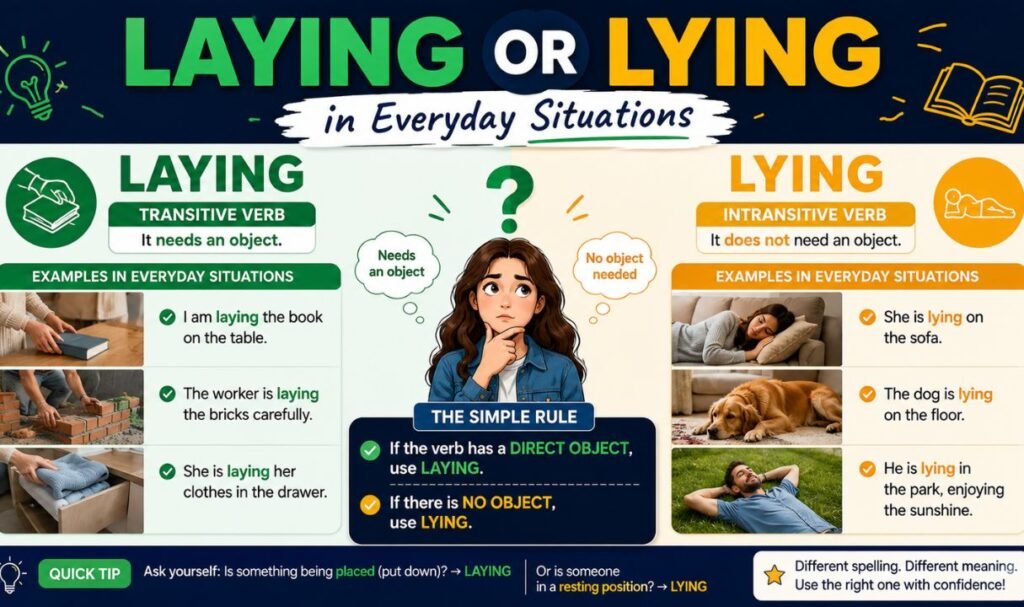
Real sentences are where this rule gets tested, so here’s how it plays out across the phrases people search for most.
Laying or lying in bed: If you’re resting, it’s “I am lying in bed.” Laying only applies if you’re placing something on the bed, like “I am laying the laundry on the bed.”
On the floor: A tired dog is “lying on the floor.” A worker installing tile is “laying flooring on the floor.” Same surface, different verb because of what’s happening.
Laying or lying on the couch: Someone relaxing says “I’m lying on the couch.” Someone arranging cushions says “I’m laying the cushions on the couch.”
Laying or lying on the beach: Sunbathers are “lying on the beach,” not laying, since nothing is being placed. You’d only use laying if you were setting down a towel or umbrella.
Laying or lying low: This idiom always uses “lying low,” meaning staying out of sight or avoiding attention. It never takes laying because no object is involved.
Laying or lying around: When someone is being idle, it’s “lying around the house.” When referring to objects left out, people often say “clothes laying around,” though strict grammar prefers “lying around” here too, since the clothes aren’t placing anything themselves.
Laying or lying meaning: In short, lying means resting or being situated; laying means putting something in a place.
Laying or lying past tense: The past of lie is lay (“she lay on the bed”). The past of lay is laid (“she laid the blanket on the bed”). This is the single biggest source of confusion in the whole topic.
You May Also Like: Infact or In Fact? The Correct Way to Write It (With Examples)
Common Mistakes and Corrections
| Wrong | Right |
|---|---|
| I am laying on the couch. | I am lying on the couch. |
| She was laying on the floor. | She was lying on the floor. |
| He is lying the phone on the table. | He is laying the phone on the table. |
| The book is laying on the shelf. | The book is lying on the shelf. |
| I’ve been laying awake all night. | I’ve been lying awake all night. |
Most errors follow the same pattern: laying gets used where lying belongs, almost always in casual speech about resting.
Why “Laying” Gets Overused in Casual English
Spoken English has slowly blurred this line, and there are a few clear reasons why.
- Sound similarity makes the two words easy to swap without noticing.
- Overlapping forms, especially “lay” serving double duty as present-tense lay and past-tense lie, create genuine ambiguity.
- Regional and casual speech patterns normalize “laying down” in everyday conversation, even though it’s technically incorrect.
- Limited grammar instruction on transitive versus intransitive verbs means many speakers never learn the underlying rule, only memorized phrases.
- Social media captions repeat the error so often that it starts to sound acceptable, even in writing meant to be polished.
None of this makes the mistake permanent. Understanding the object rule is usually enough to fix it for good.
Real-World Usage by Context
Daily conversation: “I’m lying down for a bit” and “She’s laying out the ingredients” both sound natural and correct.
Text messages and social media: Casual writing often drops the rule entirely, but “just lying in bed” is technically correct where “just laying in bed” is not, even if it’s common online.
Emails and workplace writing: “The patient is lying comfortably” and “Please find the documents laying on your desk” (technically “lying,” since documents rest rather than act) show how easily the error slips into professional writing.
Formal and academic writing: Precision matters most here. Editors and graders will flag laying/lying errors quickly, so this is where the object test earns its keep.
Memory Tricks That Actually Work
- Lay needs prey. Lay is transitive, so it always hunts down an object to act on.
- Lie down, don’t lay down (unless you’re placing yourself as an object, which almost never happens in normal speech).
- If you can drop in “it” and the sentence still works, you likely need laying: “She is laying it on the table” makes sense; “She is lying it on the table” doesn’t.
- Hens lay eggs; people lie down. A small, memorable anchor that separates the two verbs by subject type.
Related Grammar Confusions Worth Knowing
- Sit or set: similar transitive/intransitive split as lay and lie.
- Rise or raise: rise is intransitive, raise is transitive.
- Affect or effect: usually a noun/verb confusion rather than a transitivity issue.
- Its or it’s: possessive versus contraction, a spelling issue rather than a meaning one.
These pairs share the same root cause: two related words that look alike but follow different grammatical rules.
Practice Exercises
Fill in the Blank
- She is ______ on the bed. (lying)
- He is ______ the book on the table. (laying)
- The dog is ______ in the yard. (lying)
- She is ______ the baby in the crib. (laying)
- I was ______ on the sofa yesterday. (lay)
- He was ______ the carpet carefully. (laying)
Choose the Correct Word
- I am (laying / lying) down. (lying)
- She is (laying / lying) the plates on the table. (laying)
- The cat is (laying / lying) in the sun. (lying)
- He is (laying / lying) the bricks. (laying)
Advanced Cases and Exceptions
Hens lay eggs. This is a fixed, correct use of lay with an object (eggs), even though no person is doing the placing.
“Lay of the land” is an established idiom, not a grammar error, describing how a situation or terrain is arranged.
Continuous tense confusion often shows up here: “She is lying down” is correct, but “She is laying down” is only correct if she’s placing something down, which is rare phrasing outside idioms.
Regional dialects sometimes use laying more loosely, but standard written English still follows the transitive rule strictly.
Frequently Asked Questions
Is it lying or laying on bed?
It’s lying on the bed when someone is resting. Use laying only if you’re placing an item on the bed.
Is a body lying or laying?
A body is lying somewhere, since nothing is being placed. “The body was lying on the ground” is correct.
Is it laying or lying in the hospital bed?
A patient is lying in the hospital bed, since they are resting rather than placing anything.
Do you say I am lying down or laying down?
Say I am lying down. Laying down only applies when you’re placing an object, not yourself, somewhere.
What is the difference between laying and lying?
Lying means resting and takes no object. Laying means placing something and always needs an object.
Why is the past tense so confusing?
Because the past tense of lie is lay, which looks identical to the present tense of lay.
Can laying ever mean resting?
No. Laying always refers to placing something down, never to resting.
Is this mistake common among native speakers?
Yes. It’s one of the most frequently misused verb pairs in spoken English, even among fluent speakers.
Conclusion
Laying and lying trace back to two different verbs with one clear dividing line: an object. If something is being placed, laying is correct. If someone or something is simply resting, lying is correct. Once that test becomes automatic, the mistake disappears from your writing for good.