
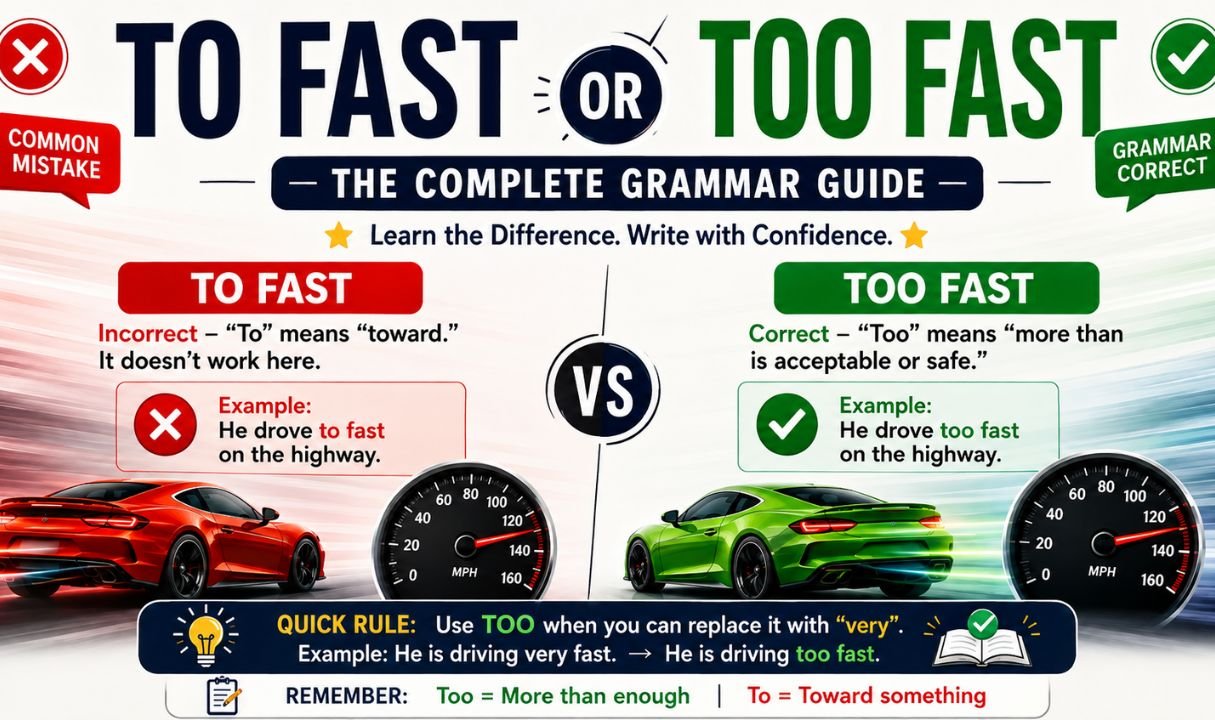
Two letters. One extra “o.” And yet “to fast” and “too fast” send your sentence in completely different directions. One is about skipping meals. The other is about a car, a runner, or a talker moving faster than anyone can handle.
If you’ve ever paused mid-sentence wondering which one belongs, you’re not alone — this is one of the most commonly confused word pairs in English, right up there with “your” and “you’re.” This guide breaks the confusion down for good, with real examples, a quick-reference table, and a short quiz at the end so you can check yourself.
Definition
To fast means to go without food or drink for a set period, usually for religious, medical, or personal reasons. Here, “fast” works as a verb, and “to” is the infinitive marker that introduces it.
Too fast means moving, speaking, or happening at a speed that’s excessive or unsafe. Here, “too” is an adverb that intensifies “fast,” which functions as an adjective or adverb describing speed.
Same sound. Different job entirely.
The Real Difference Between “To” and “Too”
The confusion isn’t really about “fast” at all — it’s about “to” and “too.” These two words are pronounced identically but grammatically unrelated.
| Word | Part of Speech | Function | Example |
|---|---|---|---|
| To | Preposition / Infinitive marker | Shows direction, purpose, or introduces a verb | I’m going to the gym. |
| Too | Adverb | Shows excess or means “also” | It’s too hot in here. |
A simple spelling trick helps: “too” has an extra “o,” and it also carries “extra” meaning — extra speed, extra heat, extra anything. “To,” with a single “o,” just points somewhere or connects to an action.
You May Like: Drier vs Dryer: Which One Should You Use in Writing?
What “To” Really Means
“To” is one of the hardest-working words in English. It rarely means anything on its own — its meaning comes from what follows it.
As a Preposition
When “to” comes before a noun or pronoun, it shows direction, destination, or purpose.
- She drove to the office.
- Send the package to him.
- We’re heading to the mountains this weekend.
As an Infinitive Marker
When “to” comes before a base verb, it forms the infinitive — the “to + verb” pattern that names an action without tying it to a specific tense or subject.
- I want to learn Spanish.
- They decided to leave early.
- He plans to fast for two days.
That last example is the one that matters here. “Fast” is acting as a verb, and “to” is simply doing its normal infinitive job — nothing about speed involved.
What “Too” Really Means
“Too” carries its own meaning independently, which is what separates it from “to.” It signals one of two things:
- Excess — more than needed, wanted, or expected (too loud, too expensive, too fast)
- Addition — meaning “as well” or “also” (I’m coming too)
- The soup is too salty.
- I’d like to come too.
- You’re driving too close to the curb.
In every one of these, “too” adds intensity or an extra layer of meaning that “to” simply cannot supply.
What “Fast” Means in Grammar
“Fast” is a flexible word, and its role changes the entire sentence depending on how it’s used.
| Role | Meaning | Example |
|---|---|---|
| Adjective | Quick, rapid | a fast runner |
| Adverb | Quickly | She runs fast. |
| Verb | To abstain from food | They fast during Ramadan. |
| Noun | A period of not eating | He broke his fast at sunset. |
This is the real source of the confusion. “Fast” as a verb pairs naturally with “to” (to fast). “Fast” as an adjective or adverb pairs naturally with “too” (too fast). The word hasn’t changed — its job in the sentence has.
When “To Fast” Is Correct
Use “to fast” whenever “fast” is functioning as a verb — meaning to deliberately go without eating, often for a set stretch of time. Look for it after verbs like “want,” “plan,” “decide,” “choose,” “need,” or “try.”
Examples (To Fast)
- I want to fast for 16 hours today.
- Doctors sometimes advise patients to fast before surgery.
- She chose to fast during the holy month.
- He tried to fast but gave in by noon.
- Many athletes experiment with intermittent eating windows and decide to fast overnight.
Case Study: Intermittent Fasting
Intermittent fasting has become one of the more talked-about approaches to eating in recent years, and it’s a good real-world anchor for this grammar rule. Two popular schedules illustrate the point:
- 16:8 method — eat within an 8-hour window, fast for the remaining 16 hours.
- 5:2 method — eat normally five days a week, restrict calories on two.
Notice how naturally “to fast” fits into that context: “People choose to fast for health, discipline, or religious observance.” Nothing about speed enters the picture — it’s entirely about eating patterns.
When “Too Fast” Is Correct
Use “too fast” whenever you’re describing speed, pace, or intensity that goes beyond what’s normal, safe, or acceptable. It typically follows a subject and a verb, and often precedes a consequence introduced by “for” or “that.”
Examples (Too Fast)
- He was driving too fast on the highway.
- You’re talking too fast for me to follow.
- The download finished too fast to be accurate.
- Kids seem to grow up too fast these days.
- She read the instructions too fast and missed a step.
Real-Life Context: “Too Fast” and Everyday Rules
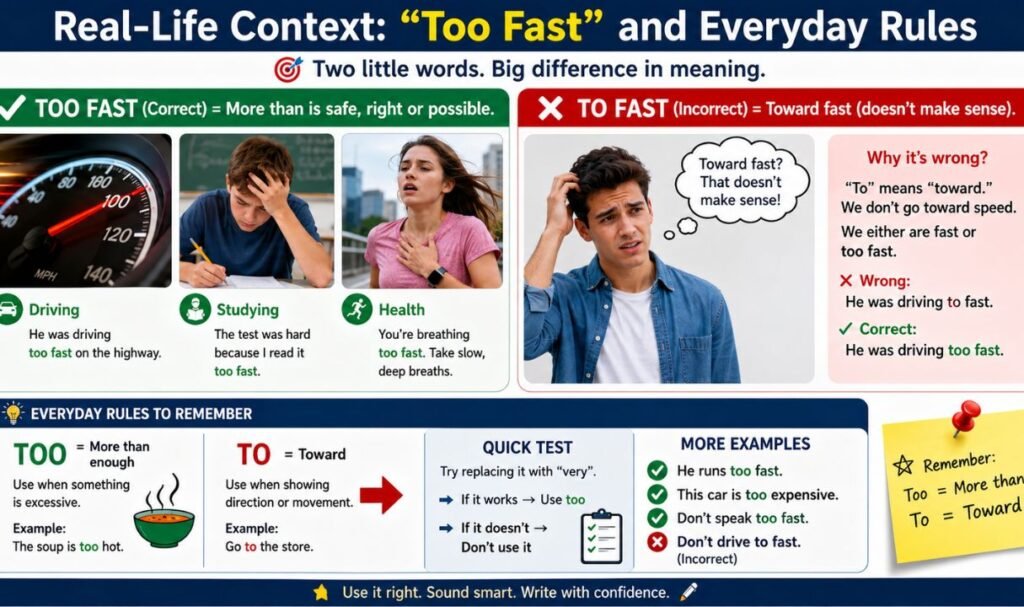
Speed isn’t just a grammar topic — it shows up constantly in daily life, and “too fast” is the phrase that gets attached to almost all of it.
People searching for “to fast or too fast meaning” usually land here for one reason: they’ve typed a sentence about speed and second-guessed the spelling. The rule stays the same no matter the context — if it’s about pace, it’s “too fast,” full stop.
A smaller number of searches also turn up oddly worded queries like “To Fast or too Fast cast.” That phrasing has nothing to do with grammar — it’s almost certainly a mix-up with a movie franchise title (likely the “Fast” film series) rather than this word pair. There’s no cast to speak of here, just a spelling rule.
In Traffic Laws
Traffic tickets and driving manuals use “too fast” constantly, usually in the phrase “driving too fast for conditions.” This means a driver was going faster than was safe given rain, fog, traffic, or road surface — even if they were technically under the posted limit.
In Sports
Coaches and commentators lean on “too fast” to describe pacing errors. A runner who starts too fast burns out before the finish line. A pitcher who throws too fast without warming up risks injury.
In Life Situations
“Too fast” also shows up in emotional or figurative contexts:
- The relationship moved too fast.
- Time flies too fast when you’re busy.
- Don’t make decisions too fast under pressure.
You May Like: Appendices vs Appendixes: Which Plural Is Actually Correct
Common Mistakes and Why They Happen
Common Errors
- Writing “I ran to fast” instead of “I ran too fast.”
- Writing “He wants too fast today” instead of “He wants to fast today.”
- Dropping the second “o” out of habit while typing quickly.
- Assuming both spellings are interchangeable because they sound identical.
Why It Happens
English has a long list of homophones — words that sound the same but differ in spelling and meaning — and “to/too” is one of the most frequent offenders. Because both words are short, unstressed in speech, and pronounced almost identically, the ear can’t tell them apart. Only context and spelling can.
Autocorrect doesn’t always help either. Most spell-checkers won’t flag “to fast” as wrong, since it’s a grammatically valid phrase on its own — just not always the one you meant.
Quick Fixes: How to Catch and Prevent These Errors
- Read your sentence back and ask: is this about speed, or about not eating?
- If you can swap in “very” or “excessively” and the sentence still makes sense, you need “too.”
- If you can swap in a different verb after “to” (like “to eat,” “to sleep”) and it still fits the pattern, you’re using the infinitive “to” correctly.
- Say the sentence out loud slowly — sometimes hearing the rhythm exposes the error your eyes missed.
- Keep a short mental list of trigger verbs (“plan,” “want,” “decide,” “choose”) that almost always pair with “to fast,” not “too fast.”
Simple Trick to Remember
Picture the second “o” in “too” as a stopwatch — a round shape that stands for excess, measurement, or degree. If the sentence is measuring something (speed, volume, distance), that extra “o” belongs there. If the sentence is naming an action — running, eating, fasting — a single “to” does the job.
Quick Reference Table
| Sentence Type | Correct Word | Example |
|---|---|---|
| Describing speed | Too fast | The train was going too fast. |
| Describing eating habits | To fast | She plans to fast tomorrow. |
| Meaning “also” | Too | I’m hungry too. |
| Introducing a verb | To | I need to sleep. |
| Showing direction | To | We’re driving to the coast. |
Mini Quiz: Test Your Understanding
Fill in the blank with “to fast” or “too fast”:
- He decided ___ for religious reasons.
- She was driving ___ near the school zone.
- The doctor told him ___ before the blood test.
- That car passed us ___ to read the plate.
- They chose ___ every Monday as part of their routine.
Answers: 1. to fast 2. too fast 3. to fast 4. too fast 5. to fast
Advanced Usage: When Both Appear in the Same Sentence
Occasionally, both phrases show up together, and the sentence still holds up grammatically — it just takes a moment to parse.
- I want to fast, but not too fast at first.
- She tried to fast for 24 hours but stopped too fast into it, feeling dizzy.
In the first example, “to fast” names the action while “too fast” describes the pace of that action — going from zero food to a full day’s fast without easing into it. Sentences like this show why context matters more than memorized rules: the two phrases aren’t rivals, they just answer different questions.
Related Confusing Word Pairs
“To” and “too” aren’t the only troublemakers in English. A few close relatives cause similar headaches:
- Then vs. than — sequence versus comparison.
- Affect vs. effect — verb versus noun (mostly).
- Your vs. you’re — possession versus contraction.
- Its vs. it’s — possession versus contraction.
- Weather vs. whether — climate versus choice.
If you find “to/too” tricky, it’s worth reviewing these as a set, since the underlying issue — homophones carrying different grammatical jobs — is exactly the same.
Linguistic Insight
From a linguistic standpoint, “to” belongs to a category called function words: words with little independent meaning that exist mainly to connect other words or mark grammatical relationships. “Too,” by contrast, is a content-bearing adverb — it changes the meaning of the word it modifies. That structural difference is why native speakers rarely confuse them in speech (stress and rhythm usually clarify things) but frequently confuse them in writing, where those audio cues disappear.
Expert Opinion
Writing tutors and editors consistently point to “to/too” mix-ups as one of the fastest ways a piece of writing loses credibility, even when every other sentence is polished. A single misplaced “o” can make a resume, an email, or an article read as careless rather than confident. The fix isn’t memorizing more rules — it’s building the habit of a quick proofread pass focused only on homophones, separate from checking content or tone.
Frequently Asked Questions
Which is correct, to fast or too fast?
Both are correct, but in different contexts. “To fast” refers to not eating; “too fast” refers to excessive speed.
When should I use to or too?
Use “to” before a verb or to show direction; use “too” to mean “excessively” or “also.”
Is it “going to fast” or “going too fast”?
It’s “going too fast” — this describes speed, so it needs the adverb “too.”
Is it “way to fast” or “way too fast”?
It’s “way too fast.” “Way” here intensifies “too,” and the phrase describes excessive speed.
Conclusion
“To fast” and “too fast” will always sound the same out loud, but on the page, the difference is easy to lock in once you know what to check. Ask whether the sentence is about not eating or about excessive speed, and the right word follows naturally. Keep the quick-reference table handy, run through the mini quiz occasionally, and this mix-up will stop showing up in your writing for good.