
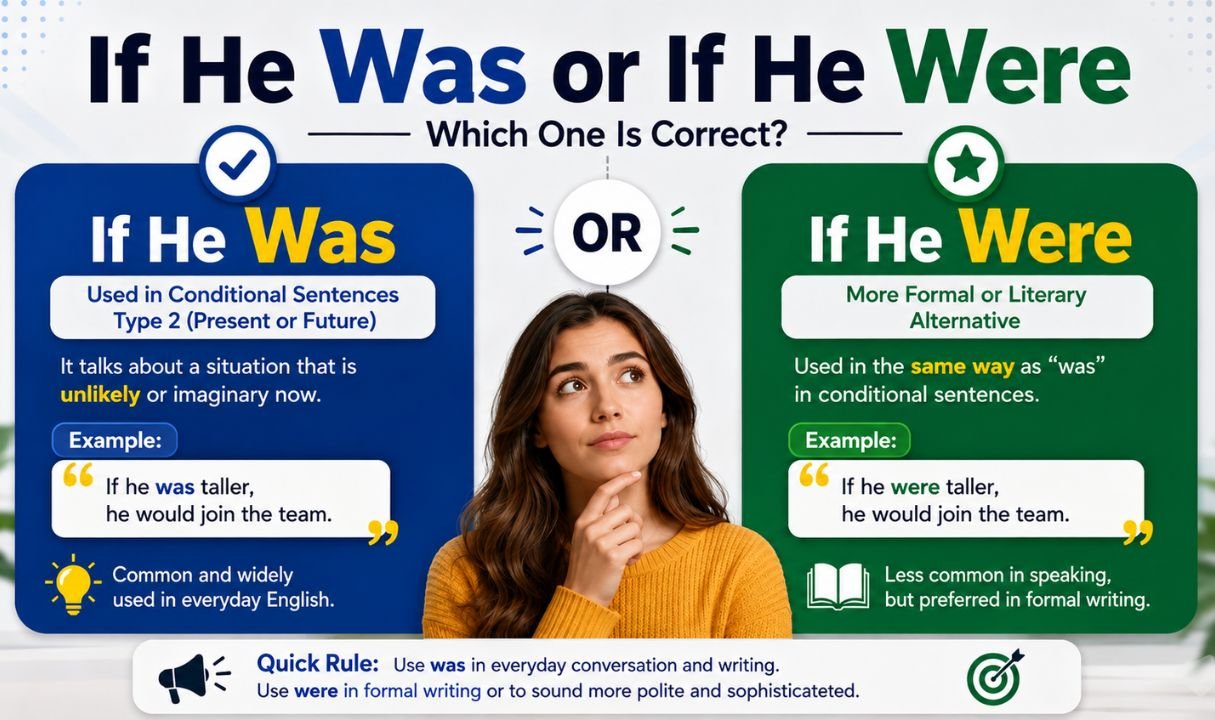
Few grammar questions trip up native speakers as often as this one. You’re writing a sentence, you pause, and suddenly two versions of the same thought sit side by side: “If he was late…” and “If he were late…” Both look correct. Both sound familiar. Only one fits the meaning you actually intend.
This guide breaks the rule down in plain language, shows you exactly when each form belongs, and gives you a quick mental test so you never have to guess again.
Definition of If He Was or If He Were
“If he was” and “if he were” are two versions of a conditional sentence built around the same subject, but they belong to different grammatical moods.
- If he was describes something that may have genuinely happened. It treats the situation as a real possibility.
- If he were describes something imagined, unlikely, or flatly untrue. It signals that the speaker is stepping outside of reality to talk about a hypothetical.
Put simply: was reports on a fact that might be true; were paints a picture of something that isn’t.
Understanding the Subjunctive Mood
Mood, in grammar, tells you how a speaker relates to what they’re saying — as fact, as command, or as fantasy. English has three main moods:
- Indicative mood — used for statements of fact (“He was tired.”)
- Imperative mood — used for commands (“Be quiet.”)
- Subjunctive mood — used for wishes, suggestions, and hypothetical conditions (“If he were here…”)
The subjunctive is the odd one out because it breaks the usual subject-verb agreement rules. Normally, “he” pairs with “was.” But in the subjunctive, every subject — I, you, he, she, it, we, they — takes “were.” That single quirk is the entire source of the confusion people feel with this phrase.
You May Like: Drier vs Dryer: Which One Should You Use in Writing?
The History: How English Got Complicated
Old English had a much richer set of subjunctive verb forms than the language does today. Nearly every verb changed shape depending on whether a speaker meant something real or something imagined. Over the centuries, most of those distinct forms faded away, and modern English kept only a few surviving fragments of the subjunctive.
“Were” is one of the last strongholds of that older system. It survives almost exclusively in conditional clauses that describe unreal situations — “if I were,” “if she were,” “if he were” — along with a handful of fixed expressions like “so be it” or “far be it from me.” Everywhere else, English simplified. That’s why the rule feels like an exception rather than a pattern: it is one of the few pieces of Old English grammar still standing.
The Modern Divide: Subjunctive vs. Indicative Mood
Today the choice comes down to a single question: is the situation real, uncertain, or purely imagined?
- Use the indicative (“was”) when you’re describing something that could genuinely be true, even if you don’t know for sure.
- Use the subjunctive (“were”) when you’re describing something contrary to fact, purely hypothetical, or a wish.
Subjunctive vs Indicative Comparison
| Feature | Indicative (“was”) | Subjunctive (“were”) |
|---|---|---|
| Describes | Real or possible events | Imaginary or false situations |
| Certainty | Uncertain but plausible | Known to be untrue |
| Common triggers | if, whether, that | if, as if, as though, wish |
| Tone | Neutral, factual | Reflective, hypothetical |
| Example | If he was home, he didn’t answer. | If he were home, he’d answer. |
“If He Was” — When It’s Actually Correct
A lot of people assume “if he was” is simply wrong, but that’s a myth. When you’re talking about a real event whose outcome you’re unsure of, “was” is the accurate, grammatically sound choice.
Think of a detective reviewing a case. She doesn’t know for certain where the suspect stood at 9 p.m., but it’s entirely possible he was there. That uncertainty — not impossibility — is what “was” signals.
When to Use “If He Was”
- Describing a real past situation with an unknown outcome
- If he was at the office, someone would have signed him in.
- Reporting indirect questions
- She asked if he was coming to dinner.
- Talking about something that plausibly happened
- If he was tired, that would explain the mistake.
- Testing the sentence with “whether” instead of “if” and having it still make sense
- If he was late → whether he was late ✅
“If He Were” — The Hypothetical Heavyweight
“If he were” belongs to situations that never happened, can’t happen, or are being imagined for the sake of argument. It’s the form you reach for when you want to explore a scenario that departs from reality.
This is also the version most people associate with the classic line “If I were you,” which stays subjunctive no matter how casual the conversation gets, at least in formal writing.
Key Uses of “If He Were”
- Describing something known to be false
- If he were a millionaire, he wouldn’t be renting this apartment.
- Expressing a wish
- He wishes he were taller.
- Giving advice through a hypothetical lens
- If he were you, he’d take the deal.
- Softening a statement for politeness or distance
- If he were to apply, the position would suit him.
Key Differences Summarized
The meaning of if he was or if he were ultimately depends on how real or imagined the situation feels to the speaker, not on the tense of the sentence. Both forms are grammatically valid; they simply point at different kinds of truth.
This distinction also shapes related structures. In the second conditional — the pattern used for unlikely or imaginary future outcomes — “were” is the standard, traditional choice: If he were to win the lottery, he’d retire immediately. Saying “if he was to win” is common in casual speech, but “were” remains the form most style guides recommend.
The same logic extends to other subjects. If I was or if I were examples follow an identical pattern: “If I was late, I’m sorry” describes a real possibility, while “If I were rich, I’d travel more” describes a fantasy. And the question of if there was or if there were works the same way — “If there was a problem, nobody reported it” states a real doubt, while “If there were no rules, chaos would follow” imagines something untrue.
A phrase like “if he were alive” versus “if he was alive” shows the contrast clearly. “If he were alive” implies the person has died — a fact contrary to reality. “If he was alive” simply questions an unknown past state, such as during a medical review.
You May Like: Tying vs Tieing: Learn the Correct Spelling in Minutes
Quick Grammar Comparison
| Sentence | Mood | Meaning |
|---|---|---|
| If he was sick, he didn’t tell anyone. | Indicative | Possibly true |
| If he were sick, he’d be resting. | Subjunctive | Imagined, not confirmed true |
| If there was a storm, the flight was cancelled. | Indicative | Real, uncertain event |
| If there were no storms, travel would be easier. | Subjunctive | Hypothetical world |
Why the Confusion Happens
If this rule still feels slippery, you’re in good company. Even confident writers second-guess themselves here, and there’s a clear explanation for that.
Main Reasons:
- Spoken English simplifies grammar. Casual speech drops many formal distinctions, and “was” has slowly crept into contexts that once required “were.”
- Regional habits differ. American English tends to relax the subjunctive in speech more than British English does.
- The rule is invisible everywhere else. Because subject-verb agreement normally demands “he was,” the exception for hypotheticals feels like it’s breaking a rule rather than following one.
- Media and everyday conversation blur the line. Song lyrics, dialogue, and social media posts use “was” freely, which trains the ear to accept it even in clearly hypothetical sentences.
Subtle Nuances in Tone and Meaning
Beyond strict correctness, was and were carry different emotional weight. “Were” often sounds more deliberate, literary, or formal. It signals that the speaker is stepping back to consider a possibility rather than reporting on daily life.
“Was” feels closer to natural speech. It doesn’t call attention to itself, which makes it the more comfortable choice in relaxed writing and conversation, provided the situation described is genuinely uncertain rather than imaginary.
Choosing between them, then, isn’t only about grammar rules. It’s also about how formal or reflective you want the sentence to sound.
Case Study: Formal vs. Casual English
Formal writing — academic papers, legal documents, published fiction — tends to preserve the subjunctive carefully. Casual writing and speech often let it slide.
Comparison Table
| Context | Preferred Form | Example |
|---|---|---|
| Academic essay | If he were | If he were correct, the theory would hold. |
| Legal document | If he were | If he were found liable, damages would apply. |
| Text message | If he was | If he was free, we could grab lunch. |
| Casual conversation | If he was | If he was there, I didn’t see him. |
| Literary fiction | If he were | If he were a ghost, no one noticed. |
Practical Tips to Remember
- Ask yourself: is this real, or am I imagining it? Real → was. Imagined → were.
- Try swapping “if” for “whether.” If the sentence still makes sense, “was” usually fits.
- Remember the phrase: were for wishes, was for what actually was.
- In formal or written English, default to “were” for anything hypothetical, even if it sounds slightly stiff.
- Read the sentence aloud. A clearly false or impossible scenario almost always calls for “were.”
Common Mistakes to Avoid
- Using “was” in fixed expressions like “if I were you”
- Mixing moods within the same sentence
- Assuming “was” is always wrong, when it’s often the correct, factual choice
- Forgetting that “were” applies to every subject in the subjunctive, not just plural ones
Examples in Literature and Pop Culture
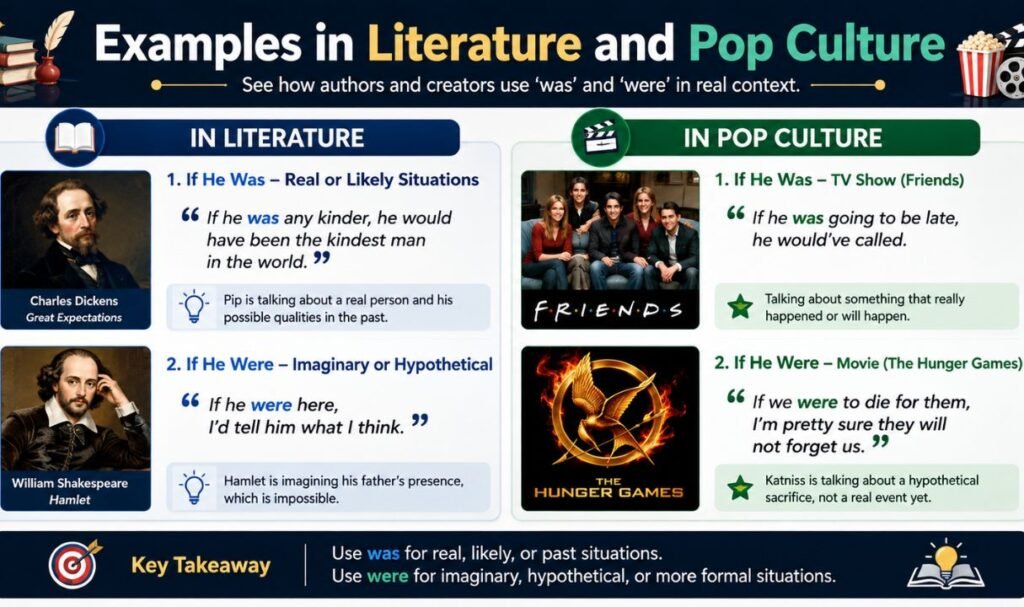
Writers have leaned on the subjunctive for centuries to add emotional distance or emphasize impossibility. Classic literature frequently uses “were” in advice-giving dialogue, particularly in lines built around the pattern “if I were you.” Song lyrics, by contrast, often favor “was” for its natural, conversational rhythm, even in places where formal grammar would call for “were.” That contrast is part of why the two forms feel so tangled in everyday use — one belongs to careful writing, the other to how people actually talk.
Linguistic Insight & Expert Opinion
Grammarians generally agree on one point: the subjunctive is fading from spoken English but remains alive in writing, particularly in edited, professional, or academic contexts. Style guides and usage dictionaries still recommend “were” for hypothetical conditionals, even as they acknowledge that “was” has become widely accepted in informal speech.
The practical takeaway from most grammar authorities is consistent match your choice to your audience and your level of formality, and reserve “were” for situations you know to be false or purely imagined.
Quick Reference Guide
- Real, uncertain event → was
- Imaginary, false, or wished-for event → were
- Formal or academic writing → lean toward were
- Everyday speech → was is widely accepted, except in fixed phrases like “if I were you”
Flowchart: Should You Use Was or Were?
- Is the situation something that could really have happened? → Yes: use “was.”
- Is the situation known to be false or purely imagined? → Yes: use “were.”
- Are you giving advice through a hypothetical lens (“if I were you”)? → Use “were.”
- Still unsure? → Swap “if” for “whether.” If it reads naturally, choose “was.”
Self-Assessment Quiz
Choose the correct form for each sentence.
- If he ___ home, he would have called. (was / were)
- She asked if he ___ coming to the party. (was / were)
- If he ___ a bird, he would fly away. (was / were)
- If there ___ a problem, nobody mentioned it. (was / were)
- If he ___ you, he’d apologize immediately. (was / were)
Answer Key
- were (hypothetical — he isn’t home)
- was (indirect question, real uncertainty)
- were (imaginary scenario)
- was (real, uncertain past event)
- were (fixed hypothetical expression)
Frequently Asked Questions
Is it “as if she was” or “as if she were”?
“As if she were” is the traditional subjunctive choice for something untrue or imagined, while “as if she was” is common in casual speech describing a real possibility.
Why “if he were” instead of “if he was”?
“If he were” is used because the sentence describes a hypothetical or false situation, and the subjunctive mood requires “were” regardless of the subject.
Do we say “he was” or “he were”?
Use “he was” for factual, real, or uncertain past events, and “he were” only in subjunctive conditional or wish statements like “if he were” or “he wishes he were.”
Which is correct, “if he were here” or “if he was here”?
“If he were here” is correct when he isn’t actually here and the sentence is hypothetical; “if he was here” fits when you’re genuinely unsure whether he was present.
Conclusion
The line between “if he was” and “if he were” comes down to one question: are you describing something that might be real, or something you know isn’t? Once that distinction clicks, the rest of the rule falls into place.
Formal writing leans on “were” for anything hypothetical, casual speech often relaxes into “was,” and both are correct in their own lane. Keep the real-versus-imagined test in mind, and you’ll never have to second-guess this sentence again.