
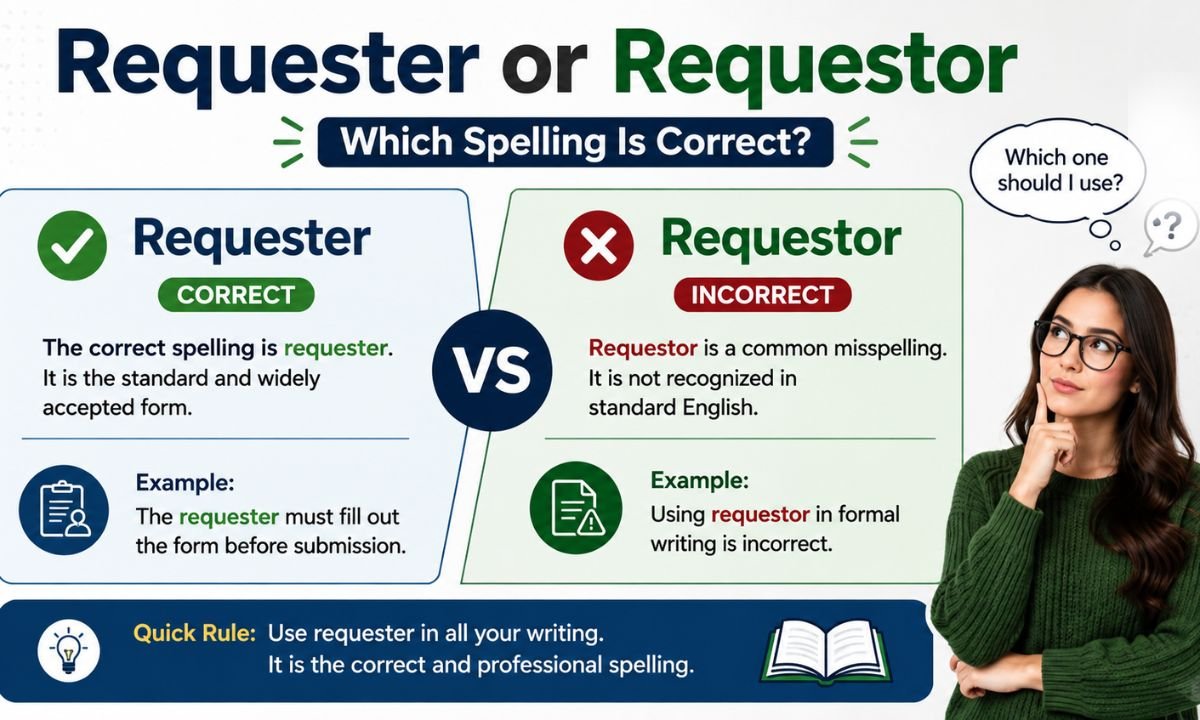
If you’ve ever paused mid-sentence wondering whether to write “requester” or “requestor,” you’re not alone. Both spellings show up in emails, legal documents, IT tickets, and government forms — and both are technically correct. The real question isn’t which one is “right,” but which one fits the context you’re writing in.
This guide breaks down the difference, shows you exactly when to use each form, and gives you simple rules so you never have to second-guess yourself again.
Comparison Overview
| Feature | Requester | Requestor |
|---|---|---|
| Spelling style | Standard, everyday spelling | Formal/legal variant |
| Common context | General writing, business emails, tech/IT | Legal documents, government forms, official policy |
| Frequency of use | More common overall | Less common, more specialized |
| Dictionary status | Widely listed as the primary form | Listed as an accepted variant |
| Typical audience | General readers, customer service, software users | Lawyers, court systems, compliance officers |
| Tone | Neutral, conversational | Formal, official |
Both words mean the same thing: a person or entity who makes a request. The difference lies almost entirely in tone and setting, not meaning.
Definition of Requester
A requester is a person, group, or system that asks for something information, access, a service, or an action. This is the more common spelling across everyday writing, and you’ll see it most often in:
- Customer service and support tickets (“the requester will be notified by email”)
- Software and IT systems (access requests, API documentation, workflow tools)
- General business communication
- News articles and blog content
Example: The requester submitted a form asking for a copy of their medical records.
Definition of Requestor
A requestor carries the exact same meaning — someone who requests something — but it leans formal. This spelling shows up most often in:
- Legal contracts and court filings
- Government and regulatory documents
- Policy manuals and compliance paperwork
- Some older or industry-specific technical writing
Example: The requestor must provide valid identification before the record can be released.
Neither spelling is a typo. Both appear in major dictionaries, though “requester” is generally listed as the primary or preferred entry, with “requestor” noted as a variant.
You May Like: Inter Vs Intra: The Complete Guide to Two Prefixes That Trip Up Even Careful Writers
Main Differences Between Requester and Requestor
Requester or requestor UK
In British English, “requester” is the dominant spelling in everyday and business use, much like in American English. “Requestor” does appear in UK legal and government contexts, but it’s the less common of the two on both sides of the Atlantic.
Requester or requestor or requestee
These three words are easy to confuse but mean different things:
- Requester/Requestor — the person making the request
- Requestee — the person or party the request is directed at (much rarer, mostly used in legal or technical writing)
Requester meaning
Someone who asks for something — a document, permission, service, or action.
Requester or requestor meaning
Identical meanings. The choice between them is stylistic, not semantic.
Requester or requestor synonym
Common alternatives include: applicant, petitioner, asker, claimant (in legal contexts), or inquirer, depending on the situation.
Requester or requestor examples
- “Please confirm the requester’s contact details.” (general/business)
- “The requestor shall submit Form 27B within 30 days.” (legal/formal)
Requester opposite
The rough opposite is provider, grantor, or responder — the party who fulfills or answers the request.
Requester plural
Both forms pluralize regularly:
- Requesters
- Requestors
No apostrophe is needed unless you’re showing possession (e.g., “the requester’s form”).
How each term is used in sentences
- Requester: “Every requester gets an automatic confirmation email.”
- Requestor: “The requestor bears the burden of proof under this clause.”
Notice how “requestor” tends to appear in sentences with a more legal or procedural rhythm, while “requester” fits naturally into plain, conversational writing.
Common mistakes learners make
- Assuming one spelling is “wrong” — both are valid.
- Switching between the two spellings within the same document, which looks inconsistent even though neither is incorrect on its own.
- Confusing “requester/requestor” with “requestee,” which has a different meaning.
- Using “requestor” in casual writing where it can feel unnecessarily stiff.
Simple rules to remember
- When in doubt, use requester — it’s the more widely recognized spelling.
- Save requestor for legal, governmental, or highly formal documents.
- Pick one spelling per document and stay consistent.
- If your organization or style guide already prefers one form, follow that over general rules.
Quick tips for writing and speaking
- Reading it aloud: both are pronounced the same way, so speech isn’t a concern.
- Check your style guide first (AP, Chicago, or your company’s internal guide) before defaulting to instinct.
- If you’re writing for a global audience, “requester” is the safer, more universally recognized choice.
You May Like: Hoodie or Hoody: Which Spelling Is Actually Correct?
When to Use Each One
Use “requester” when:
- Writing general business or marketing content
- Creating help desk, IT, or software documentation
- Writing for a broad or international audience
- No specific style guide dictates otherwise
Use “requestor” when:
- Drafting or reviewing legal contracts
- Filling out government or regulatory forms
- Matching the terminology already used in an official document
- Your industry or employer has a documented preference for it
When NOT to Use Each One
- Don’t use “requestor” in casual emails or everyday business writing it can come across as overly formal or even awkward.
- Don’t use “requester” when directly quoting or referencing a legal document that specifically uses “requestor” — match the source terminology.
- Don’t mix both spellings in the same document; pick one and use it consistently throughout.
- Don’t use either term interchangeably with “requestee” — they refer to different parties in a transaction.
Which One to Use (Decision Guide)
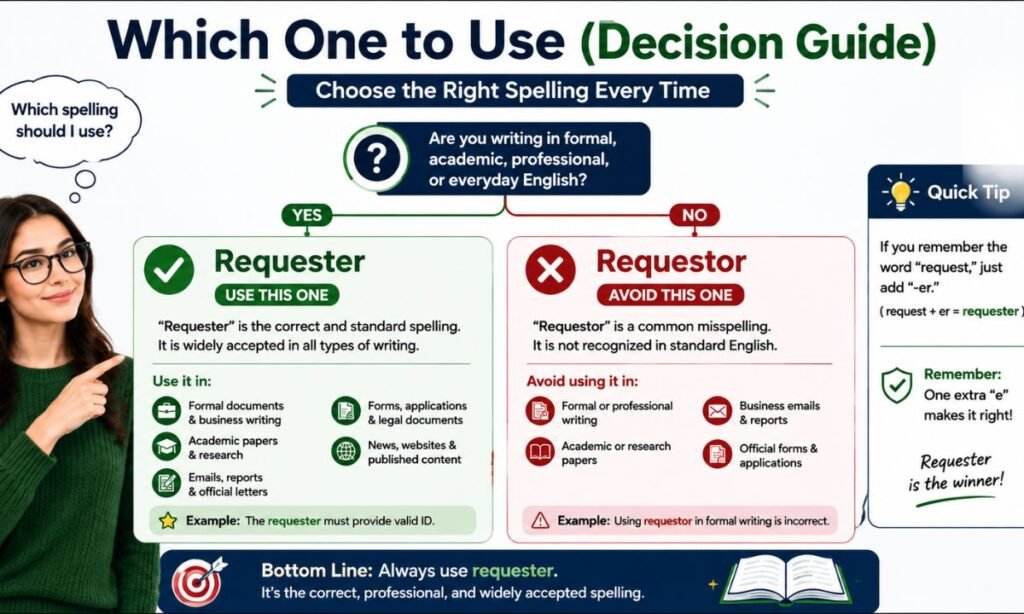
Ask yourself these questions in order:
- Does your style guide or employer specify a spelling? If yes, use that — end of discussion.
- Is this a legal, government, or compliance document? If yes, lean toward “requestor.”
- Is this general business, technical, or everyday writing? If yes, use “requester.”
- Still unsure? Default to “requester” — it’s the more broadly recognized and understood form.
Real-World Practical Examples
Requester Examples
- “The requester will receive a status update within 24 hours.”
- “Please list the requester’s department and employee ID.”
- “Our ticketing system automatically tags the requester on every update.”
- “The requester asked for expedited shipping on the replacement part.”
Requestor Examples
- “The requestor must sign and date the affidavit before submission.”
- “Under section 4.2, the requestor assumes all associated liability.”
- “The agency will notify the requestor in writing of its decision.”
- “The requestor’s application was reviewed by the compliance board.”
Self-Assessment (Fill in the Blanks)
- The ___________ submitted a help desk ticket asking for password reset access.
- Under the terms of the contract, the ___________ shall bear all filing costs.
- Please forward this form back to the original ___________.
- The court documents state that the ___________ failed to appear on the scheduled date.
- Our support team responds to each ___________ within one business day.
Answers
- Requester
- Requestor
- Requester
- Requestor
- Requester
Frequently Asked Questions
What does requester mean?
A requester is a person, system, or organization that asks for something such as information, access, or a service.
What does requestor mean?
A requestor means exactly the same thing as requester: someone who makes a request. It’s simply the more formal spelling, common in legal and government writing.
What do you call a person who requests?
You can call them a requester, a requestor, an applicant, or a petitioner, depending on the context and level of formality.
Is it requester or requestor in British English?
“Requester” is the more common spelling in British English for general use, though “requestor” does appear in formal legal and government contexts, similar to American English.
Conclusion
In conclusion, both “requester” and “requestor” are correct spellings, and both refer to a person who makes a request. However, requester is more common in modern English and is generally the better choice for everyday writing.
Requestor is also accepted, especially in technical, legal, or formal contexts. When in doubt, choose requester for clear, natural, and widely understood writing.