
You’re addressing an invitation, typing out a birthday caption, or filling in a date on a form, and your fingers type “22th” almost automatically. Then you pause. Does that look right? Something about it feels off, but you can’t quite say why.
You’re far from the only person who has stared at that word for a second too long. Ordinal numbers — the versions of numbers we use to show position, order, or rank — trip up native speakers and English learners alike, and 22 happens to be one of the most commonly mistyped numbers in the entire language. This guide walks through the correct spelling, the grammar behind it, the mistakes people make with it, and a few tricks that make it stick for good.
22th or 22nd – Quick Answer
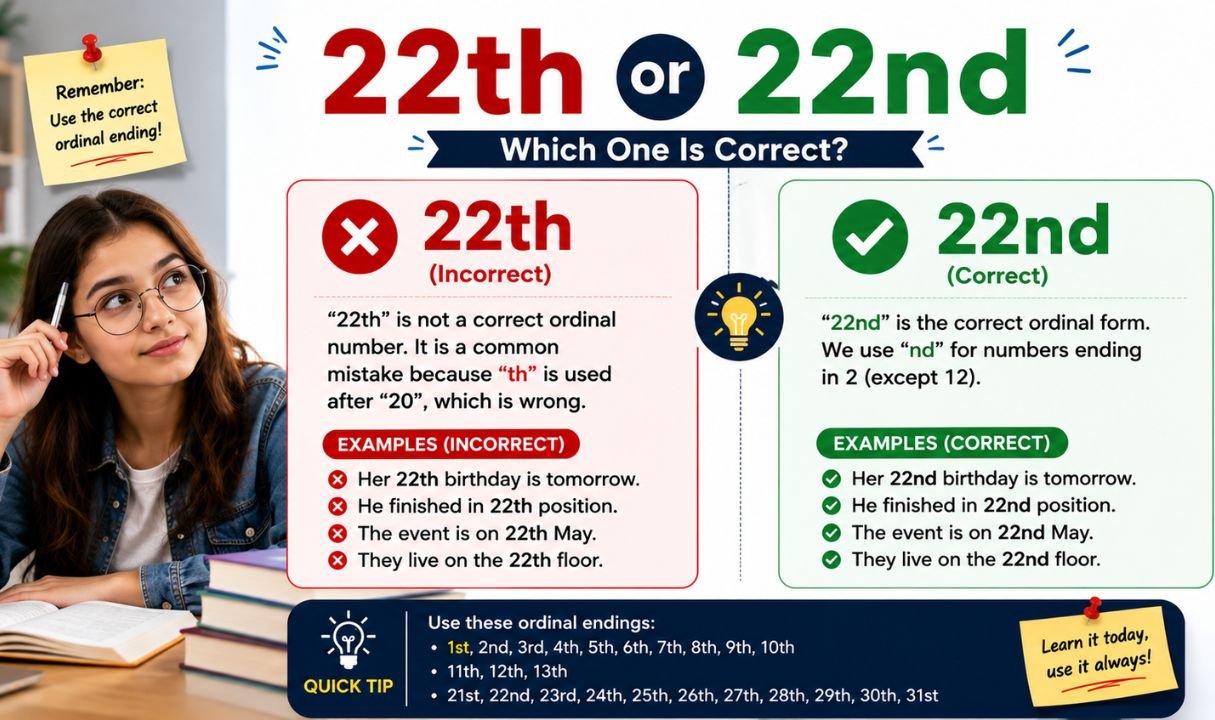
The correct spelling is 22nd. “22th” is not a recognized word in English grammar, no matter how casual or formal the writing is.
Whether you’re writing a text message, a wedding invitation, a school essay, or a corporate memo, the rule doesn’t shift. Numbers that end in 2 — 2, 22, 32, 42, and so on — take the suffix “-nd,” not “-th.”
Simple Rule
Here’s the short version, and it’s genuinely this simple:
- Numbers ending in 1 → add -st (1st, 21st, 31st)
- Numbers ending in 2 → add -nd (2nd, 22nd, 32nd)
- Numbers ending in 3 → add -rd (3rd, 23rd, 33rd)
- Everything else → add -th (4th, 15th, 100th)
Twenty-two ends in the digit 2, so it becomes twenty-second, which shortens to 22nd. There’s no version of standard English — academic, business, casual, or regional — where “22th” is treated as correct.
The Origin of 22th or 22nd
To understand why 22nd looks the way it does, it helps to look at where the suffix actually comes from. The “-nd” ending isn’t a random abbreviation tacked onto a number. It comes directly from the full word “second.” Twenty-two is built from “twenty” plus “two,” and its ordinal form follows the same pattern: twenty-second. Shorten “second” the way English speakers shorten most ordinal words, and you land on “nd” — which is where 22nd gets its ending.
The same logic applies to every number ending in 2, all the way up the number line: 32nd, 42nd, 52nd, and beyond. Meanwhile, most other numbers in English simply add “-th” because their full ordinal words end that way — fourth, seventh, ninth, twentieth. Since “-th” shows up so often, plenty of writers assume it’s a universal default. It isn’t, and 22 is one of the clearest examples of that exception.
Ordinal numbers themselves have been part of English for centuries, tracing back through Old English and Germanic number systems that already distinguished cardinal counting (one, two, three) from positional ranking (first, second, third). That distinction survived into modern English largely unchanged, which is why the rule around 22nd has stayed consistent for as long as anyone has been writing dates in this format.
British English vs American English Spelling
Here’s some good news if you’re writing for readers in more than one country: this particular rule doesn’t change based on where your audience lives. Unlike words such as “colour” versus “color,” or “organise” versus “organize,” ordinal suffixes are not a regional spelling difference. They’re a structural grammar rule, and structural grammar rules tend to hold steady across English dialects.
Whether your reader is in London, New York, Toronto, Sydney, or Karachi, “22nd” is the form they expect to see. There’s no British variant that swaps in “22th,” and no American convention that does either.
Comparison Table
| Feature | British English | American English |
|---|---|---|
| Correct spelling | 22nd | 22nd |
| Suffix rule | -nd for numbers ending in 2 | -nd for numbers ending in 2 |
| Date format example | 22nd August 2026 | August 22nd, 2026 |
| Regional exception | None | None |
| Common error | 22th | 22th |
Notice that the only real difference between the two dialects is the order in which the day and month appear in a written date — not the ordinal ending itself. British writing tends to place the day before the month (“22nd August”), while American writing usually places the month first (“August 22nd”). The suffix stays identical either way.
You May Like: Hoodie or Hoody: Which Spelling Is Actually Correct?
Which Spelling Should You Use?
Since the rule doesn’t shift by region, the answer here is refreshingly uncomplicated: use 22nd, always. There’s no scenario — casual text, formal report, academic paper, legal document, or social caption — where “22th” becomes the preferred or accepted choice.
That said, audience does still shape how you might format the date around the ordinal number, even if the ordinal itself never changes.
Audience-Based Usage
- Students and academics: Spell out the full date format cleanly, such as “the 22nd of March” or “March 22nd,” and keep ordinal suffixes consistent throughout a paper.
- Business professionals: Use 22nd in contracts, emails, and reports; abbreviated or inconsistent date formats can look careless in professional correspondence.
- Casual writers and social media users: 22nd works fine in short-form writing too — there’s no informal exception that makes “22th” acceptable in texts or captions.
- Non-native English learners: Treat 22nd as a fixed vocabulary item to memorize alongside 1st, 2nd, and 3rd, rather than trying to derive it fresh from a general rule each time.
Common Mistakes with 22th or 22nd
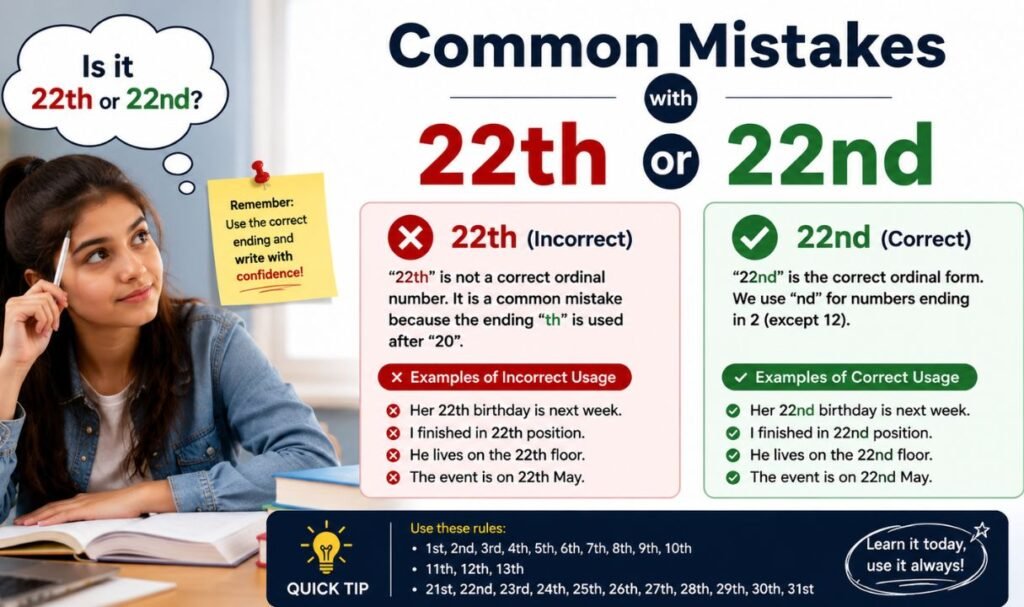
Most people who write “22th” aren’t guessing randomly. They’re applying a rule that works most of the time, just not for this particular number. Once you see the pattern behind the mistake, it becomes much easier to catch yourself before hitting send.
Common Errors and Fixes
| Incorrect | Correct |
|---|---|
| 22th birthday | 22nd birthday |
| 22th September | 22nd September / September 22nd |
| 22th December | 22nd December / December 22nd |
| 22th July | 22nd July / July 22nd |
| 22th January | 22nd January / January 22nd |
| 22th February | 22nd February / February 22nd |
| 22th June | 22nd June / June 22nd |
A phrase like “22th birthday meaning” often shows up in search bars too, and it’s worth clarifying directly: there’s no separate or alternate meaning attached to “22th.” It’s simply a misspelling of 22nd, not a different phrase with its own definition. Whoever is turning 22 is having a 22nd birthday, full stop.
Incorrect Example
“We’re celebrating her 22th birthday this weekend, and the party starts on the 22th of June.”
Correct Example
“We’re celebrating her 22nd birthday this weekend, and the party starts on the 22nd of June.”
Reading those two versions side by side usually makes the error jump out. The extra “th” interrupts the natural rhythm of the sentence once you know to look for it.
Why the Mistake Happens
A few things push people toward “22th” without them realizing it:
- Pattern overload. Most ordinal numbers in daily use — 4th, 5th, 9th, 10th, 18th, 100th — end in “th,” so the brain quietly builds a habit of defaulting to that ending.
- Autocorrect gaps. Many spellcheckers flag misspelled words but don’t always catch incorrect ordinal suffixes, since “22th” still reads as a plausible string of characters.
- Fast typing. Dates get typed quickly, often without a second glance, especially in texts, forms, and calendar invites.
- Limited exposure to the exception list. Numbers ending in 1, 2, and 3 behave differently from the rest, and that short exception list isn’t always taught explicitly.
None of this means the mistake reflects weak grammar overall — it’s closer to autopilot than ignorance. Recognizing the pattern is usually enough to fix it permanently.
Easy Rule for Ordinal Numbers
Once you separate ordinal numbers into a small handful of categories, the whole system stops feeling random.
- Numbers ending in 1 take -st: 1st, 21st, 31st, 41st, 51st
- Numbers ending in 2 take -nd: 2nd, 22nd, 32nd, 42nd, 52nd
- Numbers ending in 3 take -rd: 3rd, 23rd, 33rd, 43rd, 53rd
- Every other number takes -th: 4th, 5th, 6th, 7th, 8th, 9th, 10th
That covers nearly every number you’ll ever need to write in ordinal form.
Exceptions
There’s one important wrinkle: 11, 12, and 13 always take “-th,” even though they end in 1, 2, and 3 respectively. So you get 11th, 12th, and 13th, not “11st,” “12nd,” or “13rd.” This happens because these three numbers historically resisted the same suffix pattern as the rest of the “teens,” likely due to older pronunciation habits in English. Once you get past 13, the standard last-digit rule takes back over, which is why 21st, 22nd, and 23rd behave normally again.
You May Like: Inter Vs Intra: The Complete Guide to Two Prefixes That Trip Up Even Careful Writers
22th or 22nd in Everyday Examples
Ordinal numbers show up constantly, often in places you might not consciously notice until you’re looking for them.
Emails
“The revised proposal is due by the 22nd of this month, so please send your feedback before then.”
News
“City officials confirmed the new transit line will open to the public on August 22nd.”
Social Media
“Officially 22nd today! Thank you all for the birthday messages 🎉”
Formal Writing
“The committee will reconvene on the 22nd to finalize the quarterly budget.”
Invitations
“Please join us in celebrating Sarah’s 22nd birthday on the evening of the 22nd.”
Across every one of these contexts, the spelling never wavers. That consistency is part of what makes ordinal numbers a small but noticeable marker of careful writing — readers register the difference even when they can’t name the rule themselves.
22th or 22nd – Google Trends & Usage Data
Search behavior around this exact phrase tends to follow a predictable pattern, and it says a lot about why so many people land on grammar guides like this one.
Why People Search This Keyword
Most searches for “22th or 22nd” happen right before someone finalizes a piece of writing — a birthday post, an event date, an official document — rather than during idle grammar curiosity. It’s a last-second confirmation search, which is also why quick, direct answers tend to perform well for this topic.
Popular Countries
Interest in this exact ordinal question shows up consistently across major English-speaking regions, including the United States, United Kingdom, Canada, Australia, India, and Pakistan. Since the grammar rule doesn’t change by country, search interest tends to spike around similar moments everywhere: birthdays, anniversaries, academic deadlines, and scheduled events.
Usage Contexts
The phrase gets searched most often alongside specific occasions — birthdays, wedding dates, calendar invitations, and monthly deadlines. Related searches like “22th or 22nd birthday,” “22th or 22nd September,” and similar month pairings reflect how closely this grammar question is tied to real, dated events rather than abstract study.
Comparison Table: 22th vs 22nd
| Aspect | 22th | 22nd |
|---|---|---|
| Grammatically correct | No | Yes |
| Recognized in dictionaries | No | Yes |
| Used in formal writing | Never | Always |
| Used in casual writing | Should be avoided | Preferred |
| Regional variation | None | None (universal) |
| Root word | Misapplied “th” pattern | Derived from “second” |
Ordinal Numbers Similar to 22nd
Once you’re confident with 22nd, the same “-nd” pattern extends naturally to a whole family of related numbers:
- 2nd (second)
- 12nd — incorrect; the correct form is 12th, since 12 is part of the 11–13 exception
- 32nd (thirty-second)
- 42nd (forty-second)
- 52nd (fifty-second)
- 62nd (sixty-second)
- 72nd (seventy-second)
- 82nd (eighty-second)
- 92nd (ninety-second)
Every number ending in 2 follows this pattern, except for 12, which sits inside the 11-12-13 exception group and always takes “-th” instead.
Memory Trick to Remember 22nd
If the rule ever slips your mind mid-sentence, try this shortcut: think of the word “second,” not the number 2. Twenty-two is twenty-SECOND, and “second” naturally shortens to “-nd.” As long as you can hear that word in your head, the correct suffix follows automatically.
A second trick works well for anyone who reads a lot of dates: picture a race podium. First place gets “-st,” second place gets “-nd,” third place gets “-rd.” Every number ending in 1, 2, or 3 mentally maps back to that podium — except for 11, 12, and 13, which sit outside the medal stand entirely and always take “-th.”
Practice with real dates for a week — birthdays, meeting invites, calendar reminders — and the correct spelling stops requiring conscious thought altogether.
Frequently Asked Questions
Is it a 22th birthday or a 22nd birthday?
It’s always a 22nd birthday. “22th” is not a correct English spelling in any context.
Is it 21st or 22th?
Both examples given here contain one correct and one incorrect form: 21st is correct, and the number after it is 22nd, not “22th.”
Can I say 22th?
No. “22th” is not a recognized ordinal number in standard English grammar.
Is happy 22nd birthday correct?
Yes. “Happy 22nd birthday” is the grammatically correct way to write this greeting.
Conclusion
The rule behind 22nd is smaller than it feels the first time you question it. Numbers ending in 2 take “-nd,” numbers ending in 1 take “-st,” numbers ending in 3 take “-rd,” and everything else takes “-th” — with 11, 12, and 13 sitting outside that pattern as fixed exceptions.
“22th” isn’t a regional variant, an informal shortcut, or an accepted alternative in any style guide. It’s simply an overcorrection of the “-th” habit, applied to a number that doesn’t follow it.