
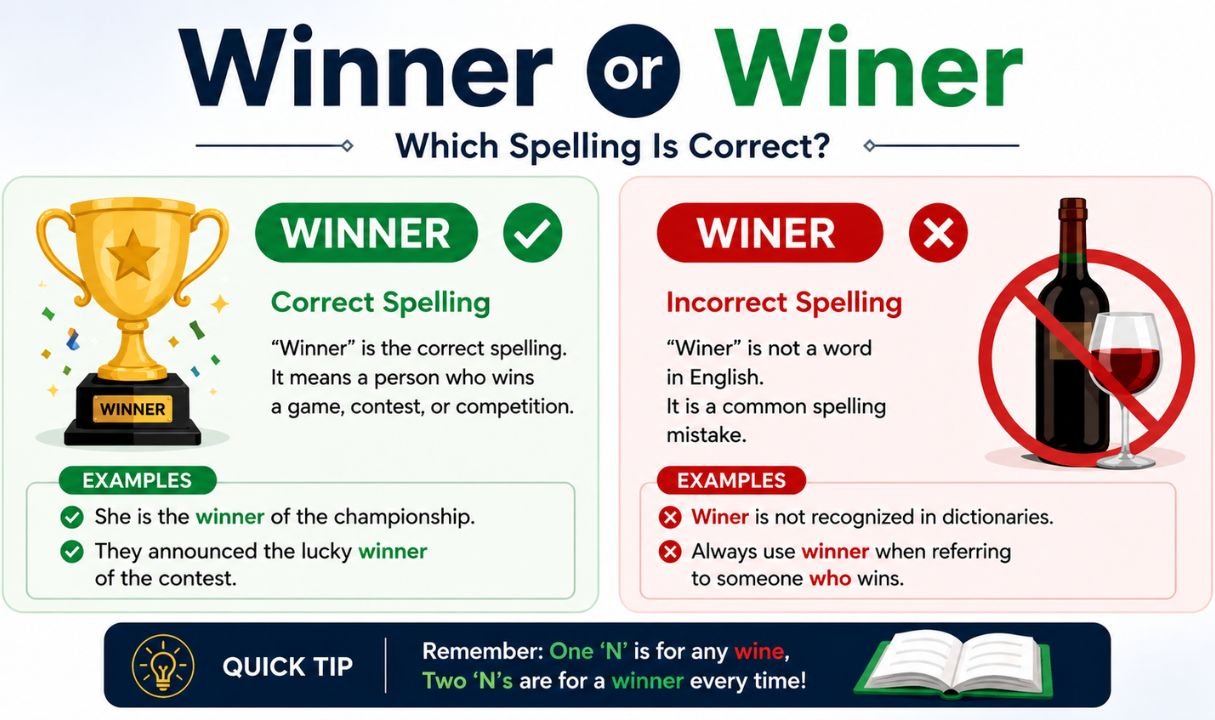
If you’ve ever paused mid-sentence wondering whether to type “winner” or “winer,” you’re not alone. This is one of the most common spelling mix-ups in English, and the answer is more straightforward than the confusion suggests.
Quick Answer
“Winner” is the correct spelling. It’s the standard English word for a person, team, or entity that wins a contest, competition, game, or award.
“Winer” is not a standard English word. It occasionally shows up as a surname, and it’s sometimes confused with “wiener” (a type of sausage) or used as a typo for “winner.” Outside of proper names, you should avoid using “winer” in formal or everyday writing.
Winner or winer meaning
“Winner” means someone or something that has won — a race winner, a lottery winner, a contest winner. “Winer” has no independent meaning in standard dictionaries; it’s essentially a misspelling.
Winner or winer in a sentence
- Correct: “She was the winner of the marathon.”
- Incorrect: “She was the winer of the marathon.”
Winner or winer synonym
Synonyms for “winner” include: champion, victor, titleholder, champ, and (in casual speech) “top dog.”
Is winer a word
No, “winer” is not recognized as a standard word in major English dictionaries. It appears almost exclusively as a surname or as an accidental misspelling of “winner.”
Winner app
“Winner” also appears as a name for various apps, games, and betting or prediction tools — always spelled with the double “n.”
Winer skin
In some gaming communities (notably skin or cosmetic marketplaces), “winer skin” shows up as a misspelled search term for “winner skin,” referring to a cosmetic item tied to winning a match or round.
Is WINER a word in Scrabble
No. “WINER” is not a valid word in standard Scrabble dictionaries (TWL or SOWPODS). “WINNER” is valid.
Winner or winners
Both are correct depending on number: “winner” is singular, “winners” is the plural form for multiple people or teams who won.
Simple Rule
Remember: winner = win + ner (double “n”). Think of the verb “to win” — you add “-ner” to describe the person who does the winning, keeping both n’s from the root spelling pattern of similarly doubled words like “runner” (run + ner) and “planner” (plan + ner).
You May Like: Hoodie or Hoody: Which Spelling Is Actually Correct?
The Origin of Winner or Winer
“Winner” comes from the Old English verb winnan, meaning “to labor, strive, or fight for,” which evolved into the modern verb “to win.” The agent noun “winner” (someone who wins) followed the same doubling pattern common in English when adding “-er” to short verbs ending in a single consonant after a single vowel — like “run” → “runner” and “plan” → “planner.”
“Winer” has no equivalent etymological root as a common noun. It exists mainly as a surname of uncertain origin, and its resemblance to “winner” is purely coincidental, arising from the simple omission of one letter.
British English vs American English Spelling
This isn’t a British-versus-American spelling difference like “colour” versus “color” or “organise” versus “organize.” Both British and American English spell the word the same way: winner, with two n’s. There is no dialectal variant that uses “winer” as a correct alternative.
Which Spelling Should You Use?
Always use “winner” in any context — academic writing, business communication, casual conversation, social media, or creative writing. “Winer” should only appear if you are specifically referring to a person’s surname (some individuals and businesses do use “Winer” as a last name or brand name).
Common Mistakes with Winner or Winer
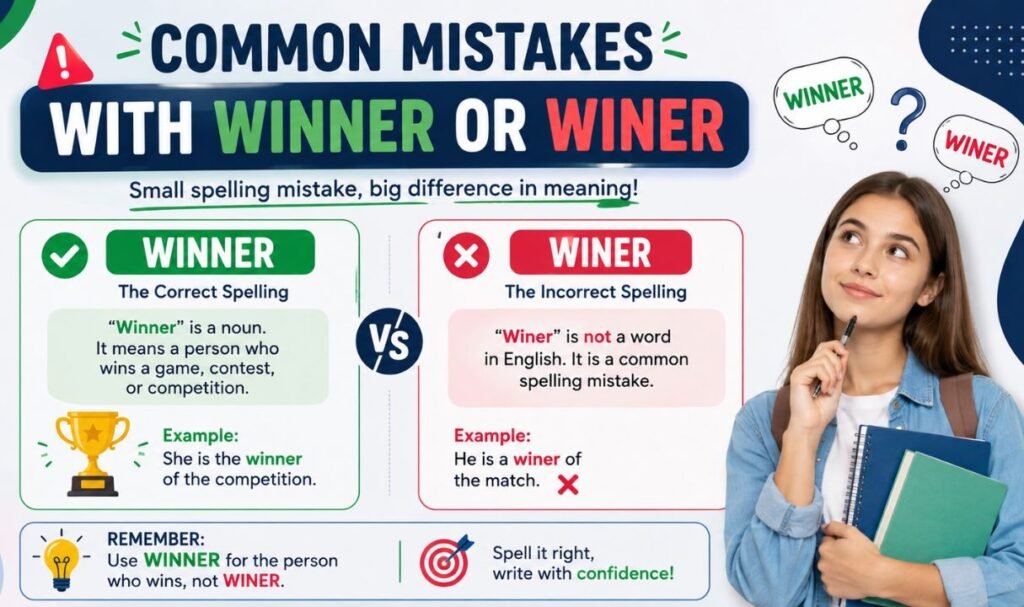
- Dropping the second “n” while typing quickly, especially on mobile keyboards.
- Confusing it with “wiener,” the sausage, due to similar letter patterns.
- Autocorrect errors that don’t catch the missing letter because “winer” resembles a plausible surname.
- Non-native speakers applying single-consonant rules inconsistently across English words.
Winner or Winer in Everyday Examples
- Sports: “The winner of the championship game gets the trophy.”
- Business: “Our proposal was declared the winner among five finalists.”
- Casual: “You’re such a winner for finishing that project early!”
- Contests: “Winners will be announced next Monday.”
None of these examples correctly use “winer” — in every case, “winner” is the required spelling.
You May Like: Inter Vs Intra: The Complete Guide to Two Prefixes That Trip Up Even Careful Writers
Winer or Winner – Google Trends & Usage Data
Search interest for “winner” vastly outpaces “winer” in search engines, and the overwhelming majority of “winer” searches are misspellings that search engines automatically correct to “winner” in results. This pattern is consistent with typo-driven search behavior rather than genuine demand for a distinct word.
Winner vs Winer: Comparison Table
| Feature | Winner | Winer |
|---|---|---|
| Standard English word | Yes | No |
| Dictionary entry | Yes | No (surname only) |
| Valid in Scrabble | Yes | No |
| Common usage | Very common | Rare/typo |
| Meaning | One who wins | No standard meaning |
| Correct spelling | ✅ | ❌ |
Frequently Asked Questions
Is it winer or winner?
It’s “winner.” “Winer” is not a standard English word and is almost always a misspelling.
What is the correct spelling of winner?
W-I-N-N-E-R, with a double “n.”
What is the meaning of winer?
“Winer” has no standard dictionary meaning. It’s occasionally used as a surname, but as a common noun it’s simply an incorrect spelling of “winner.”
What does “winner” mean?
A winner is a person, team, or entity that wins a competition, contest, game, award, or similar event.
Conclusion
The answer is simple: winner is correct. “Winer” isn’t a recognized English word, no matter how often it shows up in a rushed text or a quick caption.The mix-up usually comes down to speed, not a lack of grammar skills. Double the “n,” and the confusion disappears for good.