
You’re typing up a set of questions for your class, your team meeting, or your favorite trivia night, and you pause. Is it “quizes” or “quizzes”? The word looks simple, yet that extra z trips up more writers than you’d expect.
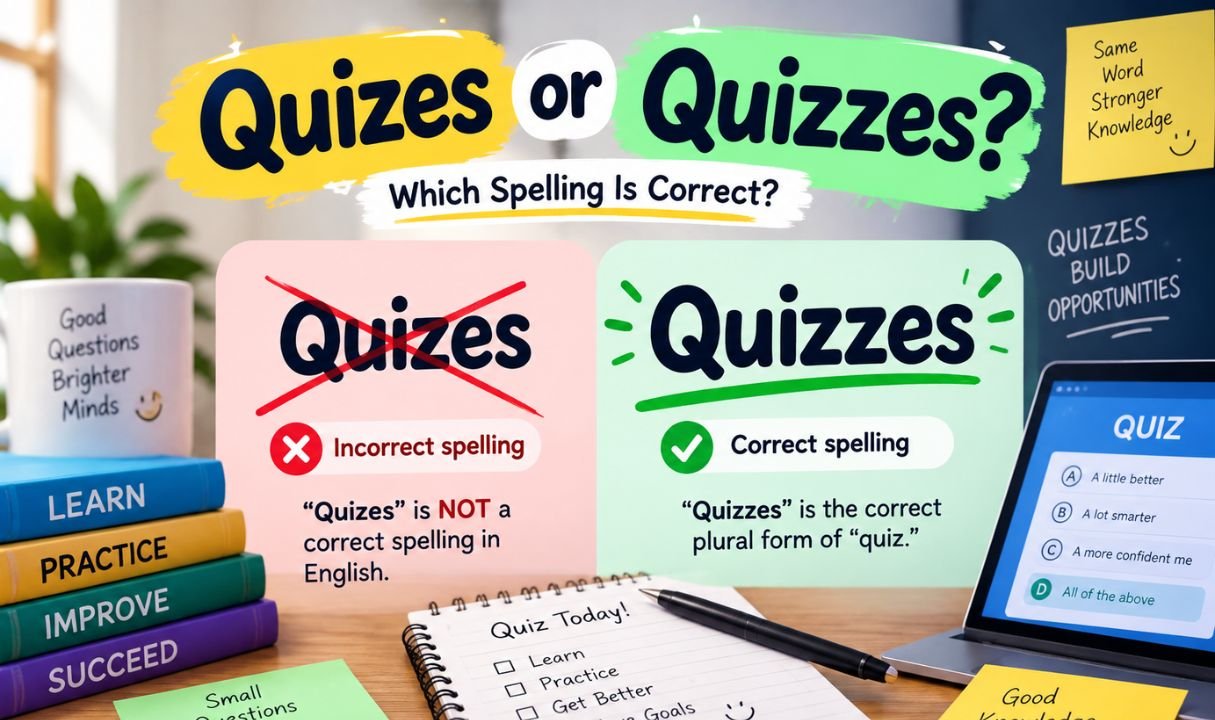
Here’s the short version: quizzes is the only correct spelling. “Quizes” is a common misspelling, not an accepted variant, and no major dictionary lists it as valid. But knowing the right answer isn’t quite the same as understanding why it’s right — and that’s what makes this word interesting.
This guide walks through the spelling rule behind “quizzes,” where the confusion comes from, how the word is used across different types of writing, and what the data says about how often people search for the wrong version anyway.
Quizes or Quizzes – Quick Answer
If you only need the answer and nothing else: write quizzes, always, in every English-speaking country.
- Quiz (singular) → Quizzes (plural)
- “Quizes” is a spelling error
- The rule applies in both British and American English
- Merriam-Webster, Cambridge, Collins, and Oxford all list “quizzes” as the plural
The reason comes down to a small but consistent pattern in English spelling: when a short, one-syllable word ends in a single consonant right after a short vowel, that consonant usually gets doubled before you add an ending like “-es” or “-ed.” Quiz fits that pattern exactly, which is why “quizzes” — not “quizes” — is correct.
The Origin of Quizes or Quizzes
The word “quiz” itself has a slightly murky history. Language historians trace it back to late 18th-century English, likely from British university slang, where it originally meant an odd or eccentric person rather than a test of knowledge. Over time it shifted toward its modern sense: a short, informal exam or set of questions used to check what someone knows.
Once “quiz” settled into everyday English as a noun, it needed a plural form like any other countable noun. English generally handles this in one of two ways:
- Add “-s” to most words (cat → cats, book → books)
- Add “-es” to words ending in a hissing or buzzing sound (bus → buses, box → boxes, wish → wishes)
“Quiz” ends in a z sound, so it falls into the second group and needs “-es” rather than a plain “-s.” But there’s an extra wrinkle. Because “quiz” is a short word with a single vowel followed by a single consonant, English spelling convention doubles that final consonant before the ending is attached. You can see the same pattern in words like “fizz,” “buzz,” and even in verb forms like “quizzed” and “quizzing.” Drop the doubled letter and the word would visually suggest a different pronunciation, closer to how “quite” or “prize” sound, rather than the short “i” in “quiz.”
So “quizzes” isn’t a random quirk. It’s the predictable result of two ordinary spelling rules working together: the “-es” rule for words ending in a sibilant sound, and the consonant-doubling rule that protects short vowel sounds.
You May Like: Lended vs Lent: Why “Lended” Is Always Wrong
British English vs American English Spelling
Plenty of words split down the middle between British and American spelling — think “colour” versus “color,” or “organise” versus “organize.” Naturally, people wonder whether “quiz” behaves the same way.
It doesn’t. This is one of the rare cases where British and American English agree completely.
| Region | Singular | Plural |
|---|---|---|
| British English | Quiz | Quizzes |
| American English | Quiz | Quizzes |
| Canadian English | Quiz | Quizzes |
| Australian English | Quiz | Quizzes |
No regional dictionary offers “quizes” as an alternate spelling. That makes this one of the more straightforward plural rules in English — there’s no need to remember which country prefers which version, because everyone uses the same one.
Which Spelling Should You Use?
Use “quizzes” in every context where you’re referring to more than one quiz. There is no situation — formal, casual, academic, or online — where “quizes” is the accepted spelling. Some writers assume informal settings like texting or social media allow more flexibility, but dictionaries and style guides don’t carve out an exception for tone or platform.
Use quizzes for:
- Referring to multiple short tests or assessments (“The teacher gave three quizzes this week.”)
- Naming a collection of trivia questions (“We built a set of movie quizzes for the party.”)
- Describing recurring content (“The app publishes new quizzes daily.”)
- Any plural reference to the noun “quiz” in writing or speech
Writers sometimes second-guess themselves because the doubled z looks unusual next to words like “boxes” or “buses,” which don’t double their final letter. But those words end in “x” and “s,” not a single consonant after a short vowel, so a different rule applies to them. “Quiz” simply belongs to a smaller group of words — including “fizzes” and “buzzes” — that double the consonant for pronunciation reasons.
A related point of confusion is the past tense of the verb “quiz.” Just as with the plural noun, the consonant doubles: quizzed, not “quized.” The same logic applies to the “-ing” form, quizzing. Whether you’re forming a noun plural or a verb tense, the rule stays consistent — double the z before adding the ending.
Search behavior around this word also reveals a few related patterns worth knowing. People frequently look up the plural of quiz Oxford Dictionary confirms, wanting a definitive source rather than a general rule explanation. Others search quiz plural and singular side by side, or type What is the plural of quiz directly into Google expecting a one-word answer.
There’s also steady interest in quizzes meaning, since the word covers both a light trivia game and a formal academic assessment depending on context, plus a wave of traffic around quizzes app as people look for platforms to build or take interactive quizzes, and quizzes join, where users search for a code or link to enter a live quiz session hosted by a teacher or event organizer.
You May Like: Truely or Truly: What is the Difference & Which is Correct?
Common Mistakes with Quizes or Quizzes
Spelling errors around this word tend to fall into a few predictable categories:
- Dropping the second z: writing “quizes” instead of “quizzes,” usually because the doubled letter feels unnecessary
- Using an apostrophe incorrectly: writing “quiz’s” to mean multiple quizzes, which actually signals possession, not plurality
- Misspelling the past tense: writing “quized” instead of “quizzed”
- Autocorrect confusion: some spell-checkers and predictive keyboards fail to flag “quizes” because it resembles other valid words ending in a single “-es”
None of these errors change the meaning much in casual conversation, but they stand out in professional writing, school assignments, published articles, and anywhere accuracy matters. A single missing letter can undercut the credibility of an otherwise well-written piece, especially in education or content marketing where readers expect polished grammar.
Quizes or Quizzes in Everyday Examples
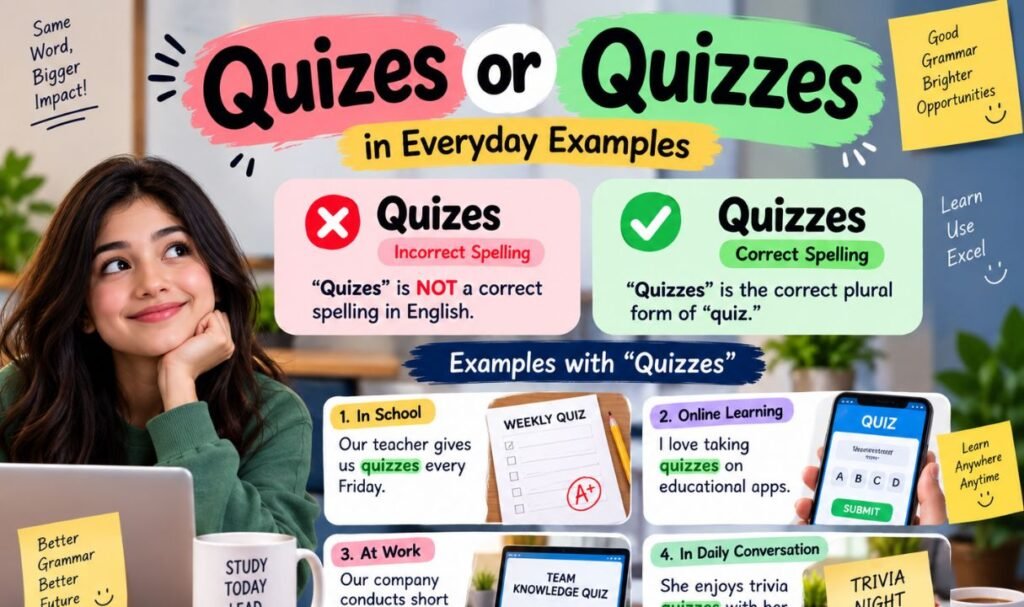
Seeing the word in real contexts makes the rule easier to remember than reciting it in the abstract. Below are five common settings where the spelling question actually comes up.
Workplace emails referencing training materials or internal assessments need the correct plural to stay professional. “Please complete the two quizzes attached before Friday’s meeting” reads correctly and clearly, while “quizes” would look like a typo to most recipients, especially in formal or client-facing correspondence.
News
Journalists covering education, entertainment, or pop culture regularly reference multiple quizzes — think year-end trivia roundups or viral personality tests. News outlets follow standard style guides like AP or Chicago, both of which use “quizzes” without exception.
Social Media
This is where “quizes” shows up most often, largely due to fast typing and limited editing. Captions like “Take our new quizes!” are common on Instagram and Facebook, but they still register as errors to careful readers, and brands that get it wrong risk looking less credible even in a casual space.
Formal Writing
Academic papers, research on assessment methods, and instructional design documents all rely on precise language. In these settings, “quizzes” is non-negotiable, and reviewers or editors will flag “quizes” immediately.
Education Platforms
Learning management systems and quiz-building apps — the tools behind that quizzes app search volume — almost universally use “quizzes” in their interface copy, help documentation, and marketing. Getting the spelling wrong on a platform meant to teach people undermines the product’s credibility.
Quizes or Quizzes – Google Trends & Usage Data
Search interest data consistently shows “quizzes” dominating over “quizes,” though the incorrect spelling still generates a meaningful volume of searches every month. This pattern lines up with broader research on English spelling errors: short, high-frequency words with irregular-looking doubled letters tend to produce persistent misspellings, because people often spell based on how a word sounds rather than how it’s written.
A few patterns show up consistently in search and usage data:
- “Quizzes” receives dramatically more search volume than “quizes” worldwide
- Searches for “quizes” tend to cluster around students and casual writers double-checking spelling
- Related searches like “quiz plural,” “is it quizzes or quizes,” and “quizzes meaning” indicate that people are actively trying to verify the word rather than assuming they already know it
- Interest in “quizzes app” and “quizzes join” reflects the word’s heavy use in education technology and interactive online learning
This tells us two things. First, most people do land on the correct spelling eventually, often after a quick search. Second, the confusion is common enough that it’s worth addressing directly rather than assuming it’s obvious — which is exactly why so many grammar and language sites, dictionaries, and forums have pages dedicated to this exact question.
Comparison Table: Quizes vs Quizzes
| Feature | Quizes | Quizzes |
|---|---|---|
| Dictionary recognition | Not recognized | Recognized (Merriam-Webster, Oxford, Cambridge, Collins) |
| Grammatical correctness | Incorrect | Correct |
| British English | Not used | Standard |
| American English | Not used | Standard |
| Follows consonant-doubling rule | No | Yes |
| Appropriate for formal writing | No | Yes |
| Common cause | Typo, unfamiliarity with spelling rule | Standard plural formation |
Frequently Asked Questions
Is it quizzes or quizes?
It’s quizzes. “Quizes” is a common misspelling and isn’t recognized by any standard dictionary.
What is the correct plural of quiz?
The correct plural is quizzes, formed by doubling the final z and adding -es.
What is the meaning of “quizzes” or “quizes”?
“Quizzes” refers to multiple short tests or sets of questions; “quizes” has no accepted meaning since it’s simply a misspelling of “quizzes.”
Is quizzes spelled correctly?
Yes, “quizzes” is the correct and only accepted spelling for the plural of “quiz” in all English-speaking regions.
Conclusion
The rule behind “quizzes” isn’t complicated once you see the pattern: short words ending in a single consonant after a short vowel double that consonant before adding “-es” or “-ed.” That’s the same reason “buzz” becomes “buzzes” and “quiz” becomes “quizzed” in the past tense. “Quizes” simply skips a step in that process, which is why it reads as an error rather than a stylistic choice.