
Anyone who writes emails, invitations, or school essays has probably paused over this word at least once. You type “occ,” your fingers hesitate, and suddenly you’re not sure whether the next letter is another “c” or an “a.” That split-second doubt is exactly why this word ranks among the most commonly misspelled in English.
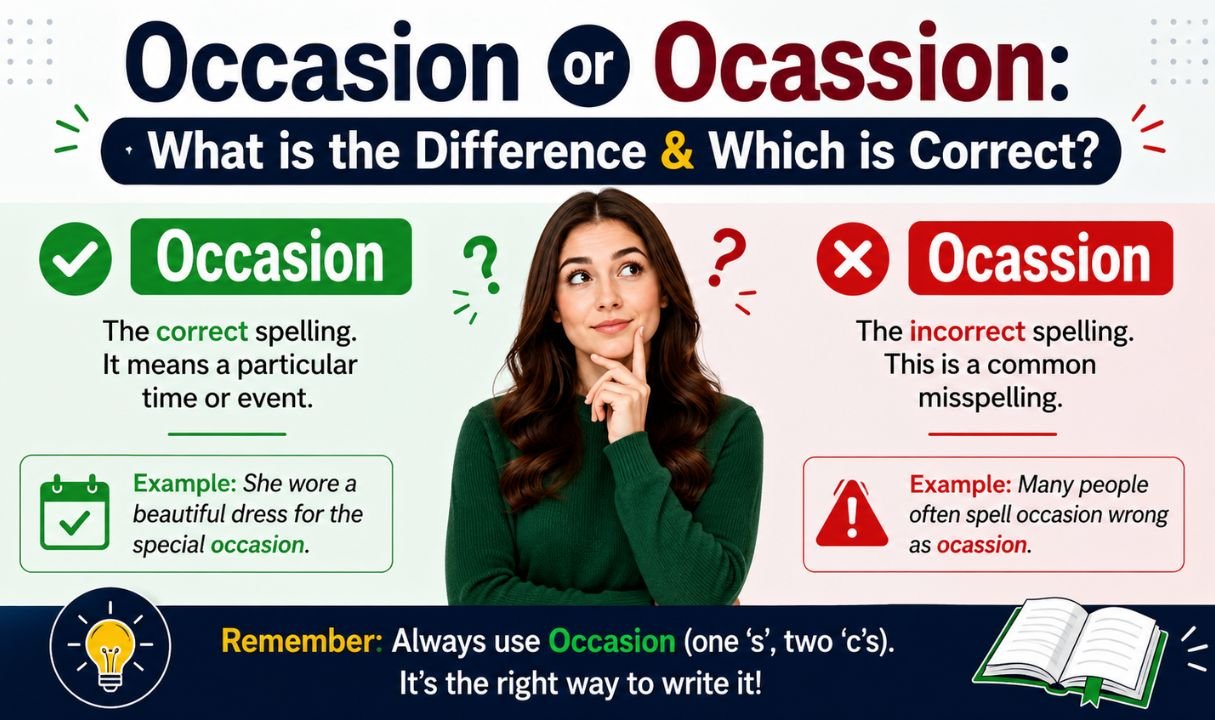
Here’s the short version: occasion is the correct spelling. Ocassion is not a real word — it’s simply a misspelling that happens because the double letters in “occasion” sit in an order that doesn’t match how we hear the word when we say it out loud.
This guide walks through the meaning, the grammar, the spelling logic, and plenty of real examples, so you never have to second-guess yourself again.
Comparison Overview
Before going deeper, here’s a quick side-by-side look at how these two forms compare.
| Feature | Occasion | Ocassion |
|---|---|---|
| Correct spelling | Yes | No |
| Found in dictionaries | Yes | No |
| Part of speech | Noun (also a verb in formal use) | Not applicable |
| Letter pattern | Double “c,” single “s” | Single “c,” double “s” (incorrect) |
| Acceptable in formal writing | Yes | Never |
| Common in typos and autocorrect slips | N/A | Yes |
The pattern is simple once you see it laid out: one of these words exists in English, and the other is a typing habit that never quite goes away.
Definition of Occasion
Meaning
Occasion is a noun that refers to a particular event, a specific time something happens, or a reason or opportunity for doing something. It can describe a happy celebration, a formal event, or simply a moment in time worth mentioning.
Less commonly, occasion also works as a verb meaning “to cause” something, as in a formal sentence like “the delay was occasioned by heavy traffic.” Most everyday use, though, sticks to the noun form.
Examples
- Her graduation was a joyful occasion for the whole family.
- We only use the good china on special occasions.
- On this occasion, the committee decided to postpone the vote.
- He mentioned, on occasion, that he missed his hometown.
- The wedding was a beautifully organized occasion.
Definition of Ocassion
Meaning
Ocassion has no meaning of its own. It doesn’t appear in Merriam-Webster, Oxford, Cambridge, or any recognized English dictionary. It’s a spelling error that results from swapping the placement of the double letters — writers place two S’s where there should be two C’s, and one C where there should be one S.
Examples
There are no correct examples of ocassion, because the word itself is wrong. The following sentences show the mistake, followed by the fix:
- ❌ It was a special ocassion. → ✅ It was a special occasion.
- ❌ We celebrated the ocassion together. → ✅ We celebrated the occasion together.
- ❌ Thank you for making this ocassion memorable. → ✅ Thank you for making this occasion memorable.
You May Like: Inter Vs Intra: The Complete Guide to Two Prefixes That Trip Up Even Careful Writers
Main Differences Between Occasion and Ocassion
Key Difference
The entire difference comes down to spelling, not meaning, since only one of the two words actually functions as English vocabulary.
| Point of Comparison | Occasion | Ocassion |
|---|---|---|
| Status | Standard English word | Misspelling |
| Origin | From Latin occasio, meaning a falling toward or a favorable moment | No linguistic origin — a typing error |
| Usage in dictionaries, books, news | Widely used | Never used |
| Effect on writing quality | Reads as correct and polished | Signals a careless error |
Writers who mix up the letters usually do it because “-ssion” appears in so many other English words — mission, passion, session, permission. That pattern feels familiar, so the brain tries to apply it here too. Occasion simply doesn’t follow that rule.
Common Contexts Where Occasion Is Used
Occasion shows up constantly in daily conversation, formal writing, and business communication. A few related search terms people often look up alongside it: occasion meaning, occasion pronunciation, occasion plural, occasion synonym, occasion spelling UK, occasion examples, special occasion, and occasion in French.
A few quick answers to those:
- Occasion pronunciation: /əˈkeɪʒən/ (uh-KAY-zhun)
- Occasion plural: occasions
- Occasion synonym: event, happening, instance, opportunity
- Occasion spelling UK: identical to US English — still “occasion,” double c, single s
- Occasion in French: occasion (same spelling, though it also means “bargain” or “secondhand” in certain French phrases, such as voiture d’occasion for a used car)
Special Events
This is the most familiar sense of the word — weddings, anniversaries, graduations, holidays. “We dressed up for the occasion” is a phrase almost everyone has said or heard.
Particular Times
Occasion also marks a specific moment without any celebration attached. “On one occasion last winter, the power went out for three days” simply points to a single instance in time.
Reasons or Opportunities
Sometimes occasion means the chance or grounds for doing something, as in “I never had occasion to visit that city” or “there was no occasion for such a harsh reply.”
Spelling Pattern Breakdown
Breaking the word into syllables makes the correct order easier to remember: oc-ca-sion.
- Two C’s come first, together, right after the first syllable.
- One S comes later, just before “-ion.”
- The whole word never doubles the S — that’s the part people get backward.
A simple trick many teachers use: think of the phrase “two C’s for a Celebration.” If you can picture the double C early in the word, the rest falls into place.
Grammar Guide
Part of Speech
Occasion functions primarily as a noun. In more formal or literary writing, it can also serve as a verb meaning to bring about or cause something.
How Each Term Is Used in Sentences
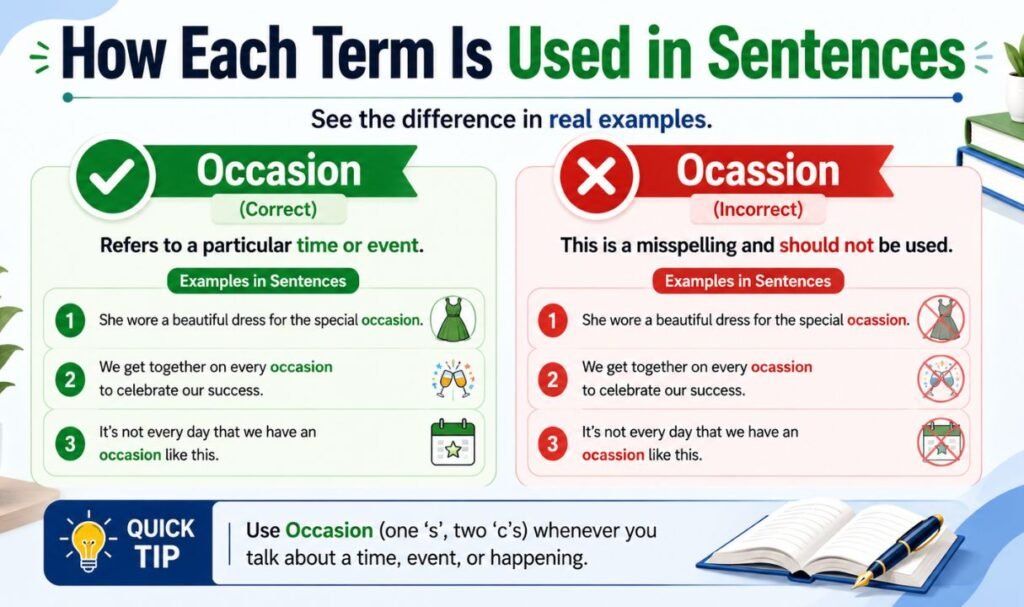
Occasion
As a noun: “This calls for a special occasion.” As a verb (formal register): “The announcement occasioned some confusion among staff.”
Ocassion
Ocassion cannot be used correctly in any sentence, in any part of speech, because it isn’t a recognized word.
Common Mistakes Learners Make
Mistake 1
Doubling the S instead of the C — writing “ocassion” because it visually resembles words like “possession” or “session.”
Mistake 2
Dropping a letter entirely and writing “ocasion,” which removes one of the required C’s.
Mistake 3
Relying on autocorrect without double-checking, since some spell-checkers flag the error but suggest the wrong replacement if the rest of the sentence is unclear.
Simple Rules to Remember
- Say the word slowly: oc-CA-sion, and picture the double C sitting right in the middle.
- Compare it to “success,” which also uses a double C before a single consonant pattern.
- Write the word by hand a few times if you’re a visual learner — muscle memory helps more than people expect.
Quick Tips for Writing and Speaking
- Read important documents aloud before sending them; hearing the word can catch a spelling slip your eyes glossed over.
- Keep a short personal list of tricky words, and add “occasion” to it if you’ve misspelled it before.
- Use a browser spell-checker as a backup, not a replacement, for actually knowing the correct spelling.
When to Use Each One
Use Occasion When
- You’re describing an event, celebration, or specific moment in time.
- You need a formal word for “reason” or “opportunity.”
- You’re writing anything meant for publication, business, or academic submission.
Use Ocassion When
There is no situation where “ocassion” is the right choice. If you’ve typed it, the fix is always to change it to “occasion.”
You May Like: Hoodie or Hoody: Which Spelling Is Actually Correct?
When NOT to Use Each One
Do Not Use Occasion Incorrectly
Avoid using occasion when you actually mean something narrower, like “party” for a casual gathering, or “reason” when a simpler word fits better in a short sentence. Occasion tends to sound more formal, so match it to the tone of your writing.
Do Not Use Ocassion
Never use ocassion — not in emails, not in captions, not in casual texts. Spell-checkers in most modern browsers and word processors will flag it, and readers who know the correct spelling will notice the slip.
Which One to Use (Decision Guide)
Ask yourself one question: Am I trying to spell the real English word for an event or reason?
- If yes, the answer is always occasion.
- There’s no second branch to this decision, because “ocassion” was never a valid option to begin with.
If you’re unsure how to spell it under pressure, break it into syllables (oc-ca-sion) and write it slowly rather than typing it fast from memory.
Real-World Practical Examples
Occasion Examples
Education
“Teachers reminded students that graduation is a formal occasion requiring proper attire.”
Daily Life
“We save the good coffee mugs for special occasions.”
Science
“Researchers noted that certain conditions occasion faster reaction rates in the lab.”
Business
“Please treat this client visit as a formal occasion and prepare accordingly.”
Writing
“The author used the wedding as the central occasion around which the whole story unfolds.”
Technology
“The app sends a reminder for each upcoming occasion saved in your calendar.”
Conversation
“I don’t drink coffee often, only on occasion, when I really need the boost.”
Ocassion Examples
There are no correct examples here — every instance of “ocassion” in real writing is simply a typo that should read “occasion.”
Self-Assessment (Fill in the Blanks)
Test yourself with these five sentences. Choose the correct spelling for each blank.
- It was a truly memorable _______ for everyone involved.
- We only visit that restaurant on special _______.
- Please spell it correctly: is it occasion or _______?
- Her promotion was reason enough to mark the _______.
- On one _______, the train arrived early.
Answers
- occasion
- occasions
- occasion (ocassion is incorrect)
- occasion
- occasion
Frequently Asked Questions
Which one is correct, occasion or occassion?
Occasion is correct. Occassion (and ocassion) are common misspellings with no dictionary standing.
How do you spell occasion correctly?
O-C-C-A-S-I-O-N — double C, single S.
How do you spell “occasion” in British English?
The same way as American English: occasion, with no regional spelling variation.
What does “occasion” mean?
It refers to a particular event, a specific time, or a reason or opportunity for something to happen.
Conclusion
The comparison between occasion and ocassion isn’t really a comparison at all — it’s a reminder that one spelling exists and the other doesn’t. Occasion carries real meaning, real grammar, and centuries of use behind it, from formal invitations to casual conversation. Ocassion is nothing more than a common typing slip caused by English’s habit of pairing double letters in unpredictable places.