
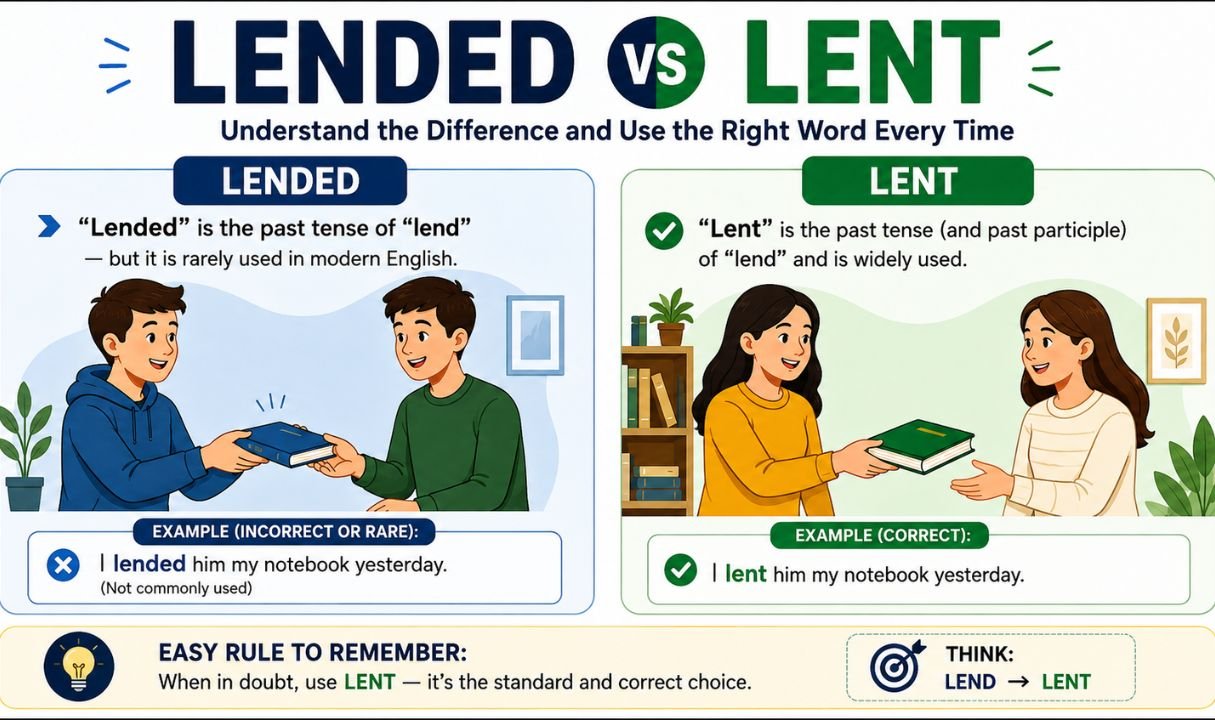
Lent is the correct past tense and past participle of the verb lend. Lended is not a real word in standard English. If you gave someone money, a book, or your car yesterday, you lent it to them, not lended it.
Lended vs Lent: Quick Answer
Here’s the short version before we go deeper. Lend is present tense. Lent covers both the past tense and the past participle. Lended doesn’t exist in any recognized dictionary or style guide, no matter how natural it might sound to a new speaker.
| Form | Correct? | Example |
|---|---|---|
| Lend | Yes (present) | I lend books often. |
| Lent | Yes (past/participle) | I lent her my umbrella. |
| Lended | No | ~~I lended her my umbrella.~~ |
Lend, Lent, and Lended: What Each Word Means
1. Lend
Lend means to give something to someone temporarily, on the understanding that it comes back. Money, tools, time, even a hand, can all be lent. It’s a present tense verb: “I lend my neighbor tools whenever he asks.”
2. Lent
Lent is what happens to lend in the past. It works as the simple past tense (“She lent me twenty dollars”) and as the past participle, paired with have, has, or had (“The bank has lent millions this quarter”). One word, two jobs.
3. Lended
Lended looks like it should work. It follows the pattern of thousands of regular English verbs. But lend never joined that pattern, and no major dictionary lists lended as an accepted variant. Treat it as a spelling mistake, not a stylistic choice.
Why Lend Is an Irregular Verb
Most English verbs form their past tense by adding -ed: walk becomes walked, jump becomes jumped. Lend skips that rule entirely. Instead of tacking on a suffix, the final d simply shifts to a t, and the word becomes lent.
Verb Forms of Lend
| Tense | Form |
|---|---|
| Base / Present | lend |
| Past Simple | lent |
| Past Participle | lent |
| Present Participle | lending |
| Third Person Singular | lends |
Notice that lend shares this transformation with a whole family of verbs. Send becomes sent. Spend becomes spent. Bend becomes bent. Once you see the pattern, lent stops feeling like an exception and starts feeling like the obvious choice.
The Origin of Lend and Lent
Lend traces back to Old English lǣnan, itself rooted in a Germanic word meaning “loan.” Many verbs inherited from Old English and Germanic sources kept irregular past forms as English evolved, while verbs borrowed later from French or Latin mostly settled into the regular -ed pattern. That history is why lend still resists the modern default.
You May Also Like: Tying vs Tieing: Learn the Correct Spelling in Minutes
Why People Say “Lended” Instead of “Lent”
1. Regular Verb Habit
English learners, and even native speakers, absorb the -ed rule early and apply it everywhere. Since roughly 200 of the most common English verbs are irregular, some slip through even confident writers, and lend is one of the more common casualties.
2. Spoken Language Influence
In fast, casual speech, lended can slide by unnoticed because lent and lended sound close enough in a sentence. Repetition of the wrong form in conversation reinforces it, even among people who would catch the mistake in writing.
3. Lack of Irregular Verb Knowledge
Non-native speakers sometimes learn regular conjugation rules before they memorize the full list of irregular verbs. Without direct correction, lended can feel like a reasonable guess rather than an error.
Lend vs Borrow: Don’t Confuse These
Lend and borrow describe the same transaction from opposite sides. Mixing them up is a separate mistake from lended versus lent, but the two often get tangled together.
- Lend: to give something out temporarily. The lender is the one giving.
- Borrow: to receive something temporarily. The borrower is the one taking.
“Can you lend me your charger?” asks the other person to give. “Can I borrow your charger?” asks to receive. Both are correct, just from different directions.
Lent in Real-World Usage
Everyday Conversation
People use lent constantly in casual talk about favors and small transactions: “He lent me his jacket,” “I lent Sarah my notes,” “They’ve lent us their car twice this month.”
Business and Financial Writing
In finance, lent describes formal transactions of money or credit. Banks, credit unions, and investors report figures using lent: “The firm lent $2 million to the startup” or “Total funds lent this quarter rose 8 percent.”
Academic and Formal Writing
Formal English never accepts lended. Academic papers, reports, and professional emails stick strictly to lent, since any deviation signals a grammar lapse to an educated reader.
News and Social Media
Financial and political news relies on lent heavily when covering loans, aid, and support: “The country lent its support to the agreement” or “Central banks lent billions to stabilize markets.” Social media is looser, but even there, lent dominates over lended by a wide margin.
Lended vs Lent: Examples Side by Side
| Correct (Lent) | Incorrect (Lended) |
|---|---|
| I lent my brother some cash. | I lended my brother some cash. |
| She has lent her voice to several causes. | She has lended her voice to several causes. |
| The library lent out every copy. | The library lended out every copy. |
| We had lent them the tent before. | We had lended them the tent before. |
Common Mistakes with Lended vs Lent
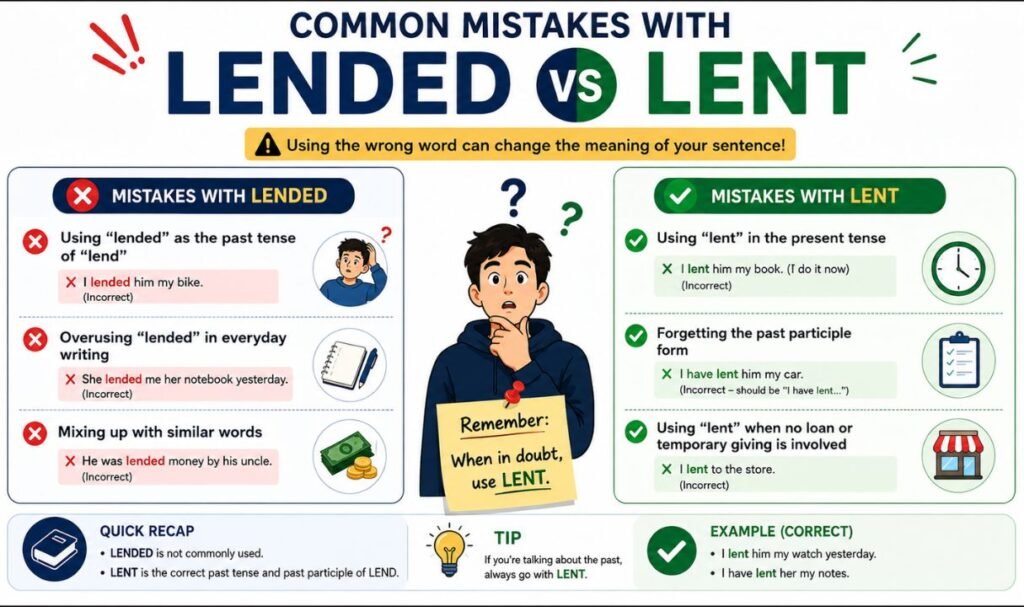
Mistake 1: Using “Lended”
This is the mistake that started the whole confusion. There’s no context, formal or casual, where lended is the accepted answer. If you catch yourself typing it, swap it for lent every time.
Mistake 2: Mixing Verb Forms
Some writers correctly use lent in one part of a sentence, then slip into lended later, especially in longer or compound sentences: “She lent me the book after I’d lended her mine.” Keep the form consistent throughout.
Mistake 3: Confusing Lend With Borrow
Even writers who nail lent versus lended still mix up lend and borrow. Remember the direction: lend gives, borrow takes. If the subject is handing something over, use a form of lend.
Related Irregular Verbs That Follow the Same Pattern
Lend belongs to a small, recognizable group of verbs where -d shifts to -t in the past tense, rather than gaining an -ed ending.
- Send → Sent
- Spend → Spent
- Bend → Bent
- Build → Built
- Send off → Sent off
Key insight: if you already trust “I sent an email” over “I sended an email,” apply the exact same logic to lend. The pattern is identical.
You May Also Like: Seeing or Seing: Which Spelling Is Correct?
Quick Exercises
Exercise 1: Choose the Correct Word
- My uncle ______ me his old guitar. (lent / lended)
- The bank has ______ over a billion dollars this year. (lent / lended)
- Please make sure you return what I ______ you. (lent / lended)
Answers: 1. lent, 2. lent, 3. lent
Exercise 2: Correct the Sentence
- Wrong: “She lended her opinion during the meeting.”
- Correct: “She lent her opinion during the meeting.”
- Wrong: “They had lended us their spare room for a week.”
- Correct: “They had lent us their spare room for a week.”
Frequently Asked Questions
Do you say lent or lended?
Always lent. Lended is not a recognized word in standard English, formal or informal.
Why do people confuse lent and lended?
Because lend looks like a regular verb, and regular verbs form the past tense with -ed. Lend is irregular, so that pattern doesn’t apply here.
Is money borrowed or lent?
Both, depending on perspective. The person receiving money borrows it. The person giving it out lends, and later says they lent it.
What is the difference between lend and lent?
Lend is present tense, describing the act right now or in general. Lent is the past tense and past participle, describing an act already completed.
Conclusion
Lend, lent, lended boils down to one rule worth memorizing: lend is irregular, so it never takes -ed. The past tense and past participle are both lent, full stop. Lended has no home in formal writing, casual conversation, business reports, or anywhere else.
The confusion is understandable. Regular verbs outnumber irregular ones, so the brain defaults to adding -ed unless it has a reason not to. Lend belongs to the same small family as send, spend, and bend, all of which swap d for t instead of gaining a suffix.