
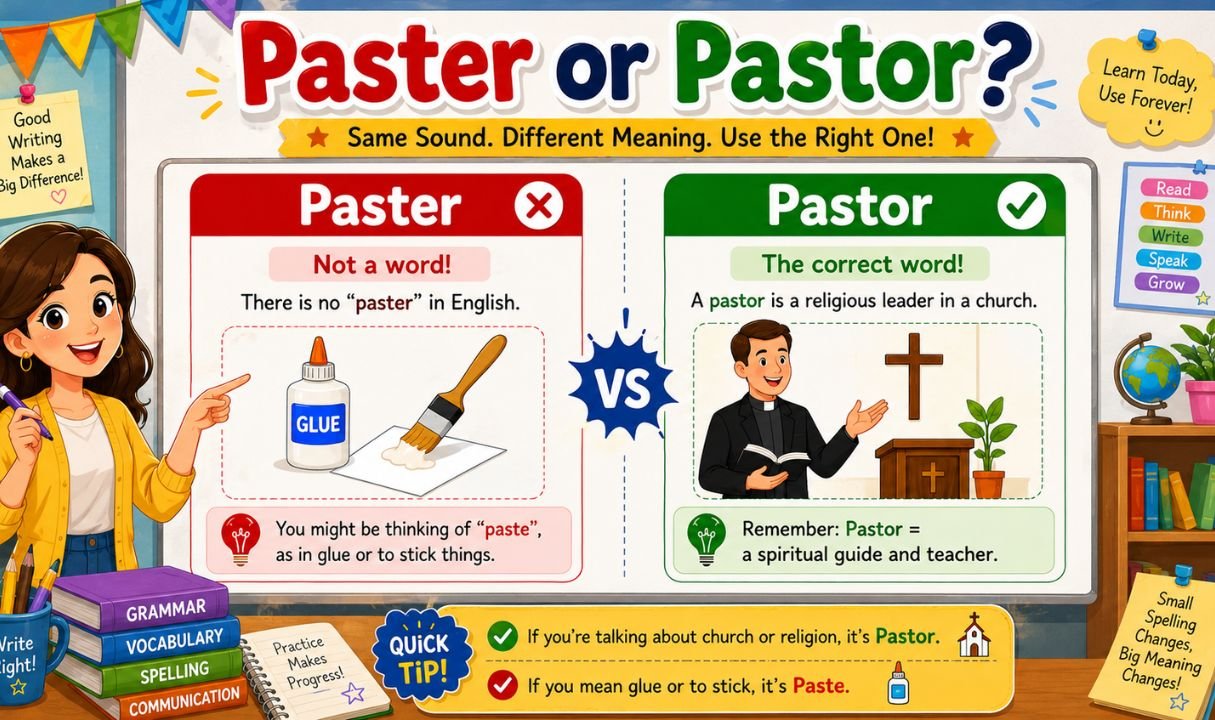
Two words, one letter apart, and two completely unrelated meanings. That’s the whole story behind “paster” and “pastor,” yet the mix-up shows up constantly in emails, church bulletins, social media captions, and even printed signage.
If you’ve typed one of these words and then paused, wondering whether autocorrect just tricked you, you’re not alone. This guide breaks down the meaning, origin, spelling rules, and real-world usage of both words so you never second-guess yourself again.
Paster
A paster is a person, tool, or machine that applies paste or adhesive. Think wallpaper crews, sign shops, and printing plants. The word is rare, and most people go years without ever needing to write it.
Pastor
A pastor is a religious leader who guides a church congregation, delivers sermons, and cares for a faith community. It’s the word almost everyone actually means when they sit down to write a sentence about church life.
Paster or Pastor: Quick Answer ✅⚡
✔ Main Difference:
- Pastor = a church leader, minister, or spiritual guide.
- Paster = someone or something that spreads paste, glue, or adhesive.
The two words are not variants of each other. They come from different roots, they belong to different fields of work, and swapping one for the other changes a sentence’s meaning entirely — or turns it into nonsense.
📌 Examples:
- The new pastor preached his first sermon on Sunday morning.
- The factory hired a paster to run the labeling machine.
- Our church pastor visits hospital patients every week.
- A wallpaper paster spread the adhesive evenly across the wall.
Definitions with Examples 📖✍️
🟢 Pastor (Definition)
A pastor is a member of the clergy who leads a Christian church or congregation. The title is common across Baptist, Lutheran, Methodist, Pentecostal, and many nondenominational churches. Duties typically include preaching, teaching scripture, performing weddings and funerals, counseling members, and overseeing the day-to-day running of the church.
📌 Examples:
- Pastor Williams leads a congregation of over three hundred people.
- She became the youth pastor at her local church last year.
- The pastor’s sermon focused on forgiveness and community.
- Many members turn to their pastor for guidance during hard times.
🔵 Paster (Definition)
Preacher vs pastor vs minister These three titles overlap but aren’t identical. A preacher is anyone who delivers sermons, whether or not they lead a congregation. A minister is a broader term covering ordained religious workers across many faiths and denominations. A pastor specifically leads and manages a particular church body, combining preaching with pastoral care and administration.
Reverend vs pastor vs minister “Reverend” is a formal title of respect placed before a clergy member’s name, similar to “Doctor” before a physician’s. A person can be both a reverend and a pastor — reverend describes the honorific, pastor describes the role.
Pastor meaning in the Bible In scripture, the word traces back to the idea of a shepherd who tends and protects a flock. Early church writings used shepherd imagery to describe spiritual leaders who guide, feed, and protect their communities, and that imagery is where the modern job title comes from.
Pastor profession As a profession, pastoral work blends public speaking, counseling, event planning, and community leadership. It usually requires theological training, ordination through a denomination, and years of hands-on ministry experience.
10 duties of a pastor Common responsibilities include:
- Preparing and delivering sermons
- Teaching Bible studies
- Counseling church members
- Performing weddings and funerals
- Visiting the sick and homebound
- Leading worship services
- Training church staff and volunteers
- Managing church finances and operations
- Representing the church in the wider community
- Mentoring new believers and leaders
Pastor profession meaning Put simply, being a pastor is a full-time calling that mixes spiritual guidance with practical management — part teacher, part counselor, part administrator.
Pastor original meaning The original meaning of pastor was literal: a herder who watched over sheep. Over centuries, the word shifted from describing livestock work to describing spiritual leadership, but the underlying idea — someone who watches over and cares for others — never changed.
Now, on the other side of the spelling divide, a paster carries none of that meaning.
📌 Examples:
- The paster glued the poster to the wall carefully.
- Our print shop’s paster machine runs all day during election season.
- He worked as a paster in a packaging plant for six years.
- The paster made sure every label sat perfectly straight.
🟡 Simple Meaning
Pastor cares for people. Paster sticks things together. That single line settles most of the confusion on the spot.
You May Like: Truely or Truly: What is the Difference & Which is Correct?
The Origin of Pastor and Paster 📜⏳
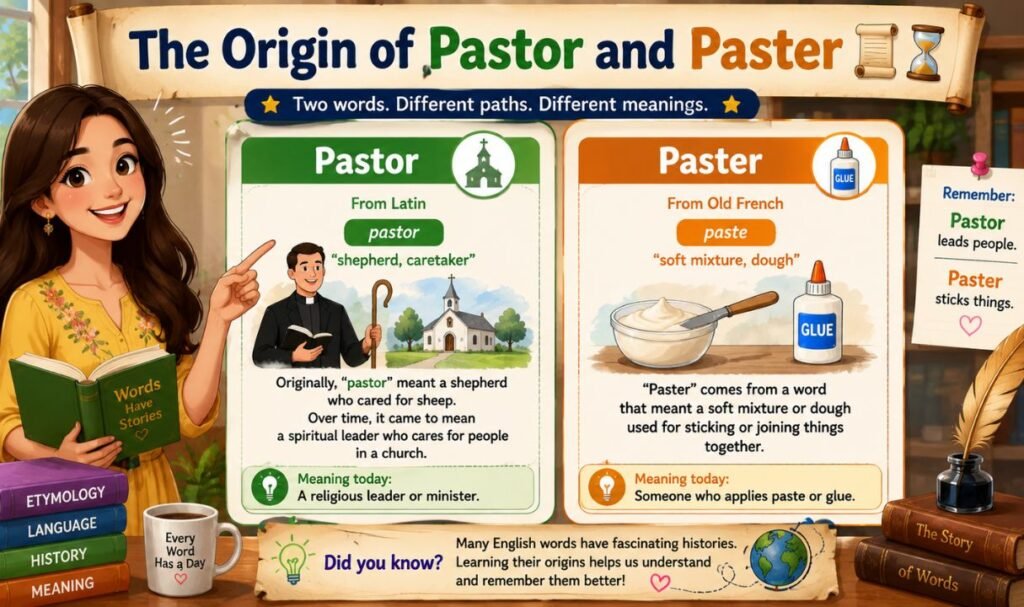
🟢 Pastor Origin
Pastor comes directly from the Latin word pastor, meaning shepherd, which itself derives from pascere, “to feed” or “to graze.” Latin-speaking Christians applied the shepherd image to church leaders because a shepherd’s job — protecting, feeding, and guiding a flock — matched the job of guiding a spiritual community. The word entered English through Old French and has kept its religious meaning ever since.
🔵 Paster Origin
Paster is far younger and far more mundane. It’s simply the noun form of the verb “paste,” which traces back to the Late Latin word pasta, meaning dough or a soft mixture. Add the agent suffix “-er,” and you get someone or something that pastes — no shepherds, no scripture, just glue and paper.
British English vs American English Spelling 🌍🇬🇧🇺🇸
📌 Key Point:
Unlike words such as “color” and “colour,” pastor and paster don’t change between British and American English. Both spellings stay identical on either side of the Atlantic. The only thing that changes is which word you actually need, based on meaning, not region.
📊 Comparison Table:
| Word | British English | American English | Notes |
| Pastor | pastor | pastor | Same spelling everywhere |
| Paster | paster | paster | Same spelling everywhere |
| Common UK alternative | vicar, priest, minister | — | Often used instead of “pastor” in the UK |
Paster vs Pastor: Key Difference Explained 📊⚖️
📊 Comparison Table:
| Feature | Pastor | Paster |
| Meaning | Church leader, minister | Person or tool that applies paste |
| Word origin | Latin pastor (shepherd) | From the verb “paste” |
| Field | Religion, ministry | Printing, packaging, construction |
| Frequency of use | Very common | Rare |
| Part of speech | Noun | Noun |
| Pronunciation | PAS-tor | PAY-ster |
📌 Example:
Compare these two sentences side by side: “The pastor blessed the new building” describes a religious act. “The paster sealed the new building’s posters to the lobby wall” describes manual labor. Same sentence shape, completely different meaning.
Which Spelling Should You Use? 🎯📝
✔ Use Pastor When:
- Writing about a church, ministry, or religious leader
- Referring to someone who preaches, teaches, or counsels a congregation
- Addressing or introducing a member of the clergy
✔ Use Paster When:
- Describing a person or machine that applies glue or paste
- Writing about printing, labeling, or wallpaper work
- Referring to someone in a manufacturing or packaging role
⚖️ Easy Tip
Ask yourself one question before you type: does this sentence involve a church, or does it involve glue? If it’s church, write pastor. If it’s glue, write paster. That two-second check clears up almost every mistake.
You May Like: Who’s vs Whose: What is the Difference & Which is Correct?
📌 Usage Tip (Very Important) 🧠✨
Spell-check tools rarely flag this error because both “paster” and “pastor” are real, correctly spelled English words. Autocorrect won’t save you here — only context awareness will. Read your sentence back and picture the scene. A person standing at a pulpit needs “pastor.” A person standing at a printing press needs “paster.”
📌 Examples:
- Wrong: “The church paster welcomed new members.” ❌
- Right: “The church pastor welcomed new members.” ✅
- Wrong: “He used a pastor to glue the posters.” ❌
- Right: “He used a paster to glue the posters.” ✅
Common Mistakes with Paster or Pastor ❌⚠️
1. Mixing Meanings
Writers sometimes assume the words are simply two spellings of the same idea. They aren’t. One belongs to religion, the other to manual labor, and mixing them creates confusing or accidentally funny sentences.
2. Spelling Confusion
Because the words differ by a single letter, fast typing is a common trigger for the mistake. Reading a sentence aloud before publishing it catches most of these slips.
3. Using Wrong Context
Some writers know the correct spelling but plug it into the wrong setting anyway, describing a church leader with the word “paster” simply because it looks close enough. Context always decides the right word, not visual similarity.
4. Typing Errors
An extra “e” sneaks in during fast typing, turning “pastor” into “paster” without the writer noticing. A quick proofread before hitting send solves this in seconds.
Pastor and Paster in Everyday Examples 💬📱
⛪ Religion
“Our pastor is retiring after twenty years of service to this congregation.”
🧴 Work
“The factory floor needed a new paster after the old labeling machine broke down.”
📱 Social Media
A caption reading “So thankful for our amazing pastor today” is correct; the same caption written as “paster” would confuse followers or draw a correction in the comments.
🏠 Daily Use
Outside of church and manufacturing settings, most households rarely need either word in daily conversation, but when the topic turns to weddings, funerals, or home renovation projects involving wallpaper, one of these two words tends to show up fast.
Pastor vs Paster: Google Trends & Usage Data 📊📈
🌍 Trends:
Search interest for “pastor” dwarfs interest in “paster” across nearly every English-speaking country. Most searches for “paster” actually come from people who meant to type “pastor” and are now double-checking the spelling, rather than people genuinely researching adhesive tools.
📊 Region Table:
| Region | Common Search Term | Typical Intent |
| United States | pastor | Church, ministry, sermons |
| United Kingdom | vicar, minister | Church leadership |
| Canada | pastor | Church, community |
| Australia | pastor | Church, ministry |
| Global | paster meaning | Spelling confusion, curiosity |
🔥 Top 10 Searches:
- Is it paster or pastor
- Pastor meaning
- Paster meaning
- Pastor vs preacher
- Pastor vs minister
- Female pastor title
- Pastor duties
- Pastor salary
- How to become a pastor
- Paster definition
Comparison Table 📋⚖️
| Category | Pastor | Paster |
| Definition | Religious leader guiding a church | Person or device applying paste |
| Origin | Latin pastor, “shepherd” | From the verb “paste” |
| Common field | Ministry, church leadership | Printing, packaging, construction |
| Everyday frequency | High | Low |
| British vs American spelling | Identical | Identical |
| Typical sentence subject | Sermons, congregation, faith | Glue, labels, adhesive machines |
Frequently Asked Questions
Who is called a pastor?
A pastor is a Christian religious leader who preaches, teaches, and guides a church congregation.
Is it spelled pastor or paster?
Pastor is the word for a church leader; paster is a separate, rarer word for someone who applies paste. The correct spelling depends entirely on the meaning you intend.
What is a female pastor called?
She is simply called a pastor, or sometimes “pastora” in some denominations and languages; the title itself isn’t gender-specific in standard English usage.
What is a paster?
A paster is a person, tool, or machine that applies paste or adhesive, most often seen in printing, labeling, or construction work.
Conclusion
Pastor and paster look almost identical on the page, but they live in entirely separate worlds. One walks alongside a congregation. The other spreads glue on a factory floor. Once you connect each word to its actual meaning instead of its spelling, the choice becomes automatic no dictionary required, just a quick mental picture of what the sentence is really about.