
You’re typing fast, the sentence needs a little punch, and your fingers land on “realy” instead of “really.” It happens to almost everyone at some point. The question is simple, but the confusion sticks around because the two words sound nearly identical when spoken aloud.
This guide settles the question for good. You’ll get the correct spelling, the grammar behind it, pronunciation notes for both American and British English, and enough practice to make sure “realy” never sneaks into your writing again.
Really vs Realy: The Clear and Final Answer
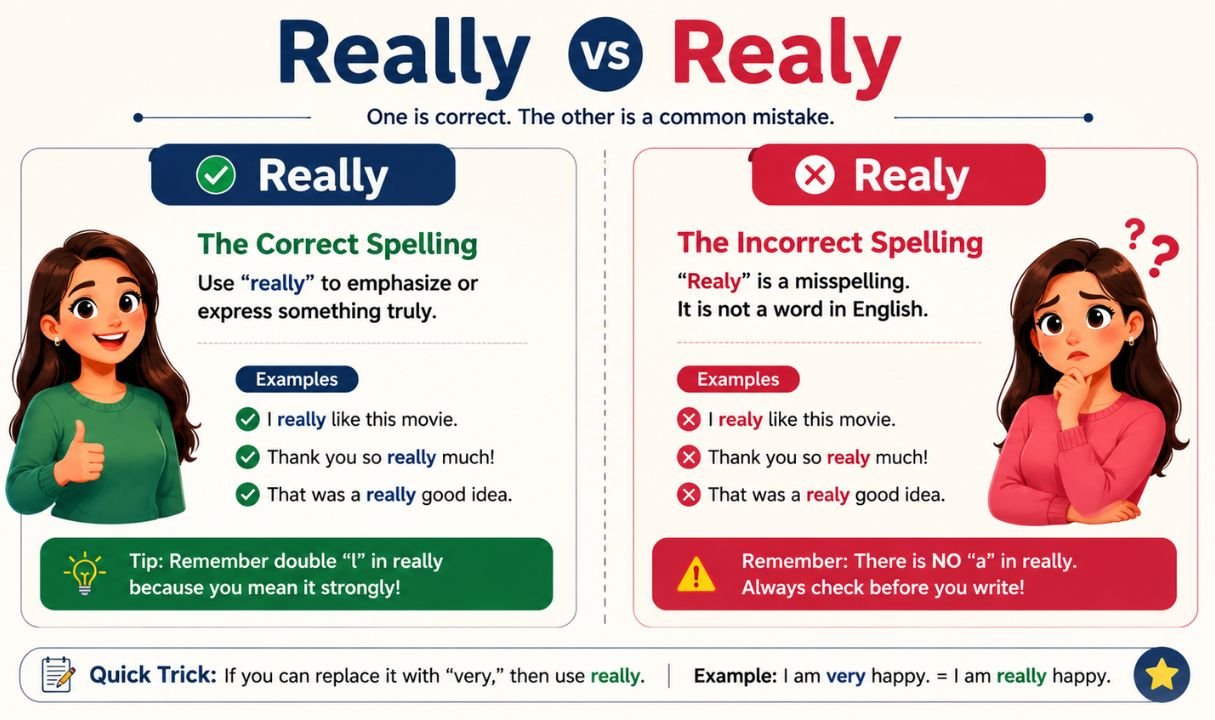
Really is correct. Realy is not a real word.
That’s the entire answer in one line. “Really” is a standard English adverb, listed in every major dictionary, and it’s the only accepted spelling for expressing truth, emphasis, or surprise. “Realy” is simply a typo — a missing letter, not an alternate spelling or informal variant.
| Word | Status | Meaning | Used In |
|---|---|---|---|
| Really | Correct | Truly, actually, genuinely | All writing — formal and casual |
| Realy | Incorrect | No accepted meaning | Never (common misspelling) |
If you remember nothing else from this article, remember that table. Everything below explains why it’s true and how to apply it confidently.
The Meaning of “Really”
What does really mean in English?
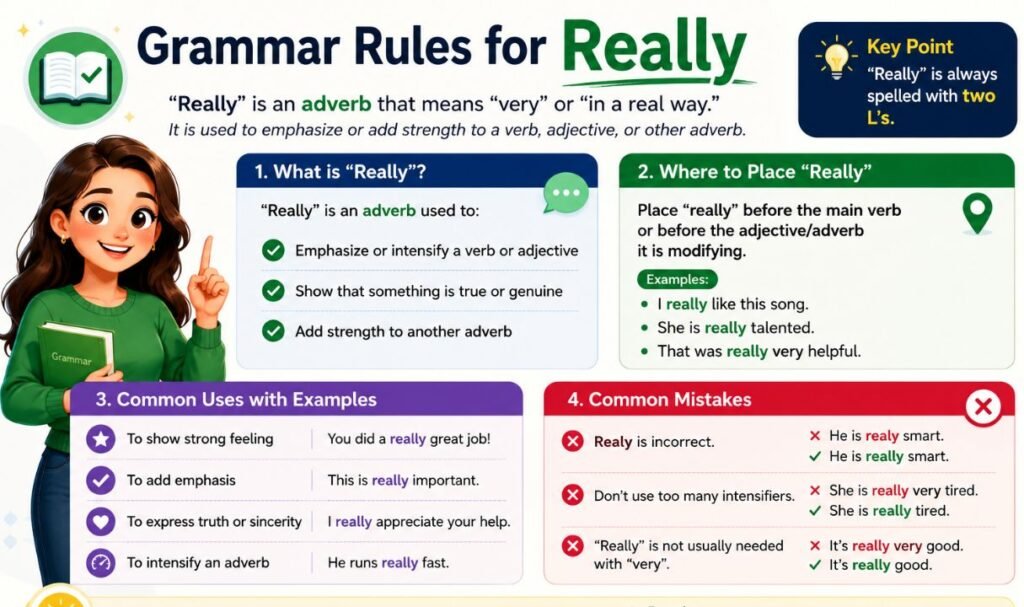
“Really” is an adverb built from the adjective “real” plus the suffix “-ly.” It carries a few distinct jobs in a sentence:
- Confirming that something is true: She really did finish the marathon.
- Adding emphasis or intensity: That soup is really spicy.
- Expressing surprise or disbelief, often on its own: Really? I had no idea.
- Softening or strengthening a statement depending on tone: I’m really not sure about this.
Because it flexes across so many contexts, “really” ranks among the most frequently used adverbs in spoken and written English.
Really vs realy synonym When people search for a synonym here, they usually mean a synonym for “really” itself, since “realy” has none — it isn’t a word. Close synonyms for really include truly, genuinely, actually, and indeed.
Really vs realy grammar Grammatically, “really” functions as an adverb of degree or an adverb of truth. “Realy” has no grammatical function because it doesn’t exist as a word; a spell-checker will flag it every time.
Really vs realy examples
- Correct: He really enjoyed the concert.
- Incorrect: He realy enjoyed the concert.
Realy or really synonym Same answer as above — only “really” has synonyms. Writers looking for variety can swap in “truly” or “genuinely” depending on tone.
Realy word “Realy” is not listed in Merriam-Webster, Oxford, Cambridge, or Collins. Typing it into any major dictionary search returns either “no results” or a suggestion to correct it to “really.”
How to pronounce really Most speakers say it as two syllables, roughly “REE-lee” or “REE-uh-lee,” depending on accent and speaking speed. The double L softens into a single flowing sound, which is exactly why so many people drop a letter when writing it.
Is Realy a Word? A Direct and Honest Explanation
Is realy a word?
No. “Realy” does not appear in any recognized English dictionary. It has no definition, no part of speech, and no accepted use in formal or casual writing. It exists only as a typing error.
Why is realy incorrect in English?
English spelling generally keeps the base word intact when adding the “-ly” suffix, especially when the base word already ends in “l.” Since “real” ends in L, adding “-ly” produces a double L: real + ly = really. Dropping one L breaks that pattern and produces a string of letters English hasn’t adopted as a word.
There’s also a simple explanation rooted in habit rather than rules: people spell based on how a word sounds rather than how it’s built. Because the double L blends together in speech, the ear doesn’t always catch it, and the hand follows the ear.
Realy meaning in English (incorrect usage)
“Realy” carries no meaning of its own. When it shows up in a sentence, readers interpret it as a spelling mistake and mentally substitute “really.” It doesn’t function as slang, an abbreviation, or a regional variant — it’s simply an error.
Grammar Rules for Really
How to use really in grammar
“Really” typically sits right before the word it modifies:
- Before an adjective: That was really impressive.
- Before another adverb: She sang really well.
- Before a verb, for emphasis: I really appreciate your help.
- At the start of a question or exclamation: Really, is that true?
It can also modify an entire sentence when placed at the beginning, signaling emphasis on the whole statement rather than a single word.
Why placement matters
Move “really” around and the emphasis shifts with it.
- I really don’t want pizza tonight. (Emphasizes the refusal.)
- I don’t really want pizza tonight. (Softens the refusal — maybe, but not strongly.)
Small shifts like this change how firm or flexible a statement feels, which matters in both everyday conversation and professional writing where tone needs to be precise.
Why Is “Really” Spelled with Two Ls?
How to spell really correctly
Break the word into its parts: real + ly. The base adjective “real” already ends in L. English doesn’t remove a letter from the root word just because a suffix is attached, so both Ls stay in place: r-e-a-l-l-y.
The double consonant pattern
This isn’t unique to “really.” Plenty of English words keep a doubled letter when a suffix meets a root that already ends in that letter:
- Formal + ly = formally
- Usual + ly = usually
- Careful + ly = carefully
In each case, the root’s final letter and the suffix’s first letter line up and stay doubled. “Really” follows the exact same logic.
Why do we drop the “e” in truly?
This is where a lot of the confusion actually starts. “True” drops its silent E before adding “-ly,” producing “truly,” not “trueley.” That’s a different rule entirely — it applies to silent E endings, not L endings. Since “real” doesn’t end in a silent E, that rule never applies to it, and the L stays doubled. Mixing up these two patterns is one reason writers second-guess themselves on “really.”
What Is the Difference Between Really vs Realy?
The difference isn’t really about meaning — it’s about existence. One is a word; the other isn’t.
| Feature | Really | Realy |
|---|---|---|
| Dictionary status | Listed in all major dictionaries | Not listed anywhere |
| Part of speech | Adverb | None |
| Formal writing | Acceptable | Never acceptable |
| Casual writing | Acceptable | Never acceptable |
| Spell-check result | Passes | Flagged as an error |
| Origin | Real + ly | Typing mistake (missing letter) |
Really vs Realy in Sentences
Seeing the words side by side in real sentences makes the pattern easier to internalize.
- Correct: This restaurant is really good. Incorrect: This restaurant is realy good.
- Correct: I’m really tired after that hike. Incorrect: I’m realy tired after that hike.
- Correct: Are you really moving to another city? Incorrect: Are you realy moving to another city?
- Correct: That was a really thoughtful gift. Incorrect: That was a realy thoughtful gift.
Notice that “realy” isn’t a lazier or more casual version of “really” — it simply reads as a mistake, even in relaxed text messages or social posts.
A Common Source of Confusion
Part of the confusion comes from how many similar-looking English words exist with different rules for doubling letters, dropping letters, or adding suffixes. Learners (and plenty of native speakers) end up guessing rather than applying a consistent rule, which is exactly how “realy” keeps showing up in searches and comment sections.
Really vs actually difference
“Really” and “actually” overlap but aren’t identical twins.
- “Really” leans toward emphasis or intensity: I really loved that book.
- “Actually” leans toward correcting an assumption or stating a fact plainly: Actually, the book was written in 1997, not 2001.
They’re often interchangeable in casual speech, but “actually” tends to carry more of a factual, corrective tone, while “really” leans emotional or emphatic.
Pronunciation of Really (US vs UK)
How do Americans pronounce really?
In American English, “really” is usually pronounced with a clear R sound and a flowing double L, often coming out as “REE-lee.” Fast speech sometimes compresses it further, but the two-syllable rhythm generally stays intact.
Realy vs really British vs American English
British English pronunciation tends to soften the R slightly and can stretch the word into something closer to “REE-uh-lee” in more deliberate speech, though quick conversational use sounds similar to the American version. Regardless of accent, spelling never changes — both American and British English accept only “really.” Neither dialect recognizes “realy” as a legitimate variant.
Can You Use Really in Formal Writing?
Yes, but with a bit of judgment. “Really” is grammatically correct in formal writing, yet it can read as vague or conversational when a more precise word would serve the sentence better.
Compare these two versions:
- Conversational: This report is really important.
- Formal: This report is essential.
Both sentences are grammatically fine. The second one simply carries more weight in a business memo, academic paper, or client email. A useful approach: keep “really” for informal writing, emails to colleagues you know well, or dialogue, and swap in words like “significantly,” “genuinely,” or “considerably” when the writing needs to sound more polished.
Common Spelling Mistakes and How to Avoid Them
“Realy” belongs to a wider family of typing slips that happen when a word’s pronunciation doesn’t match its spelling exactly. A few ways to avoid the mistake permanently:
- Break the word into its parts before typing: real + ly.
- Read the sentence back slowly instead of relying on how it sounds in your head.
- Turn on spell-check and actually review flagged words instead of ignoring the red underline.
- Practice writing the word a few times until the double L becomes automatic.
- Keep a short mental list of similar double-letter words — formally, usually, carefully — to reinforce the pattern.
A Example Why This Mistake Matters
Picture a job applicant sending a cover letter that says, “I am realy excited about this opportunity.” The hiring manager notices the typo immediately. It’s a small slip, but in a document meant to showcase attention to detail, it raises a quiet doubt about carefulness. The applicant later resends a corrected version, but the first impression already landed.
This kind of moment shows why spelling accuracy matters beyond grammar-class rules. Resumes, client emails, academic submissions, and even casual social posts all reflect on the writer, and a doubled letter left out can shift how a message is received.
How “Really” Fits into English Grammar
“Really” belongs to the broader category of adverbs of degree and adverbs of truth. It can modify:
- Adjectives (really tall)
- Other adverbs (really quickly)
- Verbs (really enjoy)
- Entire clauses (Really, I don’t mind at all.)
Because it’s so flexible, “really” shows up constantly in both spoken and written English, which is also part of why the misspelling “realy” appears so often in searches — the word simply gets typed more than most.
Really vs Very vs Truly
These three words often compete for the same spot in a sentence, but they carry slightly different shades of meaning.
| Word | Tone | Example |
|---|---|---|
| Really | Emphatic, conversational | She was really happy with the results. |
| Very | Neutral, standard intensifier | She was very happy with the results. |
| Truly | Sincere, sometimes formal | She was truly happy with the results. |
“Very” is the most neutral choice and works everywhere. “Really” feels a touch more emotional or emphatic. “Truly” leans sincere and shows up often in formal writing, speeches, or heartfelt messages. None of the three are interchangeable in every context, but all three are correctly spelled words — unlike “realy.”
Practice Exercises
Fill in the Blank
- I am ______ proud of what you accomplished. (really)
- This coffee is ______ strong today. (really)
- She ______ wanted to visit Japan. (really)
- Are you ______ leaving already? (really)
- That movie was ______ boring. (really)
Correct the Mistakes
- I am realy tired. → I am really tired.
- He realy likes his new job. → He really likes his new job.
- That test was realy hard. → That test was really hard.
- We realy need to talk. → We really need to talk.
Rewriting for Precision
Take each sentence and rewrite it for a more formal tone:
- This project is really important. → This project is essential.
- I’m really sorry for the delay. → I sincerely apologize for the delay.
- The results are really good. → The results are strong.
Identify Misuse in Context
Read each sentence and mark whether it’s correct or incorrect:
- “I realy think we should go.” — Incorrect
- “This is really the best option.” — Correct
- “She was realy excited.” — Incorrect
- “That’s really unfortunate.” — Correct
Tips for Practice
- Write the word “really” ten times by hand to build muscle memory for the double L.
- Read a paragraph aloud, then check whether your spelling matches your pronunciation.
- Keep a personal list of words you frequently misspell and review it weekly.
- Use a grammar tool for a second check, but don’t rely on it as the only safeguard.
Frequently Asked Questions
What is correct, really or realy?
“Really” is correct. “Realy” is a misspelling with no dictionary entry.
Which is correct: “really” or “really”?
Both instances shown are the same correct spelling — really, with two Ls.
What is the difference between really and real?
“Real” is an adjective meaning genuine or actual; “really” is the adverb form, meaning truly or actually.
Is it correct to say “really”?
Yes. “Really” is standard, dictionary-recognized English, appropriate in both formal and casual writing.
Conclusion
The comparison between really and realy isn’t really much of a contest. “Really” is the only correct spelling, backed by every major dictionary, standard grammar rules, and the simple logic of adding “-ly” to a word that already ends in L. “Realy” isn’t an alternate spelling, a regional variant, or shorthand — it’s a typo that spell-check will always catch.
Once you connect the spelling to its structure, real + ly, the double L stops feeling like an arbitrary rule and starts feeling automatic. Use “really” freely in everyday writing, reach for alternatives like “truly” or “significantly” when formal tone calls for it, and proofread before hitting send. That’s the whole trick to never typing “realy” again.