
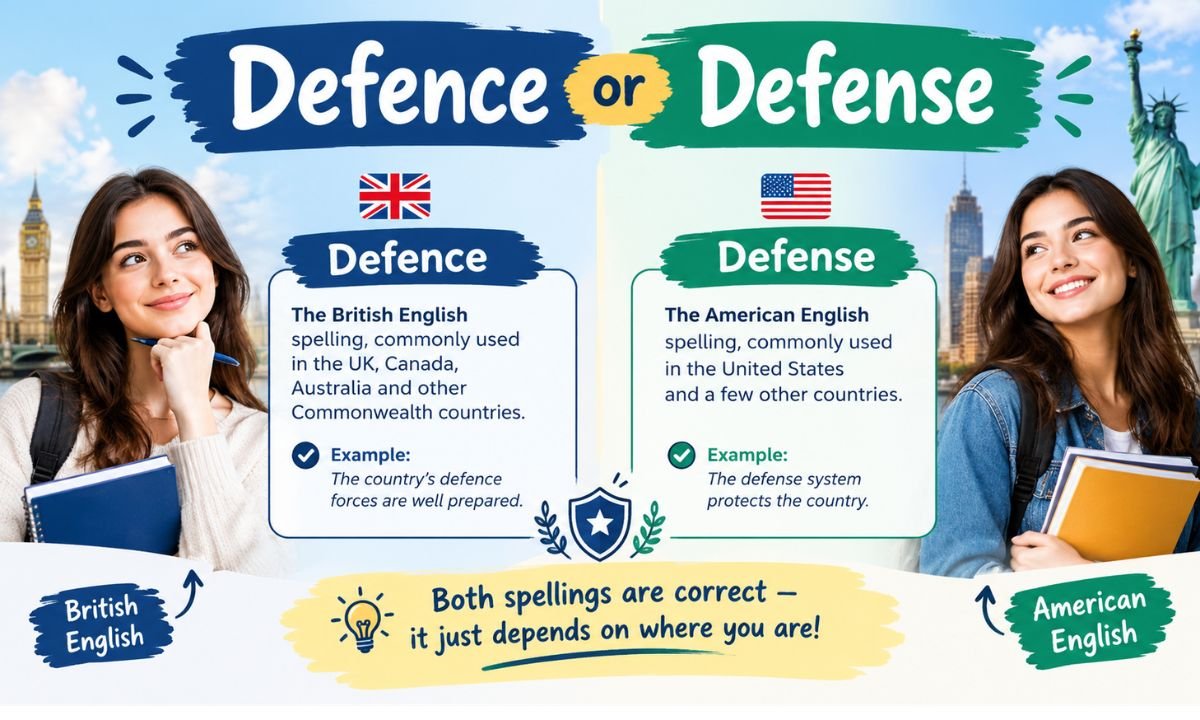
Open a British newspaper and you’ll read about the “Ministry of Defence.” Open an American one and you’ll see “Department of Defense.” Same word, same meaning, two different spellings — and both are correct.
This mix-up trips up students, marketers, journalists, and even native speakers who split their time between UK and US publications. The good news is that once you understand where the split comes from, you’ll never second-guess yourself again.
This guide breaks down the spelling rules, the history behind them, and exactly when to use each version — whether you’re writing a research paper, a football article, or website copy aimed at a global audience.
What Is the Difference Between Defence and Defense?
Both words mean the same thing: protection against attack, harm, or criticism. The only difference is regional spelling convention.
- Defence — used in British English, and in most Commonwealth countries
- Defense — used in American English
Neither spelling is “wrong” in absolute terms. The correct choice depends entirely on which English dialect you’re writing in.
Defence in British English
In the UK, Australia, Canada, New Zealand, India, and most former British territories, “defence” with a c is the standard form. You’ll find it in newspapers, textbooks, and government documents across these regions. Canada is a partial exception — it leans British for this word even though it uses some American spellings elsewhere.
Defense in American English
In the United States, “defense” with an s is the only accepted spelling in formal writing. American dictionaries, style guides, and federal agencies use this form exclusively. If you’re writing for a US audience, “defence” will look like a typo.
Why Are Both Correct?
Both spellings trace back to the same Old French and Latin root. Over centuries, British and American English drifted apart in small but consistent ways, and this word is one of dozens caught in that split. Neither version is a corruption of the other — they’re parallel outcomes of the same linguistic history.
The History Behind Defence and Defense
Spelling differences like this one didn’t happen by accident. They’re the result of deliberate choices made by dictionary writers, printers, and reformers over hundreds of years.
Origins from Latin and French
The word originally comes from the Latin defensa, meaning “a thing defended” or “protection,” passed through the Old French defense. When the word entered English after the Norman Conquest, it kept its French spelling, complete with the s.
British Standardization
For a long stretch, English spelling was inconsistent — writers used c and s almost interchangeably in words like this one. British lexicographer Samuel Johnson helped fix many spellings in his 1755 dictionary, and over time, “defence” with a c became the accepted form in Britain, aligning with other -ce endings like “licence” and “offence.”
American Spelling Reform
Noah Webster changed the picture in the United States. His dictionaries, published in the early 1800s, pushed for simpler, more phonetic American spellings that broke away from British norms. Webster preferred the s ending, partly to distinguish American English as its own standard and partly because he felt it matched pronunciation more logically. “Defense” became the American standard as a direct result of his influence.
| Aspect | Defence (British) | Defense (American) |
|---|---|---|
| Root | Latin defensa via French | Latin defensa via French |
| Popularized by | Samuel Johnson’s dictionary (1755) | Noah Webster’s reforms (early 1800s) |
| Used in | UK, Australia, Canada, India, most Commonwealth nations | United States |
| Common in | Ministry of Defence, defence policy | Department of Defense, defense budget |
When Should You Use Defence?
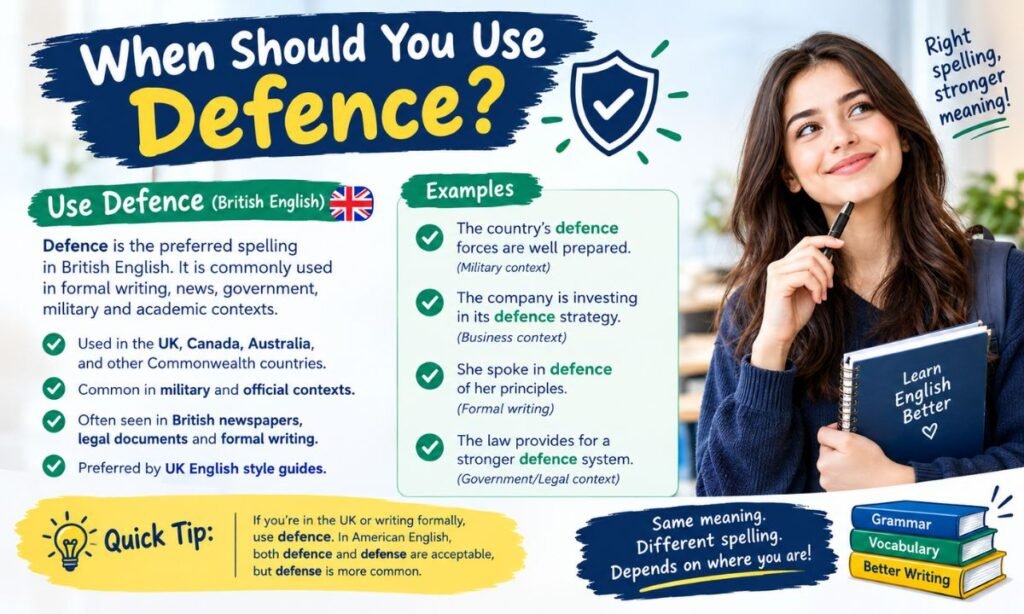
Reach for “defence” whenever your reader base or publication follows British spelling conventions.
Academic Writing in the UK
UK universities, journals, and dissertation guidelines expect British spelling throughout, including “defence.” A student writing for Oxford or Cambridge who slips into “defense” risks looking inconsistent, even if the content is strong.
Government Publications
The UK’s Ministry of Defence, along with equivalent bodies in Australia and other Commonwealth nations, uses “defence” in every official document, press release, and policy paper. This extends to related terms like “defence spending” and “defence secretary.”
International Audiences Following UK Standards
Many international organizations, former British colonies, and English-language publications outside North America default to British spelling. If your audience is based in the UK, Ireland, South Africa, or similar regions, “defence” is the safer choice.
Defence vs Defense in Global Business
Multinational companies often need to pick one spelling for consistency across markets. Businesses headquartered in London, or those targeting European and Commonwealth clients, typically standardize on “defence” for all external communication, even when a US subsidiary exists.
When Should You Use Defense?
Flip the logic for American audiences, and stick to “defense” without exception.
US Academic Writing
American colleges, journals, and style guides such as APA and MLA all use “defense.” A thesis defense, a defense of an argument, or a research paper discussing national defense — all spelled with an s.
Government and Legal Documents
The US Department of Defense, the Department of Justice, and American courts use “defense” consistently, whether referring to a legal defense strategy or defense spending in the federal budget.
Digital Marketing for US Audiences
Copywriters, bloggers, and marketers targeting American consumers should default to “defense” in ads, product descriptions, and website content. Using “defence” on a US-facing page can look like a translation error rather than a stylistic choice.
SEO Considerations
Search intent matters here. Google adjusts results based on the searcher’s location and language settings, so a page targeting US traffic should use “defense” in headers, meta descriptions, and body text to match how Americans actually search. A site targeting UK traffic should mirror that with “defence.” Mixing both spellings inconsistently on the same page can dilute keyword relevance and confuse readers.
Defence or Defense: Common Examples in Everyday Writing
Here’s how the word shows up across different fields, with the correct spelling for each audience.
Military Context
- UK: “The defence budget increased by 3% this year.”
- US: “The defense budget increased by 3% this year.”
Terms like defence or defense army, defence or defense industry, and Ministry of Defence or defense all follow the same regional rule. The UK’s armed forces fall under the Ministry of Defence, while the US equivalent is the Department of Defense.
Sports Context
Is it defence or defense in football? It depends on which football. British football (soccer) commentary uses “defence” — “their defence held firm in the second half.” American football, being an American sport, always uses “defense” — “the defense forced a turnover on downs.” This is one case where the sport itself gives you a strong clue about which spelling fits.
Legal Context
A lawyer in London builds a “defence” for their client, while a lawyer in New York builds a “defense.” Legal terminology otherwise stays largely identical between the two dialects, but this spelling rule holds firm in courtrooms on both sides of the Atlantic.
Personal Protection Context
Talking about self-protection, whether it’s a self-defence class in Manchester or a self-defense class in Chicago, follows the same regional pattern. Product listings for personal safety items — pepper spray, alarms, protective gear — should match the spelling convention of the target market.
Real-Life Example: How a Global Company Handles Defence vs Defense
Consider a defence or defense industry contractor operating in both the UK and the US, such as a company that supplies equipment to NATO members. Its UK division publishes press releases referencing “defence procurement” and works with the “Ministry of Defence.” Its US division, working with the Pentagon, refers to “defense contracts” and the “Department of Defense.”
Rather than picking one spelling globally, the company maintains two parallel style guides: one for UK-facing communication and one for US-facing communication. Marketing teams tag content by region before publishing, and translators check spelling consistency during localization. This approach avoids awkward hybrid phrases like “defence department” appearing on a US press page, which would confuse readers and weaken search visibility in that market.
Smaller businesses can borrow the same principle at a simpler scale: know your primary audience, pick the matching spelling, and stay consistent site-wide.
Defence vs Defense Statistics and Usage Trends (2025–2026)
Global content increasingly reflects regional targeting rather than a single “correct” spelling.
Key Trends
- American English dominates global search volume for this term, largely because of US media coverage of defense spending and defense technology.
- British and Commonwealth publications have held steady with “defence,” particularly in government and academic contexts, showing little movement toward American spelling.
- Search engines increasingly localize results, meaning a page using “defense” can rank differently in the UK than the same content using “defence.”
- Style guides at major international outlets, including outlets covering defence or defense in Europe, often maintain separate UK and US editions specifically to handle spelling differences like this one.
- Content aimed at European institutions, including NATO and EU defence bodies, generally follows British spelling, since English used in these contexts leans toward UK conventions.
What This Means for Writers
If you publish content for a mixed international audience, decide early which spelling matches your primary market and apply it consistently across every page. Search engines reward consistency, and readers notice when a single article switches spellings mid-paragraph.
How to Remember the Difference
A few simple tricks make this permanent.
Quick Memory Trick
Remember: Commonwealth countries use “defence” with a c, while America uses “defense” with an s. Both the country name and the correct letter share that first sound, which makes the rule easy to recall under pressure.
Use Your Audience as a Guide
Before you write, ask who’s reading. A UK job application, an Australian university essay, or a British news outlet calls for “defence.” A US-based blog, an American client, or a paper following APA style calls for “defense.”
Stay Consistent
Pick one spelling per document, website, or project, and stick with it. Word processors and browser spell-checkers can be set to UK or US English, which catches accidental switches automatically.
| Situation | Recommended Spelling |
|---|---|
| Writing for a UK, Australian, or Canadian audience | Defence |
| Writing for a US audience | Defense |
| Academic paper following British university guidelines | Defence |
| Academic paper following APA/MLA (US) style | Defense |
| Talking about American football | Defense |
| Talking about British football (soccer) | Defence |
| Global content with mixed audience | Pick one and stay consistent |
Mini Quiz: Test Your Knowledge of Defence vs Defense
Try these quick questions to check what you’ve learned.
Quiz 1: Quick Choice
Which spelling would a British newspaper use? A) Defence B) Defense Answer: A) Defence
Quiz 2: Fill in the Blank
“The US ______ Department oversees military strategy.” Answer: Defense
Quiz 3: True or False
Both “defence” and “defense” are grammatically correct, depending on the dialect. Answer: True
Quiz 4: Fill in the Blank
“The castle’s ______ withstood the siege for months.” (British spelling) Answer: defence
Quiz 5: Quick Choice
An American football commentator would say: A) Defence B) Defense Answer: B) Defense
Quiz 6: Fill in the Blank
“Australia’s ______ Force protects its coastline.” (Australian spelling) Answer: Defence
Quiz 7: True or False
“Defenseless” is spelled with an s in both American and British English when the suffix begins with an i-related sound.
Actually, correct forms: “defenceless” (British) and “defenseless” (American) — the c/s split still applies here. Answer: False — the c/s difference still applies to “defenceless” vs “defenseless.”
Quiz 8: Fill in the Blank
“Her lawyer prepared a strong ______ for the trial.” (American spelling) Answer: defense
Quiz 9: Quick Choice
Which word applies to a PhD thesis presentation in the UK? A) Thesis defence B) Thesis defense Answer: A) Thesis defence
Quiz 10: Fill in the Blank
“He took a self-______ class after moving to a new city.” (American spelling) Answer: defense
Quiz 11: True or False
Canada always follows American spelling for this word. Answer: False — Canada typically uses “defence,” following British convention.
Quiz 12: Fill in the Blank
“NATO’s ______ ministers met in Brussels.” (spelling typically used in European institutional English) Answer: defence
Quiz 13: Quick Choice
Words like “defensive” and “defensible” are spelled with which letter in both dialects? A) c B) s Answer: B) s
Quiz 14: Fill in the Blank
“The company’s ______ budget grew significantly this fiscal year.” (write it for a US government report) Answer: defense
Quiz 15: Final Challenge
Rewrite this sentence for a British audience: “The nation increased its defense spending to modernize equipment.” Answer: “The nation increased its defence spending to modernise equipment.”
Frequently Asked Questions
What is the meaning of defence?
Defence (or defense) means the act of protecting someone or something from attack, harm, or criticism. It also refers to a legal argument or a strategic role in sports.
Is it defence or defense in America?
In American English, “defense” with an s is the correct and only accepted spelling.
What is the difference between special defense and defense?
“Defense” is the general term for protection, while “special defense” usually refers to a specific defensive stat or ability in gaming contexts, such as Pokémon, where it measures resistance to particular types of attacks.
What is the difference between protection and defence?
Protection is a broader term covering any act of keeping something safe, while defence specifically implies actively resisting or guarding against an attack or threat.
Conclusion
“Defence” and “defense” are two branches of the same word, split by history rather than correctness. British English, along with most Commonwealth nations, keeps the c. American English keeps the s. Neither one is more legitimate than the other — the right choice simply depends on your audience, your region, and the style guide you’re following.
The safest habit is to decide early which English variant fits your project, then apply it consistently from your headlines down to your footnotes. Whether you’re writing about national defence policy, coaching youth football defense drills, or preparing a legal defense strategy, matching your spelling to your reader builds trust and keeps your writing polished.