
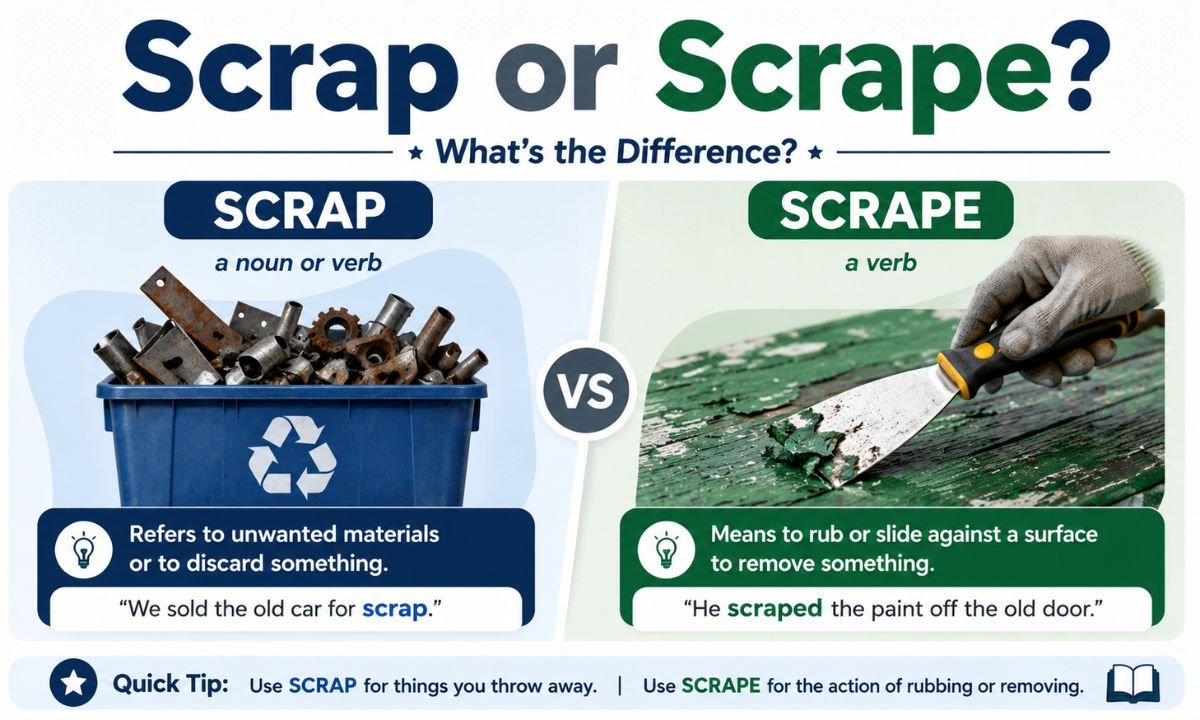
Two words, one letter apart, and yet they can send a sentence in completely different directions. “Scrap the plan” and “scrape the plate” share almost every letter but mean nothing alike. If you’ve ever paused mid-sentence wondering which one fits, you’re not alone — this is one of the most commonly mixed-up word pairs in English.
This guide breaks down exactly what separates scrap from scrape, how each word behaves in a sentence, and how to pick the right one every single time — whether you’re writing an email, texting a friend, or filling in a grammar worksheet.
Comparison Overview
Before diving into definitions, here’s a quick side-by-side look at how these two words differ.
| Feature | Scrap | Scrape |
|---|---|---|
| Core meaning | Leftover material, waste, or cancellation | Rubbing, scratching, or removing something from a surface |
| Word class | Noun and verb | Noun and verb |
| Pronunciation | /skræp/ (rhymes with “trap”) | /skreɪp/ (rhymes with “grape”) |
| Past tense | Scrapped | Scraped |
| Common phrases | Scrap metal, scrap the project, get into a scrap | Scrape by, scrape off, web scraping |
| Typical context | Recycling, business decisions, cancellations | Injuries, cleaning, surfaces, data collection |
| Example sentence | We had to scrap the trip. | She scraped her knee on the pavement. |
Keep this table in mind as a quick reference. The rest of the article unpacks each row in detail.
Definition of Scrap
At its core, scrap points to something that’s left over, unwanted, or no longer useful. As a noun, it usually describes small discarded pieces — a scrap of paper, scrap metal, or scraps of fabric left on a sewing table.
As a verb, scrap means to abandon, cancel, or throw something out entirely. A company might scrap a marketing plan. A government might scrap a policy. A student might scrap an essay draft and start over.
There’s also an informal noun use worth knowing: a scrap can mean a small fight or argument, as in “the two kids got into a scrap on the playground.” This meaning shows up mostly in casual British and American speech rather than formal writing.
So scrap, in nearly every sense, connects to something being discarded, unwanted, or called off.
Definition of Scrape
Scrape works in a different lane entirely. As a verb, it describes rubbing, scratching, or dragging something across a surface, often to remove a layer of material. You scrape ice off a windshield, scrape paint off a wall, or scrape mud from your boots.
As a noun, a scrape usually refers to a minor injury caused by friction — the kind of shallow wound you get from falling on concrete. “He walked away with just a scrape on his elbow.”
Scrape also appears in a handful of idiomatic expressions. Also “Scrape by” means to survive or manage with minimal resources. “Scrape together” means to gather something, usually money, with difficulty. And in the tech world, “web scraping” refers to extracting data from websites automatically a meaning that has grown enormously common in recent years.
Across all these uses, scrape centers on friction, contact, and the physical act of removing or gathering something bit by bit.
Main Differences Between Scrap and Scrape
The confusion between these words usually comes down to five factors: sound, spelling, meaning, grammar, and context. Here’s how they break apart.
| Difference | Scrap | Scrape |
|---|---|---|
| Meaning focus | Discarding, waste, cancellation | Friction, rubbing, minor removal |
| Physical action involved? | Rarely — mostly a decision or leftover object | Yes — always involves contact with a surface |
| Common industries | Recycling, manufacturing, business | Construction, medicine, technology, cleaning |
| Associated injury | None | Minor cuts and abrasions |
| Figurative use | Cancel a plan, idea, or event | Barely succeed (“scrape by”), gather data |
A simple way to separate them: if the sentence involves throwing something away or calling something off, reach for scrap. If it involves rubbing, scratching, or removing a thin layer from a surface, scrape is the one you need.
Grammar Guide
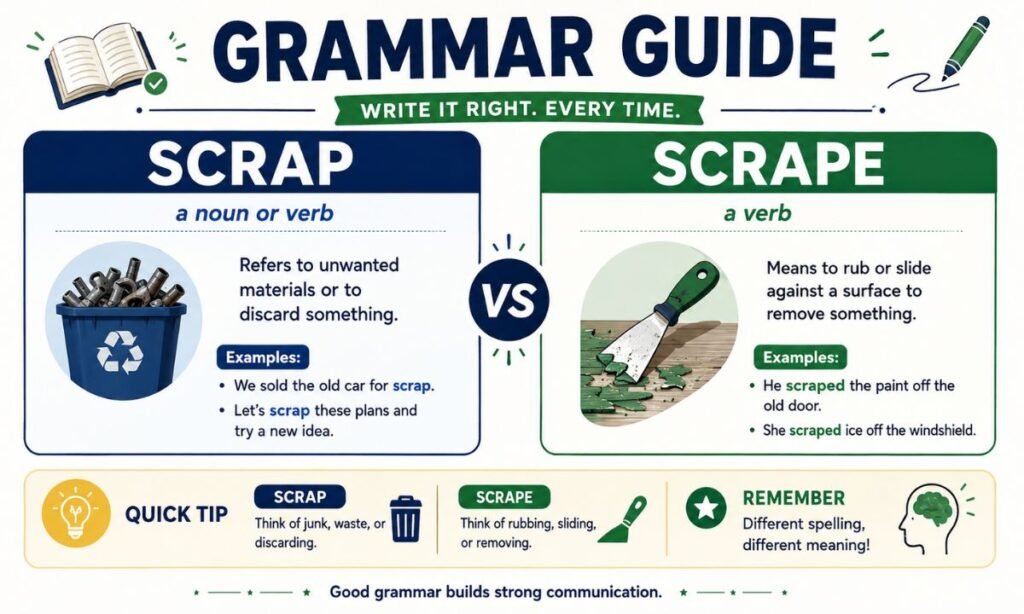
How each term is used in sentences
Both words function as nouns and verbs, but their grammar patterns follow the same logic as their meanings.
- Scrap (verb): “The board decided to scrap the merger.”
- Scrap (noun): “Only a scrap of the original document survived.”
- Scrape (verb): “He scraped the frost off the windscreen.”
- Scrape (noun): “She has a small scrape on her arm.”
Below is a rundown of the specific phrases many learners search for, answered directly.
Scrap or scrape car If a car is damaged beyond repair and being sold for parts or metal, you scrap it: “We finally scrapped the old car.” If something merely rubbed against the car’s surface, leaving a mark, that’s a scrape: “A shopping cart left a scrape on the door.”
Scrap or scrape pronunciation Scrap rhymes with “trap” and is pronounced /skræp/. Scrape rhymes with “grape” and is pronounced /skreɪp/. The extra “e” changes the vowel sound completely, which is often the easiest way to tell them apart when speaking.
Scrapped or scraped knee This one trips up a lot of writers, but only one is correct. You scrape your knee when it hits a rough surface, so the past tense is “scraped knee,” not “scrapped knee.” Scrapped applies to plans and projects, never to body parts.
Scrapping or scraping metal Scrapping metal means selling or discarding it as waste, usually for recycling: “He makes money scrapping old appliances.” Scraping metal means rubbing something against a metal surface: “The blade was scraping the metal pipe.”
Scrape vs scrap past tense The past tense of scrape is scraped. The past tense of scrap is scrapped, with a doubled “p” because of the short vowel sound in scrap. This spelling rule applies across related forms too: scrapping (present participle) versus scraping.
Scrap meaning in medical Medically, “scrap” isn’t really used at all. The correct medical term is a scrape, referring to a superficial skin abrasion where the top layer of skin is removed by friction. Doctors and first-aid guides use “scrape” or “abrasion” interchangeably.
Scrape data or scrape data Both forms use the same spelling — “scrape data” is correct in every case, referring to extracting information from a website or document automatically.
Web scraping Web scraping is the automated process of pulling data from websites using software or scripts. It always uses “scrape,” never “scrap,” since the process mirrors the physical action of gathering material bit by bit from a source.
Common mistakes learners make
- Writing “scrapped knee” instead of “scraped knee.”
- Using “scrap the surface” when the intended meaning was “scrape the surface.”
- Confusing “get into a scrap” (a fight) with “get into a scrape” (a difficult or risky situation) — both idioms exist, but they mean different things.
- Doubling the wrong consonant: writing “scraping” as “scrapping” or vice versa.
- Assuming the words are interchangeable in casual writing because they sound alike when spoken quickly.
Simple rules to remember
- If it involves throwing something away or calling something off, use scrap.
- If it involves rubbing, scratching, or a surface injury, use scrape.
- Scrap doubles its consonant in the past tense (scrapped); scrape does not (scraped).
- When in doubt, say the sentence aloud — the vowel sound often reveals which word actually fits.
Quick tips for writing and speaking
- Read the sentence back and ask: “Am I describing waste or friction?”
- Keep a mental image handy — a pile of scrap metal versus a scraped elbow — and match the sentence to the picture.
- Proofread industry-specific writing carefully, since “scrap” dominates business and recycling contexts while “scrape” dominates physical, medical, and technical ones.
- Don’t rely on autocorrect alone; both words are spelled correctly on their own, so a spellchecker won’t catch a wrong-word error.
When to Use Each One
Use scrap when you’re talking about:
- Canceling a plan, project, meeting, or idea
- Leftover or waste material, especially metal, paper, or fabric
- The recycling or salvage industry
- An informal fight or argument (British/American slang)
Use scrape when you’re talking about:
- Removing something from a surface by rubbing or scratching
- A minor skin injury from friction
- Managing to achieve something with difficulty (“scrape by,” “scrape through an exam”)
- Extracting data from a website or document (web scraping)
When NOT to Use Each One
Avoid scrap when:
- Describing a physical injury (use scrape instead)
- Talking about removing a thin layer from a surface (that’s a scraping action, not a scrapping one)
- Referring to gathering data from the internet
Avoid scrape when:
- Talking about canceling a plan or decision
- Referring to leftover material meant for recycling
- Describing a minor disagreement or fight (that’s a scrap)
Which One to Use (Decision Guide)
If you’re still unsure mid-sentence, run through this quick mental checklist:
- Does the sentence involve throwing something away or calling something off? If yes, use scrap.
- Does the sentence involve rubbing, scratching, or contact with a surface? If yes, use scrape.
- Is there an injury involved? Scrape, always.
- Is it about data, a website, or automated extraction? Scrape, without exception.
- Is it about metal, paper, or fabric being discarded? Scrap fits best.
Following this order almost always lands you on the correct word within seconds.
Real-World Practical Examples
Scrap Examples
- The airline decided to scrap the delayed flight and rebook passengers.
- There’s barely a scrap of evidence to support that claim.
- We collected scrap wood from the construction site for the campfire.
- After months of debate, lawmakers scrapped the proposed bill.
- The junkyard buys scrap metal by weight.
- The two rival teams got into a scrap after the final whistle.
Scrape Examples
- The chef scraped the leftover batter into the bowl.
- I scraped my elbow while climbing over the fence.
- It took some effort, but we managed to scrape together enough money for rent.
- Developers often scrape product prices from e-commerce sites for market research.
- She used a spatula to scrape the burnt sauce off the pan.
- He barely scraped through the final exam with a passing grade.
Self-Assessment (Fill in the Blanks)
Test what you’ve learned. Fill in each blank with either scrap or scrape (adjust tense where needed).
- The committee voted to ______ the outdated policy.
- He fell off his bike and ______ his knee badly.
- The recycling center pays for ______ metal by the pound.
- She used a tool to ______ the old paint off the fence.
- They had to ______ the wedding after the venue canceled.
- Web developers sometimes ______ data from public websites.
- It was a tough month, but we managed to ______ by.
- Only a small ______ of the letter remained after the fire.
Answers
- Scrap
- Scraped
- Scrap
- Scrape
- Scrap
- Scrape
- Scrape
- Scrap
Frequently Asked Questions
What does scrape mean?
Scrape means to rub, scratch, or remove something from a surface, often leaving behind a minor mark or injury.
What does scrape it mean?
“Scrape it” usually means to remove a substance from a surface by rubbing or scratching, such as scraping ice off a window.
Which is correct, scrapped or scraped?
Both are correct but mean different things: scrapped means canceled or discarded, while scraped means rubbed or removed from a surface.
Is “scrap” spelled correctly?
Yes, “scrap” is the correct spelling when referring to leftover material or canceling something. Do not confuse it with “scrape.”
Conclusion
Scrap and scrape may look like twins on the page, but they carry entirely separate meanings. Scrap belongs to the world of discarding, canceling, and leftover material. Scrape belongs to the world of friction, surfaces, and physical contact. Once that distinction is clear, the confusion disappears almost immediately.
The fastest way to lock this in is to picture the two scenarios side by side: a pile of scrap metal waiting for recycling and a scraped knee that stings after a fall. Neither image overlaps with the other, and neither should the words in your writing.