
You’ve typed the question a hundred times without thinking twice about it, and then one day you pause. Is it “what kind of car do you drive” or “what kinds of cars do you drive”? Both sound familiar, both show up in everyday conversation, and yet only one usually fits the sentence you’re building.
This mix-up trips up native speakers just as often as learners of English. The good news is that the rule behind it is short, logical, and easy to remember once you see it laid out clearly. This guide breaks down exactly when to use “what kind of,” when “what kinds of” is the better choice, and why the distinction matters more than most people assume.
Quick Answer
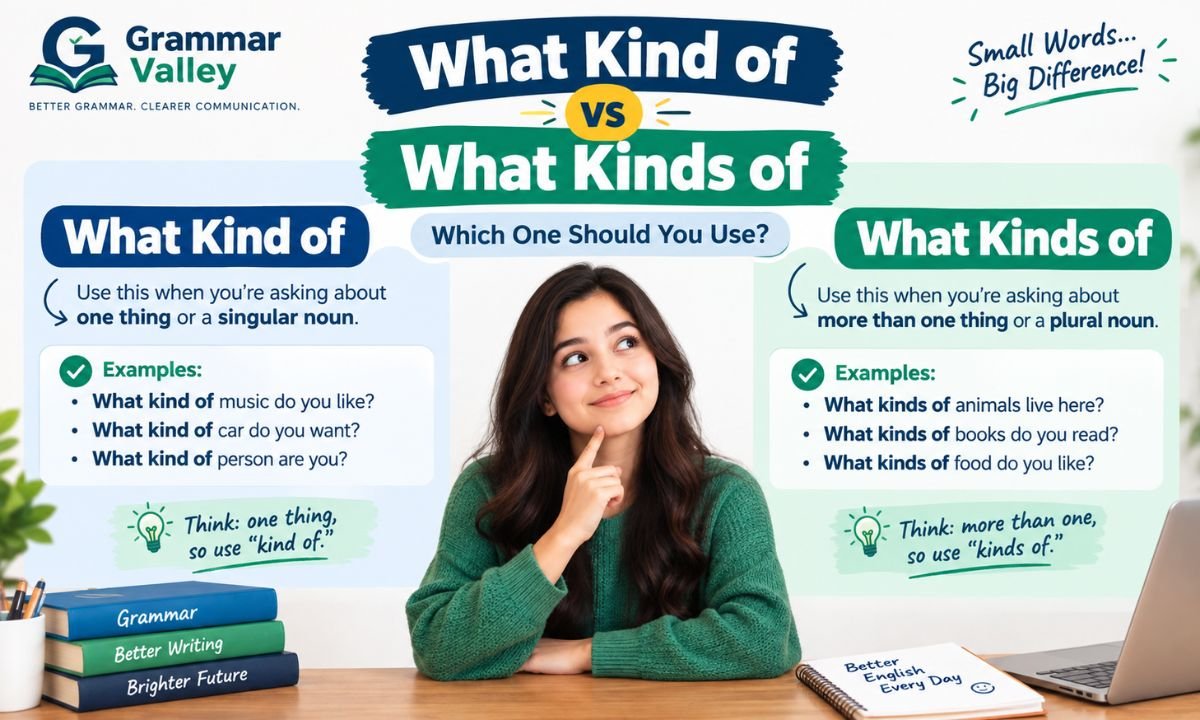
Use “what kind of” when you’re asking about a single category or type of something. Use “what kinds of” when you’re asking about multiple categories or types at once.
- What kind of music do you like? (one type, even if the answer includes several genres)
- What kinds of music do you like? (explicitly asking for a range of genres)
The word right after “kind” or “kinds” usually follows the same singular-or-plural pattern, though English speakers bend this rule constantly in casual speech. We’ll cover both the formal rule and the way people actually talk.
Meaning of “What Kind of”
“Kind” here works as a singular noun meaning a category, type, or class. When you attach “what” to the front, you’re asking someone to identify one type from a group of possibilities.
Grammatically, “kind” is singular, so it pairs naturally with a singular noun and a singular verb.
- What kind of dog is that?
- What kind of job does she want?
- What kind of person lies about something like that?
Each of these questions treats the answer as belonging to one category, even if that category itself is broad. Someone answering “What kind of music do you like?” might say “rock,” and that single word satisfies the question completely.
When to Use It
Reach for “what kind of” in these situations:
- You expect one answer. “What kind of phone do you have?” invites a single brand or model, not a list.
- The noun that follows is singular or uncountable. Uncountable nouns like water, advice, or music never take a plural form, so “kind of” fits them naturally: “What kind of advice did she give you?”
- You’re speaking casually and not worried about strict grammar. In everyday conversation, “what kind of” often gets used even when a plural noun follows, especially in American English: “What kind of shoes are those?” This is common and widely accepted despite technically mismatching the singular “kind” with a plural noun.
- You want to sound direct and specific. “What kind of approach should we take?” reads as focused and to the point.
Meaning of “What Kinds of”
“Kinds” is the plural form of “kind,” so this version of the question assumes there’s more than one category worth discussing. You’re not asking for a single label; you’re asking someone to list, describe, or compare several types at once.
- What kinds of birds nest in this area?
- What kinds of exercises help with back pain?
- What kinds of clients does your agency typically work with?
Notice that each example expects a broader answer, likely more than one item. “What kinds of birds nest in this area?” invites a list: sparrows, robins, maybe a few hawks. A one-word reply would feel incomplete.
When to Use It
Choose “what kinds of” when:
- You’re anticipating a list, not a single item. If the natural answer involves multiple things, “kinds” is the better fit.
- The following noun is plural. “What kinds of books do you read?” pairs the plural “kinds” with the plural “books,” which is the textbook-correct structure.
- You’re writing formally. Academic writing, business reports, and edited publications tend to preserve the kind/kinds distinction more carefully than spoken English does.
- You want to signal variety. Asking “What kinds of problems does this software solve?” suggests you expect a range of use cases, not one narrow function.
Key Difference Explained Simply
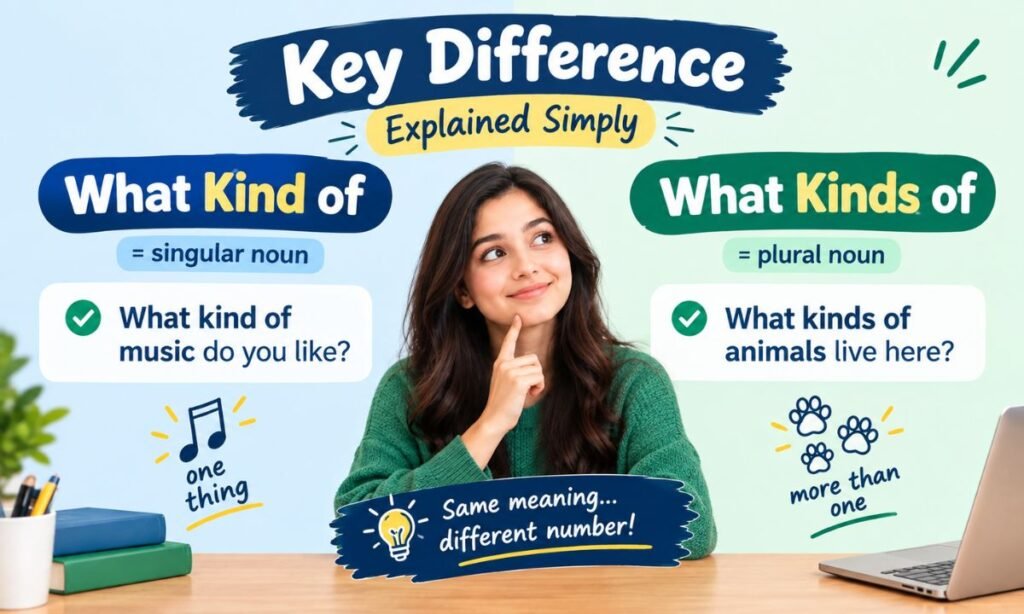
Strip away the grammar terminology and the difference comes down to one question: are you asking about one type, or several?
Think of “kind” as a single box and “kinds” as a shelf full of boxes. “What kind of shoe is comfortable for running?” is asking about one box, one category. “What kinds of shoes work for different foot types?” is asking about the whole shelf.
Here’s a simple test you can run in your head before you write either phrase:
- If your answer would naturally be one word or one category, use “kind.”
- If your answer would naturally be a list of two or more categories, use “kinds.”
There’s a wrinkle worth mentioning. In relaxed spoken English, “what kind of” often gets used even when the intended answer is plural, particularly in the United States. “What kind of vegetables do you grow?” is extremely common in speech, even though strict grammar would call for “kinds.” This isn’t wrong exactly; it reflects how English evolves through use rather than through textbook rules alone. Written English, especially in professional or academic contexts, still favors matching kind with singular and kinds with plural.
Comparison Table: What Kind of vs What Kinds of
| Feature | What Kind of | What Kinds of |
|---|---|---|
| Grammatical number | Singular | Plural |
| Expected answer | One type or category | Two or more types or categories |
| Typical noun that follows | Singular or uncountable noun | Plural noun (usually) |
| Common in speech | Very common, even before plural nouns | Common in careful or formal speech |
| Example question | What kind of car do you drive? | What kinds of cars are best for families? |
| Example answer | A hybrid sedan | Hybrids, SUVs, and minivans |
| Best used for | Direct, specific questions | Open, exploratory questions |
| Formality level | Works in both casual and formal contexts | Slightly more common in formal or written contexts |
Real-Life Example Scenarios
Seeing these phrases in context makes the choice easier than memorizing rules in isolation.
At a restaurant
- “What kind of dressing comes with the salad?” (one dressing, one answer)
- “What kinds of dressings do you offer?” (a menu with several options)
At a job interview
- “What kind of role are you looking for?” (one target position)
- “What kinds of roles have you held in the past?” (a career history with several job titles)
In a classroom
- “What kind of essay is due Friday?” (a single assignment type: persuasive, narrative, etc.)
- “What kinds of essays will we write this semester?” (multiple essay types across the term)
Shopping online
- “What kind of laptop should I buy for video editing?” (one recommendation)
- “What kinds of laptops handle video editing well?” (a comparison across brands and models)
Medical context
- “What kind of treatment does this condition usually need?” (one primary treatment path)
- “What kinds of treatments are available for this condition?” (several options: medication, therapy, surgery)
In every pair, the underlying question is really about scope. Are you narrowing in on one thing, or opening the door to several?
Common Mistakes and How to Avoid Them
Even confident writers slip up here. These are the errors that show up most often.
- Mismatching singular and plural. Saying “these kind of shoes” instead of “these kinds of shoes” or “this kind of shoe” is one of the most frequent errors in English usage. The demonstrative pronoun (this, that, these, those) needs to agree with kind or kinds: this kind, that kind, these kinds, those kinds.
- Assuming “kind of” always needs a singular noun. In casual speech, it’s fine to say “what kind of books do you like,” but in formal writing, switch to “what kinds of books.”
- Overcorrecting in conversation. Constantly saying “kinds” in speech when “kind” is more natural can sound stiff. Match your formality to the setting.
- Confusing “kind of” the phrase with “kind of” the filler word. In casual speech, “kind of” can also mean “somewhat,” as in “I’m kind of tired.” That’s a different use entirely and has nothing to do with categories.
- Forgetting subject-verb agreement. “What kind of dog barks at night?” uses a singular verb (barks). “What kinds of dogs bark at night?” uses a plural verb (bark). Mixing these up is a subtle but noticeable error.
A quick fix for most of these: read your sentence out loud and check whether the noun, the verb, and the word “kind” or “kinds” all agree in number.
Helpful Memory Trick
Here’s a shortcut that sticks: kind is one, kinds is many. Both words start with the same letters as their meaning implies once you notice the pattern: “kind” has no plural marker, so it stays with one idea. “Kinds” carries the “s,” the same “s” you’d add to make most English nouns plural, so it naturally points to more than one.
Another trick: swap “kind” for “type” in your head. “What type of car” flows the same way as “what kind of car,” and “what types of cars” mirrors “what kinds of cars.” If the singular/plural choice feels obvious with “type,” it applies the same way with “kind.”
American vs British English Differences
Both American and British English follow the same underlying grammar rule for kind versus kinds, but usage patterns differ slightly.
- American English speakers use “what kind of” more loosely, often pairing it with plural nouns in casual speech: “What kind of movies do you like?” This is widely accepted in the US even though it doesn’t strictly match singular with plural.
- British English tends to preserve the kind/kinds distinction a bit more consistently in both speech and writing, favoring “what kinds of movies” when the answer is expected to be plural.
- Formal writing in both dialects sticks closely to the traditional rule: singular with kind, plural with kinds.
- Neither dialect treats this as a hard error either way. It’s a matter of register and habit rather than a rule that changes meaning.
If you’re writing for a British audience or a formal publication on either side of the Atlantic, lean toward strict agreement. If you’re writing dialogue, marketing copy, or casual content aimed at American readers, “what kind of” with a plural noun will sound completely natural.
Related Phrases and Synonyms
Several other phrases follow the exact same singular/plural pattern as kind and kinds:
- Type of / types of — “What type of insurance do you need?” versus “What types of insurance does the company offer?”
- Sort of / sorts of — “What sort of feedback did you get?” versus “What sorts of feedback have you received over the years?”
- Class of / classes of — more common in scientific or technical writing: “What class of drug is this?” versus “What classes of drugs treat this condition?”
- Category of / categories of — often used in business and data contexts: “What category of expense is this?” versus “What categories of expenses are tax-deductible?”
Learning the kind/kinds rule essentially hands you a template for all of these related expressions, since they all behave the same way grammatically.
Why This Distinction Matters
Some readers might wonder if this level of detail is worth worrying about. It is, for a few practical reasons.
Clear questions get clearer answers. If you ask “What kind of support do you offer?” when you actually want a full list of services, you might get a one-line reply instead of the breakdown you were hoping for. Asking “What kinds of support do you offer?” signals that you expect a range of options, which shapes how the other person responds.
Precision also matters for anyone writing professionally: resumes, business emails, academic papers, or customer-facing content. A mismatched “these kind of” or “this kinds of” can quietly undercut how polished a piece of writing feels, even to readers who couldn’t explain the rule themselves.
Search intent works the same way. Someone typing “what kind of insurance do I need” is often looking for one clear recommendation, while someone typing “what kinds of insurance are there” wants a broader overview. Recognizing that difference helps writers, marketers, and educators match content to what readers actually want.
Practice Sentences
Fill in the blank with “kind” or “kinds,” then check your answers below.
- What ______ of tea do you usually drink in the morning?
- What ______ of exercises target the lower back?
- What ______ of car is best for long road trips?
- What ______ of animals live in the rainforest?
- What ______ of question is that supposed to be?
- What ______ of desserts do you serve at the bakery?
- What ______ of person volunteers for something like that?
- What ______ of skills does the job require?
Answers: 1. kind, 2. kinds, 3. kind, 4. kinds, 5. kind, 6. kinds, 7. kind, 8. kinds
If most of these felt intuitive, the rule has already settled into your instincts. If a couple surprised you, revisit the comparison table above and try the sentences again in a day or two.
Frequently Asked Questions
What is the difference between kind of and kinds of?
“Kind of” refers to one category or type, while “kinds of” refers to two or more categories or types.
When to use kind vs kinds?
Use “kind” when expecting a single answer or category, and “kinds” when expecting a list or variety of answers.
Which is correct: “all kinds of” or “all kind of”?
“All kinds of” is correct; “kind” should stay plural after “all” since it refers to multiple varieties.
Is it “what kind of things” or “what kinds of things”?
Both are used, but “what kinds of things” is grammatically more precise since “things” is plural; “what kind of things” is common in casual speech.
Conclusion
The choice between “what kind of” and “what kinds of” comes down to a simple question: are you asking about one category or several? “Kind” stays singular and pairs with one type; “kinds” goes plural and opens the door to a range of options.
Formal writing rewards strict agreement between kind, kinds, and the nouns and verbs around them, while everyday speech, especially in American English, allows a bit more flexibility.