
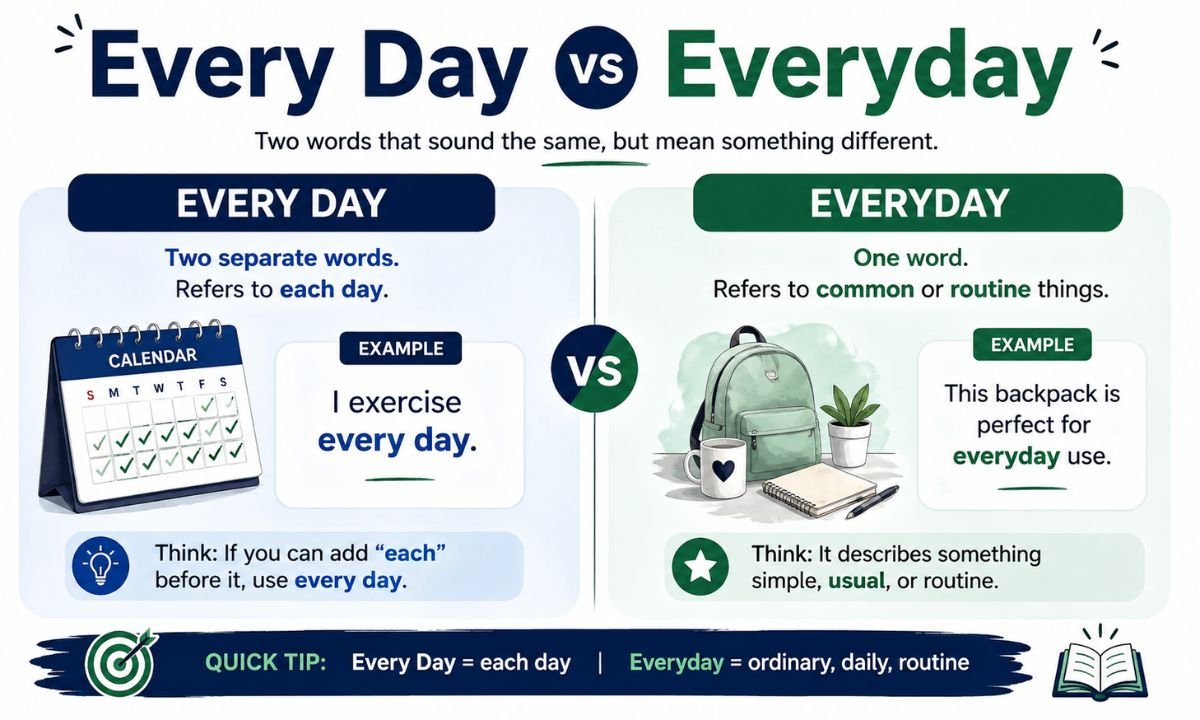
Most people type “everyday” when they mean “every day,” and nobody corrects them because the two look almost identical and sound exactly the same out loud. But a teacher marking an essay, a hiring manager reading a cover letter, or an editor reviewing a manuscript will notice the mix-up right away. One is an adjective. The other is an adverbial phrase. Swap them and a sentence can quietly change meaning or simply read as wrong.
This guide breaks down the difference in plain terms, shows you how to test which one you need in any sentence, and gives you enough examples that you won’t have to think twice about it again.
Comparison Overview
Before diving into definitions, here’s the short version.
| Feature | Every Day | Everyday |
|---|---|---|
| Word count | Two words | One word |
| Part of speech | Adverbial phrase | Adjective |
| What it modifies | A verb (tells you when or how often) | A noun (describes what kind) |
| Meaning | Each day, daily, day after day | Ordinary, routine, commonplace |
| Typical position | After the verb, or at the start/end of a sentence | Right before the noun it describes |
| Example | She jogs every day. | These are her everyday shoes. |
| Quick substitution test | Replace with “each day” | Replace with “ordinary” or “common” |
Keep that table in mind. Nearly every rule in this article traces back to those two rows.
Definition of Every Day
“Every day” is a two-word phrase built from the adjective “every” and the noun “day.” Together they function as an adverb of frequency, meaning “each day” or “on a daily basis.” It answers the question “when?” or “how often?” and it almost always sits near a verb.
Examples:
- I walk my dog every day.
- The bakery opens fresh bread every day.
- We don’t get a chance like this every day.
Notice that “day” in this phrase is still a countable noun in its own right — you could say “every single day” or “every other day,” and the sentence would still make sense. That flexibility is a strong clue you’re dealing with the two-word version.
Definition of Everyday
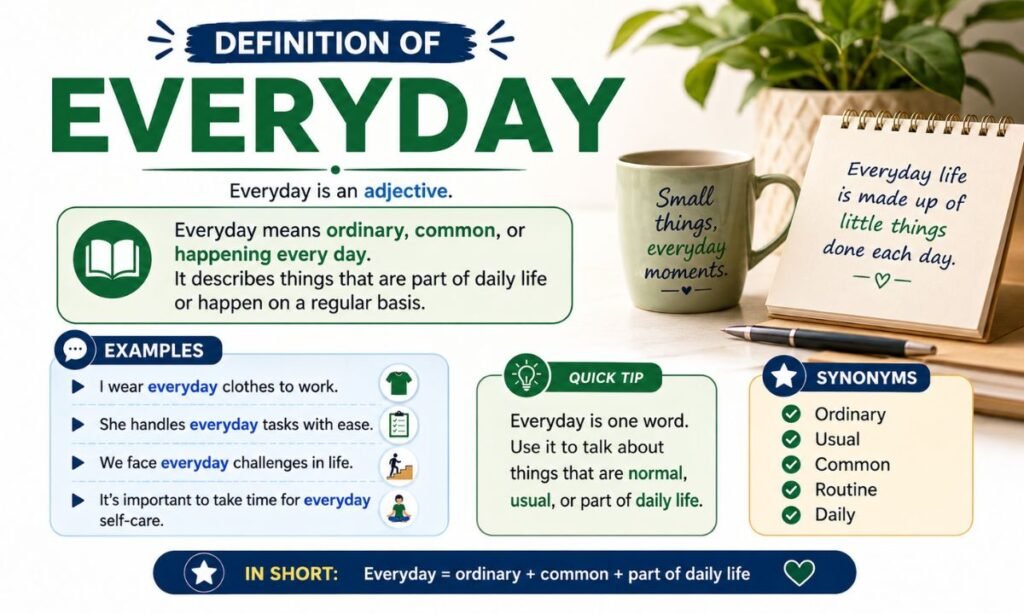
“Everyday” is a single compound word, and it’s an adjective. It describes something as ordinary, typical, or used on a regular basis — think of items you use routinely, situations you encounter often, or a plain, unremarkable version of something. It sits directly before the noun it modifies.
Examples:
- I wore my everyday shoes to the store.
- Traffic jams are an everyday annoyance in this city.
- She has an easygoing, everyday charm about her.
The key thing to remember: “everyday” never tells you how often something happens. It tells you what kind of thing you’re talking about — a plain, familiar, unremarkable one.
Main Differences Between Every Day and Everyday
Meaning Difference
The core distinction is simple once you see it side by side. “Every day” refers to frequency — something happening on each individual day. “Everyday” refers to quality — something being ordinary or routine in nature. A pair of shoes can be your “everyday” pair (you wear them often, they’re your regular ones) without you wearing them literally “every day” of the week.
Here’s how that plays out across some of the most searched phrases and questions people have about these two terms.
Everyday or every day examples
- Correct: “I check my email every day before work.” (frequency — happens daily)
- Correct: “Checking email has become part of my everyday routine.” (ordinary habit)
Every day vs everyday pronunciation Here’s the twist: both forms sound identical when spoken aloud. There’s no audible difference in casual speech, which is exactly why so many writers mix them up on the page. Some grammar teachers note a subtle stress shift — “everyday” as one word carries slightly more even stress across the compound, while “every day” as two words can carry a touch more emphasis on “day” — but in ordinary conversation, listeners can’t reliably tell them apart. You have to rely on context and grammar, not sound, to know which one a speaker intends.
Everyday vs every day quiz If you want to test yourself, try this trick before checking an answer: swap in “each day.” If the sentence still makes sense, you need “every day.” If “each day” sounds clunky or wrong, you need “everyday.” A short self-test appears later in this article, so keep reading.
I go to school everyday or every day This one should be “every day.” School attendance is a repeated action tied to frequency, not a description of an object. Correct: “I go to school every day.”
Everyday life or every day life This should be “everyday life,” written as one word. “Everyday” here describes “life” as ordinary or routine — the kind of day-to-day existence most people share. Correct: “She wanted to escape everyday life for a while.”
I miss you everyday or every day This should be “every day,” because you’re describing how often the feeling occurs. Correct: “I miss you every day.”
I love you everyday or every day Same logic applies. Correct: “I love you every day,” since it describes a feeling that repeats daily rather than describing an ordinary type of love.
Open everyday or every day A sign that reads “Open every day” is correct, because it tells customers on which days the business operates — frequency, not description. “Open everyday” is a common sign-writing mistake.
Grammar Difference
Grammatically, the split comes down to part of speech.
- “Everyday” is an adjective. Adjectives modify nouns, and in English they typically come before the noun (an everyday task, an everyday struggle).
- “Every day” is an adverbial phrase. Adverbial phrases modify verbs, and they typically appear after the verb or at the beginning or end of a clause (I read every day; every day, I read).
One more useful signal: “everyday” is almost never the last word in a sentence, because adjectives need a noun to attach to. If a sentence ends right after the word in question, it’s almost certainly “every day.”
Usage Difference
In practice, usage differences show up in three places: formal writing, business communication, and casual speech.
- In formal and academic writing, precision matters, so editors expect the correct form every time.
- In business writing — emails, reports, marketing copy — getting this wrong can look careless, especially on signage, product descriptions, or client-facing documents.
- In casual texting and speech, people often blur the line because, as noted above, both forms sound the same. That’s fine in a text to a friend, but it’s worth tightening up in anything you publish.
Every Day vs Everyday in Daily Writing
Writers run into this pair constantly because both words show up in ordinary topics: routines, habits, schedules, product descriptions, and store hours. A blog post about morning habits might need “every day” a dozen times (“I meditate every day,” “I stretch every day”) while also needing “everyday” to describe the habits themselves (“these are simple, everyday practices anyone can adopt”).
A practical habit for writers: whenever you type either form, pause for two seconds and ask what role the word is playing in that sentence. Is it telling you how often something happens, or what kind of thing you’re describing? That single question resolves almost every case.
Style guides, including those followed by major newspapers and grammar authorities, treat this as a standard usage distinction rather than a matter of preference. There’s no context — formal or informal — where the two are truly interchangeable, even though many people use them that way without noticing.
Why People Confuse Every Day and Everyday
A few reasons explain why this mix-up is so common, even among fluent native speakers.
- Identical pronunciation. Since spoken English gives no audible cue, the confusion is baked in before anyone even starts writing.
- Visual similarity. The two words share every letter; only a space separates them. Spell-checkers sometimes miss the error because both forms are valid words — just not always valid in that specific sentence.
- Autocorrect and predictive text. Phone keyboards often merge or split the phrase automatically, training users to stop double-checking.
- Limited grammar instruction. Many people never learned the underlying adjective-versus-adverb rule, so they’re guessing based on how a sentence “feels” rather than how it’s built.
- High-frequency compound words nearby. English has plenty of compounds like “anytime,” “everyone,” and “nowadays” that behave differently from their split-word cousins, so people assume “everyday” always works the same way.
Comparison Table with Examples
| Sentence | Correct Form | Why |
|---|---|---|
| I brush my teeth ___ | every day | Modifies the verb “brush,” tells frequency |
| These are my ___ clothes | everyday | Modifies the noun “clothes,” describes type |
| She calls her mom ___ | every day | Frequency of an action |
| It’s just an ___ occurrence | everyday | Describes the noun “occurrence” |
| We practice ___ after school | every day | Tells when/how often |
| He deals with ___ stress at work | everyday | Describes the kind of stress |
| The store is closed ___ | never used this way — needs a noun after “everyday,” so this needs “every day” if referring to frequency | Sentence ends without a noun |
| That’s an ___ struggle for new parents | everyday | Describes the struggle as common |
Grammar Guide
How Each Term Is Used in Sentences
Every Day
“Every day” behaves like other adverbial time expressions such as “each morning” or “once a week.” It typically appears:
- At the end of a sentence: “He goes for a run every day.”
- At the beginning of a sentence, often followed by a comma: “Every day, thousands of commuters pass through this station.”
- Mid-sentence, near the verb it modifies: “I try, every day, to read at least ten pages.”
Everyday
“Everyday” behaves like any standard adjective. It typically appears:
- Directly before a noun: “an everyday routine,” “everyday problems,” “everyday language”
- After a linking verb, though this is less common and still requires a noun nearby in context: “This struggle is everyday for millions of people” (a looser, more conversational usage)
Common Mistakes Learners Make
Mistake 1
Writing “everyday” when describing frequency, such as “I go to the gym everyday.” The correct version is “I go to the gym every day,” since it’s answering “how often,” not “what kind.”
Mistake 2
Writing “every day” when describing a noun, such as “These are my every day shoes.” The correct version is “These are my everyday shoes,” because “everyday” is describing the type of shoes.
Mistake 3
Using “everyday” at the end of a sentence with nothing to modify, such as “She feels tired everyday.” Since there’s no noun for “everyday” to describe, this should be “She feels tired every day.”
Simple Rules to Remember
- If you can replace the phrase with “each day,” use the two-word “every day.”
- If you can replace the word with “ordinary” or “common,” use the one-word “everyday.”
- If a noun comes right after the word, “everyday” is likely correct.
- If a verb comes right before the word, “every day” is likely correct.
- If the sentence would end on that word with no noun following, use “every day.”
Quick Tips for Writing and Speaking
- Read your sentence aloud and ask what’s being described — an action’s frequency or a noun’s nature.
- When proofreading, search your document for “everyday” and check that a noun follows each instance.
- Keep a sticky note nearby with the substitution trick (each day vs. ordinary) until it becomes automatic.
- Don’t trust your ear — pronunciation won’t help you here, only sentence structure will.
When to Use Each One
Use Every Day When
- You’re describing something that happens daily or repeatedly.
- The word directly modifies a verb.
- You could substitute “each day” without changing the meaning.
- The phrase appears at the start or end of a sentence with no noun attached to it.
Use Everyday When
- You’re describing something as ordinary, routine, or common.
- The word sits immediately before a noun.
- You could substitute “ordinary,” “regular,” or “common.”
- You’re talking about objects, habits, or situations people encounter routinely — not how often something occurs.
When NOT to Use Each One
Do Not Use Every Day
- Don’t use it directly before a noun where you mean “ordinary” — “every day struggle” should be “everyday struggle.”
- Don’t use it as a stand-alone adjective describing an item’s type. “My every day bag” should be “my everyday bag.”
Do Not Use Everyday
- Don’t use it to answer “how often.” “I exercise everyday” should be “I exercise every day.”
- Don’t use it at the very end of a sentence with nothing left to modify.
- Don’t use it when “each day” would fit naturally in its place.
Which One to Use (Decision Guide)
Ask yourself these questions in order:
- Does the word come right before a noun? If yes, you likely need everyday.
- Does the word come right after a verb, or is it answering “how often” or “when”? If yes, you likely need every day.
- Can you swap in “each day” and keep the sentence natural? If yes, use every day.
- Can you swap in “ordinary” or “common” and keep the sentence natural? If yes, use everyday.
- Still unsure? Rewrite the sentence more simply and see which version reads correctly out loud.
Real-World Practical Examples
Every Day Examples
- The sun rises every day, whether we notice it or not.
- My grandmother calls me every day at noon.
- Prices change every day depending on demand.
- I try to learn one new word every day.
- The train departs every day at 7 a.m., including holidays.
- We argue about something small almost every day.
- New products get added to the site every day.
Everyday Examples
- Cooking dinner is part of our everyday routine.
- He wore his everyday jacket instead of a suit.
- Small talk is an everyday skill worth practicing.
- The app is designed for everyday use, not just special occasions.
- Everyday heroes rarely get the recognition they deserve.
- She kept her everyday makeup simple and quick.
- Budgeting is an everyday concern for most households.
Self-Assessment (Fill in the Blanks)
Fill in each blank with either “every day” or “everyday.”
- I make my bed ___ before leaving the house.
- These are just my ___ sneakers, nothing fancy.
- He struggles with ___ tasks like grocery shopping.
- We meet for coffee almost ___.
- It’s an ___ mistake, so don’t feel bad about it.
- The gym is open ___, including weekends.
- She keeps a journal and writes in it ___.
- Waiting in traffic has become an ___ frustration.
Answers
- every day
- everyday
- everyday
- every day
- everyday
- every day
- every day
- everyday
Frequently Asked Questions
Is it miss you everyday or every day?
It’s “every day.” You’re describing how often you miss someone, so the two-word adverbial phrase is correct: “I miss you every day.”
Does every 1 day mean everyday?
No. “Every 1 day” isn’t standard English at all — the natural phrase is simply “every day,” meaning each day without exception.
Is it everyday life or every day life?
It’s “everyday life,” written as one word, since “everyday” is functioning as an adjective describing “life” as routine or ordinary.
What does “every day” mean?
“Every day” means “each day” or “daily” — it describes an action or event that happens on a repeated, day-by-day basis.
Conclusion
“Every day” and “everyday” will always look nearly identical and sound exactly the same, so relying on your ear won’t help you pick the right one. What will help is a single question: is this word describing how often something happens, or what kind of thing you’re talking about? Frequency points to the two-word phrase. Description points to the one-word adjective.