
If you’ve ever paused mid-sentence wondering whether to type “niece” or “neice,” you’re in good company. This mix-up shows up constantly in text messages, birthday cards, and even school essays. The good news is that once you understand why the confusion happens, you’ll never second-guess yourself again.
This guide breaks down the correct spelling, explains where the mistake comes from, and gives you simple tools to remember it for good — whether you’re a student, a parent, or just someone who wants their writing to look polished.
Quick Answer
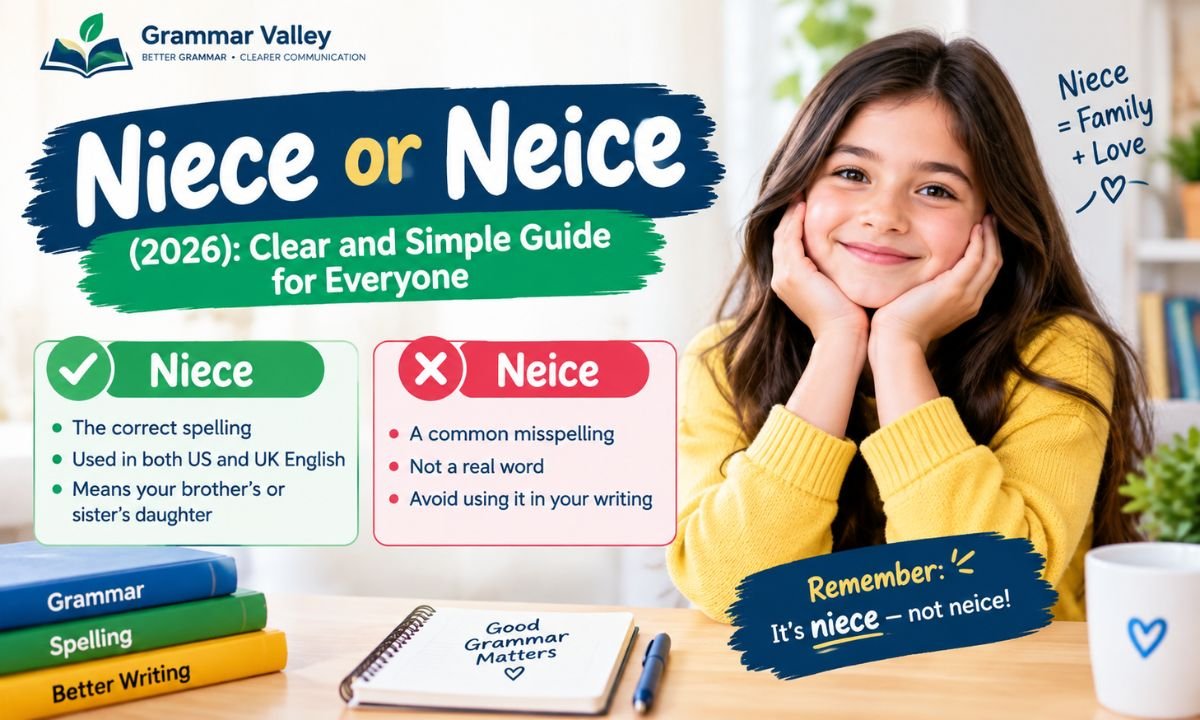
Niece is the correct spelling. Neice is a misspelling and has no place in proper English writing.
A niece is the daughter of your brother or sister, or the daughter of your spouse’s sibling. The word is pronounced “neess,” and no matter how it sounds, the letters go i-e-c-e, not e-i-c-e.
If you remember nothing else from this article, remember this: write niece, and skip neice entirely.
Simple Background
English spelling doesn’t always follow logic, and “niece” is a perfect example. The word traces back to Old French “nece,” which itself came from the Latin “neptis,” meaning granddaughter. Over centuries, the spelling settled into the form we use today.
Because English borrowed so many words from French and Latin, a lot of our trickiest spellings come from that mixed heritage. Words like “piece,” “believe,” and “receive” all share a similar vowel pattern, and people often bump into the same kind of confusion with each one.
The “ie” and “ei” combinations trip people up because they sound almost identical when spoken aloud. Your ear can’t tell the difference, so your fingers sometimes guess wrong. That single detail explains most of the confusion around this word.
Clear Explanation of the Difference
“Niece”
This is the correct, dictionary-recognized spelling. A niece is a specific family relationship — the daughter of your brother, your sister, or your spouse’s sibling. It’s a noun, and it appears in formal writing, casual conversation, legal documents, and everyday chats without any variation.
Examples:
- My niece just started her first year of college.
- We’re throwing a small party for our niece’s birthday.
- She has three nieces and two nephews.
Every one of these sentences uses the standard, accepted spelling. There’s no situation — formal, informal, academic, or casual — where “niece” isn’t the right choice.
“Neice”
This spelling carries no meaning in English. It isn’t a regional variant, an old form of the word, or an accepted alternative. It’s simply what happens when the “i” and “e” get swapped, usually without the writer noticing.
Examples of the mistake:
- I bought my neice a gift for her graduation. ❌
- She is the sweetest neice anyone could ask for. ❌
- My neice starts school next month. ❌
Every one of these should read “niece” instead. If you spot “neice” anywhere in your writing, treat it as an error and fix it immediately, the same way you’d correct a typo.
Comparison Table
| Feature | Niece (Correct) | Neice (Incorrect) |
|---|---|---|
| Spelling status | Standard, dictionary-approved | Common misspelling |
| Meaning | Daughter of a sibling or sibling-in-law | No meaning |
| Pronunciation | neess | Same sound, wrong spelling |
| Usage in formal writing | Always acceptable | Never acceptable |
| Usage in casual writing | Always acceptable | Never acceptable |
| Origin | Old French “nece,” from Latin “neptis” | No linguistic origin |
| Appears in dictionaries | Yes | No |
This table sums up the entire debate in one glance: one version is real, and the other one isn’t.
Which One to Use and When
There’s honestly no scenario where “neice” is the right call. Whether you’re writing:
- A text message to a friend
- A formal letter or email
- A school assignment
- A social media caption
- A legal or medical document
…the spelling stays the same: niece. English doesn’t offer a casual exception here the way it sometimes does with words like “okay” versus “OK.” There’s one correct form, and it works everywhere.
If you’re ever unsure while typing quickly, slow down for half a second and picture the word “piece.” Both words share that same “iece” ending, and if you can spell one, you can spell the other.
Common Mistakes People Make
Mistake 1: Reversing “i” and “e”
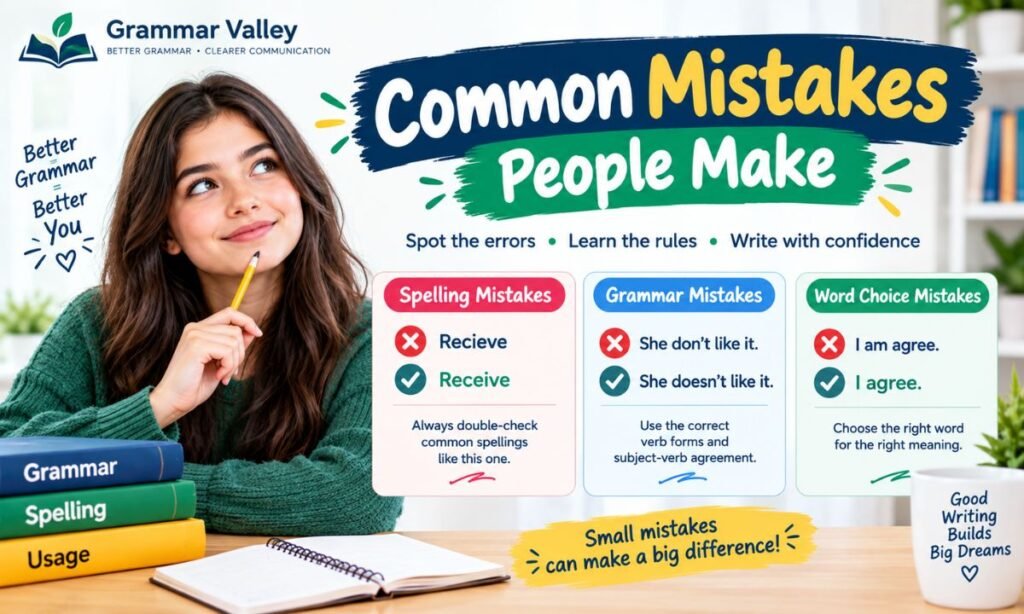
This is by far the most frequent slip-up. Because “niece” and “neice” sound identical out loud, your brain doesn’t automatically flag the wrong order. Typing fast makes this worse, since your fingers often move ahead of your thoughts.
Mistake 2: Forgetting the spelling rule
Many people were taught “i before e, except after c” in school, and they try to apply it here without checking whether the word actually needs it. “Niece” does follow “i before e,” but there’s no “c” involved at all, so some writers get confused trying to force the rule to fit a pattern it doesn’t belong to.
Mistake 3: Typing quickly
Autocorrect doesn’t always catch “neice,” especially on phones, because it can resemble other real words closely enough that the software hesitates to flag it. Rushed typing on social media, group chats, or comment sections is where this error shows up most often.
Everyday Real Life Examples
In Messages
Texting moves fast, and that speed is exactly where “neice” tends to sneak in.
- “Can’t wait to see my niece this weekend!”
- “Tell your niece happy birthday for me.”
In Emails
Professional writing calls for extra care, since a misspelling here can look sloppy to a boss, client, or teacher.
- “Please find attached the photos of my niece’s graduation ceremony.”
- “My niece will be joining us for the meeting as an intern.”
In Social Media
Captions and comments are informal, but the correct spelling still matters if you want your post to read cleanly.
- “Best day ever with my niece at the beach! 🌊”
- “So proud of my niece for her first piano recital.”
In Daily Conversations
While spoken English doesn’t reveal spelling errors, the habit of misspelling a word can carry over into how confidently you write it down later.
- “I’m picking up my niece from soccer practice.”
- “My niece just turned seven last week.”
Short Learning Section for Students and Beginners
Memory Tip
Here’s a trick that sticks: the word “niece” contains “ice” at the end. Picture your niece enjoying a bowl of ice cream. That small mental image locks in the correct letter order — n-ICE.
Another simple method is comparing it to a word you already know well: “piece.” If you can spell “piece” without hesitation, just swap the “p” for an “n,” and you’ve got “niece” locked in.
A shorter phrase some teachers use is this: “My niece is nice.” Both words start with “ni,” which reinforces the pattern every time you say it.
Practice
Try filling in the blank with the correct spelling:
- My _______ is turning ten this year.
- We took our _______ to the amusement park.
- She gave her _______ a handmade scarf.
- Our _______ just got accepted into college.
- I’m meeting my _______ for lunch tomorrow.
(Answer for every blank: niece.)
If you got all five right without hesitating, the spelling has already clicked. Reviewing it a few more times over the next couple of days will help it stay permanent.
Frequently Asked Questions
Who is Neice?
“Neice” isn’t a real word or a name reference — it’s simply a common misspelling of “niece.” If you’ve seen it written somewhere, it should be corrected to “niece.”
What is a female nephew called?
There’s no such thing as a “female nephew.” The correct term for a sibling’s daughter is simply “niece.”
What are my niece’s children called?
Your niece’s children are your grandnieces (if they’re girls) or grandnephews (if they’re boys), sometimes also called great-nieces and great-nephews.
Do I call my nephew’s wife my niece?
No. Your nephew’s wife is typically referred to as your niece-in-law, not your niece.
Conclusion
The spelling debate between “niece” and “neice” really comes down to one simple fact: only “niece” exists in English. “Neice” is a slip caused by swapped letters, fast typing, or a misapplied spelling rule — nothing more.
Once you connect the word to a trick like “niece has ice in it” or lean on the familiar comparison with “piece,” the correct spelling becomes automatic. Whether you’re writing a quick text, a formal email, or a school assignment, sticking with “niece” keeps your writing accurate and easy to trust.