
You typed a cancellation notice, an email, or a school assignment, and the word stopped you cold. One L or two? Spellcheck didn’t flag either version, and now you’re second-guessing a word you’ve written a hundred times.
You’re not alone. This is one of the most searched spelling questions in English, right up there with “canceled or cancelled.” The good news is that the answer is short, and once you understand the logic behind it, you’ll never have to pause on this word again.
Quick Answer
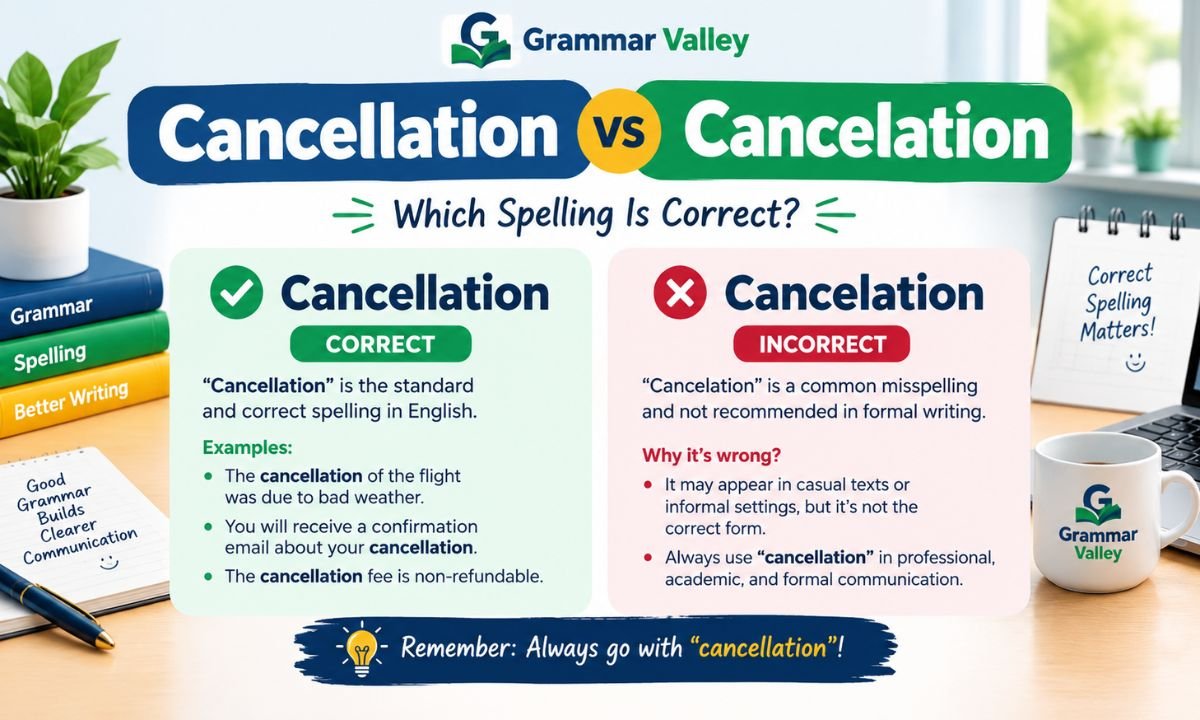
Cancellation, spelled with two L’s, is the correct and standard spelling in both American and British English.
Cancelation, with a single L, is technically listed in some American dictionaries, but it’s rarely used in real writing, whether that’s news articles, business emails, or academic papers. If you want a spelling that works everywhere without raising an eyebrow, write cancellation.
This is actually a bit different from words like “canceled” and “cancelled,” where the US and UK genuinely split. With the noun form, cancellation wins almost everywhere.
Cancellation vs Cancelation – Key Differences at a Glance
| Feature | Cancellation | Cancelation |
|---|---|---|
| Number of L’s | Two | One |
| US English | Correct and standard | Technically valid, rarely used |
| UK English | Correct and standard | Considered a misspelling |
| Dictionary status | Listed in every major dictionary | Listed as a secondary/rare variant in some US dictionaries |
| Frequency in print | Extremely common | Very uncommon |
| Recommended for formal writing | Yes | No |
| Found in news, business, legal docs | Almost exclusively | Rarely, if ever |
The takeaway is simple: cancellation is the safe, professional, universally accepted choice. Cancelation exists on paper, but it doesn’t show up much outside of niche discussions about spelling itself.
American vs British English: The Real Difference
A lot of people assume cancellation follows the same US-versus-UK pattern as other cancel-related words. That assumption is only half true.
With verb forms, the split is real and predictable:
- Canceling (one L) is standard American English.
- Cancelling (two L’s) is standard British English.
But the noun cancellation breaks that pattern. American English writers, publications, and dictionaries overwhelmingly use the double-L version too. So while “traveling” and “modeling” follow the single-L American habit, “cancellation” doesn’t budge. Understanding why requires a short trip back to spelling reform history.
Webster’s Spelling Reforms
Noah Webster, the man behind the first major American dictionary, pushed for simplified spellings across the language in the early 1800s. His changes are why Americans write “color” instead of “colour,” “theater” instead of “theatre,” and “traveled” instead of “travelled.” Webster’s general rule for words ending in a single consonant after a single vowel was to skip doubling that consonant before adding a suffix, unless the stress fell on that final syllable.
Cancel doesn’t have the stress on its last syllable, so by Webster’s own logic, canceling and canceled dropped the second L in American usage. But cancellation is a different animal. It isn’t formed by simply adding “-ing” or “-ed” to cancel. It comes from the Latin root “cancellare,” filtered through the noun form “cancellatio,” which already carried two L’s long before Webster’s reforms existed. Because the double-L spelling was baked into the word’s Latin ancestry rather than created by adding an English suffix to “cancel,” Webster’s simplification never fully applied to it.
US Spelling Trends
American style guides, from AP Style to the Chicago Manual of Style, list cancellation with two L’s as the standard spelling. Search through American newspapers, contracts, insurance policies, and airline notices, and you’ll see the double-L form used consistently. The single-L “cancelation” shows up occasionally in older or less-edited American texts, but professional editors almost always correct it.
Global Publishing Standards
Publishers outside the US, including those in the UK, Canada, Australia, and India, use cancellation without exception. Global style guides used by international news agencies and academic journals also default to the double-L spelling because it avoids any risk of looking like a typo to non-American readers. If you’re writing content meant for a worldwide audience, cancellation removes any ambiguity.
What Major Dictionaries Say
Merriam-Webster, the most authoritative American dictionary, lists “cancellation” as the primary entry and includes “cancelation” only as a secondary, less common variant. Oxford English Dictionary, Cambridge Dictionary, and Collins all list cancellation as the sole standard spelling, without treating cancelation as an equal alternative. When the reference books that define American English still favor the double-L form, that tells you almost everything you need to know.
Why Is “Cancellation” Spelled with Two Ls?
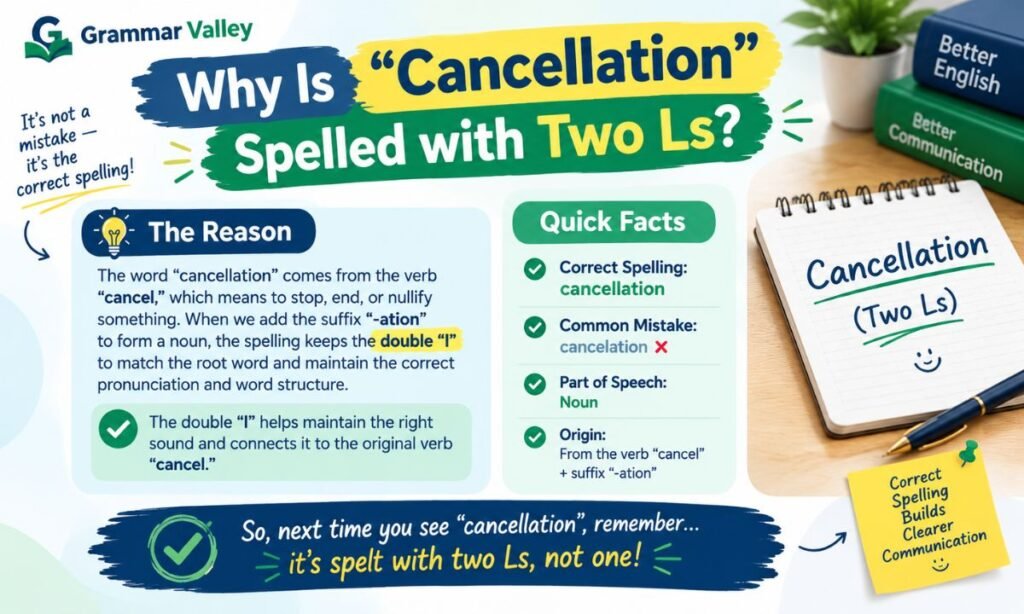
The short explanation goes back to Latin. The word traces to “cancellare,” meaning to cross out or make void, which is also where we get words like “chancel” and “cancel” itself. When Latin and French forms passed into English as “cancellation,” the double L came along with them as part of the original spelling, not as a doubled consonant added through an English grammar rule.
This matters because English spelling doubling rules (like the one that turns “run” into “running”) don’t actually apply here. Cancellation isn’t cancel + “-lation.” It’s a whole word borrowed with its spelling mostly intact from an older source. That’s why even American English, which usually strips out extra letters, left this one alone.
Is “Cancelation” Ever Correct?
Yes, in a narrow sense. Some American dictionaries, including certain editions of Merriam-Webster, list “cancelation” as an accepted variant spelling. It isn’t a made-up word or an outright error the way “recieve” would be for “receive.” But being listed in a dictionary and being commonly used are two different things.
Here’s a simple way to think about it: cancelation is grammatically defensible but stylistically unusual. If a teacher, editor, or client saw it in your writing, many would assume it was a typo rather than a deliberate, accepted spelling choice. For that reason alone, most professional writers steer clear of it.
Real Examples of “Cancellation” in Sentences
- The airline sent a cancellation notice three hours before the scheduled flight.
- Her gym membership includes a 30-day cancellation policy.
- The wedding cancellation caught everyone by surprise.
- We processed your order cancellation and issued a full refund.
- Due to heavy snowfall, school cancellation announcements went out early this morning.
- The insurance company requires written notice for policy cancellation.
- Ticket cancellation requests must be submitted 48 hours in advance.
Notice how naturally the double-L version fits across travel, retail, education, and legal contexts. That range is a good sign of how standard the spelling really is.
Is “Cancelation” Ever Acceptable?
This section covers roughly the same ground as the one above, but it’s worth separating “correct” from “acceptable” because they aren’t quite the same test. Correct asks whether a dictionary recognizes the word. Acceptable asks whether readers, editors, and institutions will treat it as normal rather than as a mistake.
Rare Acceptance Cases
There are a handful of situations where “cancelation” won’t raise concerns:
- Informal, personal writing like texts or casual notes, where spelling variance is low-stakes.
- Older American texts and some legacy government forms that predate the dominance of the double-L spelling.
- Certain simplified-spelling advocacy contexts, where writers intentionally favor reduced letter counts.
- Regional dialect variations in a small number of US publications that adopted the single-L style decades ago and never switched back.
Outside of these narrow cases, cancelation tends to look out of place.
Why It Looks Wrong to Most Readers
Readers build pattern recognition from what they see repeatedly. Since cancellation appears far more often in books, news, contracts, and everyday correspondence, a reader’s brain flags cancelation as unfamiliar, even if it’s technically valid. That mismatch between what people expect and what they see is often enough to make writing feel less polished or less trustworthy, even when nothing else about it is wrong.
Common Grammar Pattern: Traveling vs Travelling & Other Double-L Words
Confusion about cancellation often comes from a broader group of words that genuinely do split between US and UK spelling. Here’s how a few of them compare:
| Word | American English | British English |
|---|---|---|
| Traveling / Travelling | Traveling | Travelling |
| Modeling / Modelling | Modeling | Modelling |
| Canceling / Cancelling | Canceling | Cancelling |
| Labeling / Labelling | Labeling | Labelling |
| Fueling / Fuelling | Fueling | Fuelling |
| Cancellation | Cancellation | Cancellation |
Notice that cancellation sits outside the usual pattern. Every other word in that table doubles its consonant in British English but drops it in American English. Cancellation stays doubled in both, because, as covered earlier, it isn’t built the same way those other words are.
Why This Pattern Matters
Understanding this distinction helps with more than just one word. Once you know that verb forms like “traveling” follow the US-drops-a-letter rule, but that certain noun forms with older Latin roots don’t follow that rule, you’ll make fewer guesses and more informed choices across a whole family of similar words.
Common Mistakes & How to Avoid Them
Writers tend to trip over this word in a few predictable ways:
- Assuming cancellation follows the same US/UK split as canceling vs cancelling.
- Writing “cancelation” out of habit after using single-L forms like “canceled” elsewhere in the same document.
- Mixing both spellings within a single piece of writing, which looks inconsistent even if each instance is technically defensible.
- Trusting spellcheck tools that sometimes accept “cancelation” without flagging it as unusual.
- Confusing cancellation with unrelated words like “cancelation fee” versus “termination fee,” which carry different legal meanings.
How to Avoid Mistakes
A few habits will keep this word consistent across everything you write:
- Default to “cancellation” every time, regardless of your audience’s location.
- Search your document for “cancelation” before publishing, and replace any instances you find.
- Keep a short personal style note or bookmark this article for quick reference.
- If you’re writing for a specific style guide (AP, Chicago, APA), check its entry, though nearly all of them agree on the double-L spelling.
- Read your sentence aloud. If “cancellation” sounds and looks familiar, that’s usually confirmation you’ve spelled it correctly.
Quick Comparison Table
| Question | Answer |
|---|---|
| Which spelling is more common? | Cancellation |
| Which spelling do dictionaries prefer? | Cancellation |
| Is cancelation wrong? | Not technically, but it’s rare and often flagged |
| Does the US/UK rule apply here? | No, unlike canceling/cancelling |
| Best choice for professional writing? | Cancellation |
| Best choice for global audiences? | Cancellation |
Final Verdict: Which One Should You Use in 2026?
Cancellation
If you write nothing else down from this article, remember this one word: cancellation. It works in the US, the UK, Canada, Australia, and everywhere else English is written formally. It matches what dictionaries list as the primary spelling, what style guides recommend, and what readers expect to see. There’s no upside to gambling on “cancelation” when the safer, more recognized spelling costs you nothing extra to type.
For emails, contracts, school papers, business communication, or content meant to rank well and read cleanly, cancellation is the spelling that keeps your writing looking careful and correct.
Cancellation vs Cancelation – Which Should You Use?
Use cancellation. In nearly every writing situation you’ll encounter, whether personal, professional, academic, or international, the double-L spelling is the one that won’t get questioned. Save “cancelation” for the rare cases where you’re specifically discussing spelling variants or working within a document that has already established that style throughout. Outside of that, stick with two L’s, and this small spelling decision will never slow you down again.
Frequently Asked Questions
What is the difference between “cancellation” and “cancelation”?
They’re variant spellings of the same word; cancellation (two L’s) is standard everywhere, while cancelation (one L) is a rare, technically valid American variant.
Is cancellation spelled with one L or two?
It’s spelled with two L’s in standard American and British English.
What is the difference between cancelation and termination?
Cancelation/cancellation means calling something off before it happens, while termination usually means ending something that was already in progress or in effect.
Is it cancellation or cancelation in America?
Cancellation is the preferred and far more common spelling in American English, even though cancelation appears in a few dictionaries as a secondary variant.