
You typed an email, paused at that one word, and second-guessed yourself: is it “vender” or “vendor”? You’re not alone. This mix-up shows up constantly in business writing, contracts, marketing copy, and even casual texts, and autocorrect doesn’t always save you from it.
The short version is simple, but the reasons behind it are worth knowing, especially if you write for work, run a business, or just want your emails to read as polished as possible. This guide breaks down the correct spelling, where the confusion started, how British and American English treat the word, and the mistakes people make most often. By the end, you’ll never have to pause at that word again.
Vender or Vendor – Quick Answer
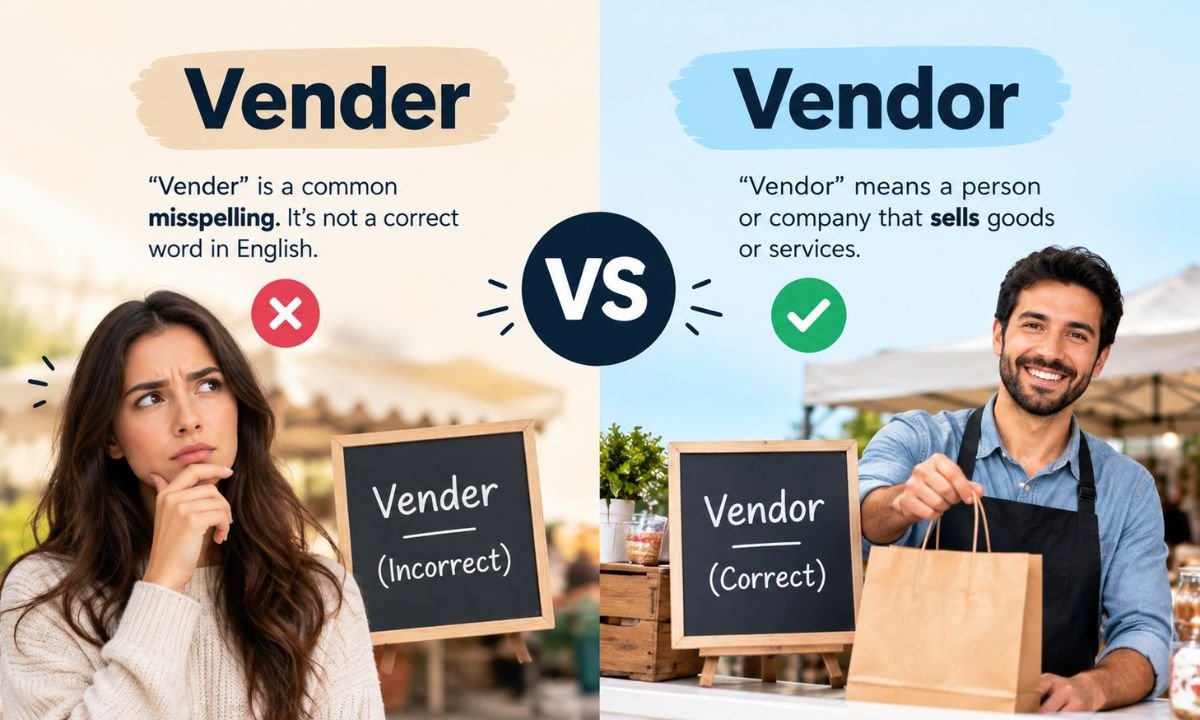
Vendor is the correct spelling in modern English. Vender is an outdated, rarely used variant that most dictionaries now label as archaic or nonstandard.
If you’re writing an email, a contract, a product listing, or a blog post, “vendor” is the only spelling you should reach for. Here’s the answer condensed into a few quick facts:
- Vendor = a person, business, or platform that sells goods or services.
- Vender = a historical spelling variant, now considered incorrect in standard usage.
- Both American and British English agree on “vendor” as the accepted form.
- Major dictionaries, including Merriam-Webster and Oxford, list “vendor” as the headword.
- Style guides used in journalism and publishing, such as AP and Chicago, also use “vendor.”
So whenever you’re unsure, default to the “-or” ending. It’s shorter to remember than it is to explain, and it will keep your writing consistent across every document you produce.
The Origin of Vender or Vendor
Understanding why “vendor” won out over “vender” makes the spelling easier to remember. The word traces back to the Latin verb vendere, meaning “to sell.” From there, it passed through Old French as vendre and into Anglo-French as vendour or vendur before settling into English.
That Anglo-French “-our” ending is the real clue here. English borrowed a huge number of legal and commercial terms from French during the medieval period, and many of them kept an “-or” suffix to mark a person who performs an action, particularly in legal or business roles. Think of words like “creditor,” “debtor,” “actor,” and “governor.” “Vendor” fits that same pattern: someone who vends, or sells.
“Vender,” on the other hand, appeared in Middle English writing as one of several loosely standardized spelling attempts. Spelling in that era wasn’t fixed the way it is today. Scribes and printers often spelled the same word several different ways depending on region, personal habit, or which language’s rules they were leaning on that day. As printing became more widespread and dictionaries started to formalize English spelling in the 18th and 19th centuries, “vendor” became the version that stuck, largely because it matched the established “-or” pattern used for other agent nouns of Latin or French origin.
By the time modern dictionaries were compiled, “vendor” had become the standardized form, and “vender” was pushed into the background as a historical footnote. You might still spot “vender” in old legal texts, antique advertisements, or scanned 19th-century documents, but it has no real place in contemporary writing.
There’s a second layer of confusion worth mentioning here too. Spanish speakers and English learners sometimes carry over the Spanish verb vender, which genuinely means “to sell” in Spanish. That overlap can make “vender” feel like a legitimate English word when it’s actually a false friend, a word that looks correct because of its similarity to another language but doesn’t hold up in English usage.
British English vs American English Spelling
One thing that trips people up is assuming British and American English might disagree here, the way they do with “colour” versus “color” or “organise” versus “organize.” That assumption doesn’t apply to this word.
Both varieties of English use “vendor,” full stop. There’s no regional split, no “British spelling” alternative hiding in the Oxford English Dictionary that favors “vender.” Cambridge Dictionary, Oxford Dictionary, and Merriam-Webster all list “vendor” as the standard entry, regardless of which side of the Atlantic you’re writing for.
Here’s a simple breakdown of how the spelling holds up across major English-speaking regions:
| Region | Preferred Spelling | Notes |
|---|---|---|
| United States | Vendor | Used in business, legal, and everyday writing |
| United Kingdom | Vendor | Matches Oxford and Cambridge dictionary entries |
| Canada | Vendor | Follows both British and American conventions here |
| Australia | Vendor | Also used in real estate to describe a property seller |
| India | Vendor | Common in business English and government documents |
Interestingly, “vendor” carries a slightly different everyday connotation in some regions. In Australian and British property listings, for example, “vendor” specifically refers to the person selling a house, distinct from the buyer. In American English, “vendor” leans more toward businesses or individuals selling goods and services generally, such as a food vendor at a festival or a software vendor supplying a company.
Either way, the spelling itself never changes. If you’re writing for a global audience, a US-based client, or a UK publication, “vendor” is always the safe choice.
Which Spelling Should You Use?
At this point, the answer is obvious, but let’s make it practical. Here’s when and how to apply it correctly in real writing situations.
Always use “vendor” when you’re writing:
- Business emails and internal memos
- Contracts, invoices, and procurement documents
- Marketing copy, product pages, and blog content
- Academic papers or professional reports
- Legal documents of any kind
- Social media posts representing a brand or business
Only encounter “vender” if you’re:
- Reading or quoting a historical text where the original spelling matters
- Studying etymology or the evolution of English spelling
- Reading Spanish text, where vender is a completely different, correctly spelled verb meaning “to sell”
There’s really no modern scenario where choosing “vender” over “vendor” is the stronger option. Even informal writing benefits from getting this right, since a misspelled word in a text or social post can still register as careless, especially if you’re representing a business.
A good mental trick: a vending machine has an “o.” The person or company operating in that same selling capacity is a vendor, also with an “o.” If you can remember the machine, you can remember the person.
Common Mistakes with Vender vs Vendor
Even careful writers slip up here, usually for predictable reasons. Knowing why the mistake happens makes it much easier to catch yourself before hitting send.
Phonetic confusion. English has a habit of pronouncing “-or” endings so they sound almost identical to “-er” endings. Think about how “doctor” and “actor” don’t sound dramatically different from a hypothetical “docter” or “acter.” That auditory overlap makes it easy to type “vender” purely on instinct, without a visual reference to correct it.
Autocorrect and typing speed. People writing quickly in emails or chat apps often don’t proofread word by word. If autocorrect doesn’t flag “vender” as wrong (and on some keyboards, it won’t, since it recognizes it as a rare but real word), the mistake slides through unnoticed.
Confusion with the Spanish verb. As mentioned earlier, bilingual writers or anyone who has studied Spanish may unconsciously borrow the Spanish spelling, especially in industries with a lot of cross-border communication, like import/export businesses or hospitality.
Assuming historical usage still applies. A small number of writers know that “vender” appeared in older English texts and mistakenly conclude it’s a valid stylistic choice today. It isn’t. Language evolves, and dictionaries update to reflect current standard usage, not centuries-old variants.
Here’s a quick side-by-side of what incorrect and correct usage look like in a sentence:
| Incorrect | Correct |
|---|---|
| We need a new vender for office supplies. | We need a new vendor for office supplies. |
| The food vender set up near the entrance. | The food vendor set up near the entrance. |
| Please confirm the vender’s invoice. | Please confirm the vendor’s invoice. |
| Our software vender missed the deadline. | Our software vendor missed the deadline. |
If you catch yourself typing “vender” in any professional context, treat it the same way you’d treat any other typo: fix it before it goes out.
Vendor vs Vender in Everyday Examples
Seeing the word in real context makes the correct choice easier to internalize than memorizing a rule alone. Here are a few common scenarios where “vendor” shows up regularly, written the way you’d actually use them.
- In business and procurement: “The procurement team compared three vendors before renewing the contract.”
- In retail and events: “Every vendor at the farmers market needs a permit from the city.”
- In technology: “Our cloud vendor rolled out a security patch overnight.”
In real estate (especially UK and Australian usage): “The vendor accepted an offer just below the asking price.”
In everyday conversation: “There’s a coffee vendor right outside the office building.”
Notice how the word adapts across industries without changing spelling. Whether you’re talking about a company supplying enterprise software or a person selling tacos from a cart, “vendor” covers both. That flexibility is part of why it has remained the dominant term for so long: it’s broad enough to describe almost any seller relationship, formal or informal.
Vender Meaning
Since “vender” still occasionally surfaces, it’s worth clarifying what it actually means when you do encounter it, rather than dismissing it outright.
Historically, “vender” carried the same meaning as “vendor”: a person or entity that sells goods or services. It wasn’t a different word with a separate definition; it was simply an alternate spelling that existed before English spelling was standardized. If you found “vender” in an 18th-century ledger or an old legal document, it would refer to exactly the same role a “vendor” plays today.
In Spanish, vender means something different in form but related in meaning: it’s a verb meaning “to sell,” used in sentences like “Quiero vender mi coche” (“I want to sell my car”). This is a case of two languages sharing a Latin root (vendere) but developing the word differently. English turned it into a noun describing the seller; Spanish kept it as a verb describing the act of selling.
So if someone shows you “vender” and insists it’s correct, there are really only two contexts where that claim has any footing: historical English texts, or Spanish-language content. Outside of those two situations, “vender” doesn’t hold up as standard English.
Comparison Table: Vender vs Vendor
For a quick reference you can bookmark or screenshot, here’s a full breakdown comparing the two spellings side by side.
| Feature | Vendor | Vender |
|---|---|---|
| Correct in modern English | Yes | No |
| Recognized by major dictionaries | Yes, as the standard headword | Yes, but labeled rare or archaic |
| Used in American English | Yes | No |
| Used in British English | Yes | No |
| Appropriate for business writing | Yes | No |
| Appropriate for legal documents | Yes | No |
| Historical usage | Common before spelling standardization | Was once an accepted variant |
| Common in Spanish | No (different word entirely) | N/A (Spanish vender is a verb, not this noun) |
| Plural form | Vendors | Venders (rarely used, also outdated) |
| Root word | Latin vendere (“to sell”) | Same root, older spelling path |
This table alone answers most of the lingering questions people have once they understand the basic rule. When in doubt, the right column should never be your choice in professional or everyday writing.
Frequently Asked Questions
What does “vender” mean?
“Vender” is an outdated English spelling variant of “vendor,” meaning a seller of goods or services. It’s now considered archaic and incorrect in modern writing, though the same spelling functions as a verb meaning “to sell” in Spanish.
What do you mean by vendor?
A vendor is a person, business, or platform that sells goods or services to customers, clients, or other businesses. The term applies broadly, from a street food seller to a large enterprise software supplier.
What is the difference between a vendor and a vendee?
A vendor is the seller in a transaction, while a vendee is the buyer. The terms are most commonly used together in legal and real estate contracts to clearly identify each party’s role.
What is the difference between a vendor and a seller?
“Vendor” and “seller” are often used interchangeably, but “vendor” tends to appear in formal, business, legal, or procurement contexts, while “seller” is a more general, everyday term used in casual and retail settings.
Conclusion
The rule here is refreshingly simple once you strip away the historical detail: write “vendor,” not “vender,” every single time. The “-or” ending has been the standard for well over a century, it’s what every major dictionary lists as correct, and it holds true whether you’re writing for a US audience, a UK client, or anyone in between.