
You typed it fast, hit send, and then that little itch of doubt showed up. Was it “congratulations” or “congradulations”? You’re not alone. This word trips up native speakers and learners alike, and it’s one of the most Googled spelling questions in English. This guide settles the confusion for good, explains why the mistake happens in the first place, and shows you exactly how to use the word correctly in emails, texts, cards, and formal documents.
Congratulations or Congradulations – Quick Answer
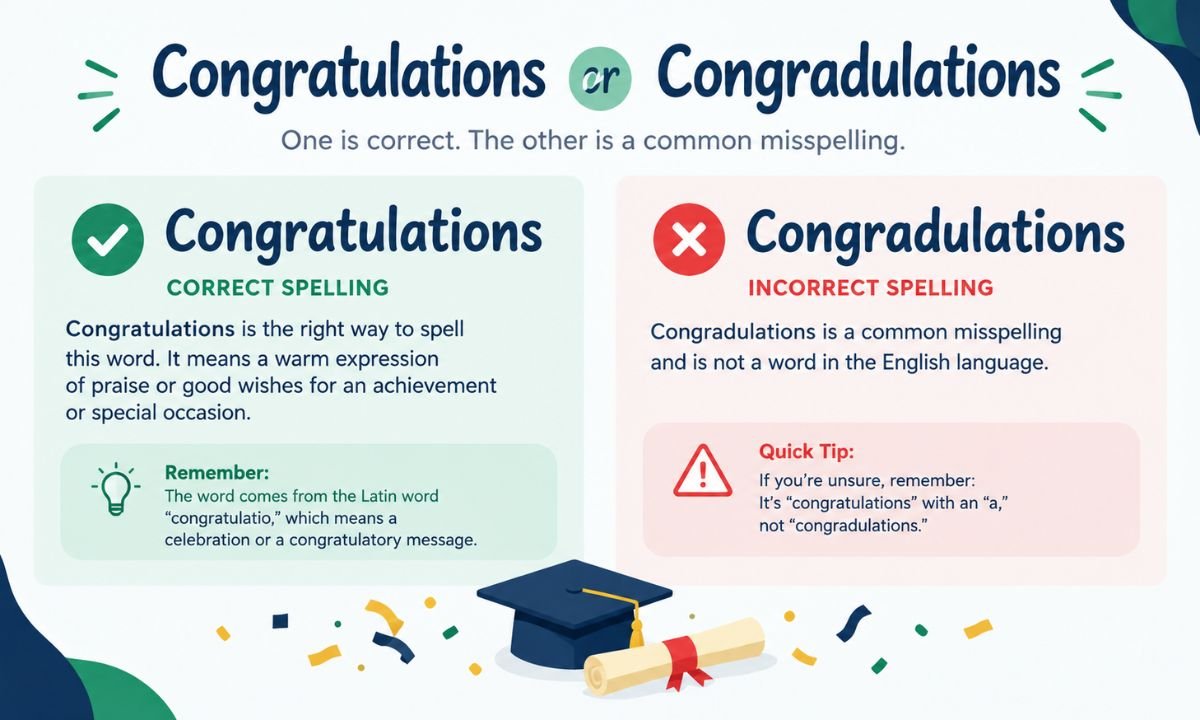
“Congratulations” is the only correct spelling. “Congradulations” is a misspelling, and it doesn’t appear in any standard English dictionary, whether American, British, or otherwise.
The word contains a “t,” not a “d.” That single letter is the entire source of confusion, because when people say the word out loud quickly, the “t” often sounds like a soft “d.” Your ears hear “congradulations,” but your keyboard should type “congratulations.”
Here’s the breakdown of the word so the spelling sticks:
- con-grat-u-la-tions
- The root comes from the Latin word gratulari, meaning “to show joy” or “to wish someone well”
- The “t” belongs to that root, so it never changes to a “d,” no matter how the word is pronounced
Examples:
- Correct: Congratulations on your new job!
- Incorrect: Congradulations on your new job!
- Correct: She sent congratulations to the newlyweds.
- Incorrect: She sent congradulations to the newlyweds.
- Correct: Congratulations, you passed the exam.
- Incorrect: Congradulations, you passed the exam.
If you remember nothing else from this article, remember this: there is a “t” in the middle, not a “d.” Say it slowly in your head — con-grat-u-la-tions — and the correct spelling becomes much easier to picture.
The Origin of Congratulations or Congradulations
Understanding where a word comes from usually makes it easier to spell, and “congratulations” is no exception.
The word traces back to Latin. It combines two parts:
- The prefix com-, meaning “with” or “together”
- The root gratulari, meaning “to give thanks” or “to show joy”
Put together, the original sense of the word was something close to “to share joy with someone” or “to wish someone well together.” That Latin root passed into Old French and then into English sometime around the 15th century, arriving with the “t” fully intact. English speakers have used the word in its current form, congratulations, for hundreds of years. There has never been an official or historical version spelled with a “d.”
“Congradulations” isn’t an older form of the word, a regional variant, or a simplified version that caught on over time. It’s simply a spelling error, and a fairly recent one in terms of how often it shows up in writing, largely thanks to text messages, social media captions, and quick typing where autocorrect doesn’t always catch the mistake.
Why does “congradulations” exist?
The misspelling survives for a few practical reasons, and none of them make it correct:
- Pronunciation blending. In casual, fast speech, the “t” sound softens and can sound almost identical to a “d.” Linguists call this a form of consonant flapping, and it’s common in everyday American English pronunciation of words like “water,” “better,” and “congratulations.”
- Visual association with similar words. Words like “graduate” and “graduation” contain a “d” and share a similar rhythm, so the brain sometimes borrows that letter by mistake.
- Muscle memory from typing quickly. People who type the word often, especially on phones, sometimes build a habit around the wrong spelling without noticing.
- Lack of double-checking. Because the word is used so casually and so often, people rarely pause to verify the spelling before hitting send.
None of these reasons change the fact that “congratulations” is the only accepted spelling in dictionaries, style guides, and formal writing standards.
British English vs American English Spelling
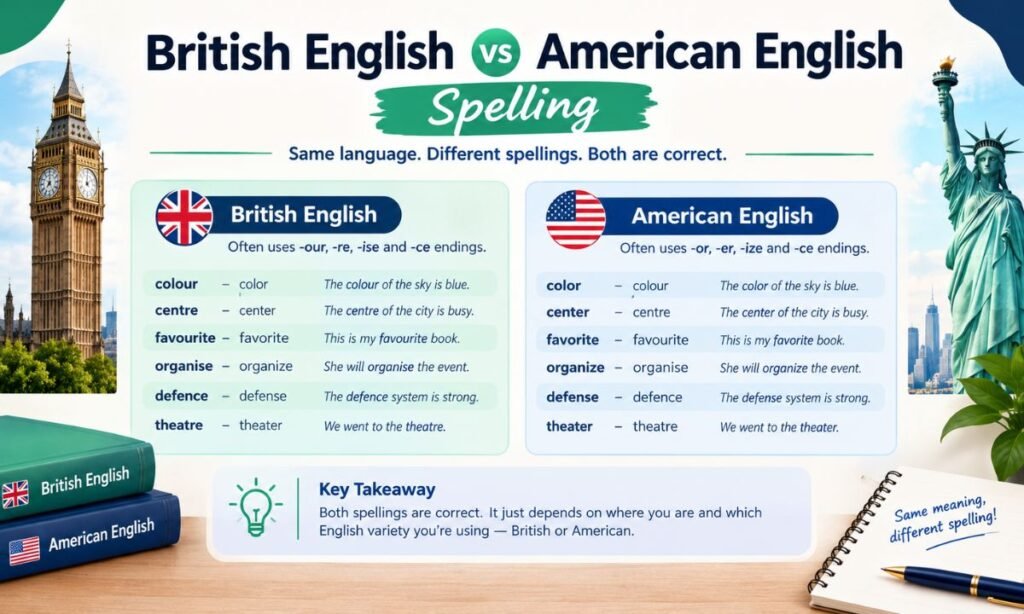
One question that comes up often: does the spelling change depending on whether you’re writing in British English or American English? The short answer is no.
Unlike words such as “colour” and “color,” or “organise” and “organize,” which do have regional spelling differences, “congratulations” is spelled exactly the same way in both varieties of English. There’s no British version with extra letters and no American shortcut. The word is identical on both sides of the Atlantic, as well as in Australian, Canadian, and Indian English.
This makes “congratulations” one of the more reliable words in English, at least in terms of spelling. The only real issue writers run into is the “t” versus “d” confusion covered above, not a regional variation.
Comparison Table
| Spelling | Region | Status |
|---|---|---|
| Congratulations | American English | Correct |
| Congratulations | British English | Correct |
| Congratulations | Australian English | Correct |
| Congratulations | Canadian English | Correct |
| Congradulations | Any region | Incorrect |
| Congraduation | Any region | Incorrect |
| Congradulate | Any region | Incorrect |
As the table shows, there’s no version of English where the “d” spelling is accepted. If you see “congradulations” written anywhere, including on a printed card or a business sign, it’s a mistake, not a regional style choice.
Which Spelling Should You Use?
This one is simple: always use “congratulations.” There’s no scenario, formal or informal, where “congradulations” is the right call. That said, how you use the correct word can shift depending on who’s reading it.
Based on your audience:
- Close friends and family: A relaxed, shortened form like “Congrats!” works fine in texts or casual messages. It’s friendly, quick, and universally understood.
- Coworkers and professional contacts: Use the full word, “Congratulations,” especially in emails. It reads as more polished and respectful in a workplace setting.
- Clients, business partners, or formal letters: Stick with the complete spelling and consider expanding the sentence slightly, such as “Please accept my congratulations on your promotion,” rather than a bare one-word message.
- Graduation cards, wedding cards, or milestone cards: The full spelling is expected here. Handwritten or printed cards are exactly the place where a misspelling stands out the most, since there’s no autocorrect to catch it.
- Social media captions: Either “Congrats” or “Congratulations” is acceptable, but double-check your spelling before posting, since typos on public posts tend to get noticed and screenshotted.
A good rule of thumb: the more formal or permanent the message, the more important it is to write out the full, correct spelling rather than relying on a shortcut.
Common Mistakes with Congratulations or Congradulations
Spelling errors around this word tend to fall into a few predictable patterns. Recognizing them makes it much easier to catch a mistake before you hit send or print.
Common Mistakes
- Congradulations (swapping the “t” for a “d”)
- Congraduations (adding an extra letter that mimics “graduation”)
- Congradulate (the verb form of the same mistake)
- Congradulatory (the adjective form of the same mistake)
- Congratulasions (misplacing the “t” and “s”)
- Congratualtions (letters swapped out of order)
- Congrats with an extra “d,” written as “congrads”
Correct Forms
| Incorrect | Correct |
|---|---|
| Congradulations | Congratulations |
| Congraduations | Congratulations |
| Congradulate | Congratulate |
| Congradulatory | Congratulatory |
| Congrads | Congrats |
| Congratualtions | Congratulations |
A helpful trick for remembering the correct spelling is linking it to related words that also contain a “t”:
- Congratulate (verb)
- Congratulatory (adjective)
- Congratulator (someone who congratulates, though rarely used)
Every single one of these related words keeps the “t.” If you can spell “congratulate” correctly, “congratulations” follows the same pattern with a few extra letters at the end.
Congratulations or Congradulations in Everyday Examples
Seeing the word used correctly across different formats can help reinforce the spelling in your memory. Below are realistic examples from the kinds of writing where this word shows up most often.
Emails
- “Congratulations on closing the deal with the new client. The whole team is thrilled for you.”
- “I wanted to send my congratulations on your recent promotion to team lead.”
- “Congratulations on five years with the company. Here’s to many more.”
Workplace emails almost always call for the full spelling, since a typo here can come across as careless, especially in a message meant to celebrate someone’s achievement.
News Headlines
- “Congratulations Pour In for Local Team After Championship Win”
- “City Council Sends Congratulations to Retiring Fire Chief”
- “Congratulations to This Year’s Scholarship Recipients”
News writing follows strict editorial standards, so you’ll never see “congradulations” in a published headline from a credible outlet. If you ever spot it, it’s almost certainly a typo that slipped past an editor, not an accepted style.
Social Media
- “Congrats to my sister on her graduation! So proud of you 🎓”
- “Congratulations to everyone who finished the marathon today!”
- “Big congrats to the newlyweds 💍”
Social captions are more casual, so shortened forms like “congrats” are common and completely fine. Still, whenever the full word appears, it should carry the correct spelling.
Formal Writing
- “On behalf of the board, please accept our sincere congratulations on your appointment as director.”
- “The committee extends its congratulations to all graduates of this year’s program.”
- “Congratulations are in order for the entire research team on this remarkable achievement.”
Formal documents, certificates, award letters, and official announcements are exactly where a spelling mistake stands out most. These are also the places where readers are least forgiving of typos, since the tone is meant to be polished and deliberate.
Frequently Asked Questions
Why do people say congradulations instead of congratulations?
The mix-up happens because the “t” sound blends into a soft “d” sound during quick, casual speech, a pattern linguists call flapping. The ear picks up “congradulations,” but the correct spelling always keeps the “t.”
Is it congradulations or congratulations for graduation?
It’s “congratulations,” even in the context of graduation. The similarity to the word “graduation” is exactly why people mistakenly add a “d,” but the spelling of “congratulations” never changes based on the occasion.
Is congradulation a word?
No. “Congradulation” is not a recognized word in any English dictionary. The correct singular form is “congratulation,” and the word is almost always used in its plural form, “congratulations.”
Is it congrats or congrads?
“Congrats” is correct. It’s the accepted short form of “congratulations” and keeps the “t” from the original word. “Congrads” is a misspelling and should be avoided in writing.
Conclusion
“Congratulations” is spelled with a “t,” never a “d,” and that holds true across American English, British English, and every other regional variety. The confusion comes down to pronunciation, not grammar or regional style, so once you separate how the word sounds from how it’s written, the spelling becomes much easier to lock in.