
I typed “time flys” in a text message last year, hit send, and immediately felt that little stomach drop you get when you know something looked off. My friend didn’t say anything, but I went down a rabbit hole that night trying to figure out why my fingers had betrayed me. Turns out, I’m far from the only one who has typed this phrase wrong. So I dug through grammar guides, old English textbooks, and a stack of real examples to settle this once and for all.
Here’s what I found, laid out in a way that will actually stick with you.
My Quick Answer
“Time flies” is correct. “Time flys” is always wrong, in every context, in every style guide.
There’s no debate here, no British-versus-American split, no exception hiding in academic writing. If you remember one thing from this article, remember that. Everything below explains why, so the rule finally makes sense instead of just being something you memorized.
Why I Found It’s “Time Flies”
When I first started researching this, I expected some obscure exception to pop up. It didn’t. The reason “time flies” wins is baked into basic English verb conjugation, something most of us learned in grade school and then forgot the moment autocorrect started doing the thinking for us.
“Time” is a singular noun. In English, when a singular subject (think “he,” “she,” “it,” or in this case “time”) pairs with a present-tense verb, that verb usually needs an -s or -es ending. Regular verbs get a simple -s: he runs, she talks, it works. But verbs that end in a consonant followed by the letter y behave differently, and “fly” is exactly that kind of verb.
I noticed that people who get this wrong almost always mix up two separate grammar patterns:
- The rule for making regular nouns plural (fly → flies, meaning more than one flying insect)
- The rule for conjugating a verb in third-person singular present tense (fly → flies, meaning the action one thing performs)
Both processes land on the same spelling, “flies,” which is honestly a strange coincidence of English. But because the destination is identical, a lot of writers assume the noun-plural logic (“add an s and swap the y”) somehow applies loosely to verbs too, and they land on “flys” by accident. It doesn’t exist as a correct form for either the noun or the verb.
The Grammar Rule I Discovered
Once I looked at “fly” the way a linguist would, the pattern became obvious:
| Subject | Verb Form | Example |
|---|---|---|
| I / You / We / They | fly | They fly to Chicago every summer. |
| He / She / It / Time | flies | Time flies when the deadline is close. |
Notice that only the third-person singular row picks up the -ies ending. That single row is where “time” belongs, since it behaves grammatically like “it.” Once I saw the table laid out this way, the confusion I’d carried around for years just evaporated.
The Consonant + Y Rule I Learned
Here’s the piece that actually explains the spelling, not just the grammar. English has a quiet but consistent rule for words ending in “y”:
- If a consonant comes right before the final y, change the y to i and add -es (fly → flies, cry → cries, try → tries).
- If a vowel comes right before the final y, just add -s and leave the y alone (play → plays, stay → stays, enjoy → enjoys).
“Fly” ends in the letter y, and the letter right before it is L, a consonant. That single detail is why the correct form swaps the y for an i and tacks on -es. Compare that with a word like “play,” where the letter before the y is a, a vowel, so it simply becomes “plays,” no swap required.
I found this pattern holds up across dozens of common verbs, and once you see three or four examples side by side, it stops feeling like a random exception and starts feeling like a rule you already half-knew.
| Verb | Letter Before “Y” | Correct Third-Person Form |
|---|---|---|
| fly | l (consonant) | flies |
| cry | r (consonant) | cries |
| try | r (consonant) | tries |
| play | a (vowel) | plays |
| stay | a (vowel) | stays |
| enjoy | o (vowel) | enjoys |
Important Exception I Found
I want to be upfront about something most grammar articles gloss over: proper nouns don’t follow this rule. If a company is named “Sunny Flys Airlines” or someone’s last name happens to end in y, that spelling stays exactly as written, because names aren’t subject to standard pluralization or conjugation rules. That’s a naming choice, not a grammar exception for the verb “fly” itself. For the actual verb, used in ordinary sentences, there is no legitimate exception. “Time flies” and only “time flies” is correct in standard writing, formal or casual, British or American.
What “Time Flies” Means
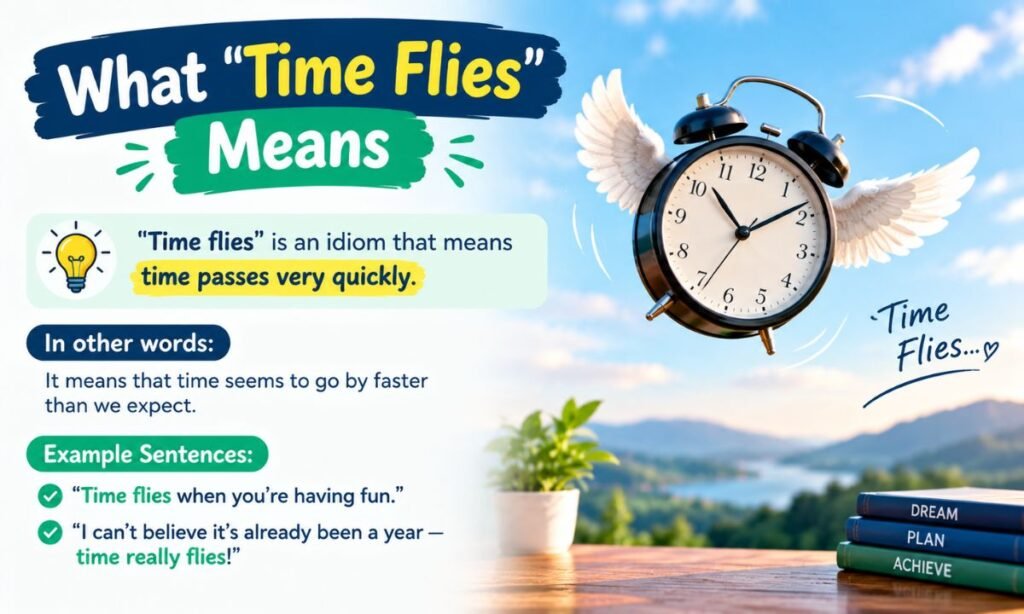
Grammar aside, this phrase carries real emotional weight, which is probably why it shows up so often in conversation, cards, and captions. At its core, “time flies” describes the sensation that time is passing faster than you expected, usually because you were absorbed in something, distracted, or simply not paying close attention to the clock.
I’ve noticed the phrase tends to show up in a handful of recurring situations.
1. Expressing Surprise
This is the most common use I’ve come across. Someone glances at a calendar, realizes months or years have slipped by, and reaches for this exact phrase because nothing else captures that jolt quite as well. “Wait, it’s already September? Time flies.”
2. Reflecting on Memories
People also use it when looking back, often with a mix of nostalgia and disbelief. A parent watching an old video of their toddler, now a teenager, might say it under their breath. It’s less about surprise in the moment and more about processing how much has changed.
3. “Time Flies When You’re Having Fun”
This extended version is arguably more common than the base phrase on its own. It pins the fast passage of time to enjoyment specifically, suggesting that engaging or pleasant experiences make hours feel like minutes. Researchers who study time perception have actually studied this effect, and the short version is that focused attention on something enjoyable really does shrink our sense of elapsed time.
4. “Time Flies By”
Adding “by” doesn’t change the meaning much, but it does shift the rhythm of the sentence and shows up frequently in more casual or spoken contexts. “The years just fly by” and “time flies by so fast” are both common, natural variations you’ll hear in everyday speech.
Common Mistakes I’ve Found and How to Avoid Them
After reading through comment sections, social captions, and even a few professional newsletters, I started keeping a informal list of where this goes wrong. A few patterns kept repeating.
- Applying noun logic to a verb. Writers see “flies” as the plural of the insect and assume the verb must follow different, simpler rules, so they default to “flys.” It’s an understandable mix-up, but the verb and the noun happen to share the identical correct spelling.
- Trusting autocorrect too much. Some keyboards and browsers won’t flag “flys” as a misspelling if it appears in a name or brand somewhere in their dictionary, so the red squiggly line doesn’t always save you.
- Overcorrecting out of second-guessing. A few people know the rule, then talk themselves out of it because “flys” looks more like a typical plural. When in doubt, go back to the base test: is “time” acting like “it” here? If yes, the verb needs the -ies ending.
- Copying a mistake they’ve seen elsewhere. Once an incorrect spelling appears on a poster, mug, or greeting card, people sometimes assume it must be an accepted stylistic variant. It isn’t. Commercial products get grammar wrong more often than people expect.
A simple gut check works almost every time: replace “time” with “it” in your head. “It flies” sounds correct and reads naturally, while “it flys” would look obviously wrong to nearly everyone. That mental swap catches the mistake before it ever reaches the page.
Real-World Examples I’ve Collected
Seeing the phrase used in different settings helped me internalize the correct spelling faster than any rule ever did. Here are a few realistic examples pulled together from common everyday writing situations.
Example 1: Social Media Post
“Can’t believe my daughter starts kindergarten next week. Time flies! Feels like she was just born.”
Example 2: Birthday Card
“Happy 30th! Time flies, but the memories we’ve made together only get better with age.”
Example 3: Work Email
“Just a quick note, time flies and I realized we haven’t followed up since our call last month. Let’s schedule something this week.”
Example 4: Conversation
“Wow, has it really been ten years since we graduated? Time flies.”
Across every one of these, the pattern holds steady: singular subject, matching verb ending. None of them would read naturally with “flys” swapped in, which is a good informal test if you ever want to double-check your own writing.
Time Flies vs Time Flys: My Summary Table
| Feature | Time Flies | Time Flys |
|---|---|---|
| Grammatically correct | Yes | No |
| Follows consonant + y rule | Yes | No |
| Accepted in formal writing | Yes | Never |
| Accepted in casual writing | Yes | Never |
| Regional variation (US/UK) | None, same everywhere | Not applicable |
| Common cause of error | Confusing noun plural with verb form | Autocorrect gaps, second-guessing |
Other Common Variations I Found
Once I started noticing this phrase, I realized it shows up in more shapes than I expected. Some are just as correct as the original, while others are casual spins people use in speech.
- Time flies when you’re having fun
- Time really does fly
- The years fly by
- Doesn’t time fly?
- Time sure flies these days
- How time flies
Key Pattern I Noticed
Whenever “time” is the direct singular subject acting in present tense, the verb needs “flies.” But notice “the years fly by” uses “fly” instead, because “years” is plural, not singular. Same logic, different subject, different verb form. And “doesn’t time fly?” uses the base form “fly” because it follows the helping verb “does,” which already carries the third-person marker for you. English does this a lot: once a sentence has “does,” “do,” or “did” doing the conjugating, the main verb drops back to its plain form.
Memory Tips I Use to Remember the Rule
I’ve tried a handful of memory tricks over the past year, and a few of them actually stuck.
Memory Trick #1: The “Baby” Method
Think of “baby” turning into “babies” in the plural. Same consonant-plus-y pattern, same swap. If you can remember one baby becomes two babies, you already know why one flying moment becomes “time flies.”
Memory Trick #2: The French Fry Test
French fry becomes French fries, never “frys.” Picture a plate of fries next time you’re unsure, and the correct spelling of “flies” should follow right along with it.
Memory Trick #3: The Real Flies
Picture actual houseflies buzzing around a picnic. One fly, many flies. That mental image of the insects, oddly enough, reinforces the exact spelling you need for the verb too, since both land on the same four letters.
Other Words That Follow the Same Rule
Once this pattern clicked for me, I started spotting it everywhere. Here’s a short list of everyday verbs that behave exactly like “fly” does.
| Base Verb | Third-Person Singular |
|---|---|
| cry | cries |
| try | tries |
| deny | denies |
| carry | carries |
| worry | worries |
| study | studies |
| apply | applies |
| supply | supplies |
Pro Tip I Learned
If a verb ends in a consonant plus y, drop the y, add -ies, and you’re set for third-person singular present tense almost every single time. It’s one of the more reliable rules in English, without the pile of exceptions that trip people up elsewhere in the language.
Frequently Asked Questions
Which is correct, flys or flies?
“Flies” is correct. “Flys” is not a standard English word in any context involving the verb “fly.”
How time flies or flys?
The correct phrasing is “how time flies,” since “time” is a singular subject and needs the -ies verb ending.
Is it okay to say time flies?
Yes, “time flies” is grammatically correct and widely used in both casual and formal English.
How time flies meaning?
It means time seems to pass unusually fast, often noticed with surprise when looking back on recent months or years.
Wrapping It Up
“Time flies” isn’t one of those grammar rules that only matters to editors and English teachers. It’s a phrase people reach for constantly, in birthday cards, work emails, and late-night texts about how fast a year went by. Getting it right comes down to one small fact: “time” behaves like a singular subject, and singular subjects that end in a consonant plus y swap that y for -ies.