
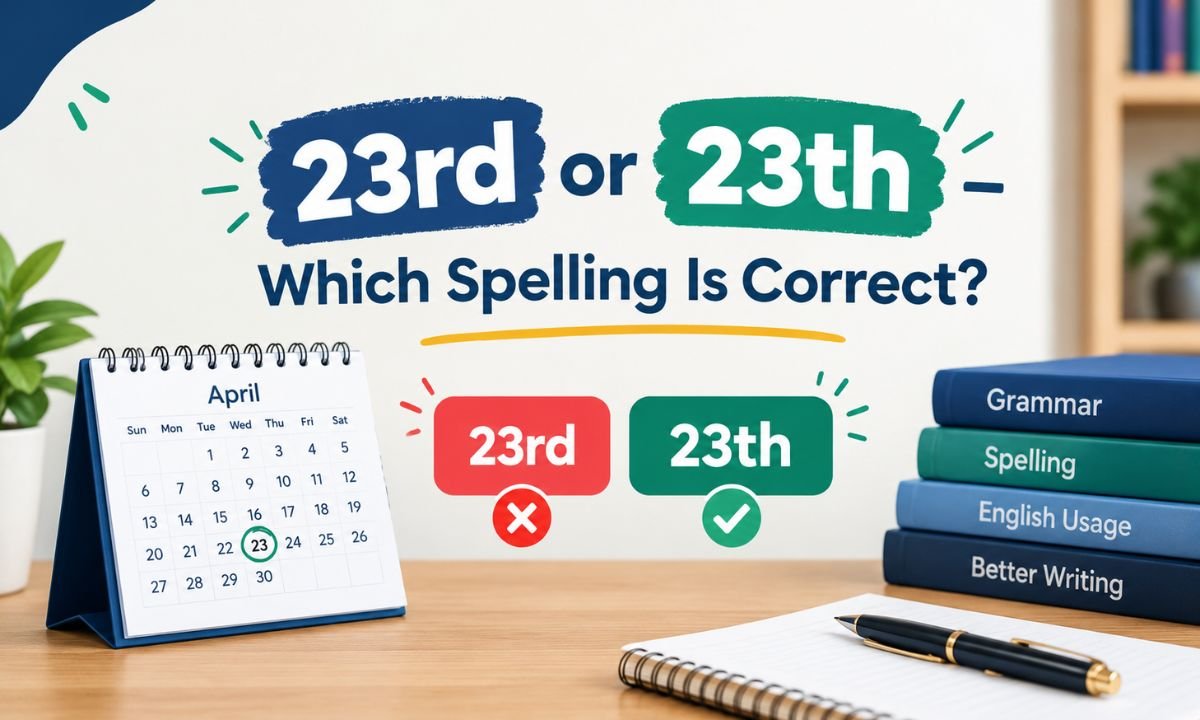
Short answer: the correct form is 23rd. “23th” is a spelling mistake, and no dictionary or major style guide accepts it.
Plenty of people still type it. The word “twenty-third” ends with a “th” sound, so the brain adds “th” to the numeral without checking. That habit is the whole reason this question gets searched so often.
This guide settles it. You’ll see why 23rd is right, why 23th feels right to so many writers, and how to write the number correctly in dates, birthdays, floors, addresses and formal documents. There is also a set of quick FAQ answers near the end.
Quick reference
| Form | Correct? | Note |
|---|---|---|
| 23rd | Yes | Standard written form |
| twenty-third | Yes | Spelled-out form, hyphenated |
| 23th | No | Common typing error |
| 23nd | No | Mixes up the 2 and 3 rules |
| 23st | No | Mixes up the 1 rule |
| 23d | Rare | Used in some legal styles only |
23rd
“23rd” is the ordinal form of the number 23. An ordinal number shows position in a sequence: first, second, third, and so on. A cardinal number shows quantity: one, two, three.
So “23” tells you how many things there are, while “23rd” tells you which one you mean. If 23 people enter a race and you cross the line in position twenty-three, you finished 23rd.
Why the ending is “rd”
The suffix comes from the last word of the spelled-out number. Twenty-three becomes “twenty-third” as an ordinal, and “third” ends in the letters r and d. Those two letters get attached to the numeral, which gives you 23rd.
The same thing happens with the smaller numbers:
- first gives 1st
- second gives 2nd
- third gives 3rd
- fourth gives 4th
Each numeral borrows the last two letters of its word. Nobody writes “3th” because nobody spells the word “thirth.” The word is “third,” so the numeral is 3rd. Twenty-three follows the pattern exactly, since its ordinal word is “twenty-third.”
The suffix rule in one table
You don’t need to memorize every number. You only need the last digit, plus one exception for the teens.
| Last digit | Suffix | Examples |
|---|---|---|
| 1 (not 11) | -st | 1st, 21st, 101st |
| 2 (not 12) | -nd | 2nd, 22nd, 102nd |
| 3 (not 13) | -rd | 3rd, 23rd, 103rd |
| 0, 4 to 9 | -th | 4th, 10th, 20th |
| 11, 12, 13 | -th | 11th, 12th, 13th |
Since 23 ends in 3 and isn’t 13, it takes “-rd.” That settles it.
The exception that trips people up
Numbers ending in 11, 12 and 13 always take “-th.” That is why we say 11th, 12th and 13th, and also 111th, 112th and 113th.
This exception is probably the source of the 23th mistake. Writers remember that 13 becomes 13th, then carry that “th” over to 23 because the two numbers look alike. The teen rule stops at the teens. Once you reach 23, 33, 43 and beyond, the number ends in a plain 3, and the normal “-rd” rule applies again.
How to say and spell 23rd
You say it “twenty-third.” The stress falls on the first part, and the final sound is the “th” of “third.” That final sound is exactly what misleads writers, because the spoken word ends in “th” while the written numeral ends in “rd.”
When you spell it out, use a hyphen between the two parts: twenty-third. English hyphenates compound ordinals and cardinals from 21 through 99. So you get twenty-first, twenty-second, twenty-third and thirty-fourth.
Where you’ll see 23rd used
Here are the situations where this number turns up most, each with a sample sentence.
- Dates: “The meeting is on the 23rd.”
- Birthdays: “She is celebrating her 23rd birthday this weekend.”
- Anniversaries: “They marked their 23rd wedding anniversary in Lisbon.”
- Floors: “His office is on the 23rd floor.”
- Streets: “The bakery sits on West 23rd Street.”
- Rankings: “Our team finished 23rd out of 40.”
- Numbered events: “The 23rd annual charity run starts at dawn.”
Some well-known uses of the term come from history and public life:
- The 23rd Amendment to the U.S. Constitution, ratified in 1961, gave residents of Washington, D.C. the right to vote for president.
- The XXIII Olympic Winter Games were held in PyeongChang in 2018, and the XXIII Olympiad (Summer Games) took place in Los Angeles in 1984.
- Psalm 23, often called the 23rd Psalm, is one of the most quoted passages in the Bible.
- 23rd Street in Manhattan is one of the city’s major cross streets.
In every one of these, the written form is 23rd. You will never see an official document, a legal text or a published reference use “23th.”
Should the letters be superscript?
Word processors often shrink the letters automatically, so “23rd” turns into 23<sup>rd</sup>. Both versions are fine. Superscript looks neat in print, while regular-size letters are simpler for emails, texts and web pages. Pick one style and keep it consistent within the same document.
23th
Now the other side. “23th” is not a real ordinal spelling. It doesn’t appear in standard dictionaries, grammar references or style manuals. If you spot it in a piece of writing, it is a slip.
Why people write it anyway
Most writers who type “23th” know English well. The error happens for understandable reasons.
- The sound leads the spelling. “Twenty-third” finishes with a “th” sound, so the hand adds “th.”
- Most ordinals end in -th. From 4th to 20th, nearly every ordinal takes that ending. The brain treats “-th” as the default.
- The 13th exception spreads. As covered above, 13 takes “-th,” and writers wrongly stretch that to 23.
- Autopilot typing. People write dates quickly and rarely stop to check a suffix they have used thousands of times.
- Non-native learners. Learners who study the “-th” ending first sometimes apply it more widely than the rule allows.
None of this makes the spelling acceptable. It only explains why the error is so persistent.
Why “23th” cannot be correct
An ordinal suffix is not a free choice. It is a shortened copy of the ending of the full word. Look at how the word behaves:
- twenty-three becomes twenty-third
- the final letters of “third” are rd
- so the numeral must end in rd
For “23th” to be right, the spelled-out word would have to be “twenty-threeth” or “twenty-thirth,” and neither exists. The numeral has to match the word, and it doesn’t.
Related mistakes worth avoiding
Once you understand why 23th fails, several other errors make sense too.
| Mistake | Why it’s wrong | Correct form |
|---|---|---|
| 23th | “third” ends in -rd | 23rd |
| 23nd | -nd belongs to numbers ending in 2 | 23rd |
| 23st | -st belongs to numbers ending in 1 | 23rd |
| 33th | Same error, different tens digit | 33rd |
| 103th | Ends in 3, not a teen | 103rd |
| 113rd | 113 is a teen number | 113th |
Notice the last two rows. Even large numbers follow the same logic, because only the final two digits matter. So 103rd takes “-rd,” while 113th takes “-th.”
Is there ever a place for “23d”?
There is a real variant you may meet: 23d. Some legal citation styles shorten 2nd and 3rd to “2d” and “3d,” and by extension write 23d. Legal writers in the United States sometimes use this in case citations and court documents.
Outside those settings, it looks odd. For emails, articles, invitations, school papers and general business writing, stick with 23rd.
Which Is Used the Most?
23rd is used almost exclusively in published writing. “23th” turns up mostly in casual messages, comment threads and quick social posts, and it is treated as an error wherever editors are involved.
I could not find a trustworthy published frequency count for the two spellings, and I won’t make up percentages. If you want hard numbers, Google’s Ngram Viewer lets you compare “23rd” and “23th” across a large body of printed books. The result is lopsided. The correct form dominates and the misspelling barely registers.
There is one more sign of how the two are seen. Grammar and language-learning sites publish full explainers on this exact pair, and they all give the same verdict. Nobody writes a page arguing that 23th is acceptable, because there is no argument to make.
Usage by context
| Context | Standard form | Where “23th” might appear |
|---|---|---|
| Books, news and journals | 23rd | Almost never |
| Government and legal documents | 23rd (or 23d in some legal styles) | Never |
| School and academic writing | 23rd or twenty-third | Student drafts, corrected in editing |
| Business emails | 23rd | Rushed messages |
| Social media | 23rd | Casual posts and captions |
| Search queries | Both | People checking which is right |
That last row explains why this page exists. Plenty of people type both versions into a search bar just to confirm, which is a sensible habit.
Fresh reference: upcoming 23rd dates
Here is a practical example. The next few months of 23rd dates fall on these days:
| Date | Day of the week |
|---|---|
| September 23, 2026 | Wednesday |
| October 23, 2026 | Friday |
| November 23, 2026 | Monday |
| December 23, 2026 | Wednesday |
| January 23, 2027 | Saturday |
In each case, the written form is “the 23rd,” and in speech it is “the twenty-third.”
How to Write 23rd in Different Situations
Getting the suffix right is step one. Step two is choosing between the numeral and the spelled-out word, and that depends on the setting.
Writing dates
Date styles differ around the world, and the suffix habit changes with them.
| Style | Example | Common region |
|---|---|---|
| Month, day, year | September 23, 2026 | United States |
| Day, month, year | 23 September 2026 | UK and much of the world |
| With suffix | September 23rd, 2026 | Informal US writing |
| With “the” and “of” | the 23rd of September | Informal UK writing and speech |
| All numeric | 23/09/2026 or 09/23/2026 | Varies by country |
Be careful with the all-numeric format. A date like 03/04/2026 means March 4 in the U.S. and April 3 in many other countries. The 23rd is safe in this respect, because no month has a 23rd month number, so 09/23/2026 can only be read as September 23. That small quirk can help you spot which format a document uses.
What the major style guides say
Style guides do not agree with each other about ordinals in dates, so it helps to know the difference.
- AP style drops the suffix in dates. You write “Sept. 23,” not “Sept. 23rd.”
- Chicago style prefers spelled-out ordinals in running text for numbers under one hundred, such as “the twenty-third of the month,” while writing dates as “September 23.”
- Everyday and business writing usually accepts “September 23rd” as normal.
The takeaway is that the suffix is optional in many formal date formats. When you do use it, though, it must be “rd.”
Birthdays and anniversaries
For a milestone, the ordinal numeral or the spelled-out word both work:
- “Happy 23rd birthday!”
- “Her twenty-third birthday fell on a Sunday.”
- “We celebrated our 23rd anniversary quietly at home.”
On a card, banner or invitation, the numeral is friendlier. In a formal letter or a piece of formal prose, the spelled-out form reads better.
Floors and buildings
Ordinals label floors the same way they label anything else: “the 23rd floor,” “the 23rd storey” in British English. Some buildings skip the 13th floor for superstitious reasons, but the 23rd floor keeps its name and takes “-rd” regardless.
Addresses and street names
Numbered streets use the ordinal numeral, as in “West 23rd Street.” Mapping services, postal databases and signage all use the “-rd” form. If you type “23th Street” into an address field, some systems will fail to match it, which makes this a practical concern as well as a grammatical one.
Sports, rankings and places
The numeral is standard for results: “She placed 23rd in the marathon.” Sports tables, race results and ranked lists all use it. Again, “23th” would be treated as a typo.
Numbers within larger figures
The rule works on the final digits, so you can build the correct suffix for any number:
| Number | Suffix | Written form |
|---|---|---|
| 23 | -rd | 23rd |
| 33 | -rd | 33rd |
| 63 | -rd | 63rd |
| 103 | -rd | 103rd |
| 123 | -rd | 123rd |
| 1,023 | -rd | 1,023rd |
| 113 | -th | 113th |
Every number here ends in 3, so every one takes “-rd,” apart from 113, which lands in the teen exception.
Easy Ways to Remember 23rd
A few habits make the correct form automatic.
- Say the small number first. Think of 3rd. You would never write “3th,” so you won’t write 23th.
- Check the last digit only. For ordinals, the digits in front don’t change the suffix (with the teen exception).
- Hear “third,” see “rd.” The spoken word ends in a “th” sound, but the letters you need are the last two of the word “third.”
- Watch for teens. If the number ends in 11, 12 or 13, use “-th.” If it doesn’t, follow the last digit.
A short check you can run in five seconds:
- Look at the last two digits.
- If they are 11, 12 or 13, write “th.”
- Otherwise, look at the last digit: 1 is “st,” 2 is “nd,” 3 is “rd.”
- Anything else is “th.”
For 23, the last two digits are 23, which isn’t a teen, and the last digit is 3, so the answer is “rd.”
Practice: Pick the Right Form
Try these quickly, then check the answers underneath.
- Her ___ birthday is next Friday. (23rd / 23th)
- The office is on the ___ floor. (23rd / 23th)
- We meet on the ___ of March. (23rd / 23th)
- It was the ___ time he had visited. (33rd / 33th)
- She finished ___ in the ranking. (113rd / 113th)
Answers: 1. 23rd. | 2. | 23rd. 3. 23rd. 4. 33rd. 5. 113th.
Why Getting This Right Matters
Some readers wave off ordinal errors as trivia, and in casual chat that is fair. In other settings the small slip costs you credibility.
On a résumé, a cover letter or a client email, an ordinal error is one of the quick things a reader spots, and it can make careful writing look careless. On a wedding invitation or a business announcement, it is printed for everyone to see. For a website or a piece of marketing copy, it can reduce trust in an otherwise solid page.
It also affects searchability. People looking for “23rd Street,” “23rd Amendment” or “23rd anniversary” type the correct form, so content that uses “23th” can miss those searches.
The good news is that the rule is short and has no real exceptions beyond the teens. Once you have seen it laid out, it is easy to apply.
Frequently Asked Questions
Is it 23rd or 23th in date?
It is 23rd, as in “September 23rd.” Many formal styles drop the suffix entirely and write “September 23.”
Is it “23rd” or “23th” birthday?
Write “23rd birthday.” The numeral takes “-rd” because it ends in 3.
Is it 23rd floor or 23th floor?
It is the 23rd floor. “23th floor” is a spelling error.
How to write 23rd?
Write the digits 23 followed directly by “rd,” with no space: 23rd. In words, write it with a hyphen: twenty-third.
Why is 23 not written as 23th?
The spelled-out ordinal is “twenty-third,” which ends in “rd” when abbreviated. The “th” you hear is part of the word “third,” not the suffix.
Is 23d correct?
It is a shortened form used in some legal writing. For general use, 23rd is the standard.
Do I need a superscript for 23rd?
No. Both 23rd and 23<sup>rd</sup> are correct, so choose one style and stay consistent.
Conclusion
The answer is simple: 23rd is the only correct written form, and 23th is a mistake. The suffix comes from the last word of the spelled-out ordinal, “twenty-third,” which ends in “rd.” That matches the way 3rd, 33rd and 103rd are written.
The error survives because the spoken word ends in a “th” sound and because most ordinals take “-th.” The teen exception (11th, 12th, 13th) adds to the muddle. Once you know that only the last digit matters, apart from those teens, the pattern is easy to follow.