

The plural of chief is chiefs, not chieves. Chief follows the regular rule, so you just add an s. Chieves isn’t a correct English word, even though thief becomes thieves and leaf becomes leaves in everyday writing.
The confusion is understandable, since many nouns ending in f switch to ves. This guide explains why chief skips that pattern and shows the plural of chief in real sentences, with British English notes included.
Quick Answer
The plural of chief is chiefs. You add a plain s, exactly as you do with roof and brief. The f stays put, and no ves ending appears in standard American or British English writing.
Example: The tribal chiefs met before sunrise to sign the agreement.
Chief vs Chieves: Clearing the Confusion
Chief is correct in the singular and chiefs is correct in the plural. Chieves has no place in dictionaries. It only looks believable because it copies the pattern of thief and thieves.
Writers reach for chieves because the two words sound alike. Both end in a long e followed by an f sound, so the brain assumes they share a plural. Spelling rarely follows sound that neatly.
Example: Wrong: The two chieves arrived late. Right: The two chiefs arrived late.
English Plural Rules for Nouns Ending in -F
Nouns ending in f or fe take one of two routes. Some switch to ves, while many others simply add s. Nothing in the spelling tells you which route a word takes, so memory does the work.
The ves group is mostly older Germanic words such as leaf, wolf, knife and shelf. Words that arrived later, often through French, usually keep the f and take a plain s. Chief sits in that second camp.
| Pattern | Singular | Plural |
|---|---|---|
| f to ves | wolf | wolves |
| f to ves | leaf | leaves |
| plain s | chief | chiefs |
| plain s | roof | roofs |
Example: One wolf becomes two wolves, but one chief becomes two chiefs.
Why Chief Follows the Regular Plural Rule
Chief takes a plain s because English borrowed it from French rather than inheriting it from the older Germanic stock. The word kept its f and picked up the default English plural ending.
Chief comes from Old French chef, which traces back to Latin caput, meaning head. Borrowed words usually receive the standard s ending. That history explains the split far better than any spelling trick could.
Example: The fire chiefs from neighboring counties shared one radio channel.
Example Sentences Using Chiefs
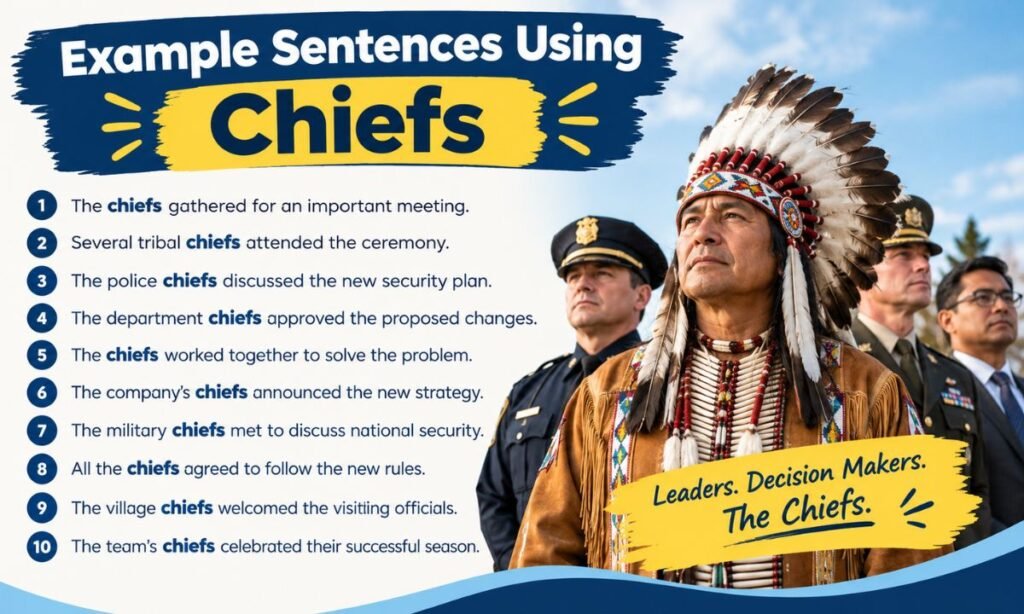
The plural of chief works like any regular noun, so you can drop chiefs into a sentence without changing anything else around it. These sentences show it in casual, formal and team-name contexts.
- Example 1: The police chiefs agreed to share their training data.
- Example 2: The village chiefs gathered under the old banyan tree.
- Example 3: The Kansas City Chiefs are an NFL team, and the s is part of the official name.
- Example 4: The Joint Chiefs of Staff advise the president on military matters.
Related Plurals of Similar Words
Most words ending in ief behave exactly like chief. Belief, brief and relief all take a plain s, and thief is the one common word that breaks away with thieves.
The table below keeps the pairs side by side, which makes the pattern easier to spot and remember.
| Singular | Plural |
|---|---|
| chief | chiefs |
| belief | beliefs |
| brief | briefs |
| relief | reliefs |
| thief | thieves |
| handkerchief | handkerchiefs |
Example: The lawyers filed two briefs on Monday.
Common Grammar Mistakes
The two biggest slips are writing chieves and adding a stray apostrophe. Both disappear once you remember that the plural of chief is just chiefs, with nothing extra attached.
Compound titles cause trouble too, because writers pluralize the wrong word. The table shows the most frequent errors next to their fixes.
| Wrong | Right |
|---|---|
| chieves | chiefs |
| the chief’s arrived | the chiefs arrived |
| chiefes | chiefs |
| chiefs executive officer | chief executive officers |
Example: Wrong: The chief’s signed the deal. Right: The chiefs signed the deal.
Quick Grammar Tip
Treat every word ending in ief as a plain s word, and remember thief as the single exception. That shortcut covers chief, belief, brief and relief without any extra effort.
Say the singular, add s, and stop. If the result looks odd, check whether the word is thief or a close relative before you reach for ves.
Example: Belief becomes beliefs and chief becomes chiefs, but thief becomes thieves.
Plural of Chief Is Chieves (Is This Ever Correct?)
No, the plural of chief is never chieves in standard English. Major dictionaries list chiefs as the only plural, and style guides treat chieves as a spelling error.
You may spot chieves in casual posts, usually as a typo or a guess based on thieves. A spelling showing up online doesn’t make it correct, so stick with chiefs in anything you publish.
Example: If a friend texts “the chieves are here,” the fix is one swap: “the chiefs are here.”
Why Is the Plural of Chief Chiefs and Not Chieves?
Chief is a French loanword, and English gave it the default s ending. The ves change belongs to an older, separate group of native words that went through a sound shift.
In Old English, an f between vowels was pronounced like v, which is why leaf became leaves. Most French borrowings never joined that group. A few words, like scarf and hoof, allow both forms.
Example: English speakers say “leaves” but “chiefs,” so two neighboring words can follow different rules.
Plural of Chief in English
In general English, the plural of chief is chiefs in books, newspapers, legal writing and speech. Only compound titles need extra care, because the plural sometimes lands on a different word.
Titles like chief of staff and chief of police pluralize the first noun, giving chiefs of staff and chiefs of police. When chief works as an adjective, as in chief executive officer, the last noun takes the s.
Example: The chiefs of staff met privately, and the chief executive officers joined later.
Plural of Chief in British English
British English uses chiefs too. Spelling differences like colour and color don’t touch this word, so the form stays identical on both sides of the Atlantic.
UK titles follow the same logic as American ones. Chief constable and chief whip use chief as an adjective, so the plurals are chief constables and chief whips.
Example: The chief constables agreed on a shared policy for the region.
Plural of Cliff
The plural of cliff is cliffs. Nouns ending in a double f take a plain s, so cliffs never turns into clives.
The same holds for cuff and puff, which become cuffs and puffs. The double f acts like a lock that keeps the ves switch out.
Example: The coastal cliffs turn gold at sunset.
Plural of Gulf
The plural of gulf is gulfs. It keeps its f and takes a plain s, just as chief does.
You’ll see it in geography, where gulfs are large sea inlets, and in figurative writing about gaps between groups or ideas.
Example: Deep gulfs separate the two sides of the debate.
Plural of Belief
The plural of belief is beliefs. The verb believe carries a v, which tempts some writers into typing believes as the noun plural, but believes is only a verb form.
Keep the noun and verb apart in your head. Belief and beliefs stay with f, while believe and believes keep the v.
Example: Their beliefs differ, but she believes in open dialogue.
Plural of Handkerchief
The plural of handkerchief is handkerchiefs. Some dictionaries list handkerchieves as a secondary form, though handkerchiefs is the safer and more common choice.
Even where that variant exists, it doesn’t spread to chief on its own. The standalone word chief has just one plural, and that’s chiefs.
Example: She packed six handkerchiefs for the trip.
Chief’s vs Chiefs vs Chiefs’: Possessive Forms
Chief’s shows that one chief owns something, chiefs’ shows that several chiefs own it, and chiefs is a plain plural with no ownership. The apostrophe only appears when possession is involved.
Place the apostrophe before the s for a single owner and after the s for multiple owners. The form chiefs’s isn’t used.
| Form | Meaning |
|---|---|
| chief’s | one chief owns it |
| chiefs | more than one chief |
| chiefs’ | several chiefs own it |
Example: The chiefs’ decision surprised the chief’s assistant.
Plural of Roof, Proof and Brief
Roof, proof and brief all keep the f and take a plain s. Their plurals are roofs, proofs and briefs, the same pattern as chiefs.
You may see rooves in some British writing, but roofs is the standard form. Proofs and briefs have no accepted ves version at all.
Example: The lawyers filed briefs, and the builders checked the roofs.
Where the Word Chief Comes From
Chief traces back to Latin caput, meaning head, through Old French chef. A chief is literally the head of a group.
The same root gave English capital and captain. It also produced chef, which English borrowed later for the head of a kitchen, and its plural is chefs.
Example: A chef is the head cook of a kitchen, and both words grew from one root.
Frequently Asked Questions
What is the plural of chief?
The plural of chief is chiefs. Add an s and change nothing else.
Is it chiefs or chieves?
It’s chiefs. Chieves isn’t a word in standard English.
Why doesn’t this word follow the same pattern as thief?
Thief is a native English word that kept the old f to v shift. Chief came from French, so it took the regular s ending.
Does British English use a different plural form?
No. British and American English both use chiefs.
How do you pluralize compound titles like “chief executive officer”?
Pluralize the main noun. That gives chiefs of staff, but chief executive officers, because chief works as an adjective in the second title.
What’s the plural of chef, and is it different from chief?
The plural of chef is chefs. It’s a different word with the same root, and it also takes a plain s.
Are there any other -ief words that behave the same way?
Yes. Belief, brief, grief and relief all add a plain s. Thief is the common exception.
Wrapping Up
Chiefs is the only correct plural of chief. The word keeps its f, takes a plain s, and needs no special handling in American or British English. Next time thieves pulls you toward chieves, remember chief’s French roots. Keep the f, add the s, and the plural of chief takes care of itself.