
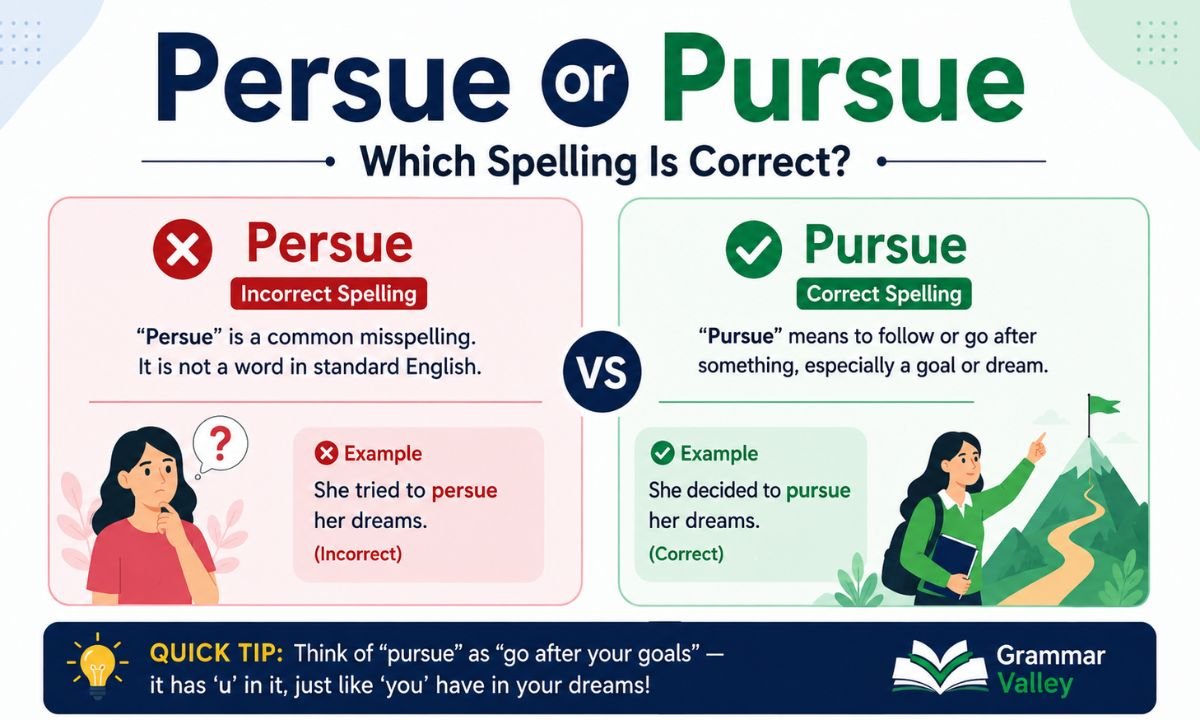
Typing a word and then staring at it, unsure if it looks right, happens to almost everyone. “Persue” is one of those words. It sounds correct out loud, it shows up constantly in casual writing, and yet spell-checkers keep flagging it. This guide settles the question for good, explains why the mistake happens so often, and gives you simple ways to remember the right spelling every time you write.
By the end of this article, you’ll know the correct spelling, the meaning behind it, how to use it in real sentences, and how to avoid mixing it up with similar-sounding words like peruse and persuade.
What Is the Correct Spelling: Persue or Pursue?
The correct spelling is pursue, spelled with two U’s — one after the P and one before the E. “Persue” is not a recognized word in any major English dictionary, including Merriam-Webster, Oxford, and Cambridge. It’s a spelling error, not an alternate form, a regional variant, or an older version of the word.
Quick Answer
| Spelling | Status | Notes |
|---|---|---|
| Pursue | Correct | Standard verb in American and British English |
| Persue | Incorrect | Common misspelling, not found in dictionaries |
If you remember nothing else from this article, remember this: pursue has two U’s, and persue does not exist.
Why Do People Misspell Pursue as Persue?
The mix-up isn’t random. It comes from how the word sounds when spoken and from a handful of writing habits that quietly reinforce the error.
The Pronunciation Confusion
Pursue is pronounced /pərˈsuː/, roughly “per-soo.” Because the first syllable sounds exactly like the prefix “per-” in words such as perform, perfect, and persist, the brain naturally reaches for that familiar pattern. English, unfortunately, doesn’t always spell words the way they sound, and pursue is a textbook example. The letters “pur” simply don’t announce themselves clearly when you say the word out loud, so writers fill in the gap with what feels intuitive rather than what’s actually correct.
Common Situations Where Mistakes Occur
Certain writing situations seem to invite this typo more than others:
- Typing quickly in emails or chat messages without reviewing the text
- Writing on a phone keyboard, where autocorrect sometimes fails to catch it
- Non-native English speakers relying on phonetic spelling
- Students writing essays under time pressure
- Job seekers drafting resumes and cover letters late at night
None of these situations are unusual, which is exactly why the mistake shows up so often, even among careful writers.
There’s also a visual factor at play. English has a long list of common words beginning with “per-“: perform, persist, permit, perhaps, perceive. Because these words appear so frequently, the eye and the hand both grow accustomed to typing “per” first. Pursue breaks that pattern, and breaking a pattern takes conscious effort. Most people aren’t thinking about spelling rules while they write an email or a text message, so the more familiar pattern quietly wins.
Autocorrect tools complicate the picture further. Some keyboard software recognizes “persue” as close enough to “pursue” and fixes it automatically, which means a writer might type the wrong word for years without ever noticing. Others, particularly on older devices or in certain browser text fields, don’t catch it at all. That inconsistency across platforms is part of why this particular typo has stayed so persistent.
Meaning of Pursue in English
Pursue is a verb with several related meanings, all built around the idea of following, chasing, or continuing toward something.
Pursue a Goal
This is the most common everyday use. It means to work steadily toward achieving something, often over a long period.
- She decided to pursue a career in nursing after college.
- He’s pursuing a master’s degree in economics.
Pursue Someone or Something
This sense refers to physically chasing or following a person, animal, or object.
- The officer pursued the vehicle through downtown traffic.
- The hawk pursued the rabbit across the open field.
Pursue an Activity
Pursue can also describe continuing or engaging in an activity, hobby, or interest over time.
- They pursue hiking every weekend during the summer.
- She pursues painting as a way to relax after work.
Persue vs Pursue: Side-by-Side Comparison
| Feature | Pursue | Persue |
|---|---|---|
| Spelling status | Correct | Incorrect |
| Dictionary listing | Yes (Merriam-Webster, Oxford, Cambridge) | No |
| Part of speech | Verb | Not applicable |
| Common usage | Formal and informal writing | Typo only |
| Related forms | Pursuit, pursuing, pursued, pursuer | None |
Key Takeaway
There is no context, dialect, or formal exception where “persue” becomes acceptable. If you’re unsure while writing, default to pursue and move on.
How to Remember the Correct Spelling of Pursue

A few small memory tricks can make this word stick permanently.
Trick 1: Think of “Pure Success”
Pursue starts with the same three letters as “pure.” Picture chasing a “pure” goal, and the first syllable locks into place.
Trick 2: Remember the “U”
Pursue contains two U’s, and so does the word “you.” Try the phrase “pursue with you” to anchor both U’s in your memory.
Related searches people also look up: persue or pursue pronunciation, persue or pursue synonym, pursue meaning in relationship, pursue pronunciation, pursue me meaning, pursuing, pursue noun.
Quick answers to a few of these: the pronunciation is “per-SOO,” common synonyms include chase, seek, and strive for, and the noun form of pursue is “pursuit,” not “pursue.”
Trick 3: Visual Memory Method
Write the word in large letters and circle both U’s in a different color. Studies on spelling retention consistently show that visually isolating the tricky part of a word helps it stay in long-term memory better than repeating the whole word over and over.
Trick 4: Use It in Sentences
Repetition in context works better than memorizing the word alone. Try writing three original sentences using pursue right now — one about a goal, one about a hobby, and one about someone chasing something.
Real-Life Example: How One Misspelling Cost a Job Applicant
A hiring manager at a mid-sized marketing firm once described rejecting a promising candidate’s cover letter almost immediately after opening it. The line read, “I am eager to persue new opportunities in your growing company.” The rest of the letter was well written, the candidate’s experience matched the role closely, and the tone was professional throughout.
The problem was that single typo. In competitive hiring, reviewers often skim dozens of applications in one sitting, and a misspelled word in the opening paragraph can create an impression of carelessness before the reader even reaches the qualifications section. The candidate wasn’t rejected for lack of skill. The application simply didn’t get a second look.
This kind of story repeats itself across industries. Recruiters, professors, and editors all report the same pattern: a single spelling slip can shift how the rest of a document is judged, even when the content itself is strong.
Pursue in Different Contexts
Education
Students and academics use pursue constantly when describing degrees, research interests, and long-term study plans.
- She plans to pursue a PhD in molecular biology.
- Many students pursue double majors to broaden their career options.
Career Development
In professional writing, pursue signals ambition and direction, which makes it a popular word in resumes, LinkedIn summaries, and interview answers.
- He’s pursuing certification as a project management professional.
- The company encourages employees to pursue internal promotions.
- During the interview, she explained why she wanted to pursue a leadership role.
Career coaches often point out that pursue carries a slightly more determined tone than a plainer word like “try” or “want.” Saying you’re pursuing a role in your cover letter suggests sustained effort rather than a passing interest, which is one reason the word shows up so often in application materials.
Business
Businesses use pursue when describing strategy, partnerships, and growth plans.
- The firm decided to pursue expansion into international markets.
- Investors are pursuing opportunities in renewable energy.
Personal Goals
Outside of school and work, pursue often describes hobbies, relationships, and personal ambitions.
- He’s pursuing a healthier lifestyle this year.
- She chose to pursue her passion for photography full-time.
Common Examples of Correct Usage
1. In Everyday Conversation
- “I’m going to pursue that job opening I saw yesterday.”
- “Are you still pursuing guitar lessons?”
2. In Academic Writing
- “This study pursues a deeper understanding of climate migration patterns.”
- “The researcher pursued three separate hypotheses before reaching a conclusion.”
3. In Business Writing
- “Our team will pursue this partnership through the next fiscal quarter.”
- “The board voted to pursue a more conservative investment strategy.”
Language Trends and Spelling Accuracy Statistics (2025–2026)
Spelling errors involving phonetically confusing words remain widespread, even as writing tools improve. Grammar-checking platforms have reported that homophone and near-homophone errors, including mix-ups like persue/pursue, peruse/pursue, and persuade/pursue, remain among the most frequently flagged issues in professional documents such as resumes, emails, and reports.
A few patterns worth noting:
- Mobile writing continues to produce more spelling errors than desktop writing, largely due to autocorrect inconsistencies and smaller keyboards.
- Non-native English writers report “pursue” as one of the top ten commonly misspelled verbs in workplace English courses.
- Editors and recruiters consistently rank spelling accuracy as a factor influencing first impressions in written applications, even when it isn’t the primary hiring criterion.
The takeaway isn’t that spelling mistakes define someone’s ability. It’s that small, avoidable errors still shape how quickly and favorably a reader responds to a piece of writing.
Search behavior tells a related story. Search engines regularly see queries for “persue” alongside “pursue,” which shows how many people type the wrong version into a search bar without realizing it. Most search platforms now correct the query automatically and return results for pursue, but that behavior also confirms just how common the misspelling remains across everyday typing, not just in formal documents.
Voice-to-text software adds another layer to this trend. Since pursue and “per sue” sound almost identical when spoken aloud, dictation tools occasionally transcribe the word incorrectly, especially in noisy environments or with certain accents. Writers who rely on dictation for drafting emails or notes may want to double-check this particular word before sending anything important.
Step-by-Step Guide to Avoid Spelling Mistakes
Step 1: Write Naturally
Don’t stop mid-sentence to second-guess every word. Get your ideas down first, since interrupting your flow to check spelling constantly tends to produce worse writing overall.
Step 2: Run a Spell Check
Use a built-in spell checker or a dedicated grammar tool once your draft is complete. These tools catch most obvious errors, including persue, almost instantly.
Step 3: Read Aloud
Reading your text out loud slows your eyes down and often reveals errors that silent reading skips over.
Step 4: Verify Uncertain Words
If a word looks slightly off, even after a spell check passes it, look it up. This matters especially for words like pursue, peruse, and persuade, since some spell checkers won’t catch a wrong word used correctly elsewhere.
Step 5: Create a Personal Error List
Keep a short running list of words you personally tend to misspell. Reviewing this list occasionally builds long-term accuracy far faster than relying on autocorrect alone.
Commonly Confused Words Similar to Pursue
Accept vs Except
Accept means to receive or agree to something. Except means excluding something. “I accept your offer” versus “Everyone except Sam agreed.”
Advice vs Advise
Advice is a noun (guidance given). Advise is a verb (the act of giving guidance). “She gave good advice” versus “She advised him carefully.”
Loose vs Lose
Loose describes something not tight or secure. Lose means to misplace or fail to win. “The knot is loose” versus “Don’t lose your keys.”
Affect vs Effect
Affect is usually a verb meaning to influence. Effect is usually a noun meaning a result. “The weather affected the game” versus “The effect was immediate.”
Persue vs Pursue
As covered throughout this article, pursue is the only correct spelling. Persue is simply a typo, not a legitimate alternative.
Mini Quiz: Persue or Pursue
Test what you’ve learned with these quick checks.
Quiz 1: Choose the Correct Spelling
Which is correct: “persue” or “pursue”? Answer: pursue.
Quiz 2: Fill in the Blank
“She wants to ___ a degree in law.” Answer: pursue.
Quiz 3: True or False?
“Persue is an accepted British English spelling.” Answer: False.
Quiz 4: Meaning Check
What does pursue mean when used with a goal? Answer: to work toward achieving it.
Quiz 5: Spot the Correct Sentence
“He is persuing his dream” or “He is pursuing his dream”? Answer: the second one.
Quiz 6: One-Letter Challenge
How many U’s does pursue contain? Answer: two.
Quiz 7: Workplace Writing Test
Is “actively pursuing new clients” correct for a business email? Answer: Yes.
Quiz 8: Quick Grammar Check
Is pursue a verb or a noun? Answer: a verb.
Quiz 9: Find the Mistake
“They persue their goals with dedication.” What’s wrong? Answer: “persue” should be “pursue.”
Quiz 10: Dream Chaser Test
Fill in: “Never stop ___ your dreams.” Answer: pursuing.
Quiz 11: Dictionary Check
Does Merriam-Webster list “persue” as a word? Answer: No.
Quiz 12: Correct or Incorrect?
“I will persue this matter further.” Answer: Incorrect.
Quiz 13: Multiple Choice
Which spelling appears in professional resumes? A) Persue B) Pursue Answer: B.
Quiz 14: Finish the Word
P-U-R-S-–-E. Answer: U, U (pursue).
Quiz 15: Final Challenge
Write one original sentence using pursue correctly, then check it against the examples above.
Frequently Made Mistakes to Double-Check Before Publishing
A quick final checklist before you hit send or publish:
- Search your document for “persue” using find-and-replace, and correct every instance.
- Check nearby words that sound similar, such as peruse and persuade, to confirm you haven’t swapped meanings by accident.
- Read your first and last paragraphs aloud, since these are the sections readers judge most closely.
- If you used dictation software, scan the transcript for pursue-related errors specifically.
- Save a personal note or bookmark this guide so the correct spelling is always one search away.
Small habits like these take only a minute but consistently prevent the kind of error that quietly undermines otherwise strong writing.
Frequently Asked Questions
What does persue mean?
It doesn’t have a meaning of its own. Persue is simply a common misspelling of the word pursue.
How do you use pursue in a sentence?
As a verb describing chasing, seeking, or continuing something, such as “She pursued her goal of becoming a doctor.”
Is there a word “persue”?
No. It’s not listed in any standard English dictionary and is considered a spelling error.
What does pursue mean in love?
In relationships, pursuing someone typically means actively showing romantic interest and making an effort to build a connection with them.
Conclusion
The rule here is short and easy to keep: pursue is correct, persue is not, and the difference comes down to two U’s that pronunciation tends to hide. Whether you’re writing a resume, a school essay, or a quick email, taking a second to double-check this word can prevent an unnecessary distraction for your reader. Use the memory tricks in this guide, run a quick read-aloud check on your next draft, and pursue — never persue — whatever goal you’re writing about next.