
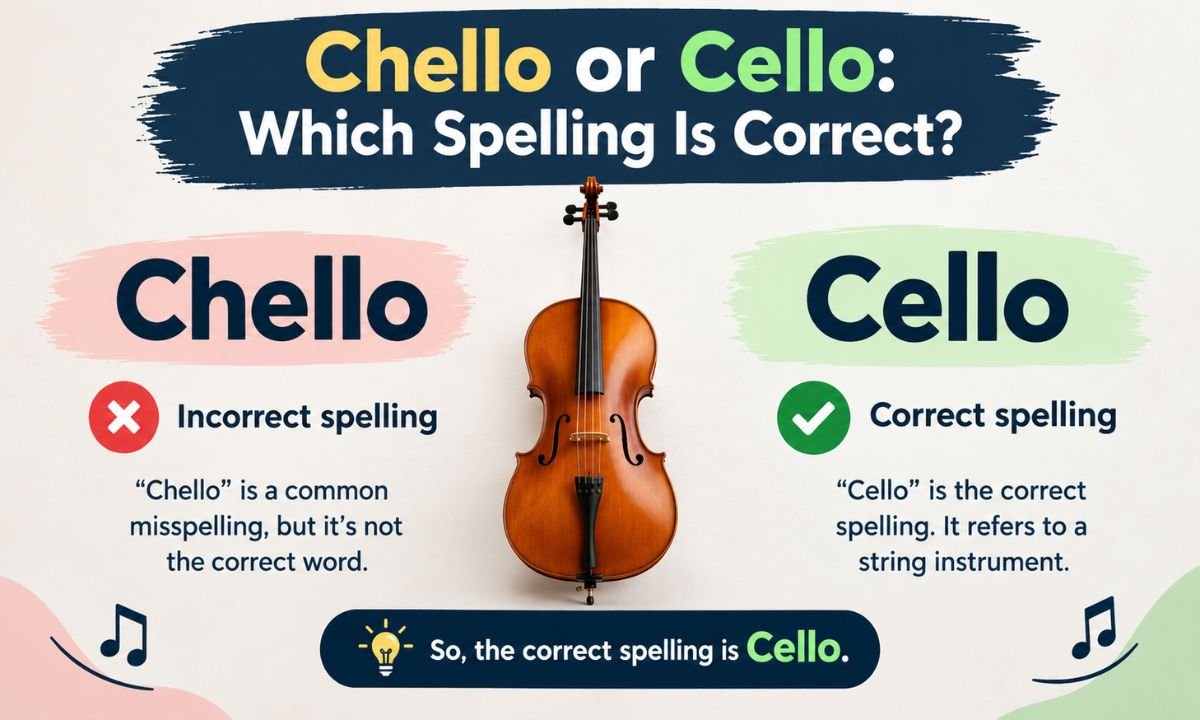
The correct spelling is cello. Chello is not a word in standard English, even though the instrument’s name sounds as if it starts with “ch.” If you mean the four-stringed instrument played with a bow, write cello, with a single c, two l’s and no h.
Chello or Cello – Quick Answer
Cello is correct. Chello is a misspelling. Dictionaries list cello as the English spelling of the instrument. None of them presents chello as a variant, a regional form or an accepted alternative.
Here is the short version for anyone in a hurry:
- Correct spelling: cello
- Incorrect spelling: chello
- Pronunciation: CHEL-oh
- Full name: violoncello
- Plural: cellos, or celli in some musical settings
The confusion has a simple cause. English speakers say the word with a “ch” sound, so the brain expects to see “ch” on the page. The word was borrowed from Italian, though, and Italian spelling rules do not match English ones.
Examples
The pairs below show the right and wrong forms in plain sentences.
- ✅ She plays the cello in the school orchestra.
- ❌ She plays the chello in the school orchestra.
- ✅ The cello has a warm, deep tone.
- ❌ The chello has a warm, deep tone.
- ✅ He bought a used cello online.
- ❌ He bought a used chello online.
- ✅ Two cellos were tuned before the concert.
- ❌ Two chellos were tuned before the concert.
Notice that the wrong versions are not wrong because of grammar. They fail because the word chello does not exist in English dictionaries. A spell checker will usually underline it in red for that reason.
The Origin of Chello or Cello
To understand the spelling, start with the full name of the instrument. The word cello is a clipped form of violoncello, which English borrowed from Italian. In Italian, violoncello means “little violone.”
The violone was an early large bowed instrument, related to the double bass. The word violone itself is built from viola plus the ending “-one,” which signals something big. So the instrument’s older name combined a “big” ending with a “little” ending.
The “-cello” at the end of violoncello is a diminutive suffix. It works a bit like adding “-let” to make something smaller in English. When people shortened the long name, they kept only that last piece, and the short form cello was born.
For a time, writers marked the shortening with a leading apostrophe, as in ‘cello. The apostrophe stood for the missing “violon” part. By the early twentieth century this clipped form was common, and the apostrophe later dropped away. Today you will almost never see it outside older books.
| Form | Meaning | Status today |
|---|---|---|
| violoncello | “little violone” in Italian | Full formal name, rare in daily use |
| ‘cello | Shortened with an apostrophe | Dated |
| cello | Clipped form without apostrophe | Standard spelling |
| chello | Phonetic guess | Not accepted |
Now to the “ch” sound. In Italian, the letter c before an e or an i is pronounced like the “ch” in “cheese.” The Italian speaker who sees “cello” reads it as “chello” with no extra effort, so the spelling needs no help from an h.
Italian actually works the other way around from what many English learners expect. When Italian writes “ch” before an e, the result is a hard k sound. So if the word were spelled chello in Italian, it would be read something like “kello.” That would give the wrong sound entirely.
British English vs American English Spelling
Many people ask this question because some English words really do change between regions. That makes it reasonable to wonder whether chello could be a British form or an American one. It is neither.
Both British and American English spell the instrument cello. Dictionaries from both traditions list the same headword. No regional guide recommends chello for any audience, and no style manual treats it as a variant.
What does differ slightly is the way the vowel at the end is pronounced. The sound is minor, and it never changes the letters on the page.
| Variety | Spelling | Common pronunciation |
|---|---|---|
| British English | cello | CHEL-oh, with a vowel that glides like “uh-oo” |
| American English | cello | CHEL-oh, with a vowel that glides like “oh-oo” |
| Other English varieties | cello | Close to one of the two above |
Writers in Canada, Australia, India and other English-speaking countries also use cello. If you write for an international audience, you do not need to pick a regional version. One spelling serves everyone.
This is worth knowing if you work with an editor or a style checker set to a specific English variety. Switching the checker from American to British settings will not change how cello is spelled. If a tool flags the word, the cause is a typo, not a regional rule.
Which Spelling Should You Use?
Use cello every time you refer to the instrument. That covers school essays, work emails, product listings, concert programs, blog posts and text messages. There is no setting where chello is the better choice.
A few small rules can help you decide between the remaining forms:
- Write cello in everyday and professional writing.
- Write violoncello only when you want the full historical or formal name, such as in a scholarly paper.
- Avoid the old ‘cello form unless you are quoting an older source.
- Use cellos as the standard plural.
- Use celli only if your field or audience already uses it.
Here is a simple memory trick. The lowest string on a standard cello is tuned to a C. When you want to remember the first letter of the word, picture that low C string. The instrument itself begins with the letter it plays at the bottom.
Another quick check is visual. Count the letters: five in total, with c at the start and two l’s in the middle. If your version has an h, it has six letters, and it is wrong.
If you ever doubt yourself, look at the word as written in a dictionary or on a music store’s product page. Retailers, orchestras and music schools all use cello. That consistency is the best proof of the standard form.
Common Mistakes with Chello or Cello
Most errors with this word fall into a few predictable groups. Knowing them helps you catch the problem in your own writing before anyone else does. The three below come up most often.
Mistake 1
Spelling the word the way it sounds. This is the classic error. A writer hears “chello,” so they type “chello.” The ear leads the hand, and the extra h slips in.
The fix is to remember that English spelling often follows the origin of a word rather than its sound. Cello is a borrowed word, and it kept its Italian letters. Treat it as a word you simply have to memorize.
| Wrong | Right |
|---|---|
| The chello solo was beautiful. | The cello solo was beautiful. |
| She is learning the chello. | She is learning the cello. |
Mistake 2
Inventing other phonetic spellings. Some writers avoid the h but still guess wrongly. Versions such as “sello,” “celo” or “chelo” appear in casual writing. They share the same cause as chello: the writer is trying to match a sound.
Each of these also creates a risk. Some can look like other words, and others simply look like typos. A reader who sees “sello” may stop and wonder what you meant. That small pause weakens your message.
- ❌ sello
- ❌ celo
- ❌ chelo
- ❌ chello
- ✅ cello
The correct form always has two l’s and begins with c. If you remember only those two facts, you will get it right almost every time.
Mistake 3
Getting the plural or the apostrophe wrong. Writers sometimes add an apostrophe to make a plural, as in “cello’s,” which is wrong for more than one instrument. The plural is cellos, with no apostrophe.
Some writers also drop the final s and write “two cello” when they mean two instruments. In music circles you may meet the Italian plural celli, which follows the Italian pattern of changing a final -o to -i. Both cellos and celli are accepted, but celli is rarer in everyday English.
| Wrong | Right |
|---|---|
| Five cello’s played together. | Five cellos played together. |
| The chellos were tuned. | The cellos were tuned. |
| The section has four cello. | The section has four cellos. |
The possessive is a different matter. “The cello’s neck” uses an apostrophe correctly, because it shows ownership. The difference is whether the word owns something or simply counts as more than one.
Chello or Cello in Everyday Examples
Seeing the word in real situations makes the rule easier to remember. The examples below are written for illustration, not taken from any one source. Each one uses the correct spelling in a different setting.
In email, a spelling slip can look careless, especially in a professional message. A short, clean subject line helps, too.
Subject: Cello lessons for next term
Hello Ms. Rivera,
I would like to book a weekly slot for cello lessons starting next month. My daughter already owns a half-size cello, so we only need a teacher.
Thank you for your time.
Notice how the word appears twice, and both times it is spelled cello. If you write about an instrument several times in one email, a single wrong spelling can repeat and become more noticeable.
News
News writers follow style guides that expect standard spelling. A headline that uses chello would likely be flagged during editing. Here are the sort of lines you would expect to read:
- Local cellist wins regional music prize
- School adds cello classes to its music program
- Orchestra seeks donations to repair its cello section
News copy also tends to name the instrument plainly, with no apostrophe. You will rarely see ‘cello in modern news writing.
Social Media
On social platforms, casual spelling is common, and many people type quickly. Still, a wrong spelling can have a practical cost. Hashtags and search terms work by matching letters, so a post tagged with the wrong form may be harder for interested people to find.
- ✅ Practised the cello for an hour today. #cello #celloplayer
- ❌ Practised the chello for an hour today. #chello
Most people will understand the second post. The difference is that the first one uses the form the audience is more likely to search for. If you run a music account or a lesson page, the standard form is the safer habit.
Formal Writing
In essays, reports, program notes and applications, correct spelling signals care. Formal readers often judge a document by small details. A single wrong word can draw attention away from a strong argument.
The concerto features a solo cello supported by strings and woodwinds, and the cello’s opening phrase sets the mood for the whole piece.
In formal contexts you may also use violoncello once, then switch to cello for the rest of the text. For example: “The violoncello, commonly called the cello, belongs to the violin family.” That sentence introduces both forms and makes clear that they refer to the same thing.
Chello or Cello – Google Trends & Usage Data
Search data can tell you how often people look up a spelling question. It cannot tell you which spelling is correct. Correctness comes from dictionaries and usage, not from popularity. A typo can be searched often and still be wrong.
This article does not quote percentages or rankings, because Google Trends figures change over time and are shown as relative values rather than raw counts. Any number printed here could be out of date by the time you read it. A safer approach is to check the live data yourself.
Here is how to do that in a few minutes:
- Open Google Trends at trends.google.com.
- Enter cello as the first search term.
- Add chello as a second term to compare the two.
- Set the location to a country, or leave it on worldwide.
- Choose a time range, such as the past five years.
Google Trends scores interest from 0 to 100, where 100 marks the peak popularity of a term within the chosen range and region. A score of 50 means half that peak. The scale compares terms against each other, so it shows relative interest, not the number of searches.
When you compare cello and chello, expect the correct spelling to show far higher interest, since it is the real name of the instrument. The misspelling may show a small, steady line. Searches for misspellings often come from people who are checking the spelling, which is why guides like this one exist.
Usage in print tells a similar story. Dictionaries, music publishers, instrument makers and orchestras all use cello. A search for chello in a reference work will usually return a note that you may mean cello, or nothing at all.
Countries with high search interest
Google Trends has an “Interest by subregion” section. It lists where a term is most popular, scaled so that the top location scores 100. You can use it to see which countries show the most interest in your chosen spelling.
This article does not rank countries, because a list written today could change tomorrow. What you can say with confidence is that spelling questions like this one matter most in places where English is widely used in schools and workplaces. Examples include:
- the United States
- the United Kingdom
- Canada
- Australia
- India
- the Philippines
These are listed as markets where the question is relevant, not as a ranking of search volume. Treat the live Google Trends report as the source for any country comparison. If you publish a version of this article with figures, add the date you collected them.
One more tip: a small bump in interest can appear near school terms and concert seasons, when students and parents write about music. If you see a pattern like that in your own data, it is a reasonable sign that the search comes from learners. Confirm it against the time range you selected before drawing conclusions.
Comparison Table: Chello vs Cello
The table below puts the two forms side by side, so you can see every difference at once.
| Feature | Cello | Chello |
|---|---|---|
| Correct in standard English | Yes | No |
| Found in major dictionaries | Yes | No |
| Meaning | A large bowed string instrument | None, a misspelling |
| Origin | Short for Italian violoncello | Guess based on sound |
| Pronunciation | CHEL-oh | Same sound, wrong spelling |
| Letters | c-e-l-l-o | c-h-e-l-l-o |
| British English | Used | Not used |
| American English | Used | Not used |
| Plural | cellos, or celli | Not applicable |
| Safe for essays and work emails | Yes | No |
| Safe for hashtags and search | Yes | Not recommended |
The pattern is clear. Everything that matters in writing points to cello. Chello does not gain any advantage in a single row, apart from matching the sound.
Frequently Asked Questions
1. Is chello a real word?
No. Chello is not recognized in standard English dictionaries. It is a common misspelling of cello caused by the way the word is pronounced.
2. What is a cello?
A cello is a large bowed string instrument from the violin family. It has four strings, and the player holds it between the knees while sitting.
3. Why do people write chello?
People write chello because the word is pronounced with a “ch” sound. The spelling comes from Italian, where c before e already sounds like “ch,” so no h is needed.
4. Is cello used in orchestras?
Yes. The cello is a standard member of the orchestra’s string section, alongside violins, violas and double basses. It also appears in chamber groups and as a solo instrument.
5. Do British and American English spell cello differently?
No. Both varieties spell it cello. Only the pronunciation of the final vowel differs slightly between the two.
Conclusion
The answer to the chello or cello question is short. Cello is the correct spelling, and chello is a mistake that comes from pronunciation. The word began as the end of the Italian violoncello, and English kept the Italian letters.