
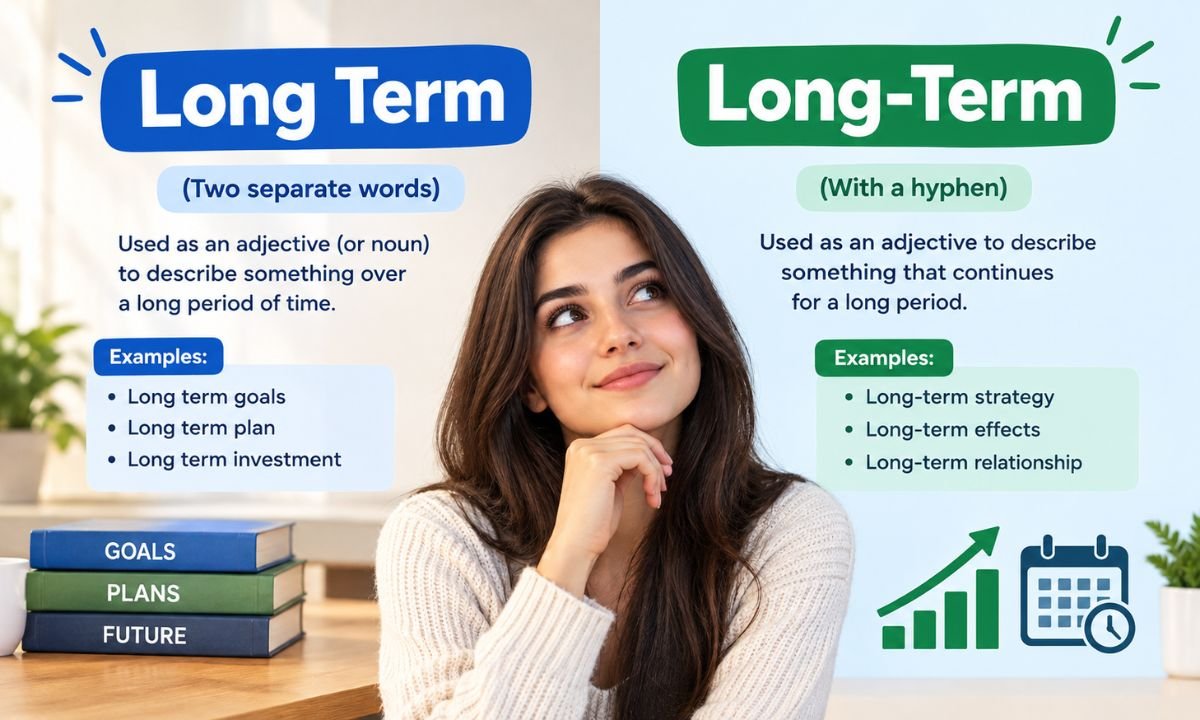
If you’ve ever typed “long term” and then stared at it, wondering whether it needed a hyphen, you’re not alone. It’s one of those phrases that looks slightly wrong no matter which way you write it, especially once you’ve stared at it for more than five seconds (a phenomenon known as semantic satiation, and yes, it happens to editors too).
The good news is that the rule behind “long term” and “long-term” is short, consistent, and easy to keep in your head once it clicks. This guide walks through the grammar, the history, the common mistakes, and enough real examples that you won’t need to look this up again.
Quick Answer
Both spellings are correct. The one you need depends on the job the phrase is doing in your sentence.
- Long term (no hyphen) is a noun phrase. It names a stretch of time. Example: We’re planning for the long term.
- Long-term (hyphenated) is a compound adjective. It describes a noun that comes right after it. Example: We’re planning a long-term strategy.
Is “longterm” correct?
No. “Longterm” as a single, unhyphenated word does not appear in Merriam-Webster, Oxford, or Cambridge, and no major style guide accepts it. If you see it on a website or in a URL, it’s either a typo or a stylistic shortcut, not a standard spelling. Treat it as an error in any formal or professional writing.
When to use “long term”
Use the open, two-word form when the phrase is functioning as a noun, usually after a preposition like in, over, or for.
- In the long term, the investment paid off.
- She’s focused on the long term.
- Over the long term, habits matter more than motivation.
When to use “long-term”
Use the hyphenated form when the phrase sits directly before a noun and describes it.
- Long-term investment
- Long-term relationship
- Long-term care
One-line grammar rule you can memorize
If a noun comes right after the phrase, hyphenate it. If the phrase is standing on its own, leave the hyphen out.
What Does “Long-Term” Mean?
“Long-term” is a compound adjective built from “long” and “term,” joined by a hyphen so they act as a single describing word. When two words team up to modify a noun, English typically hyphenates them to prevent misreading. Without the hyphen, a reader’s eye can momentarily misparse the sentence, especially in longer, denser writing like contracts or reports.
Grammatically, “long-term” answers the question “what kind?” A long-term goal is a particular kind of goal. A long-term illness is a particular kind of illness. That descriptive function is the giveaway.
You’ll see “long-term” most often in:
- Business and finance: long-term debt, long-term growth, long-term liabilities
- Health and medicine: long-term care, long-term side effects, long-term prognosis
- Relationships and lifestyle: long-term partner, long-term commitment
- Planning and strategy: long-term plan, long-term vision, long-term goals
In each case, the word right after “long-term” is a noun, and “long-term” is telling you something about that noun. Pull the noun away and the sentence usually falls apart, which is a useful test in itself.
What Does “Long Term” Mean?
“Long term,” without a hyphen, is a noun phrase referring to an extended stretch of time. It usually shows up after a preposition, most commonly in the, for the, or over the.
- In the long term, remote work may reduce office costs.
- The company is playing the long term.
- Her health improved over the long term.
Here, “long term” isn’t attached to any noun that follows it. It’s standing in for a concept: an extended period, often contrasted with “the short term.” You could swap in a synonym like “the future,” “the coming years,” or “the extended period ahead,” and the sentence would still hold its shape. That’s a solid sign you’re dealing with the open, unhyphenated form.
This is also the version you’ll usually find after a linking verb, as in the effects were long term — more on that construction shortly, because it’s where a lot of writers slip.
The Simple Grammar Rule (Easy Memory Trick)
Here’s the entire rule, reduced to something you can actually keep in your head while writing:
Before a noun, hyphenate. Everywhere else, don’t.
A few ways to test it in the moment:
- Ask what comes next. If a noun immediately follows the phrase, hyphenate: long-term lease. If nothing follows, or a verb does, skip the hyphen: the lease is long term.
- Try the swap test. Replace the phrase with a single adjective like “extended” or “prolonged.” If it fits smoothly before a noun (“extended lease”), the phrase needs a hyphen. If it works as a standalone description (“the lease is extended”), it doesn’t.
- Check for a preposition just before it. Words like in, over, for, and during usually signal the noun phrase is coming, which means no hyphen: in the long term.
This positional logic isn’t unique to “long-term.” It applies to a whole family of compound modifiers: short-term, part-time, full-time, high-quality, well-known. If you can hyphenate one confidently, you can hyphenate the rest the same way.
Long Term vs Long-Term (Side-by-Side Comparison)
| Feature | Long Term | Long-Term |
|---|---|---|
| Word count | Two separate words | One hyphenated compound word |
| Part of speech | Noun phrase | Compound adjective |
| Position in sentence | Usually stands alone or follows a preposition | Usually comes directly before a noun |
| Typical signal words | in, over, for, during | goal, plan, care, strategy, relationship, effect |
| Example sentence | We’re saving for the long term. | We’re building a long-term savings plan. |
| Common fields | General usage, finance discussions, planning talk | Business, healthcare, legal writing, relationships |
| Is it ever one word (“longterm”)? | No | No |
A quick side-by-side often clears up more confusion than a paragraph of explanation, so keep this table handy the next time you’re second-guessing a sentence.
Why Do People Get Confused?
A few things conspire to make this trickier than it should be.
First, “long term” and “long-term” look almost identical, and the hyphen is a small mark that’s easy to miss on a screen, especially at smaller font sizes or on mobile keyboards that sometimes auto-correct it away.
Second, there’s a related word, “longtime,” that has fully merged into one word without a hyphen — as in a longtime friend. Because “longtime” broke the usual compounding pattern, some writers assume “long-term” followed the same path. It didn’t. Dictionaries treat the two differently: “longtime” is one word, “long-term” is hyphenated, and “long term” as a noun phrase stays open.
Third, hyphenation rules in English aren’t applied with perfect consistency across every compound word, so writers who’ve absorbed a general “when in doubt, don’t hyphenate” habit sometimes drop the hyphen even when a noun follows directly.
Finally, a lot of everyday speech doesn’t distinguish the two at all — nobody hears a hyphen out loud — so the confusion only becomes visible once you sit down to write.
Common Mistakes Writers Make
Some patterns show up again and again in student essays, business emails, and blog drafts:
- Dropping the hyphen before a noun. Long term goals should be long-term goals. If you can point to the noun right after the phrase, the hyphen almost always belongs there.
- Adding a hyphen where none is needed. The results were long-term should be the results were long term, since nothing follows the phrase for it to describe.
- Writing “longterm” as one word. This shows up most in casual online writing, chat messages, and rushed first drafts. It isn’t recognized by any major dictionary.
- Inconsistent hyphenation within the same document. Using both “long term” and “long-term” for the identical grammatical function in one piece signals a lack of proofreading and can quietly undercut a reader’s trust in the rest of the writing.
- Hyphenating after a linking verb out of habit. Sentences built around “is,” “was,” “seems,” or “became” almost always call for the open form: the arrangement seems long term, not long-term.
A short table can make the fixes easier to spot at a glance.
| Incorrect | Corrected |
|---|---|
| We need a long term plan. | We need a long-term plan. |
| The disease is long-term. | The disease is long term. |
| She has longterm goals. | She has long-term goals. |
| Our strategy is long-term focused. | Our strategy is long-term-focused, or better: our strategy focuses on the long term. |
| He thinks in the long-term. | He thinks in the long term. |
Is “Longterm” Correct?
It’s worth repeating on its own, because it’s the question people search for most often: no, “longterm” is not standard English. Merriam-Webster, Oxford, and Cambridge dictionaries all list the hyphenated adjective “long-term” and the two-word noun phrase “long term,” but none of them recognize a single fused word.
You may run into “longterm” in casual writing, on social media, or occasionally in a brand name or domain (something like LongtermInvestors.com), where businesses sometimes drop hyphens for a cleaner-looking web address. That’s a naming choice, not a grammar rule, and it shouldn’t carry over into formal writing, resumes, academic papers, or professional communication. Spell checkers and grammar tools will flag it, and so will most editors.
Real-Life Usage Examples (High SEO Value)
Seeing the rule applied across different fields tends to lock it in faster than any explanation. Here’s a spread of examples from finance, health, relationships, and everyday planning.
Finance and business
- Long-term investments generally carry more risk tolerance than short-term ones.
- The company reported a rise in long-term debt this quarter.
- Analysts expect the stock to perform well over the long term.
- Their long-term growth strategy focuses on international markets.
Health and wellness
- Long-term exposure to loud noise can damage hearing.
- Doctors recommend long-term physical therapy after the surgery.
- The medication’s long-term effects are still being studied.
- Recovery, in the long term, depends on consistent aftercare.
Relationships and personal life
- They’ve been in a long-term relationship for six years.
- Long-term compatibility matters more than early chemistry, most counselors say.
- In the long term, small daily habits shape a marriage more than big gestures.
Careers and planning
- She’s building a long-term career in public health.
- The team set both short-term and long-term goals for the project.
- Over the long term, remote skills have become more valuable to employers.
Notice the pattern holding steady across every field: hyphen before a noun, no hyphen when the phrase stands alone. The subject matter changes; the grammar doesn’t.
Quick Grammar Test (Interactive Section)
Try filling in the blank before checking the answer underneath. Cover the answer with your hand if you want the full effect.
- We’re not thinking about tomorrow — we’re planning for the ______ (long term / long-term). Answer: long term. No noun follows, so it stays open.
- This is a ______ (long term / long-term) commitment, not a fling. Answer: long-term. It sits directly before the noun “commitment.”
- The side effects, doctors warned, could be ______ (long term / long-term). Answer: long term. It follows a linking verb (“could be”) with no noun after it.
- Her ______ (long term / long-term) memory is sharper than her short-term memory. Answer: long-term. It’s describing the noun “memory.”
- In the ______ (long term / long-term), consistency beats intensity. Answer: long term. Preposition “in the” signals the noun phrase.
If you got four or five right, the rule has already settled in. If a couple tripped you up, go back to the one-line rule above and try the swap test on your own writing for the next week or so. It becomes automatic faster than most grammar rules do.
Frequently Asked Questions
Is long term one word or hyphenated?
It depends on use: it’s two separate words as a noun (“in the long term”) and hyphenated as an adjective before a noun (“long-term plan”).
How to write long term correctly?
Hyphenate it when it directly precedes a noun; leave it open when it stands alone or follows a verb or preposition.
Is the word “long time” hyphenated?
No, “long time” as a noun (“it’s been a long time”) isn’t hyphenated, though “longtime” as a single-word adjective before a noun is (“a longtime friend”).
Is long term 1 or 2 words?
It’s always two words, never fused into one; the only choice is whether a hyphen connects them.
Conclusion
The distinction between “long term” and “long-term” comes down to one question: is the phrase describing a noun, or standing in for one? Put a noun right after it, and the hyphen belongs there. Let it stand alone, and the hyphen goes away. “Longterm” as a single fused word never enters the picture, no matter which context you’re writing in.