
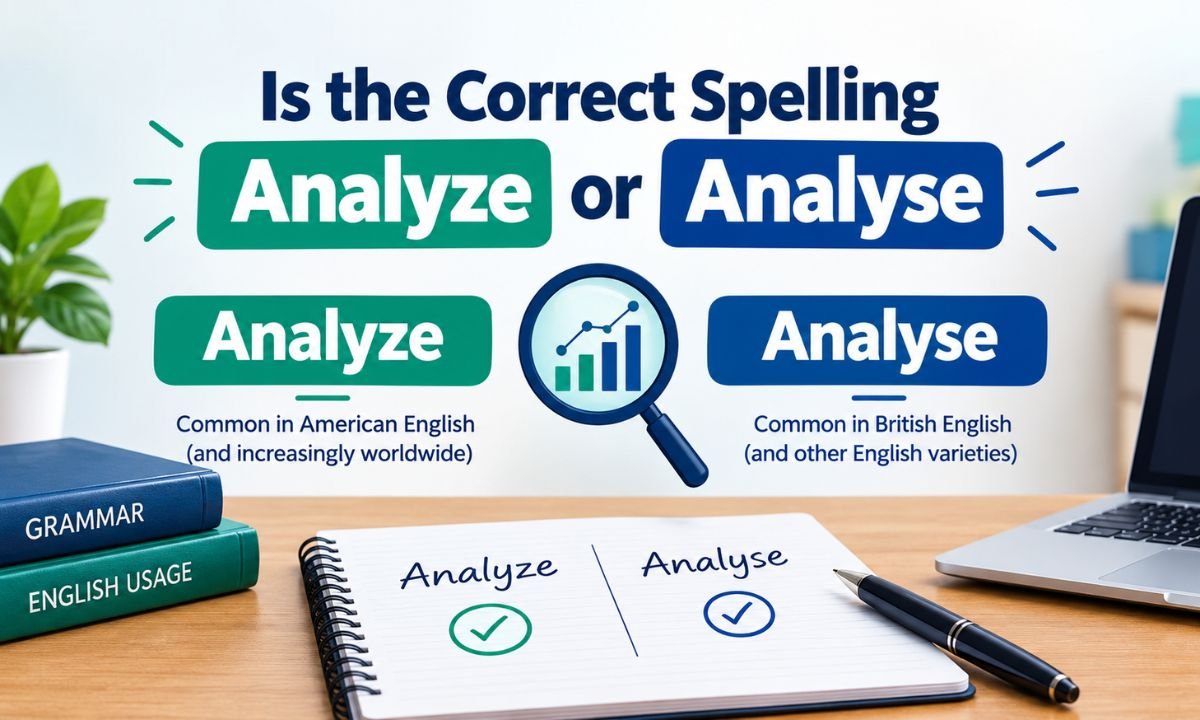
Both spellings are correct. Analyze with a Z is the standard form in American English, and analyse with an S is the standard form in British English. The meaning is identical, so the only real decision is which audience you are writing for.
Quick Answer: Analyze or Analyse?
- Analyze is used in the United States and is often used in Canada.
- Analyse is used in the United Kingdom, India, Australia and New Zealand.
- Both mean to examine something closely to understand it.
- Pick one spelling and keep it throughout your document.
Analyze vs. analyse
The two words are spelling variants of one verb. Dictionaries define the verb as studying something in detail, usually by breaking it into parts. Nothing about the grammar, the pronunciation or the sense changes when you swap the Z for an S.
The table below shows how the two forms line up across the whole word family.
| Feature | American English | British English |
|---|---|---|
| Base verb | analyze | analyse |
| Third person | analyzes | analyses |
| Past tense | analyzed | analysed |
| Present participle | analyzing | analysing |
| Person or device | analyzer | analyser |
| Noun | analysis | analysis |
The noun stays the same on both sides of the Atlantic. Only the verb and the words built from it change.
Words ending in “-yze” or “ize” / “-ise” or “-yse”
English has two separate spelling patterns that often get mixed up. The first is the verb ending -ize or -ise. The second is the ending -yze or -yse, which appears in a small group of words that come from the Greek word lysis, meaning loosening or release.
Analyze belongs to the second group. That is why it behaves differently from words like organize.
The “-ize” and “-ise” pattern
In American English, the ending is almost always -ize. In British English, -ise is the common choice, although some British publishers use -ize on purpose. Oxford University Press is the best known example, and its house style is often called Oxford spelling.
| American | British |
|---|---|
| organize | organise |
| realize | realise |
| recognize | recognise |
| minimize | minimise |
| finalize | finalise |
| apologize | apologise |
The “-yze” and “-yse” pattern
This group is small. American English writes every one of these words with -yze. British English writes them with -yse, and that includes Oxford style.
| American | British |
|---|---|
| analyze | analyse |
| paralyze | paralyse |
| catalyze | catalyse |
| dialyze | dialyse |
Even publishers who prefer -ize in British text still write analyse with an S. Oxford spelling uses -ize for most verbs but keeps the S in analyse and paralyse, because those words trace back to lysis and not to the Greek -izein suffix.
A few words that never change
Some verbs end in -ise everywhere. Advise, revise, exercise and surprise keep the S in the United States and the United Kingdom alike, so do not turn them into -ize forms by habit.
Sentences with analyze/analyse in the media
News and business writing show the split clearly. The sentences below are original examples written in the style of typical reporting. They are not quotes from any outlet.
American style
- Researchers will analyze the survey results before the end of the quarter.
- Investigators continue to analyze the data from the flight recorder.
British style
- Researchers will analyse the survey results before the end of the quarter.
- Investigators continue to analyse the data from the flight recorder.
The structure, tense and object are the same. Only the spelling shifts, and readers who share your variety of English will not notice either form.
Synonyms of analyze
A synonym can keep your writing fresh and add a more specific shade of meaning. Each word below overlaps with analyze but is not an exact match.
- Examine: look at something carefully and in detail.
- Study: spend time learning how something works.
- Assess: judge the quality, size or value of something.
- Evaluate: measure something against a standard.
- Inspect: check for faults or problems.
- Break down: separate something into smaller parts.
- Interpret: explain what the information means.
- Dissect: take apart to see how the pieces fit.
Synonyms ending in -ize follow the same split. Scrutinize is American, and scrutinise is common in British writing.
Origin of the word analyze
The word comes from Greek. The ancient Greek noun análusis meant a breaking up or an untying. It was built from ana-, which can mean up or thoroughly, and lysis, which means loosening. The Greek verb analúō carried the sense of unravelling or investigating.
From Greek, the word passed into Medieval Latin as analysis. The Oxford English Dictionary records the noun in English from the late 1500s, with its earliest evidence in the writing of the scholar Gabriel Harvey in 1580.
The verb followed the noun. Dictionary sources describe the English verb as growing out of the noun analysis. The lysis part of the Greek original is what led to the -yse ending in British English.
Analyze in American English
In the United States, analyze joined the large family of verbs that end in -ize. A writer there sees organize and analyze as members of one regular pattern.
American dictionaries list analyze as the standard form and treat analyse as a British variant. In a United States classroom or office, analyze is what readers expect.
What does “analyse” mean?
Analyse means to study something in detail in order to understand it, explain it or draw conclusions from it. It has exactly the same meaning as analyze. Only the letter near the end differs.
You can analyse many kinds of things:
- A set of numbers, such as sales figures or test scores.
- A piece of writing, such as a poem or a legal contract.
- A physical sample, such as soil or blood.
- A situation, such as a drop in website traffic.
In each case you separate the subject into parts, look at how the parts relate, and then say something useful about the whole.
Why are there two spellings?
Two forces pulled English in different directions. French verbs of this type end in -iser, and British writers often followed that pattern with -ise. The Greek source, meanwhile, used the suffix -izein, which supported the -ize form.
In the United States, Noah Webster and others pushed for simpler, more regular spellings in the early nineteenth century. American usage settled on -ize, and it applied the same logic to analyze and paralyze.
British English treated this small group differently. Because analyse comes from lysis, with an S, the British form kept the S. Neither spelling is a mistake. Each variety applied its own rule consistently.
When should you use “analyze”?
Use analyze whenever your readers expect American spelling. That includes United States publishers and any organization that writes in American English. Canadian writers also use analyze often, even though Canadian English borrows many other spellings from Britain.
Match the audience, then stay consistent. Here is how that plays out in common situations.
Academic writing
In American schools and universities, analyze is the usual spelling in essays and theses. A typical prompt reads, “Analyze the causes of the Great Depression.” A student who writes analyse in a United States course may lose marks for inconsistency, even though the spelling is valid elsewhere.
Business writing
American business documents use analyze in reports and emails alike. Phrases such as “analyze customer behavior” and “analyze quarterly results” fit naturally in job descriptions and reviews. Set your software to American English so the spelling stays uniform.
Scientific writing
Methods sections often say that samples were analyzed with a certain instrument. Always check the journal’s author guidelines, because some international journals accept either variety while others require one.
Everyday writing
In texts and personal notes, people in the United States write analyze without thinking about it. A message such as “I need to analyze this before I decide” looks completely normal.
Technology
Software menus, error messages and documentation commonly show buttons labeled “Analyze.” If a product uses that exact label, keep its spelling when you refer to it, even in a British text.
When should you use “analyse”?
Use analyse whenever your readers expect British spelling. That means audiences in the United Kingdom, Ireland, India, Australia, New Zealand and many other countries that follow British conventions.
British academic writing
British universities expect analyse in essays and dissertations. A common instruction is “Analyse the causes of the First World War.” Some British publishers use Oxford spelling, which prefers -ize for many verbs, yet the verb stays analyse with an S even there.
Reports
Government papers and industry reviews in Britain and Australia use analyse. A line such as “The committee will analyse the evidence and publish its findings” fits right in. A quick search for “analyze” in your final draft will catch stray American forms.
Business communication
Companies in India, Australia and the United Kingdom use analyse in emails and proposals. Job listings ask candidates to “analyse data and prepare summaries.” A multinational team should agree on a house spelling early.
Everyday British English
In daily life, British speakers write analyse in messages and forum posts. A phrase such as “I need to analyse my budget” looks entirely ordinary to a British reader.
Formal writing
Formal documents such as legal briefs and policy papers should follow the convention of the country they are written in. In British, Indian and Australian settings, that means analyse. A consistent spelling signals care.
Analyze or analyse in a sentence
Seeing both forms in context makes the rule easier to remember. Each pair below uses the same sentence with the American form first and the British form second.
- “We analyze the results every Friday.” / “We analyse the results every Friday.”
- “She will analyze the poem for her literature class.” / “She will analyse the poem for her literature class.”
- “Engineers analyzed the bridge after the storm.” / “Engineers analysed the bridge after the storm.”
- “He is analyzing the contract line by line.” / “He is analysing the contract line by line.”
- “The lab analyzes water samples daily.” / “The lab analyses water samples daily.”
The last pair shows an extra wrinkle. In British English, “analyses” can be a verb form, as in “the lab analyses water samples,” and also the plural noun, as in “two analyses.” Context makes the meaning clear.
What about “analyzed” and “analysed”?
The same rule applies to the past tense. Analyzed is the American form, and analysed is the British form. Both are regular past tense and past participle forms, so you add -d to the base verb.
| Form | American | British |
|---|---|---|
| Past tense | analyzed | analysed |
| Past participle | analyzed | analysed |
| Present participle | analyzing | analysing |
| Third person singular | analyzes | analyses |
Neither version is wrong in its own region.
Analyze vs analyse pronunciation
The two spellings sound the same. Both are pronounced with the stress on the first syllable, roughly “AN-uh-lyze.” The last syllable rhymes with “size” and “eyes.”
The noun is different in sound. Analysis is stressed on the second syllable, “uh-NAL-uh-sis,” and the plural analyses is pronounced “uh-NAL-uh-seez.” Do not confuse the verb and noun when you read aloud.
Analyze vs analyse: common mistakes
Most errors with this word come from assumptions about what is “right” everywhere. These four are the most common.
Mistake 1: Calling “analyse” wrong in American English
Some American readers see analyse and assume it is a typo. It is not. It is a valid British spelling, and you should leave it alone when quoting a British source or writing for a British audience.
If you are writing for a United States audience, use analyze. If you are editing a British text, do not “fix” the S into a Z.
Mistake 2: Calling “analyze” wrong in English
The opposite error also happens. Some British, Indian or Australian readers treat analyze as an American mistake. In fact it is an accepted variant, and some Canadian publications use it by default.
Mistake 3: Mixing regional conventions
A common slip is writing “We analyse the colour of the samples” next to “We organize the results.” This mixes British and American conventions in one text. Readers notice, and spell checkers often flag it.
Choose a variety of English, then apply it to every word, including colour or color and analyse or analyze.
Mistake 4: Assuming the meaning is different
A few people believe that analyze and analyse describe slightly different actions. They do not. Any shade of meaning, such as detailed versus quick, comes from the sentence and not from the letter Z or S.
To signal depth, use an adverb such as “carefully” and not a different spelling.
Analyze or analyse in formal writing
Formal writing rewards consistency. A thesis or a company report should use one spelling style from the first page to the last.
Before you submit formal work, run through this checklist:
- Confirm which variety of English the publisher or institution requires.
- Set your word processor’s proofing language to match.
- Search the document for both spellings and fix stray forms.
- Leave quoted material in its original spelling.
American vs British English
The analyze/analyse split is part of a bigger pattern. Spelling differences between the two varieties show up in dozens of everyday words, and learning the pattern helps you handle new ones.
American English
American English tends to simplify. It uses -ize and -yze endings and drops the u in color and favor. Analyze fits this pattern.
British English
British English keeps more older forms. It uses -ise in most words and keeps the u in colour and favour. For the lysis words it keeps the S, giving analyse and paralyse.
Indian English generally follows British conventions, and Australian English mainly follows UK guidelines. New Zealand writers do the same.
Related confusion: analysis
Many people wonder why the noun is analysis while the verb has a Z or an S. The answer is that the noun and the verb come from the same Greek root but developed their endings separately. The noun ends in -sis in every variety of English.
You write “an analysis of the results” in both countries.
The plural of analysis is analyses, with an E. People sometimes write “analysises” by mistake. That form is not correct in any variety.
Analyze vs analysis
These two words are different parts of speech, and mixing them up leads to grammar errors.
| Word | Part of speech | Example |
|---|---|---|
| analyze / analyse | verb | “We will analyze the report.” |
| analysis | noun | “The analysis shows a clear trend.” |
| analyst | noun | “The analyst reviewed the data.” |
| analytical | adjective | “She has an analytical mind.” |
Use the verb for an action and the noun for a result. If you can put “the” or “an” before it, you need analysis.
Analyze or analyse in school and college writing
Students often lose marks over this word without realising why. The safest habit is to read the assignment brief and copy its spelling. A paper that uses analyse in the introduction and analyzed in the conclusion looks unpolished.
Analyze or analyse in business writing
Business writing values speed and clarity, so spelling should never slow a reader down. A company that sells mostly in the United States should write analyze. One that sells mostly in the United Kingdom, India or Australia should write analyse.
Analyze or analyse in everyday communication
In texts and social posts, nobody grades your spelling, but the same habit helps. Write the form your friends and followers use.
If someone corrects you online, remember that neither version is an error. A friendly note about the regional difference usually settles it.
Is “analyse” ever an incorrect spelling?
Analyse is incorrect only in a context that demands American spelling. In a United States academic paper, a corporate document or an American publication, an S in this word will look like an error to readers and editors.
Outside those settings, analyse is fully correct. It is the standard in the United Kingdom, India, Australia and New Zealand, and it appears in the Oxford English Dictionary as the British form.
Is “analyze” ever an incorrect spelling?
Analyze is incorrect only in a context that demands British spelling. A British university, a UK government department or an Australian agency may expect analyse and treat a Z as an error.
Elsewhere, analyze is perfectly acceptable.
A simple memory trick
Two short tricks make the choice easy.
- The “British” trick. The word “British” has an S, and so does analyse. Link them and you will always remember which spelling goes with British English.
- The “zee” trick. Americans call the letter Z “zee,” while the British say “zed.” Analyze uses the Z, so link it with the American “zee.”
When unsure, ask who will read the text. The answer settles the spelling.
Frequently Asked Questions
Is analyze or analyse correct?
Both are correct. Analyze is standard in American English, and analyse is standard in British English.
Is it analyse or analyze in India?
Indian English generally follows British spelling, so analyse is the standard form in India.
Is analysing with an S or Z?
Analysing, with an S, is the British form, and analyzing, with a Z, is the American form. The meaning is the same.
How do you spell “analyse” in Australia?
Australian English mainly follows UK guidelines, so the spelling is analyse with an S.
Conclusion
Analyze and analyse are two correct spellings of the same verb. Write analyze with a Z for American readers, and often for Canadian readers. Write analyse with an S for readers in the United Kingdom, India, Australia and New Zealand.