
You’re writing an invoice, a school essay, or a quick email to your boss, and your fingers stall on one word. Is it amount or ammount? The pause only lasts a second, but the doubt is real, and you’re far from the only one who feels it.
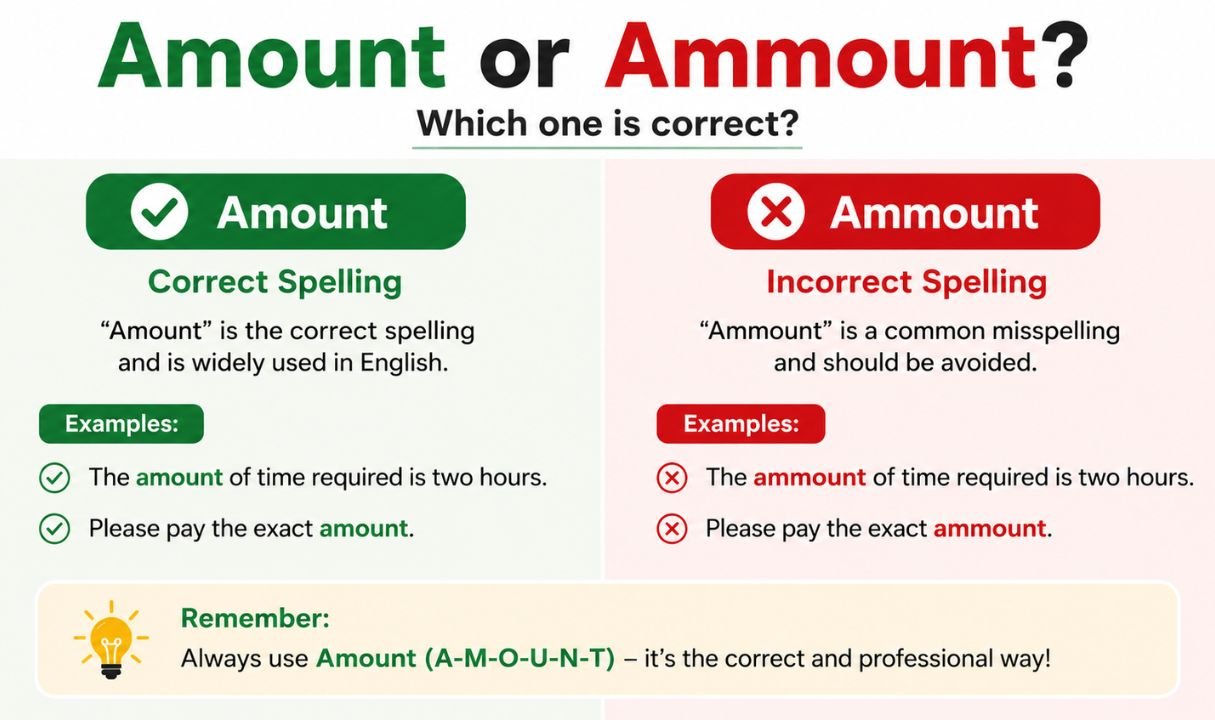
Here’s the answer before anything else: amount is correct. Ammount is a misspelling and has no place in formal or informal English writing. One “m” is all this word has ever needed.
That said, knowing the answer and knowing why people keep getting it wrong are two different things. This guide walks through the meaning, the grammar, the history, and the small habits that cause the mix-up in the first place — so you stop second-guessing yourself for good.
Quick Answer
| Question | Answer |
|---|---|
| Correct spelling | Amount |
| Incorrect spelling | Ammount |
| Part of speech | Noun, verb |
| Pronunciation | uh-MOUNT (/əˈmaʊnt/) |
| Found in dictionaries? | Yes (amount only) |
| Regional spelling difference? | None |
Amount or ammount meaning
Amount refers to a total, sum, or quantity of something. It can describe money, time, effort, sugar in a recipe, or anything else that can be measured or counted. Ammount has no independent meaning of its own — it’s simply amount typed with an extra letter.
Amount or ammount grammar
Grammatically, amount works two ways:
- As a noun: “The amount of rain this month surprised everyone.”
- As a verb: “Her savings amounted to almost three thousand dollars.”
Neither role ever calls for a double “m.” Verb forms such as amounts, amounted, and amounting follow the same single-“m” rule.
Amount or ammount examples
- Correct: The total amount due is $250.
- Incorrect: The total ammount due is $250.
- Correct: He put in an enormous amount of effort.
- Incorrect: He put in an enormous ammount of effort.
Amount of money
When people write about finances — invoices, receipts, salaries, refunds — “amount of money” is one of the most common phrases they reach for. It simply means the total sum being discussed, and it’s also one of the places where the ammount typo shows up most, probably because financial writing is often rushed.
All amount
“All amount” isn’t standard English on its own. Depending on context, writers usually mean “the entire amount,” “all amounts,” or “the full amount.” If you catch yourself typing “all amount,” it’s worth pausing to ask which of those three you actually intend.
Amount synonym
A few words can substitute for amount depending on context:
- Quantity
- Total
- Sum
- Volume
- Extent
- Number (for countable items)
Choosing between these often comes down to whether you’re describing something countable (number, quantity) or something measured as a whole (sum, total).
Amount of money meaning
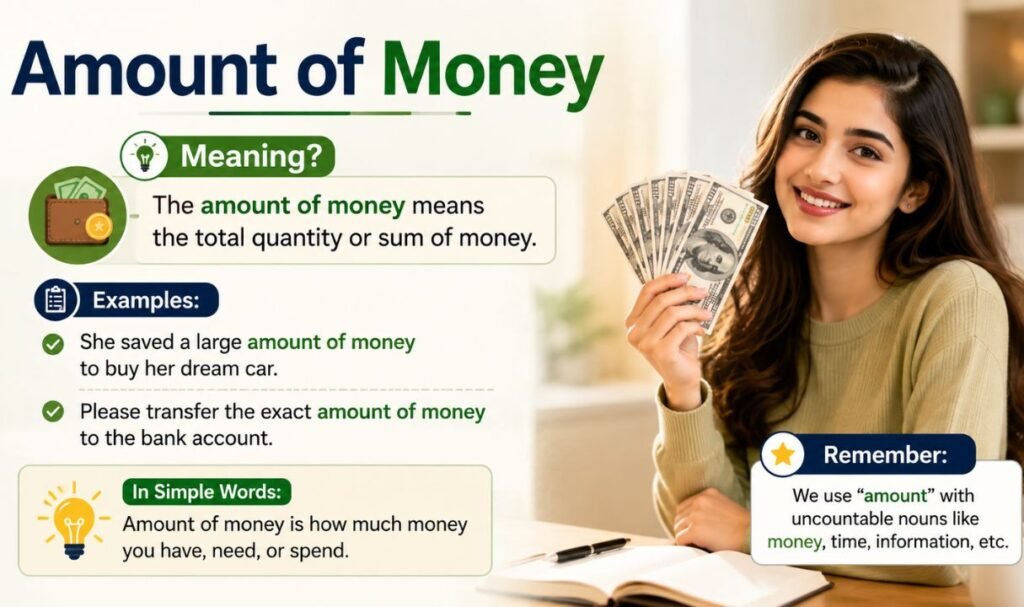
This phrase simply means the specific sum of currency being referred to in a sentence — how much money is involved, whether that’s a bill, a paycheck, a fine, or a donation.
You May Like: 22th or 22nd: Which One Is Correct? Grammar Guide (2026)
The Origin of Amount or Ammount
Amount didn’t start out as an English word at all. It traces back to the Old French amonter, built from the phrase à mont, meaning “upward” or “to the mountain.” The idea was literal at first: something rising or adding up, much like climbing toward a peak.
The word moved into Middle English as amounten, still carrying that sense of quantities rising or totaling together. Over the following centuries, spelling and pronunciation settled into the modern form we use now — amount, with a single “m” from the very start.
Ammount never existed at any stage of that history. It isn’t an old variant, a regional form, or a forgotten spelling that fell out of fashion. It’s simply a typing slip that has become common because the word is used constantly and because pronunciation makes the double letter feel plausible.
British English vs American English Spelling
Some English words split down the middle depending on the country — colour versus color, organise versus organize, travelling versus traveling. Amount isn’t one of them.
Every major English-speaking country uses the same spelling: amount, one “m,” no exceptions. Whether you’re writing for a British audience, an American one, an Australian one, or anywhere else, the word never changes.
Comparison Table
| Feature | British English | American English |
|---|---|---|
| Spelling | Amount | Amount |
| Pronunciation | /əˈmaʊnt/ | /əˈmaʊnt/ |
| Regional variant | None | None |
| “Ammount” accepted? | No | No |
Which Spelling Should You Use?
Use amount. Every time, in every context — academic papers, business documents, casual texts, resumes, social media posts. There’s no formal-versus-informal distinction here, no British-versus-American split, and no situation where the double-“m” version becomes acceptable.
If you want a quick way to lock it in, try one of these tricks:
- Break the word into its shape: a-m-o-u-n-t. Say each letter slowly once or twice.
- Link it mentally to a word you already spell correctly, like total — both have a single consonant sitting in the middle.
- Notice that amount starts with “a” and ends with “t,” with nothing doubled in between.
None of these tricks are magic. What actually fixes the habit is repetition — reading and writing the correct spelling enough times that your hands stop reaching for the extra letter.
Common Mistakes with Amount or Ammount
Most people who type ammount aren’t confused about the word’s meaning. They know exactly what they’re trying to say. The mistake comes from a handful of predictable habits:
- Pronunciation influence. Spoken quickly, “amount” can sound like it has a slightly heavier middle sound, which nudges some writers toward doubling the letter.
- Pattern matching with other words. English is full of double-consonant words — common, summit, hammer — and the brain sometimes assumes amount belongs to that group.
- Typing speed. On phones and keyboards, a fast typist can hit a key twice without noticing, especially in a word that already has a rhythm to it.
- Autocorrect blind spots. Some writers see a red underline, assume it’s a false flag, and move on without checking.
- Copy-paste habits. Once a misspelling appears in a document — a template, an old email, a shared spreadsheet — it can get reused without a second look.
None of these reasons make ammount correct. They just explain why the mistake is so common, even among careful writers.
You May Like: Winner or Winer: Which Spelling Is Correct? (2026 Guide)
Amount or Ammount in Everyday Examples
Seeing the word in context often does more than any rule. Here are a few everyday sentences using the correct spelling:
- “Please confirm the amount before we process the refund.”
- “The recipe calls for a small amount of cinnamon.”
- “Their donations amounted to over ten thousand dollars this year.”
- “I was impressed by the amount of detail in her report.”
- “The amount of traffic on this road has doubled since last year.”
- “We still need to calculate the exact amount owed.”
Notice how the word shifts easily between money, quantity, effort, and abstract measurement. That flexibility is part of why it shows up so often — and why the misspelling spreads just as widely.
Amount or Ammount – Google Trends & Usage Data
Search interest in this exact spelling question stays fairly consistent year over year, which tells you something: this isn’t a passing trend, it’s a recurring stumble. People search “amount or ammount,” “is it ammount or amount,” and similar phrasing steadily, often spiking around the start of school terms and tax season, when writing about totals, fees, and figures becomes unavoidable.
A quick scan of search behavior shows a few patterns:
- Interest tends to rise during financial deadlines, when invoices and forms are being filled out.
- Students search the term ahead of essay submissions and grammar tests.
- Non-native English speakers make up a notable share of searches, since the pronunciation-to-spelling gap is a common trap across many language backgrounds.
None of this changes the answer. It just confirms that the confusion is widespread enough to keep this question near the top of spelling searches year after year.
Amount or Ammount Comparison Table
| Category | Amount (Correct) | Ammount (Incorrect) |
|---|---|---|
| Recognized in dictionaries | Yes | No |
| Used in formal writing | Yes | Never |
| Used in casual writing | Yes | Never |
| Grammatically valid noun | Yes | No |
| Grammatically valid verb | Yes | No |
| Regional spelling variant | None | Not applicable |
| Historical origin | Old French amonter | Modern typo, no origin |
| Autocorrect flags it | No | Yes |
Frequently Asked Questions
Is it ammount or amount?
It’s amount. Ammount is a misspelling and isn’t recognized in any standard English dictionary.
What is the correct spelling of amount?
The correct spelling is a-m-o-u-n-t, with a single “m.”
What does “amunt” mean?
“Amunt” isn’t a word — it’s another common misspelling of amount, missing the “o.”
What does amount mean?
Amount means a total, sum, or quantity of something, such as money, time, or effort, and can also be used as a verb meaning “to add up to.”
Conclusion
The rule here couldn’t be simpler: amount has one “m,” and ammount is never correct, no matter who’s writing it or where. The confusion makes sense given how the word sounds and how many similar English words double their consonants, but once you’ve seen the pattern a few times, it tends to stick.
Next time you pause mid-sentence, you won’t need to guess. Write amount, trust the single “m,” and move on with your day.