
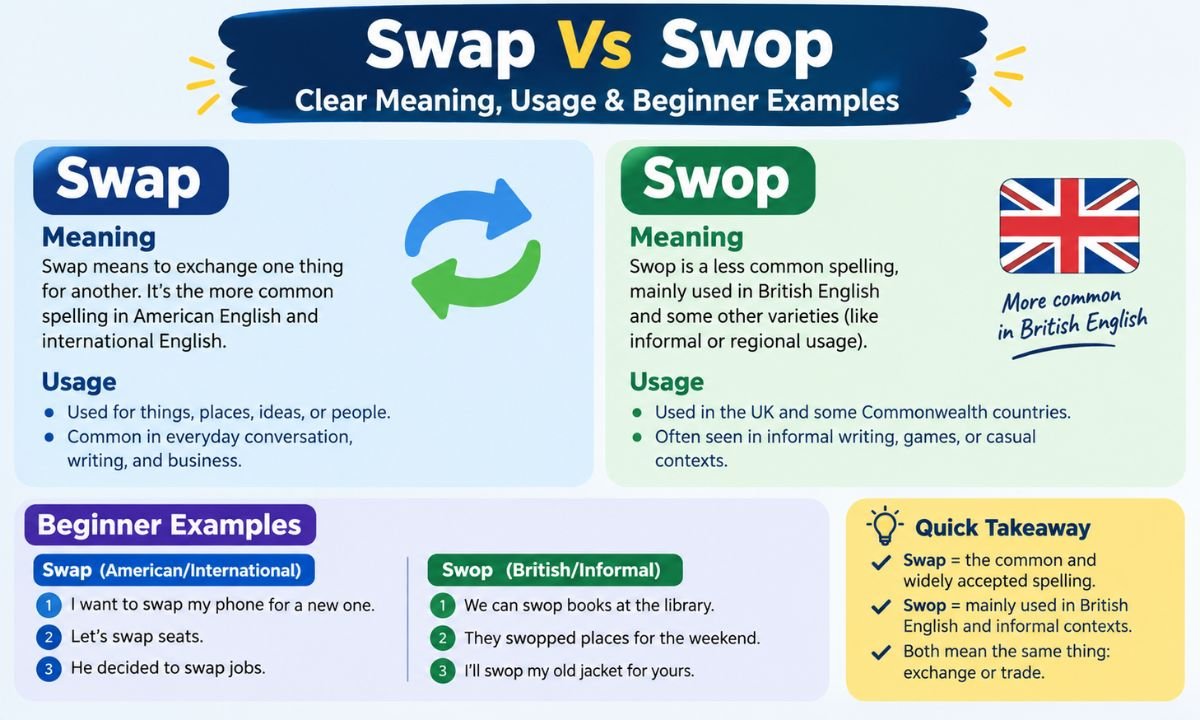
You have two words, one meaning, and a nagging feeling that one of them is a typo. That is the whole puzzle behind swap vs swop. Someone writes “let’s swop seats” in a British email, and a reader in Chicago wonders if the writer slipped on the keyboard. Someone else types “swap” in a London newsroom and nobody blinks.
The short answer: Swap is the standard spelling almost everywhere. Swop is a recognised variant, found mostly in British English and in some other regions, and it is now far less common. Both verbs mean the same thing. They name the act of exchanging one thing for another.
Definition
Swap (verb): to exchange one thing for another, or to trade places, items, roles or ideas with someone.
Swop (verb): a variant spelling of swap, with the same meaning. Collins Dictionary defines it simply as a variant spelling of swap, and its American English entry labels it a chiefly British alternative spelling.
Both words also work as nouns. A swap or a swop is an exchange, or the thing that gets exchanged.
Here is the definition in one line you can quote:
Swap and swop mean the same thing: to exchange or trade. Swap is the standard spelling worldwide, while swop is a less common variant used mainly in British English.
What Do Swap and Swop Mean?
The core idea is a two-way exchange. You give something up, and you receive something else. Nobody is simply handing things over for free, and nobody is just buying.
Core meanings
Dictionaries group the senses of swap in a few clear ways:
- To trade items. Two kids trade football stickers at school.
- To switch positions or roles. Two colleagues change desks for a week.
- To replace one thing with another. You pull out an old battery and fit a fresh one.
- To exchange ideas or information. Friends trade stories over dinner.
- A financial contract. In finance, a swap is an agreement where two parties exchange liabilities or payments, such as fixed and floating interest rates.
Swop covers the first four senses in ordinary speech. The financial sense is almost always written swap today (as in “interest rate swap” or “credit default swap”), even by British writers.
Grammar basics
The verb works in two common patterns:
- Swap + thing + for + thing: “I swapped my bike for a scooter.”
- Swap + thing + with + person: “She swapped shifts with Maria.”
Both patterns work the same way with swop.
Word forms
| Form | Swap | Swop |
|---|---|---|
| Base verb | swap | swop |
| Third person singular | swaps | swops |
| Past tense | swapped | swopped |
| Present participle | swapping | swopping |
| Noun (plural) | swaps | swops |
| Person who does it | swapper | swopper |
Notice that both spellings double the final p before -ed and -ing. A small slip people make is writing “swaped” or “swoped.” Neither is correct.
A note on formality
Swap is sometimes called informal because it sounds casual. Yet Merriam-Webster’s usage guide, as quoted by the language blog Grammarphobia, says swap is fine in all but the most formal writing. In a legal contract you might prefer exchange. In a blog post, an email or a news story, swap is perfectly at home.
Historical Roots: How “Swop” Emerged from “Swap”
The story starts with a handshake, not a spelling rule.
According to the British dictionary entry reproduced on several reference sites, swap appeared in the 14th century with the sense of striking hands together to seal a bargain. The word is thought to be imitative, meaning it was shaped by the sound of a slap or a smack. Think of two merchants clapping palms to agree on a price.
Grammarphobia’s history of the word adds a useful detail. Early on, people said they would “swap a bargain,” meaning to strike one. Soon afterward the verb dropped the object and took on its modern sense of trading. The Oxford English Dictionary quotes an example from John Lyly’s play Mother Bombie (1594), where a character refuses to swap his father for anything.
Where did the “o” come from?
The earliest written forms used an a. Over the centuries, writers also spelled the word with an o, particularly in Britain. A plausible reason is pronunciation. In British English the vowel in swap sounds like the vowel in stop and shop, so spelling it swop feels natural to the ear. Many English words with wa- are pronounced with that “o” sound (wash, want, watch), and spelling has never been fully consistent about it.
I would be wary of anyone who gives you an exact date for when swop “emerged.” Several low-quality pages online claim precise decades and even say Victorian novels favoured it. Those claims are rarely backed by sources. What reliable references do say is simpler: swop is an old variant, it grew mostly in British usage, and the Oxford English Dictionary recommends swap as the spelling for both verb and noun.
Quick timeline
| Period | What happened |
|---|---|
| 14th century | Swap appears, meaning to strike hands on a bargain |
| Late 1500s | The modern “exchange” sense is in use (Lyly, 1594) |
| Following centuries | The swop spelling appears alongside swap, mainly in Britain |
| Modern era | Swap becomes the dominant spelling; swop remains a recognised variant |
Swap vs Swop: Key Differences at a Glance
Because the words are variants of each other, the differences are about spelling, region and frequency. They are not about meaning.
| Feature | Swap | Swop |
|---|---|---|
| Meaning | To exchange or trade | To exchange or trade (identical) |
| Part of speech | Verb and noun | Verb and noun |
| Status | Standard spelling | Variant spelling |
| Frequency today | Very common | Uncommon |
| Typical region | Worldwide | Mainly British English; also seen in parts of Africa |
| Pronunciation (UK) | /swɒp/ | /swɒp/ |
| Pronunciation (US) | /swɑːp/ | /swɑːp/ (rarely used) |
| Recommended by OED | Yes | No |
| Safe in global writing | Yes | Risky |
The same differences as a quick list
- Meaning: no difference at all.
- Pronunciation: no difference at all.
- Spelling: a versus o.
- Reach: swap is understood everywhere, while swop may look like an error to some readers.
- Risk: swap is never marked wrong. Swop can be flagged by spell-checkers set to American English.
Usage in Different English-Speaking Regions
English spelling shifts from country to country, and swop is a good example of a word caught in that drift. Here is how it plays out.
United Kingdom
British English is the home of swop. You can still find it in older books, local newspapers and everyday notices. Yet even in Britain, swap has become the main choice in modern writing.
A well-known example: the BBC children’s programme Multi-Coloured Swap Shop, which ran from the 1970s, used the a spelling. And if you search for “swap shop” in the UK today, you will find the a spelling used widely for community exchange groups.
Practical guidance for UK writers:
- Use swap for websites, business writing, marketing and news.
- Use swop only if a house style, a historical text, or a deliberate voice calls for it.
- Be consistent inside a single document.
United States
In the United States, swap is the default and swop is treated as foreign or simply wrong. Collins’ American English entry flags swop as a chiefly British alternative. An American editor who sees “swop” will usually change it to “swap” without a second thought.
That fits a broader pattern. American spelling tends toward simplicity and fixed forms, and many British variants never took hold there. If your readers are American, skip swop entirely.
Australia & New Zealand
Australian English mostly follows British spelling norms, with some American spellings accepted as standard. For this word, though, swap dominates. You will see it on classifieds, community noticeboards and in everyday talk, as in “clothes swap” or “book swap.”
New Zealand English follows the same habit. Swop is understood but rarely written. If you are writing for either country, choose swap.
Other Regions
- Canada: Canadian spelling blends British and American forms, and Canadians tend to be tolerant of both. Swap is by far the usual form.
- South Africa: Swop is more visible here than in most places. You may spot it in local shop names, community exchange groups and informal writing. It still sits beside swap, and neither is considered an error.
- India and other countries using British-style English: Usage varies by publication. Most modern writing uses swap.
- International business and tech: Swap is the working standard. Terms like “swap file,” “currency swap” and “credit default swap” are always written with an a.
Regional summary
| Region | Preferred spelling | Is swop accepted? |
|---|---|---|
| United Kingdom | Swap | Yes, as a variant |
| United States | Swap | Rarely; seen as unusual |
| Australia | Swap | Understood, uncommon |
| New Zealand | Swap | Understood, uncommon |
| Canada | Swap | Understood, uncommon |
| South Africa | Swap and swop both seen | Yes |
| Global business and tech | Swap | Not used |
Real-Life Usage Examples
Seeing the word in sentences removes most of the confusion. Each pair below means exactly the same thing.
1. Swapping things
- “Can I swap my sandwich for your apple?”
- “Can I swop my sandwich for your apple?”
2. Swapping places or roles
- “Let’s swap seats so you can see the screen.”
- “Let’s swop seats so you can see the screen.”
3. Swapping with a person
- “I swapped shifts with Daniel on Friday.”
- “I swopped shifts with Daniel on Friday.”
As a noun
- “That was a fair swap.”
- “That was a fair swop.”
With -ing forms
- “They’re swapping phone numbers.”
- “They’re swopping phone numbers.”
Figurative use
- “She swapped her corporate job for a farm in Wales.”
- “He swopped the city life for the quiet of the coast.”
Common phrases and collocations
| Phrase | Notes |
|---|---|
| swap meet | Common in the US; an outdoor market where people trade goods |
| swap shop | Common in the UK; a place or event for exchanging items |
| swap out | Replace one part with another (“swap out the old filter”) |
| swap places | Change positions with someone |
| swap stories | Share experiences back and forth |
| clothes swap | Event where people trade garments |
| swap file | Computing term; always spelled with a |
| currency swap | Finance term; always spelled with a |
If you are a beginner, here is a helpful habit. Copy the sentence structure of the examples above, and swap in your own nouns. The grammar never changes.
What Dictionaries & Style Guides Say
Opinions matter less than evidence here, so it helps to check the references that editors rely on.
Dictionary Insights
Collins Dictionary lists swop as a variant spelling of swap, with the forms swops, swopping and swopped. In its American English section, it labels swop as a chiefly British alternative spelling.
British dictionary data (as reproduced on reference sites) gives swap as the main entry. It lists swops, swopping and swopped as the variant forms, and records swopper as a variant of swapper.
WordReference presents the entry as “swap, also UK: swop,” which signals that the o form is a British alternative to the main spelling.
The Oxford English Dictionary, according to Grammarphobia, recommends the swap spelling for both the verb and the noun, while acknowledging that swop is accepted as a chiefly British variant.
Putting those together:
- Every major source treats the two words as the same word.
- Every major source puts swap first.
- No reputable dictionary treats swop as a different word with a different meaning.
Style Guide Recommendations
Style guides rarely devote a full entry to a single variant like swop, so you will not find a long rule. The practical guidance from editors and publishers tends to look like this:
- Follow your audience. Writing for an international or American readership means swap.
- Follow your house style. Some British publishers prefer swap for all copy. Others leave it to the author, as long as the choice is consistent.
- Stay consistent. If you choose swop, use swopped and swopping throughout, not a mix.
- Keep quotations untouched. If you quote an older text that uses swop, keep the original spelling.
When in doubt, check the style guide your employer, publisher or university uses. If none exists, swap is the safe pick.
Modern Usage in Everyday English
Language usage today is shaped less by printed dictionaries and more by screens. Search engines, spell-checkers, apps and social media all push toward the most common form, and the most common form is swap.
Here is what that looks like in daily life:
- Spell-checkers: Most default to American English and underline swop in red. Even British-English settings may accept it but suggest swap in grammar tools.
- Apps and platforms: Features such as “swap seats,” “swap photos,” “swap lanes” and “token swap” all use the a.
- Online communities: Groups that exchange clothes, plants, books and games almost always call themselves swap groups.
- Education: Teachers of English as a second language use swap in materials, because it is the form learners will meet most often.
Swop has not vanished. It lingers in speech transcripts, in the writing of older readers, in some regional signage, and in the style of writers who like a traditional British flavour. But it is a minority choice now, and it has been for a long time.
A small point on pronunciation: because the spoken word is identical in both spellings, you will never hear the difference. The only place a reader notices it is on the page.
Which One Should You Use Today?
Use swap unless you have a specific reason not to.
Here is a simple decision guide:
| Your situation | Best choice |
|---|---|
| Writing for a global or American audience | swap |
| Business email, report or website copy | swap |
| School or university essay | swap |
| English learner in any country | swap |
| Technical, finance or computing text | swap |
| Quoting an older British source | match the source |
| Fiction set in a traditional British voice | swop is optional |
| Writing for a South African audience | either; follow the publication |
Numbered quick rule
- Default to swap.
- Choose swop only for a clear stylistic or regional reason.
- If you choose swop, keep every form consistent (swops, swopped, swopping).
- Never mix both spellings in one piece of writing.
This guidance matches what the Oxford English Dictionary itself suggests. If the most authoritative dictionary of English recommends swap, you are on solid ground using it.
Why Clarity and Consistency Matter
Readers do not stop to think about spelling variants. They notice when something looks off, and then their attention drifts from your message to the odd word.
Clarity. A spelling that some readers read as a typo costs you trust, even if it is technically valid. For a business page or a school paper, that small doubt is not worth it.
Consistency. Switching between swap and swop in the same article looks careless. Switching between swapped and swopped looks worse. Editors call this a house-style slip, and it is one of the easiest errors to prevent.
Search visibility. If you publish online, remember that people searching for the term overwhelmingly type swap. A page that uses only swop may be missed by readers who are looking for the more common form. When you do need to mention swop, it helps to explain its relationship to swap in the text, as this article does.
Accessibility. Screen readers and translation tools handle the standard spelling more reliably. Learners using translation apps will usually find swap instantly, while swop may return fewer or odd results.
A good habit: before publishing, run a search inside your document for “swop.” If you find one, decide whether it is intentional. If it is not, change it.
Real-World Examples of Swap and Swop
Here are examples from different settings. Each sentence is written for illustration and is not taken from any particular publication.
Everyday life
- “We swapped numbers at the train station.”
- “The kids swopped cards in the playground until the bell rang.”
Work and study
- “Could you swap shifts with me on Thursday?”
- “Two students swapped notes before the exam.”
- “The manager approved the swap of two desks.”
Community and sustainability
- “Our street holds a spring plant swap.”
- “The library runs a monthly book swop in the foyer.”
- “A school uniform swap helps families save money.”
Shopping and money
- “She swapped the jacket for a larger size.”
- “Some travellers swap currency at the airport, though rates are often poor.”
Technology
- “You can swap the battery without any tools.”
- “When memory runs low, the system uses swap space on the disk.”
- “Users can swap one token for another on the platform.”
Finance
- “The two companies entered an interest rate swap to manage borrowing costs.”
- “A credit default swap works like insurance against a borrower failing to repay.”
Notice how the finance and computing examples all use swap. If you ever see “swop file” or “credit default swop,” treat it as a mistake.
Typical mistakes and their fixes
| Mistake | Correction | Why |
|---|---|---|
| “I swaped my seat.” | “I swapped my seat.” | Double the p before -ed |
| “We are swoping places.” | “We are swapping places.” | Double the p before -ing |
| “She swopped, then swapped again.” | Pick one spelling | Keep it consistent |
| “A credit default swop” | “A credit default swap” | Finance uses swap |
| “Swap my pen to you.” | “Swap my pen with you.” or “Swap pens with me.” | Use with or for correctly |
Self Assessment Section
Test yourself. Answers are at the end.
Question 1. Which word is the standard spelling used worldwide? a) swop b) swap
Question 2. Fill in the blank: “They ______ phones for the day.” (past tense of swap) a) swaped b) swapped c) swapt
Question 3. True or false: swop and swap have different meanings.
Question 4. Which spelling is always used in finance, as in “credit default ______”? a) swop b) swap
Question 5. You are writing a report for a global audience. Which spelling is the safest choice?
Question 6. Which sentence is consistent? a) “He swopped his bike, then swapped his helmet.” b) “He swapped his bike, then swapped his helmet.”
Question 7. Which region shows the swop spelling more often than most others? a) the United States b) South Africa c) Japan
Question 8. Complete the phrase: “a clothes ______” (an event where people trade garments).
Answers
- b) swap. It is the standard form everywhere.
- b) swapped. Double the p.
- False. They mean the same thing.
- b) swap. Finance terms use the a.
- swap. It is understood in every English-speaking market.
- b). Option a mixes two spellings.
- b) South Africa. Swop appears more often there than in the US or Japan.
- swap. “A clothes swap” is the usual form.
Scoring: 7 to 8 correct means you have this mastered. 5 or 6 means a quick reread of the “Which One Should You Use Today?” section will help. Below 5, review the word forms table and try again.
Frequently Asked Questions
What is the difference between swap and swop?
There is no difference in meaning. Swap is the standard spelling used worldwide, and swop is a less common variant found mainly in British English.
Is swop still used in the UK?
Yes, but rarely. Most British writers now use swap, and swop appears mainly in older texts, informal writing and traditional styles.
Do swap and swop mean the same thing?
Yes. Both mean to exchange or trade one thing for another, and both work as verbs and nouns.
Which is correct: swap or swop?
Both are accepted, but swap is the preferred and safer spelling. Use swop only if your style guide or a British context calls for it.
Should English learners use swap or swop?
Learners should use swap. It is the form they will see most often, and it is correct in every English-speaking country.
Conclusion
The question of swap vs swop looks bigger than it is. The two words are one word with two spellings. They mean the same thing, they sound the same, and they follow the same grammar. What separates them is habit, region and reach.