
You’re typing a sentence, your fingers pause at the “z,” and suddenly you’re not sure if it should be an “s” instead. It happens to almost everyone who writes in English for more than one audience. The good news is that this isn’t really a grammar problem at all — it’s a geography problem, and once you see it that way, the confusion clears up fast.
This guide breaks down exactly where the two spellings come from, how British and American writers treat them differently, and which one belongs in your next email, blog post, or report.
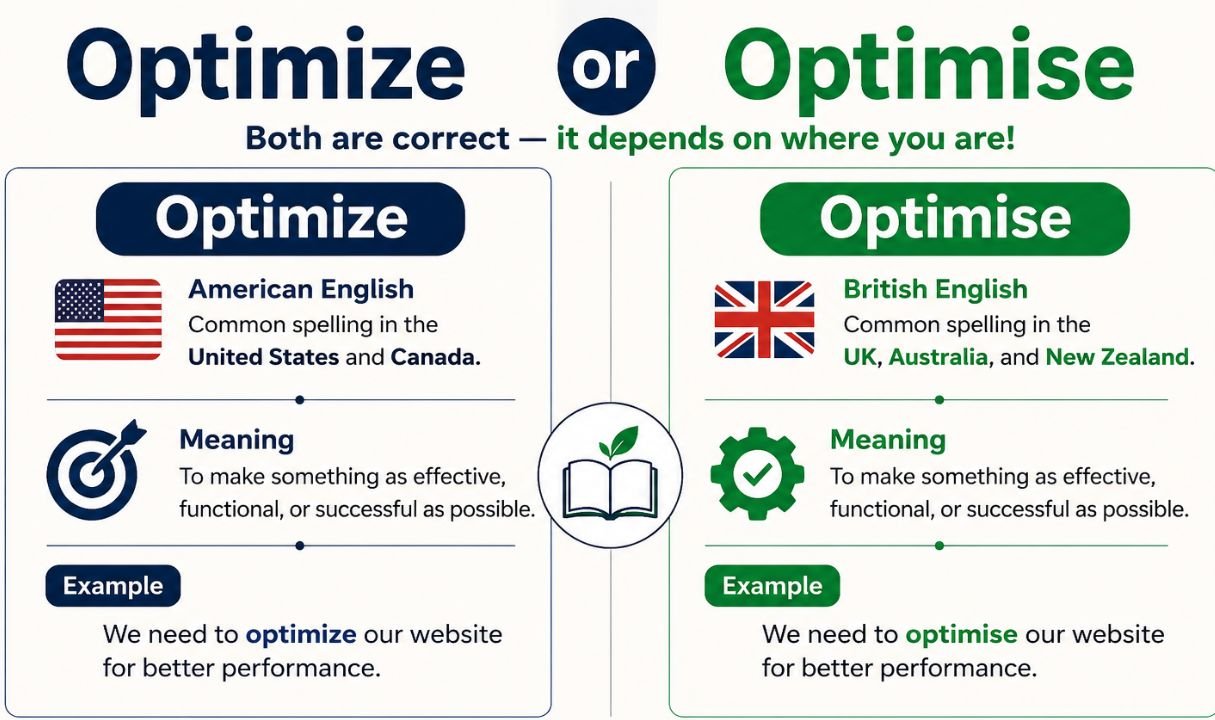
Optimize or Optimise – Quick Answer
Both words are correct. Neither one is a typo, and neither one is “more proper” than the other.
- Optimize is the standard spelling in American English.
- Optimise is the standard spelling in British English, and it’s also common across Australia, New Zealand, South Africa, and much of the Commonwealth.
The meaning doesn’t shift at all between the two. Whichever spelling you pick, you’re describing the same action: making something work as well as it possibly can.
Examples:
- We need to optimize our checkout page for mobile users. (US)
- We need to optimise our checkout page for mobile users. (UK)
- The team optimized the delivery route to cut fuel costs. (US)
- The team optimised the delivery route to cut fuel costs. (UK)
Read them out loud and you’ll notice they sound identical. The pronunciation never changes — only the letter before the ending does.
The Origin of Optimize or Optimise
The story behind this spelling split goes back further than most people expect. Both words trace to the Latin optimus, meaning “best.” From there, the term moved through French before settling into English, where writers eventually added a verb-forming suffix to turn “best” into an action word.
That suffix is where things get interesting. English has long allowed two ways of writing this ending: -ize and -ise. For centuries, British writers actually used -ize just as often as Americans do today — it wasn’t originally an American invention at all. The Oxford English Dictionary has favored -ize since it was first compiled, precisely because the ending reflects the word’s Greek-influenced roots.
What changed was publishing convention, not correctness. As American English standardized through its own dictionaries and school systems in the 19th and 20th centuries, -ize became the fixed national habit. Meanwhile, many British newspapers, universities, and style guides drifted toward -ise, partly under French spelling influence, until it became the version most UK readers now expect to see.
So when someone tells you “optimise is the original spelling,” that’s only half true. Both endings have deep roots in English. What settled the matter was regional preference, not etymology.
You May Like: Inter Vs Intra: The Complete Guide to Two Prefixes That Trip Up Even Careful Writers
British English vs American English Spelling
The optimize/optimise split isn’t a one-off quirk. It’s part of a much wider spelling pattern that separates American and British English, and once you understand the pattern, you can predict dozens of similar word pairs without memorizing each one individually.
Here’s the general rule:
| Spelling Feature | American English | British English |
|---|---|---|
| Verb ending | -ize (organize, realize, optimize) | -ise (organise, realise, optimise) |
| Noun ending | -ization (optimization) | -isation (optimisation) |
| Typical regions | United States, and often Canada in business writing | UK, Australia, New Zealand, South Africa, Ireland |
| Style guide leanings | AP Style, Merriam-Webster | Oxford (allows -ize), Cambridge, Collins (favor -ise) |
A detail that trips people up: not every “-ise” word has an American “-ize” twin. Words like advertise, surprise, compromise, and revise keep the “s” in every English variety, because that ending is baked into the word itself rather than being the optional verb-forming suffix. Optimize/optimise, organize/organise, and realize/realise belong to a different category — one where the spelling genuinely swaps by region.
It’s also worth knowing that British English isn’t fully uniform on this. Oxford University Press has always recommended -ize as its house style, even for UK writing, while Cambridge and Collins lean toward -ise. That’s why you’ll sometimes spot “optimize” in a British newspaper or academic paper and “optimise” in an American one — style guides don’t always follow the stereotype.
Which Spelling Should You Use?
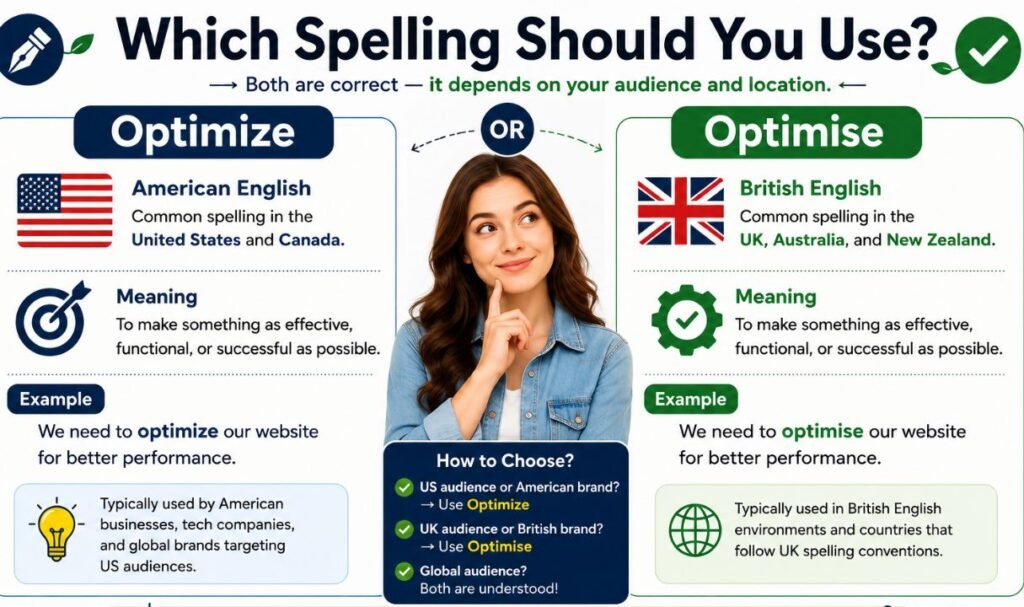
The honest answer is that it depends on who’s reading. Below are the practical situations people search for most, along with a straight answer for each.
Optimize or optimise meaning: Identical. Both describe improving something — a process, a design, a webpage, a schedule — so it performs at its best.
Optimize or optimise examples: “Optimize your resume for applicant tracking systems” (US) versus “Optimise your CV for applicant tracking systems” (UK). Same advice, different spelling.
- Optimise or optimize UK spelling: In the UK, optimise is the spelling readers expect on websites, in newspapers, and in business documents, though optimize still appears in Oxford-style academic writing.
- Optimise English: This simply refers to the British English form of the word, used across most Commonwealth countries.
- Optimise thesaurus: Close synonyms include improve, enhance, streamline, fine-tune, refine, and maximize/maximise (though “maximize” implies pushing something to its highest point, which isn’t always the same as optimizing it).
- Auto optimise meaning: This phrase usually shows up in software and device settings — think “auto-optimise storage” or “auto-optimise battery.” It means a system adjusts itself automatically for better performance, without the user manually tweaking settings.
- Optimise Oxford Dictionary: Oxford dictionaries list both spellings, but their primary entry and house style favor -ize, even though optimise is recognized as the common British variant.
Use Optimize if:
- Your readers are based in the United States
- You’re writing for a US company, app, or publication
- Your style guide follows AP or Merriam-Webster conventions
- You’re writing technical, SEO, or software documentation, where -ize dominates globally
Use Optimise if:
- Your readers are in the UK, Australia, New Zealand, or South Africa
- Your organization follows Cambridge or Collins-style British English
- You’re writing for a British publication, government body, or education sector
For Global Websites
If your audience spans multiple countries, pick one spelling and stay consistent across the entire page or document. Mixing “optimize” in one paragraph and “optimise” in the next looks careless, even though both are technically correct. A practical approach many international brands use:
- Check your existing content — if most of your site already leans American or British, match it.
- Look at your primary market’s location and search behavior.
- Set a house-style rule and add it to your writing guidelines so every contributor follows the same version.
- If you serve two audiences equally, consider separate regional versions of key pages rather than switching spellings mid-page.
Common Mistakes with Optimize or Optimise
A few habits show up again and again, even among experienced writers:
- Switching spellings mid-document. Starting with “optimize” in paragraph one and slipping into “optimise” by paragraph four is the single most common error, especially when multiple people edit the same file.
- Assuming one version is “more correct.” Neither spelling outranks the other grammatically. Preferring one over the other is a style choice, not a rule of English.
- Forgetting related word forms. If you choose “optimize,” the noun should be “optimization” and the past tense “optimized” — not “optimisation” or “optimised.” Consistency has to run through the whole word family, not just the base verb.
- Applying the -ize/-ise rule to every word that ends in “-ise.” As noted earlier, words like advertise and surprise never take a “z” in any variety of English, so blanket “search and replace” edits can introduce new errors.
- Ignoring your CMS or spellchecker language setting. Many writers switch spellings without realizing their software’s language setting is still flagging the “wrong” one, which quietly damages proofreading accuracy.
You May Like: Truely or Truly: What is the Difference & Which is Correct?
Optimize or Optimise in Everyday Examples
Different formats call for slightly different habits. Here’s how the choice plays out across common writing situations.
Business emails usually mirror the recipient’s region. Writing to a US client, you’d say: “I’ve optimized the proposal based on your feedback.” Writing to a UK client: “I’ve optimised the proposal based on your feedback.” Matching the reader’s spelling is a small courtesy that signals attention to detail.
News
Major American outlets — from tech blogs to national newspapers — almost always run “optimize.” British outlets like the BBC or The Guardian typically print “optimise,” reinforcing the regional split readers already expect from those sources.
Social Media
Social captions tend to follow whichever spelling feels native to the platform’s dominant audience, though there’s more flexibility here. A US-based creator writing “5 ways to optimize your morning routine” won’t confuse anyone by switching to “optimise” occasionally, but consistent branding still helps a profile feel professional.
Formal Writing
Academic papers, legal documents, and government reports are the strictest environment for spelling consistency. A dissertation submitted to a British university should use “optimise” throughout, including in the abstract, headings, and reference list, while a paper submitted to a US journal should stick with “optimize.”
Optimize or Optimise – Google Trends & Usage Data
Search behavior reflects the same regional pattern found in everyday writing. “Optimize” consistently draws far higher global search volume than “optimise,” largely because of the sheer size of the US market and the dominance of American terminology in digital marketing, software, and SEO content worldwide. Even users in countries that technically prefer British spelling often type “optimize” out of habit, since so many tools, tutorials, and platforms use the American form by default.
That said, “optimise” still holds a clear lead within the UK, Ireland, Australia, and New Zealand, where it appears far more often in local news coverage, government websites, and educational material than “optimize” does. For SEO purposes, this means targeting the right keyword variant for your audience’s country can matter more than targeting the version with the highest raw search volume — a UK-focused page built around “optimize” may miss a chunk of local searchers typing “optimise.”
Comparison Table: Optimize vs Optimise
| Feature | Optimize | Optimise |
|---|---|---|
| Region | American English | British English, Commonwealth |
| Meaning | To make something as effective as possible | Identical meaning |
| Related noun | Optimization | Optimisation |
| Past tense | Optimized | Optimised |
| Present participle | Optimizing | Optimising |
| Preferred by | US style guides, AP, Merriam-Webster | Cambridge, Collins |
| Global search volume | Higher | Lower, but stronger regionally |
| Common in | Tech, SEO, US business writing | UK media, government, education |
Frequently Asked Questions
What do you mean by optimizing?
Optimizing means adjusting something — a system, page, or process — so it performs as efficiently and effectively as possible.
How can you optimize?
You optimize by identifying weak points, testing changes, and refining the process based on results until performance improves.
What does “optimize” mean?
It means to make something as good, efficient, or effective as it can possibly be.
What do we mean by optimise?
“Optimise” carries the exact same meaning as “optimize” — it’s simply the British English spelling of the word.
Conclusion
There’s no winner between optimize and optimise, and there never really was one to begin with. The choice comes down to a single question: who is reading your work? Match your spelling to your audience’s region, keep it consistent from your headline to your final sentence, and the “z” versus “s” debate stops being a problem you have to think about twice.