
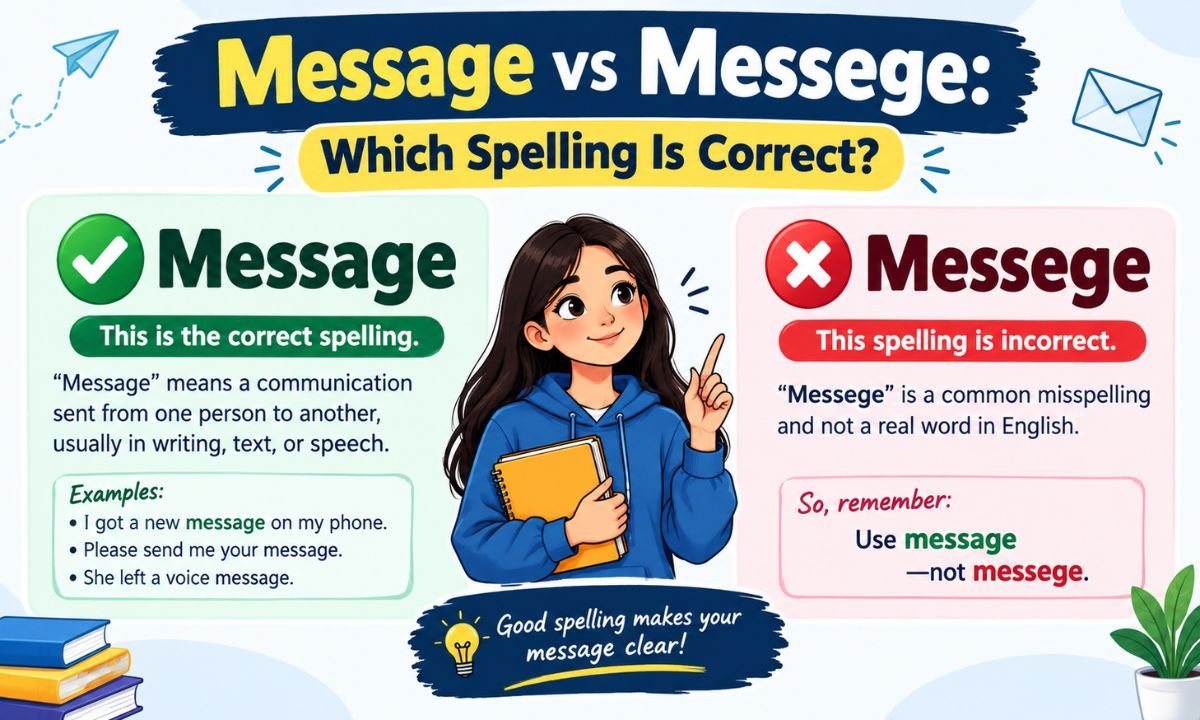
If you’ve ever paused mid-sentence and stared at the word “messege,” wondering if the letters are in the right order, you’re not the only one. This mix-up shows up constantly in texts, emails, and social media comments. The good news is that the answer is short and permanent: there’s only one correct spelling, and this guide clears up every doubt around it, from the meaning of the word to the reasons your brain keeps trying to spell it wrong.
Quick Answer
Message is the correct spelling. Messege is not a word in the English language — it’s a common misspelling caused by how the word sounds when spoken quickly. Dictionaries, spell-checkers, and style guides all recognize only one version: message, spelled with an “a” in the second syllable.
Message vs Messege at a Glance
| Feature | Message | Messege |
|---|---|---|
| Correct spelling | Yes | No |
| Found in dictionaries | Yes | No |
| Passes spell-check | Yes | No |
| Word origin | Old French “message,” from Latin “missus” | None — not a recognized word |
| Common in professional writing | Yes | Never acceptable |
| Typical cause | N/A | Pronunciation habits and fast typing |
What Does “Message” Mean?
A message is a piece of information passed from one person to another. It can travel through speech, writing, gestures, or digital platforms. The word works as both a noun and a verb.
As a noun, it refers to the content itself:
- She left a message on the kitchen table.
- The voicemail contained an urgent message.
As a verb, it describes the act of sending that content:
- Message me when you land.
- He messaged the whole group about the schedule change.
The word traces back to Old French “message,” which itself came from the Latin “missus,” meaning “sent.” That Latin root explains why the spelling has stayed fixed for centuries rather than shifting to match casual pronunciation. English holds onto a lot of these older spelling patterns even after everyday speech starts to sound different from the written form.
Is “Messege” a Real Word?
No. “Messege” has no dictionary entry, no accepted usage in formal or academic writing, and no grammatical function of its own. Every major English dictionary — Merriam-Webster, Oxford, Cambridge — lists only “message.” Word processors and spell-checkers flag “messege” as an error the moment you type it, and grammar-checking tools such as Grammarly treat it the same way.
Some learners assume that because “messege” sounds close to the spoken word, it must be an accepted informal spelling, similar to how “gonna” gets a pass in casual writing. That’s not the case here. Unlike shortened or slang forms that carry their own recognized identity, “messege” is simply an error. It doesn’t shorten anything, it doesn’t add meaning, and it doesn’t appear in any style guide as an alternate spelling.
Why Do People Confuse Message and Messege?
The confusion isn’t random. A handful of specific habits push writers toward the wrong version again and again.
- Pronunciation mismatch. English spelling often ignores how a word actually sounds. “Message” is pronounced roughly as “mes-ij,” and that final unstressed vowel sound doesn’t clearly signal whether the letter should be an “a” or an “e.”
- Fast typing on phones. Mobile keyboards make it easy to swap adjacent vowels without noticing, especially when you’re typing quickly during a conversation.
- Visual similarity between endings. The “-age” ending and a hypothetical “-ege” ending look close enough at a glance that the eye doesn’t always catch the difference during a quick reread.
- Muscle memory. Once someone types “messege” incorrectly a few times, their fingers tend to repeat the same pattern without conscious thought.
- Autocorrect gaps. Not every keyboard or app catches the error immediately, particularly in comment sections or informal chat apps with looser spell-check settings.
Put simply, the mistake comes from sound, not logic. Your ear hears one thing, but English spelling asks you to remember a fixed pattern instead of guessing from pronunciation.
How to Remember the Correct Spelling
A few memory tricks make the correct spelling stick for good.
- Break it into parts. Think of the word as “mess” + “age.” Both are common, easy-to-spell words on their own, and joining them gives you “message.”
- Connect it to “age.” Many familiar words end in “-age” — package, village, storage, cabbage. “Message” follows that same family pattern, while “-ege” endings are rare in English overall.
- Use a short mnemonic. “A message has an A, like a letter you send.” Tying the missing letter to the idea of sending mail helps some learners recall it faster.
- Read it out loud, slowly. Saying “mess-AGE” instead of rushing through it can retrain your ear to expect the “a” sound.
- Proofread before sending. A quick second look at texts, emails, or documents catches the error before it reaches anyone else.
Repetition is what makes any of these tricks work. Writing the word correctly a few times a day, even in unrelated sentences, trains your hand to type it automatically without a second thought.
Examples of Message in Sentences
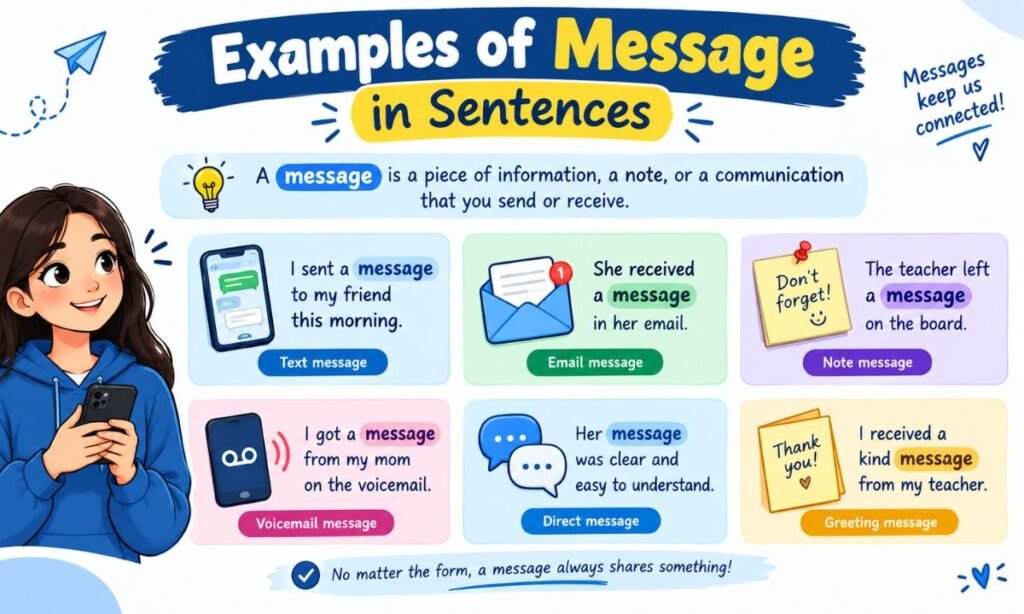
Seeing the word in different settings helps lock in the correct usage.
Formal Examples
- The CEO delivered a message to all employees regarding the merger.
- Please find the attached message from the legal department.
- The ambassador’s message emphasized the need for continued cooperation.
- Our records show that your message was received on Tuesday morning.
Informal Examples
- I sent her a message this morning and she hasn’t replied yet.
- Did you see the message I left on your phone?
- He texted a quick message before boarding the flight.
- Leave me a message if you’re running late.
Workplace Examples
- Please forward this message to the rest of the team.
- The manager left a message about the shift change on the board.
- I’ll message you the file as soon as it’s ready.
- Our support team responds to every customer message within 24 hours.
Common Misspellings of Message
Beyond “messege,” a few other variations pop up in casual writing. None of them are correct.
| Misspelling | Correct Form | Notes |
|---|---|---|
| Messege | Message | Most frequent error, caused by vowel confusion |
| Mesage | Message | Missing the double “s” |
| Massage | Message | Wrong word entirely, different meaning |
| Messsage | Message | Extra letter from a typing slip |
| Meassage | Message | Rare, but appears in fast typing |
If you ever spot one of these in a draft, replace it right away — none of them will pass a spell-check, and all of them can distract a reader from the point you’re trying to make.
Related Communication Terms
The word “message” appears inside several compound terms that describe how people communicate today. Each one follows the same spelling rule.
Text Message
A text message is a short written communication sent through a mobile phone’s SMS or messaging app. Example: “I got your text message during the meeting and replied right after.”
Voice Message
A voice message is an audio recording left for someone to listen to later, often through voicemail or a messaging app’s voice-note feature. Example: “She left a voice message explaining why she couldn’t make it.”
Instant Message
An instant message, often shortened to IM, is a real-time text communication sent through a chat platform. Example: “We exchanged a few instant messages before jumping on a call.”
Direct Message
A direct message, commonly called a DM, is a private message sent through a social media platform rather than posted publicly. Example: “He slid into her direct messages to ask about the job posting.”
Message vs Other Frequently Misspelled Words
Message vs Massage
These two words look similar but mean completely different things. A message is information sent between people. A massage is a physical treatment involving pressure and manipulation of muscles for relaxation or therapy. Mixing them up in writing can create an awkward or even funny sentence, such as “Can you massage me the report?” when the writer clearly meant “message.”
Message vs Mesage
“Mesage” drops one of the two S’s in “message.” It’s a simple typo rather than a pronunciation-based error, and it’s far less common than “messege,” but it still shows up in rushed writing. There’s no dictionary entry for it, and it should always be corrected to “message.”
Message vs Messenger
“Messenger” refers to a person or app that delivers a message, not the message itself. Someone acts as a messenger; the thing they carry is the message. Example: “The messenger arrived with an urgent message for the general.” Confusing the two isn’t usually a spelling issue so much as a mix-up in meaning, since both words are spelled correctly on their own.
Message Pronunciation Guide
The word “message” is pronounced MES-ij (IPA: /ˈmɛs.ɪdʒ/), with stress on the first syllable. Here’s a quick breakdown:
| Syllable | Sound | Notes |
|---|---|---|
| mes- | “mess” | Stressed syllable |
| -sage | “ij” | Unstressed, soft “j” sound at the end |
Note that the second syllable doesn’t sound like the letter “a” at all — it comes out closer to a short “ih” sound. That’s precisely why so many writers guess at an “e” instead of an “a” when spelling it out. Once you know the written form doesn’t match the spoken form, the mismatch stops being confusing and just becomes a fact to remember.
Frequently Asked Questions
Which is correct, messege or message?
Message is correct. Messege is a common misspelling and isn’t recognized in any English dictionary.
What’s the difference between a message and a massage?
A message is information sent between people, while a massage is a physical treatment that relaxes muscles through pressure and touch.
What is messege?
Messege isn’t a real word — it’s simply a frequent misspelling of “message,” usually caused by pronunciation confusion.
Is it correct to say “I messaged you”?
Yes. “Messaged” is the correct past-tense verb form, used when message functions as an action rather than a noun.
Conclusion
“Message” is the only correct spelling, and “messege” is a misspelling with no place in dictionaries, spell-checkers, or professional writing. The confusion almost always comes down to how the word sounds versus how it’s written, plus a bit of fast typing and muscle memory. Once you connect the word to its “mess + age” structure or its family of “-age” words like village and storage, the correct spelling becomes automatic.