
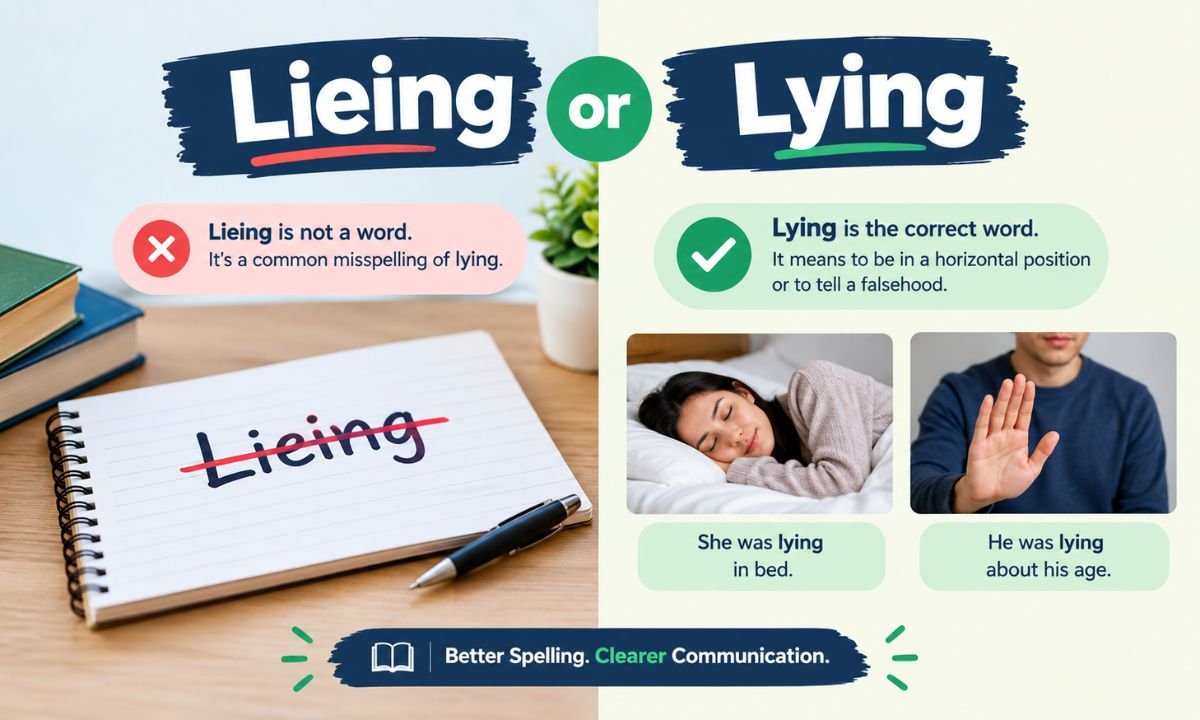
Type “lieing” into any search bar and you’ll likely pause before hitting enter. Something about it looks off, but plenty of people write it anyway, especially when they’re typing fast or trusting autocorrect to catch their mistakes. Autocorrect doesn’t always help here, and neither does instinct, because English spelling rules for words ending in “-ie” don’t follow the pattern most of us expect.
This guide settles the question for good. You’ll get the correct spelling, the grammar rule behind it, the two very different meanings the word can carry, and the mistakes that trip up even confident writers. By the end, you won’t need to double-check this one again.
Lieing or Lying – Quick Answer
Lying is correct. Lieing is a misspelling and doesn’t appear in any standard English dictionary.
The confusion happens because most verbs simply add “-ing” to their base form: walk becomes walking, jump becomes jumping, talk becomes talking. Following that logic, “lie” would become “lieing.” But English has a separate rule for verbs that end in “-ie,” and “lie” falls squarely into that category.
| Spelling | Status | Example |
|---|---|---|
| Lying | Correct | She is lying on the couch. |
| Lieing | Incorrect |
Keep that table in mind and you’ve already solved 90% of the problem. The rest of this article explains why the rule works this way and how to avoid related mix-ups.
What Is “Lieing”?
“Lieing” isn’t a word. It’s a spelling error that comes from applying the standard “-ing” rule to a verb that doesn’t follow it. People write it for a few understandable reasons:
- They’re treating “lie” like a regular verb (see, seeing; tie… except tie is also irregular).
- Autocorrect on some devices doesn’t flag it consistently.
- Non-native English speakers often learn the “-ing” rule before they learn its exceptions.
- It simply looks like it should work, since “die” and “tie” cause the exact same confusion.
If you’ve searched for this term before writing an email, a school essay, or a work message, you’re in good company. It’s one of the most commonly searched spelling questions in English, right alongside “there” versus “their.” The good news is that once you understand the underlying rule, the mistake tends to disappear for good.
What Is “Lying”?
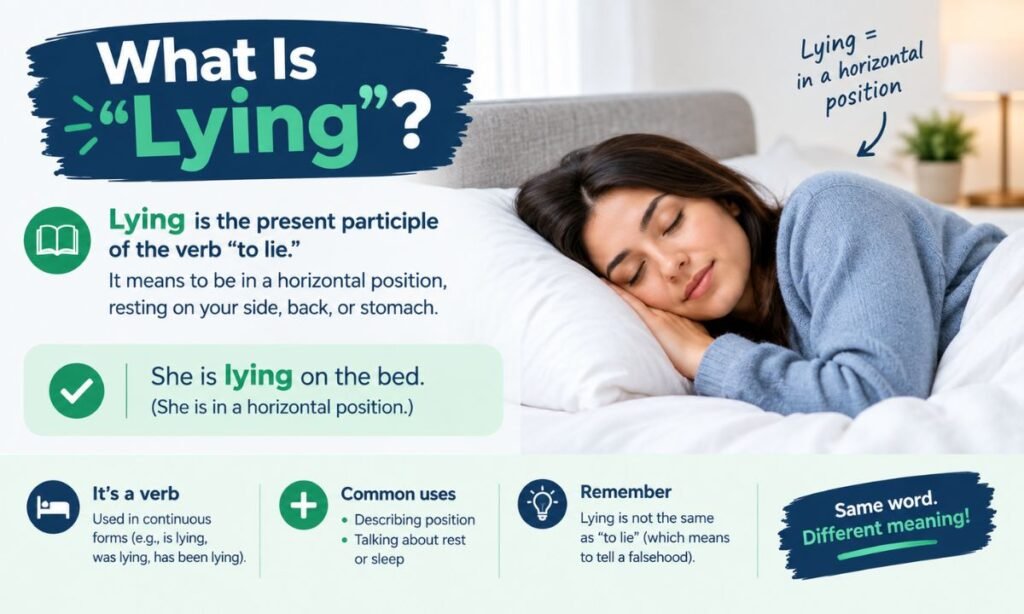
Here’s where things get genuinely interesting, because “lying” isn’t just one word doing one job. It’s the present participle of two completely different verbs that happen to share the exact same spelling.
Meaning 1: To Be in a Horizontal or Resting Position
This sense of “lying” comes from the verb “to lie,” meaning to recline, rest, or be positioned flat.
Examples:
- The dog is lying by the fireplace.
- I’ve been lying awake for hours.
- Old newspapers were lying on the porch.
This verb is intransitive, meaning it doesn’t take a direct object. You can’t “lie” something; you can only lie down yourself, or describe something else as lying somewhere.
Meaning 2: To Tell an Untruth
The second sense comes from the verb “to lie,” meaning to say something false on purpose.
Examples:
- He’s lying about where he was last night.
- Stop lying to me.
- The witness admitted to lying under oath.
Both meanings trace back to different Old English root words that simply converged in modern spelling. Context almost always makes clear which one a speaker means, which is part of why English speakers rarely notice they’re using two separate verbs at all.
Lieing or Lying – The Grammar Rule Explained
The -IE to -Y Rule
English has a quiet but consistent spelling rule: when a verb ends in “-ie,” you drop the “e,” change the “i” to a “y,” and then add “-ing.”
Here’s the pattern in action:
| Base Verb | Present Participle |
|---|---|
| lie | lying |
| die | dying |
| tie | tying |
| vie | vying |
Why does this rule exist at all? Mostly to avoid awkward or ambiguous letter combinations. “Lieing” and “dieing” would create a double vowel cluster (“iei”) that looks clunky and doesn’t match typical English spelling conventions. Swapping the “i” for a “y” keeps the word visually clean and easier to pronounce.
This isn’t a huge category of verbs, which is exactly why the rule catches people off guard. Most learners never see it explicitly taught; they just absorb “lying” and “dying” as if they were irregular vocabulary rather than the product of a rule they could apply elsewhere.
The Origin of Lieing or Lying
The verb “to lie” (as in reclining) comes from the Old English word “licgan,” while “to lie” (as in telling an untruth) descends from “leogan.” Over centuries of sound shifts and spelling standardization, both verbs settled into the same modern form: lie, lay, lain for the resting sense, and lie, lied, lied for the deception sense.
The “-ing” spelling rule itself solidified as English spelling became more standardized between the 15th and 18th centuries, particularly once printing presses created pressure toward consistent, agreed-upon spellings across regions. Before that, spelling was far more fluid, and forms resembling “lieing” likely did appear in handwritten texts. Standardization is precisely what eliminated them.
So in a sense, “lieing” isn’t a modern invention. It’s closer to an old habit resurfacing, one that formal English spelling rules quietly phased out long ago.
British English vs American English Spelling
Good news for anyone juggling regional spelling differences: this is one case where British and American English fully agree.
| Feature | British English | American English |
|---|---|---|
| Present participle of “lie” | Lying | Lying |
| Past tense (untruth) | Lied | Lied |
| Past tense (resting) | Lay | Lay |
| Past participle (resting) | Lain | Lain |
Unlike “colour/color” or “organise/organize,” there’s no transatlantic split here. Whether you’re writing for a British publication, an American audience, or anything in between, “lying” is the spelling to use every time.
Which Spelling Should You Use?
Always use “lying.” There’s no context, formal or casual, academic or conversational, where “lieing” is acceptable. Style guides, dictionaries, grammar checkers, and standardized tests all treat it as an outright error rather than a variant spelling.
A few practical reminders:
- If you’re describing a resting position, use “lying” (lying down, lying in bed, lying on the grass).
- If you’re describing dishonesty, use “lying” (lying to someone, caught lying, lying under oath).
- Never use “lieing” in either case; it isn’t a recognized alternative in any dictionary.
If you find yourself hesitating mid-sentence, a quick trick helps: think of “dying.” Nobody writes “dieing” instead of “dying,” and the two words follow the identical spelling pattern. If “dying” looks right to you, “lying” should too.
Common Mistakes with Lieing or Lying
Mistake 1: Confusing “Lying” with “Laying”
This is the single most common error connected to this topic, and it trips up native speakers just as often as learners.
- Lie (intransitive, no object): I lie down. She is lying on the bed.
- Lay (transitive, needs an object): I lay the book on the table. She is laying the blanket down.
A simple test: if you can name what’s being placed somewhere, use “lay/laying.” If nothing is being placed and the subject is simply resting, use “lie/lying.”
| Sentence | Correct? | Why |
|---|---|---|
| I’m going to lay down for a nap. | Incorrect | No object; should be “lie down.” |
| I’m going to lie down for a nap. | Correct | Intransitive, no object needed. |
| She laid her keys on the counter. | Correct | “Keys” is the object. |
| She lay on the sofa all afternoon. | Correct | Past tense of “lie,” no object. |
Mistake 2: Getting the Past Tense Wrong
The two meanings of “lie” have completely different past tense forms, and mixing them up is extremely common.
| Verb | Present | Past | Past Participle |
|---|---|---|---|
| Lie (recline) | lie/lying | lay | lain |
| Lie (untruth) | lie/lying | lied | lied |
Notice that “lay” is the past tense of “lie” (recline), which is exactly why people also confuse it with the separate verb “lay” (to place something down). It’s a genuinely messy corner of English grammar, and even professional writers reach for a grammar guide to double-check it.
Mistake 3: Writing “Dieing” Instead of “Dying”
Since “die” follows the same “-ie” pattern as “lie,” it suffers from the identical spelling problem.
- Incorrect: The plant is dieing from lack of water.
- Correct: The plant is dying from lack of water.
If you remember that “die” becomes “dying” and “tie” becomes “tying,” you’ll automatically remember that “lie” becomes “lying.” All three verbs follow the same drop-the-e, swap-i-for-y pattern, so learning one effectively teaches you all three.
Lieing or Lying in Everyday Examples
Seeing the word in natural sentences often cements the spelling faster than any rule can. Here are examples covering both meanings:
Resting or reclining:
- The cat has been lying in the sun all morning.
- Papers were lying scattered across his desk.
- We spent the afternoon lying in the park, doing nothing in particular.
Telling an untruth:
- She knew he was lying the moment he avoided eye contact.
- Lying to your boss rarely ends well.
- The report accused several officials of lying about the budget numbers.
Notice how context alone tells you which meaning applies. Nobody reads “lying in the park” and assumes deception, and nobody reads “lying to the police” and pictures someone reclining. That’s part of what makes this dual-purpose word so resilient in everyday English despite its spelling quirks.
Lieing or Lying – Google Trends & Usage Data
Search behavior around this topic tells its own story. Queries like “lieing or lying,” “is lieing a word,” and “lying vs lieing” show consistent search volume year-round, without major seasonal spikes, suggesting the confusion is driven by everyday writing rather than any single event or news cycle.
Related high-volume searches include:
- “laying vs lying”
- “lay or lie past tense”
- “dieing or dying”
- “how do you spell lying”
This pattern reflects a broader trend in English usage: the “-ie” to “-y” spelling rule affects a small handful of verbs, but those verbs (lie, die, tie) are used constantly in daily speech and writing. Small rule, frequent collisions, and that’s exactly why this question keeps resurfacing across forums, grammar sites, and search engines alike.
Frequently Asked Questions
How do you spell lying as a liar?
It’s spelled “lying” in every context, whether you mean telling an untruth or reclining. “Lieing” is never correct.
Is it laying or lying in bed?
“Lying in bed” is correct. “Laying” needs a direct object, and simply resting in bed doesn’t involve placing anything down.
Is not telling the truth lying or lieing?
It’s “lying.” The verb “to lie,” meaning to say something false, becomes “lying” in its present participle form, just like the resting sense of the word.
What are the two meanings of lying?
“Lying” can mean being in a horizontal, resting position, or it can mean telling an untruth. Both meanings share the same spelling, and context makes clear which one applies.
Final Thoughts
“Lying” is the only correct spelling, whether you’re talking about resting on the couch or being less than honest. The mistake happens because “lie” belongs to a small group of verbs, including “die” and “tie,” that swap their ending letters before adding “-ing” instead of just tacking it on.