
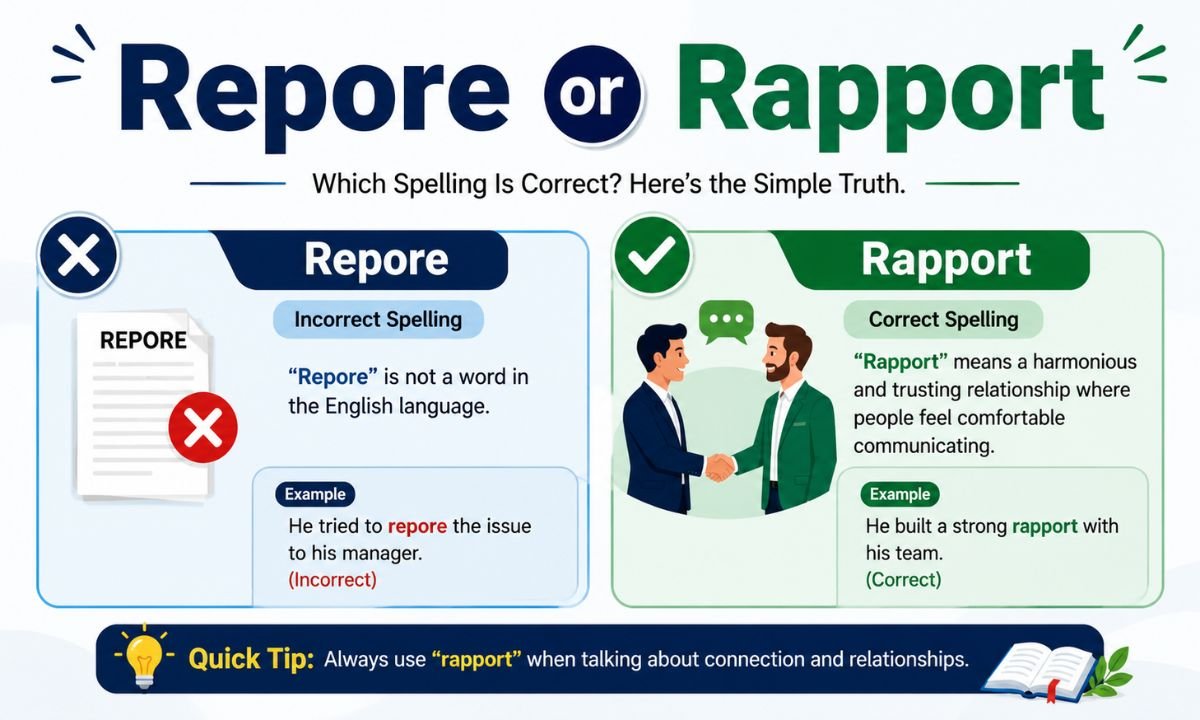
You typed “repore” into a text box, and the little red squiggle showed up under it. Now you’re stuck between two options that sound almost identical, and only one of them is a real word. This happens to a surprising number of people, from students writing essays to sales reps drafting follow-up emails.
The short version: rapport is the correct spelling. Repore is not a word in any English dictionary. But knowing that isn’t quite enough — you probably also want to know why the mix-up happens, how to pronounce the word properly, and how to use it in a sentence without a second thought. That’s what this guide covers.
Repore or Rapport – Quick Answer
Here’s the answer without any padding:
| Spelling | Status | Notes |
|---|---|---|
| Rapport | ✅ Correct | Standard English word, found in every major dictionary |
| Repore | ❌ Incorrect | A phonetic misspelling, not a recognized word |
| Repoire | ❌ Incorrect | Another common typo of the same word |
| Raport | ❌ Incorrect | Missing a letter; still wrong |
Rapport means a close, friendly connection between people — the kind of ease you feel when a conversation just clicks. You build rapport with a new coworker, a client, a therapist, or a stranger you happen to hit it off with at a wedding.
The confusion exists because rapport doesn’t sound the way it’s spelled. Say it out loud and you’ll hear something close to “ruh-POR,” with a silent final T. Nothing about that pronunciation hints at a double P. So when people go to write it down, they guess, and “repore” feels like a natural shortcut.
It isn’t one. If you remember nothing else from this page, remember this: two P’s, silent T, and it’s always rapport.
The Origin of Repore or Rapport
Rapport arrived in English from French, and that’s really the whole story behind the spelling confusion. The French verb rapporter means “to bring back” or “to relate,” and over time the noun rapport came to describe a relationship in which people are connected — where ideas, feelings, or understanding pass easily between them.
English absorbed the word sometime around the 17th century, during a period when French vocabulary was flowing steadily into English usage, particularly in areas tied to diplomacy, social manners, and psychology. Rather than reshaping the spelling to match English pronunciation habits, English speakers kept the French form largely intact. That’s a pattern you’ll notice with a lot of borrowed words — ballet, bouquet, and cliché all kept their French skeletons even though English speakers don’t pronounce every letter the way French does.
That silent T at the end is the giveaway. French frequently drops a final consonant sound in pronunciation while keeping it in spelling, and rapport followed the same rule once it crossed into English. So when someone writes “repore,” they’re actually spelling the word the English way — phonetically — while ignoring its French roots. The mistake isn’t careless so much as it’s a reasonable guess that happens to be wrong.
Modern dictionaries, including Merriam-Webster and the Oxford English Dictionary, list only one accepted spelling: rapport. There’s no alternate form, no regional variant, and no informal exception. If a dictionary entry exists at all, it’s spelled R-A-P-P-O-R-T.
British English vs American English Spelling
Here’s some good news if you’re used to double-checking every word that crosses the Atlantic differently: rapport is spelled the same way in British English and American English. There’s no “color” versus “colour” situation here, no extra U, no swapped letters.
| Region | Spelling | Pronunciation |
|---|---|---|
| British English | rapport | ruh-POR |
| American English | rapport | ruh-POR |
| Australian English | rapport | ruh-POR |
| Canadian English | rapport | ruh-POR |
Because the word is a direct French loanword rather than one that passed through older Latin or Germanic routes, it never picked up the regional spelling splits that affect words like “organize/organise” or “traveled/travelled.” Whether you’re writing a cover letter for a company in London, Los Angeles, or Toronto, the spelling stays exactly the same.
Repore or Rapport Examples
Seeing the word in context tends to lock it in faster than memorizing a rule. Here are some everyday examples:
- The sales team worked hard to build rapport with new clients before pitching anything.
- Her warm tone helped her establish rapport with nervous patients almost immediately.
- Good teachers know that rapport with students often matters more than the lesson plan itself.
- The negotiators struggled because they never developed any real rapport.
- He has a natural rapport with animals, even ones that are usually skittish around strangers.
Repore or Rapport in Psychology
Psychology is actually where this word shows up constantly, and it carries real technical weight in that field. In therapy, rapport refers to the trust and mutual understanding between a therapist and a client — a foundation that has to exist before any real progress can happen. Researchers have found that the strength of that connection, often called the “therapeutic alliance,” is one of the more reliable predictors of whether treatment works.
You’ll also see the term in interviewing, counseling, and coaching literature, where building rapport quickly is treated as a learnable skill rather than something people either have or don’t. Mirroring body language, active listening, and shared eye contact are common techniques cited for establishing it. In every one of these contexts, the word is spelled rapport — never repore, never repoire.
Rapport Synonym
If you want to avoid repeating “rapport” too many times in a single piece of writing, several close synonyms work depending on tone:
- Connection
- Bond
- Understanding
- Affinity
- Chemistry
- Camaraderie
- Empathy (in more emotional contexts)
None of these are exact matches — rapport specifically implies mutual ease and communication, while “bond” can suggest something deeper and more permanent, and “chemistry” leans toward romantic or creative contexts. Still, they’re useful when you want variety.
Pronounce Rapport
Say it as ruh-POR, with the stress on the second syllable. The final T stays silent, matching the word’s French origin. A few tips that help:
- Drop the T entirely — don’t even give it a light touch.
- Stress “por,” not “rap.”
- Avoid pronouncing both P’s separately; they blend into a single hard P sound.
If you’re used to hearing “rapport” in movies or interviews and never seeing it written down, that gap between sound and spelling is exactly why “repore” feels intuitive. It just isn’t accurate.
“I Have a Good Repore With Them”
This is one of the most common real-world examples of the mistake, and it usually shows up in casual writing — texts, emails, LinkedIn posts, or forum comments. The corrected version is:
❌ I have a good repore with them. ✅ I have a good rapport with them.
The sentence means the same thing either way — a comfortable, trusting relationship — but only the second version is grammatically correct.
Rapport With Someone
“Rapport with someone” is a standard phrase used constantly in professional and everyday writing. It works the same way whether you’re describing a coworker, a customer, a date, or a new acquaintance:
- Building rapport with someone takes time and consistent honesty.
- She lost rapport with someone she used to trust deeply.
- Sales reps are trained to establish rapport with someone within the first two minutes of a call.
Good Rapport
“Good rapport” is another frequent pairing, often used to describe a relationship that’s functioning well:
- The manager and her team have good rapport, which shows in how openly they communicate.
- Good rapport between doctor and patient tends to improve treatment outcomes.
- Interviewers who create good rapport get more honest answers from candidates.
Which Spelling Should You Use?
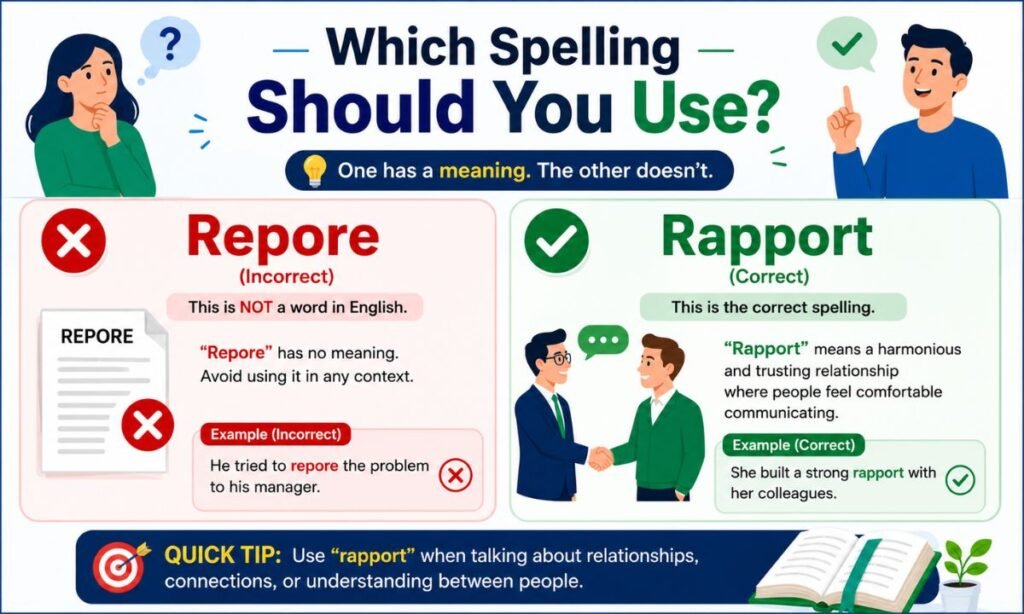
Always use rapport. There’s no context — formal, informal, academic, casual, British, American — where “repore” is the accepted spelling. If you’re writing:
- A resume or cover letter, use rapport.
- A therapy note or clinical report, use rapport.
- A text message to a friend, still use rapport.
- A school essay, use rapport.
There’s genuinely no exception here. Spellcheck tools, style guides, and dictionaries agree on a single form. If you’re ever unsure mid-sentence, a quick trick is to picture the French root — rapporter — which carries that double P and helps the correct spelling stick.
Common Mistakes with Repore or Rapport
Beyond “repore,” several other misspellings show up regularly online:
| Common Misspelling | Why It Happens |
|---|---|
| Repore | Phonetic spelling based on pronunciation |
| Repoire | Blend of “repore” and the French-looking “-oire” ending |
| Raport | Missing the second P |
| Repor | Dropped final vowel |
| Rapore | Letters swapped mid-word |
A few writing habits make these errors more likely:
- Relying on autocorrect. Some autocorrect tools won’t catch “repore” because it resembles other real words closely enough to slip through.
- Learning the word by ear first. People who hear “rapport” in meetings, podcasts, or shows before ever seeing it written are more likely to guess the spelling wrong.
- Typing quickly without proofreading. In casual messaging, spelling mistakes like this get typed and sent without a second look.
- Confusing it with similar-sounding words. “Report” and “rapport” share several letters and a similar rhythm, which sometimes causes cross-contamination in typing.
The fix for all of these is the same: pause before you send or publish, and double-check any word that sounds different from how it’s spelled.
Repore or Rapport in Everyday Examples
Here’s how the correct word shows up across different settings:
Workplace: “Our manager makes an effort to build rapport with every new hire during their first week.”
Customer service: “Representatives who establish quick rapport tend to resolve complaints faster.”
Education: “Teachers who build rapport with students early in the semester see better engagement all year.”
Healthcare: “A strong rapport between nurse and patient can ease anxiety before a procedure.”
Sales: “Closing a deal almost always starts with rapport, not a pitch.”
Dating and relationships: “They had instant rapport, the kind that makes a first date feel effortless.”
Notice that in every one of these, “rapport” functions the same way grammatically — usually as the object of “build,” “establish,” “have,” or “lose.” That consistency is part of why the word is worth learning properly; it shows up in nearly identical sentence patterns across very different fields.
Repore or Rapport – Google Trends & Usage Data
Search interest for “repore” has stayed fairly consistent over the past several years, which tells us this isn’t a one-off typo but a recurring, widespread mix-up. Thousands of people search variations of “repore or rapport,” “repore spelling,” and “how do you spell repore” every month, largely because the word is heard far more often than it’s read.
A few patterns worth noting:
- Searches for the misspelling spike around interview season, when people are prepping resumes and cover letters.
- Psychology and counseling students search the term often, since “rapport” is a core concept in therapeutic training.
- Business and sales content frequently references “building rapport” as a soft skill, which drives search traffic from professionals double-checking their writing.
The pattern suggests most searchers already understand the concept — a friendly, trusting connection — but need reassurance on the spelling before hitting publish or send. That’s a good sign, honestly. It means the confusion is almost always about form, not meaning.
Comparison Table: Keyword Variations
Different people search for this topic in different ways. Here’s how the common variations stack up:
| Search Term | Correct Form | Common Context |
|---|---|---|
| repore or rapport | rapport | General spelling confusion |
| repoire vs rapport | rapport | Alternate misspelling |
| repour vs rapport | rapport | Confusion with “pour” |
| have a good repore | have a good rapport | Casual usage |
| rapport meaning | — | Definition lookup |
| rapport pronunciation | — | Audio/phonetic lookup |
| rapport synonym | — | Vocabulary search |
| build rapport with someone | — | Professional/relationship context |
| repore psychology | rapport in psychology | Academic/clinical usage |
| how do you spell repore | rapport | Direct spelling query |
Whatever route brought you to this page, the destination is the same word every time: rapport.
Frequently Asked Questions
Is it rapport or repour?
It’s rapport. “Repour” is not a real word in this context — it looks like a mix of “repore” and “pour,” but the correct spelling has always been rapport.
What does it mean to have good repore?
It means to have a good rapport — a friendly, trusting relationship where communication feels easy. “Repore” itself isn’t a real word, but this is the meaning people usually intend.
What is a repore?
There’s no such word as “repore” in standard English. People who search this term are almost always looking for “rapport,” which means a close, positive connection between people.
What does rapport mean?
Rapport means a harmonious, trusting relationship marked by mutual understanding and easy communication between two or more people.
Final Thoughts
The rapport-versus-repore mix-up is one of the more forgivable spelling mistakes out there, since the word simply doesn’t sound the way it’s written. Once you know the reason — a French loanword that kept its silent letters — the correct spelling tends to stick a lot better than if you’d just memorized it as an arbitrary rule.
Next time you’re describing that easy, trusting connection with a coworker, a client, or a new friend, you’ll know exactly which word to reach for: rapport, spelled with two P’s and a silent T, no exceptions.