
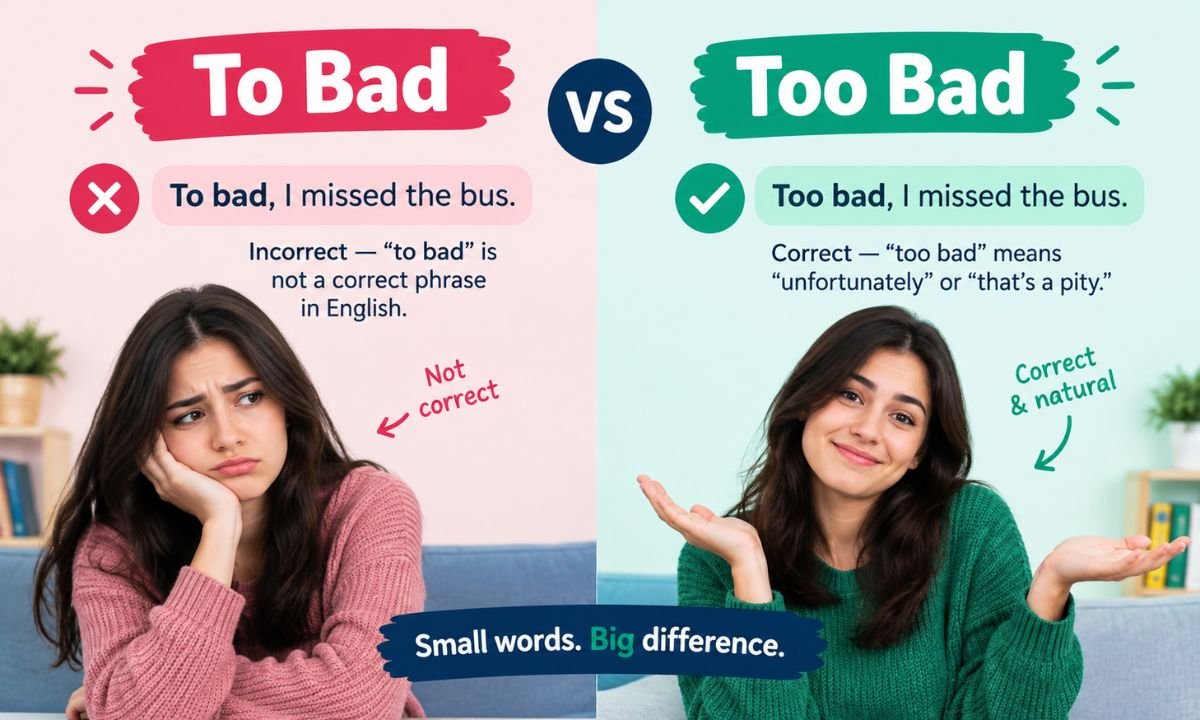
I typed “to bad” into a text message last winter, stared at it for three seconds, and deleted the whole sentence. That tiny pause sent me down a rabbit hole of grammar guides, dictionary entries, and old English textbooks. What I found surprised me a little: the rule is simple, but the reasons people get it wrong are not. Here’s everything I learned, laid out the way I wish someone had explained it to me the first time.
My Quick Answer
“Too bad” is correct. “To bad” is not a real phrase in standard English.
Use “too bad” whenever you mean something is unfortunate, disappointing, or excessively bad. “To bad” only shows up correctly when “to” and “bad” happen to land next to each other for unrelated grammatical reasons, like “This company went from good to bad.” That’s not the phrase we’re talking about — that’s just two ordinary words that ended up side by side.
If you remember nothing else from this article, remember this: whenever you’re expressing sympathy, disappointment, or regret, spell it with two O’s.
Why I Found That “Too Bad” Is Correct
Once I broke the sentence down word by word, the confusion mostly disappeared.
“Too” is an adverb. Its job is to modify adjectives or other adverbs, and here it means “excessively” or “very.” “Bad” is an adjective describing a state or quality. Put them together and you get an adverb-adjective pair that intensifies the meaning — “too bad” literally reads as “excessively bad” or “very unfortunate.”
“To,” on the other hand, is a preposition or an infinitive marker. It shows direction (“go to the store”), or it pairs with a verb to form an infinitive (“to run,” “to think,” “to decide”). What “to” cannot do is sit in front of an adjective like “bad” and modify it. Prepositions point somewhere; they don’t intensify feelings. That mismatch in function is the entire reason “to bad” fails as a phrase.
The Grammar Rule I Use
Here’s the shortcut I settled on after reading through a stack of style guides: if the word can be swapped for “very” or “excessively” and the sentence still makes sense, you need “too.” If the word is followed by a verb, or is showing movement from one place or state to another, you need “to.”
Try it yourself:
- “It’s too bad you missed the show” → “It’s very bad you missed the show.” Still makes sense. Use “too.”
- “I need to leave” → you can’t swap “to” for “very” here. “To” stays because it’s paired with the verb “leave.”
That one substitution test solved about ninety percent of my confusion.
My Definition and Usage Analysis
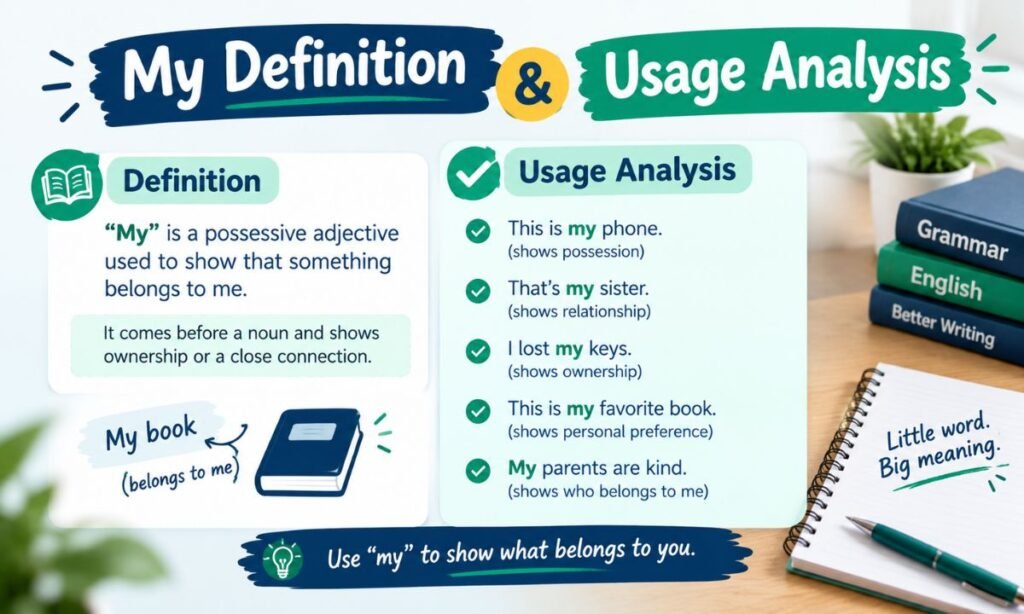
“Too bad” isn’t a single-note phrase. Depending on tone and context, it can carry three fairly different meanings.
1. Very Unfortunate
This is the most literal use. It describes a situation, event, or outcome that’s genuinely disappointing on a factual level.
Example: “It’s too bad the flight got cancelled — we had non-refundable hotel bookings.”
2. Disappointing
Slightly softer than “unfortunate,” this version leans toward a personal letdown rather than a hard fact.
Example: “Too bad you couldn’t make it to dinner; we saved you a seat.”
3. Expressing Indifference (Informal)
In casual speech, “too bad” sometimes drops the sympathy entirely and becomes almost dismissive — closer to “that’s not my problem” than “I feel sorry for you.”
Example: “You didn’t book early enough? Too bad, tickets are sold out now.”
Context and tone of voice usually make it obvious which of these three meanings is intended, but it’s worth knowing they exist, especially if you’re writing dialogue or customer-facing copy where tone matters.
My Complete Comparison Table: Too Bad vs To Bad
| Feature | Too Bad | To Bad |
|---|---|---|
| Grammatical correctness | Correct | Incorrect as a standalone phrase |
| Part of speech | Adverb + adjective | Preposition + adjective (mismatched) |
| Meaning | Unfortunate, disappointing, regrettable | No independent meaning |
| Common usage | Everyday speech, writing, dialogue | Only valid when “to” and “bad” are unrelated words in a sentence |
| Example | “That’s too bad you lost your keys.” | “The weather turned from good to bad.” (different meaning entirely) |
| Formality | Works in both formal and informal writing | Should be avoided; often a typo |
| Word count trick | Has an extra “o” — think “more” | Shorter — think “direction” |
Real Examples I Found in Daily Life
I started noticing this phrase everywhere once I began paying attention — texts, emails, sitcom scripts, even street signs. Here’s a running list of what I’ve seen written correctly and incorrectly.
✓ Correct Examples I Use:
- “It’s too bad the concert got rained out.”
- “Too bad, so sad — we’ll try again next weekend.”
- “That’s too bad about your car; I hope the repair isn’t expensive.”
- “It’s too bad you can’t join us for the trip.”
- “Too bad the store closed before we got there.”
✗ Incorrect Examples I Avoid:
- “It’s to bad you missed the meeting.” (should be “too bad”)
- “That’s to bad, honestly.” (should be “too bad”)
- “To bad we didn’t win.” (should be “too bad”)
- “I feel to bad about what happened.” (should be “too bad”)
Every single wrong example above follows the same pattern: someone dropped an O by accident, usually while typing quickly or relying on autocorrect that didn’t catch the error.
My Memory Tricks to Remember
I collected a few tricks along the way that stuck with me better than the textbook explanation did.
Trick #1: The “Extra O” Rule
“Too” has one more letter than “to,” and that extra letter stands for “more.” Whenever you mean “more than enough” or “excessively,” reach for the version with more letters.
Trick #2: The Replacement Test
Swap the word for “also” or “very.” If the sentence still reads naturally, “too” is correct.
- “I want to go too” → “I want to go also.” Works.
- “It’s too bad” → “It’s very bad.” Works.
- “I want to run” → “I want to also run” doesn’t carry the same meaning, so “to” belongs here instead.
Trick #3: The “Direction” Test
Ask whether the word is pointing somewhere or connecting to a verb. If yes, it’s “to.” If the word is instead describing intensity or degree, it’s “too.”
- “Drive to the airport” — direction, so “to.”
- “That’s too far” — degree, so “too.”
Similar Phrases I Found Related to “Too Bad”
While researching, I kept running into variations of the same expression. Here’s what each one means and how it’s typically used.
1. “Too Bad, So Sad”
A rhyming, slightly sarcastic version that leans toward indifference rather than genuine sympathy. It’s common in casual conversation and often used half-jokingly.
2. “That’s Too Bad”
A gentler, more sympathetic phrase, usually said in direct response to someone sharing bad news.
3. “It’s Too Bad That…”
This version introduces a specific reason for the disappointment and works well in more formal writing.
Example: “It’s too bad that the museum was closed for renovations during our visit.”
4. “Too Bad to…”
Used to describe something so poor in quality that it fails to meet a standard.
Example: “The road conditions were too bad to drive on safely.”
Why I Think People Make This Mistake
After reading through dozens of comment threads and forum posts, a pattern emerged. Most people aren’t confused about the meaning of “too bad” — they know what they want to say. The mistake happens at the typing stage, not the thinking stage.
A few reasons kept coming up again and again:
- “To” and “too” are homophones, so there’s no audio cue to catch the mistake while speaking.
- Autocorrect tools sometimes “fix” typing errors incorrectly, especially on mobile keyboards.
- Fast, casual typing (texting, social media, chat apps) skips the mental proofreading step most people use for formal writing.
- Some learners were taught the spelling of “to” first and never fully separated it from “too” and “two.”
None of this means the people making the mistake don’t know English well. It’s almost always a typing slip rather than a real misunderstanding of grammar.
My Research on Other “To” vs “Too” Confusions
“Too bad” isn’t the only phrase where this mix-up shows up. A few others I found worth mentioning:
- “To much” vs “too much” — same rule applies; “too much” means an excessive amount.
- “To many” vs “too many” — “too many” describes an excessive number of countable things.
- “To late” vs “too late” — “too late” means past the acceptable or useful time.
- “To hot” vs “too hot” — “too hot” describes an excessive temperature.
Notice the pattern: whenever the word is describing degree or excess before an adjective, it needs the extra O.
Expert Opinions I Found
Oxford English Dictionary
Dictionaries generally list “too” as an adverb meaning “to a higher degree than is desirable, permissible, or possible,” which lines up directly with how “too bad” functions in everyday speech.
Merriam-Webster
Standard dictionary entries define “too” as meaning “excessively” or “also,” reinforcing that it’s the correct choice whenever intensity or addition is being expressed — exactly the role it plays in “too bad.”
Grammar Experts
Writing instructors and editors I came across consistently point to the same substitution test I mentioned earlier: if you can swap the word for “very” or “also” without breaking the sentence, you need “too.” This test shows up across nearly every grammar resource I checked, which tells me it’s a reliable, widely accepted shortcut rather than a personal opinion.
My Personal Tips for Avoiding This Mistake
A few habits helped me stop second-guessing myself:
- Read your sentence back silently before sending it, especially in texts and emails.
- Turn off overly aggressive autocorrect if it keeps swapping “too” for “to.”
- Practice the substitution test until it becomes automatic — it takes less than a second once you’re used to it.
- Keep a short mental list of common excessive-degree phrases (“too bad,” “too much,” “too late”) and treat them as a set.
- Proofread slowly in formal writing like emails, reports, or cover letters, where a small typo can look like a bigger mistake than it is.
Frequently Asked Questions
Which is the right to or too?
“Too” is right whenever you mean “excessively” or “also.” “To” is right when showing direction or forming an infinitive verb, as in “to go.”
How to use too bad in a sentence?
Place it before or after the subject to express disappointment, such as “It’s too bad you missed the party” or “Too bad, we’ll catch the next one.”
What is the meaning of too bad?
It means something is unfortunate, disappointing, or regrettable, and can sometimes carry a more indifferent tone in casual speech.
Which is correct: “it’s too bad” or “it’s to bad”?
“It’s too bad” is correct. “It’s to bad” is a common typo and isn’t standard English.
My Final Warning
“To bad” is one of those small errors that can quietly undercut otherwise polished writing. A single missing letter won’t confuse most readers, but in professional emails, resumes, or published content, it can make careful work look rushed. Spend the extra half-second checking it. It’s a small habit that pays off every time you write.