
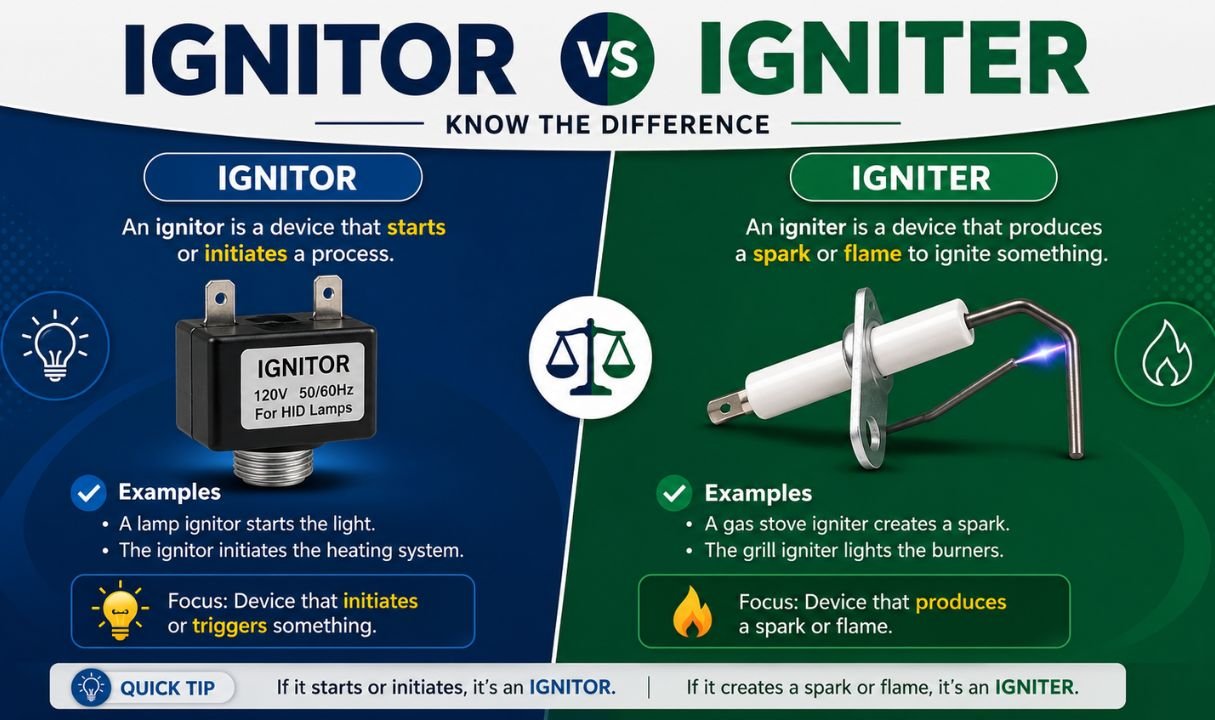
Ignitor and igniter both name the same thing: a device that starts combustion or triggers a spark. Igniter is the standard modern spelling in dictionaries and everyday writing, while ignitor survives mainly in technical, industrial, and older product naming. Neither spelling changes the meaning.
Quick Answer
If you only remember one rule, remember this: igniter is the safer, more widely recognized spelling for general use. Ignitor is not incorrect, but it shows up less often outside engineering manuals, HVAC parts catalogs, and certain brand names. Use igniter unless your industry, employer, or supplier already uses ignitor consistently.
Ignitor vs Igniter at a Glance
| Feature | Ignitor | Igniter |
|---|---|---|
| Dictionary status | Recognized variant | Standard headword |
| Common setting | Technical, industrial, HVAC parts | General writing, appliances, journalism |
| Frequency online | Lower | Higher |
| Meaning | Same as igniter | Same as ignitor |
| Best for | Product codes, legacy manuals | Emails, articles, everyday speech |
Ignitor vs Igniter Meaning
Both words describe a component that produces a spark, flame, or intense heat to start a chemical reaction, most often combustion. You will find the part in furnaces, gas stoves, grills, car engines, rocket motors, and fireworks. Whichever spelling a manufacturer prints on the box, the part does exactly the same job.
Grammatically, both forms are countable nouns built from the verb ignite, meaning to set something on fire or cause it to start burning. English regularly forms agent nouns this way, adding a suffix to a verb to name the thing or person that performs the action. Igniter follows the more common -er pattern, while ignitor follows the less common -or pattern.
The Origin of Ignitor and Igniter
The root verb ignite traces back to the Latin ignire, tied to the noun ignis, meaning fire. English borrowed and adapted the verb centuries ago, and once ignite became established, writers needed a noun for the device that performs the ignition. Two competing suffixes entered the picture at roughly the same time, which is exactly why the spelling split still exists today.
English has plenty of agent nouns that ended up with two acceptable spellings this way. Think of advisor and adviser, or connector and connecter. In most of these pairs, one spelling eventually became dominant in everyday use while the other stayed alive in specific trades or regional habits. Ignitor and igniter followed the same path.
Dictionaries did not settle on a single winner quickly. Early twentieth century engineering texts used ignitor about as often as igniter, and both spellings appeared in patents describing early spark and glow plug technology. It took decades of consumer product marketing, style guide decisions, and dictionary editing for igniter to pull noticeably ahead in general usage, while ignitor kept its footing inside the trades that adopted it early.
Why Igniter Is More Common Today
Modern dictionaries, style guides, and major appliance brands treat igniter as the default spelling. Search volume, print usage, and editorial style sheets all lean the same direction. A few reasons explain the shift.
- The -er suffix is more productive in English. Words like starter, heater, and toaster all use -er, so igniter fits the pattern readers already expect.
- Editors standardize spelling for consistency. Newsrooms and publishers pick one accepted form and stick to it, and igniter won that internal vote decades ago.
- Search engines reinforce the trend. Once igniter pulled ahead in usage, content written for search visibility kept reinforcing that spelling, which further widened the gap.
None of this makes ignitor wrong. It simply means igniter is the form most readers expect to see first.
Common English Pattern: -er vs -or Agent Nouns
This spelling contest is not unique to fire related vocabulary. English has dozens of pairs where -er and -or compete for the same job. Compressor and compressed both derive from compress, yet only compressor survives as the noun. Actor kept -or while writer kept -er, and no clean rule predicts which suffix wins.
A rough pattern does exist, though it has plenty of exceptions. Words rooted more directly in Latin verbs, especially those already ending in -ate or -ct, tend to favor -or (inventor, projector, elevator). Words that feel more native or that came through French influence tend to favor -er (worker, driver, printer). Ignite sits in a gray zone, which is exactly why both ignitor and igniter took hold.
Industry Usage
Technical fields kept ignitor alive longer than general writing did. HVAC technicians, automotive parts suppliers, and aerospace engineers often use ignitor in catalogs, wiring diagrams, and internal documentation, partly because older equipment manuals were printed that way and updating every part number would be costly and confusing.
Consumer facing industries moved differently. Gas stove manufacturers, grill brands, and furnace repair companies increasingly print igniter on packaging and in customer facing manuals, because that spelling matches what most home owners search for and recognize instantly.
Automotive repair sits somewhere between the two extremes. Some parts distributors list ignitor coils and ignitor modules under legacy part codes, while the same components appear as igniters in newer consumer catalogs and repair guides aimed at do it yourself car owners. A mechanic pulling a part number needs to know both spellings exist, since searching only one term can miss half the available listings.
Aerospace and defense documentation tends to favor ignitor most consistently of all, largely because specifications for propulsion systems were standardized decades ago and rarely get rewritten purely for spelling updates. Changing a single word across thousands of pages of certified documentation introduces real cost and risk, so the older spelling simply persists.
Search Trends
Search data consistently shows igniter pulling far more monthly volume than ignitor across general shopping and how to queries. Ignitor still holds a meaningful share of searches tied to specific product names, industrial parts numbers, and a handful of brand trademarks that never updated their spelling. For content aimed at a broad audience, igniter is the term more people actually type into a search bar.
This gap also shows up in how questions get phrased. Searches starting with “how to replace” or “why won’t my stove light” almost always use igniter, while searches containing a specific part number or model code are more likely to include ignitor. That split gives a useful signal: informational, how to content should default to igniter, while parts and inventory content should include both spellings to avoid losing traffic from either search pattern.
American and British English
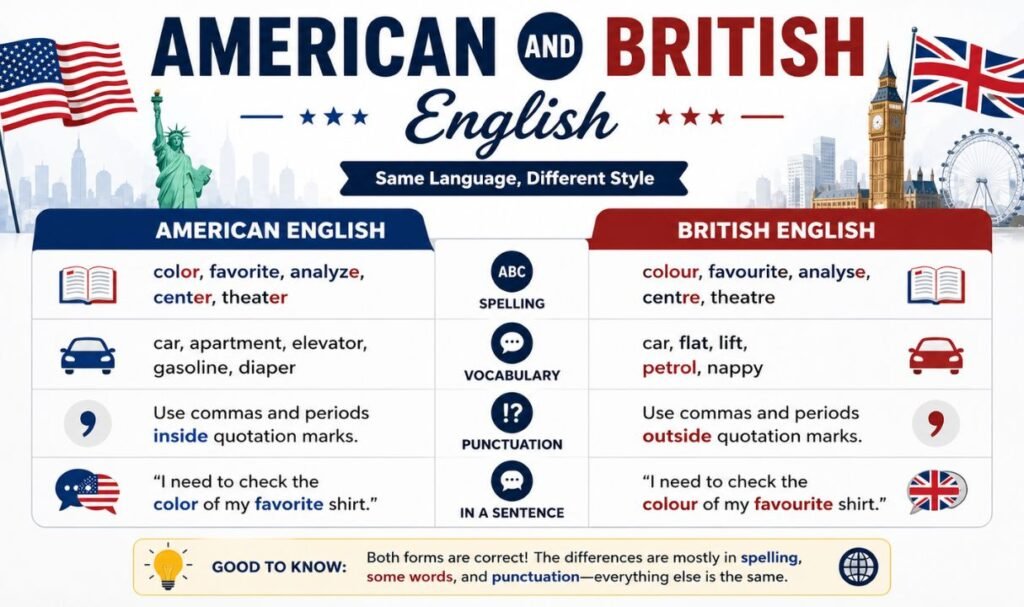
Spelling guides sometimes claim a strict American versus British split, but the reality is messier. Igniter appears as the primary form in both American and British dictionaries, including major references published on each side of the Atlantic. Ignitor shows up as a recognized variant in both regions rather than as a distinctly British or distinctly American choice.
What differs more is context than country. A British engineering manual and an American HVAC manual are both just as likely to use ignitor internally, while consumer writing in both countries leans toward igniter. Treat this as an industry pattern first and a regional pattern second.
Common Synonyms and Related Words
Depending on context, a few other words overlap with ignitor and igniter, though none are perfect substitutes. Knowing them helps you vary your writing without losing precision.
- Spark plug: A specific type of igniter used in gasoline engines, not a general synonym.
- Pilot light: A small, continuously burning flame that can ignite a larger burner, functionally related but not the same device.
- Starter: Sometimes used loosely for ignition systems in casual speech, though it more often refers to the motor that starts an engine.
- Detonator: Used specifically in explosives contexts, carrying a narrower and more serious meaning than igniter.
- Firing pin: A mechanical term from firearms, unrelated to combustion ignition but occasionally confused with igniter in casual writing.
None of these words should replace ignitor or igniter directly in a sentence about furnaces, stoves, or engines. They belong to related but distinct categories, and swapping them in changes the meaning rather than just the spelling.
When to Use Each One
Choose igniter when you are writing for a general audience, drafting marketing copy, answering a customer service question, or producing any content meant to be read widely and understood instantly. It is the form dictionaries list first, and it is the spelling most people already recognize without pausing.
Choose ignitor when you are working inside an established technical document, matching a supplier’s existing part numbers, or writing for a specialized audience that already expects that spelling. Sticking with the terminology already in use prevents confusion across a team or a set of related documents.
When NOT to Use Each One
Avoid ignitor in consumer facing marketing, general blog content, or anything optimized for broad search visibility, since it captures less search volume and can feel slightly unfamiliar to casual readers. It is not wrong, but it is not the strongest choice when your goal is maximum clarity for a general audience.
Avoid igniter only in the narrow case where you are editing or extending an existing technical document that already uses ignitor throughout. Introducing a second spelling there creates the exact inconsistency problem this article warns against, even though igniter is the more common word overall.
You May Like
Appendices vs Appendixes: Which Plural Is Actually Correct
Which Spelling Should You Use
General and Global Writing
For blog posts, emails, product descriptions, news articles, and anything meant for a broad audience, choose igniter. It matches reader expectations, ranks better for search intent, and avoids the small hesitation a less familiar spelling can create. When in doubt, igniter is the default that will never look out of place.
Technical or Industry-Specific Context
If you work in HVAC repair, automotive engineering, aerospace, or a field where existing documentation already uses ignitor, match that documentation. Switching spelling mid-manual creates confusion for technicians pulling part numbers, and consistency with existing schematics matters more than following the general trend.
Consistency Rule
Whichever spelling you pick, lock it in for the entire document. A style sheet, brand guide, or simple find and replace pass before publishing prevents the two forms from appearing side by side. Readers rarely notice correct spelling, but they do notice inconsistency, and it reads as careless.
Common Mistakes with Ignitor vs Igniter
Mistake 1: Thinking Ignitor Is Wrong
Writers sometimes assume ignitor is a typo because igniter shows up more often in casual reading. That assumption is incorrect. Ignitor is a legitimate, dictionary recognized spelling, not a misspelling, and plenty of professional catalogs use it deliberately.
Mistake 2: Mixing Both Spellings in One Piece
The most common real error is not choosing the wrong word, it is using both spellings in the same article, email, or product listing. This looks like a proofreading slip even when the meaning stays clear, and it can make a brand or writer appear less careful.
Mistake 3: Assuming Different Meanings
Some readers guess that ignitor and igniter refer to different parts, perhaps assuming one is a spark source and the other a heating element. They are the same device. Any apparent difference in meaning comes from context, such as which industry uses the part, not from the spelling itself.
Example Sentences
Ignitor Examples
- The technician ordered a replacement ignitor for the industrial furnace.
- Engineers tested the rocket ignitor twice before the scheduled launch.
- The parts catalog lists the ignitor under part number IG-204.
- A faulty ignitor was the reason the boiler kept shutting off.
Igniter Examples
- The igniter on the gas stove clicked but produced no spark.
- We replaced the grill’s igniter after three seasons of use.
- The furnace igniter glows red before the burner kicks on.
- Her article explained how a car’s igniter works inside the ignition system.
Ignitor vs Igniter in Everyday Writing
Emails
Customer service emails, especially from appliance brands, almost always use igniter. It reads naturally to a general audience and avoids sounding overly technical when a home owner is simply asking why their stove will not light.
News and Journalism
News stories about appliance recalls, home safety, or product reviews default to igniter, matching general dictionary preference and keeping language accessible for readers outside any specific trade.
Social Media
Casual posts and product reviews on social platforms lean heavily toward igniter as well, largely because it is the spelling most people learned and the one autocomplete tends to favor.
Formal and Technical Writing
Engineering reports, patent filings, and industrial specifications are where ignitor still holds real ground. These documents often inherit spelling from decades old standards, and updating every reference would introduce more risk than benefit.
Legal and regulatory writing tends to follow whichever spelling first appeared in a certified specification or safety standard, then repeats it for the life of that standard. A safety inspector citing a furnace code, for example, will use whatever spelling that specific code adopted years earlier, even if newer consumer guidance in the same industry has since shifted toward igniter.
Related Terms and Common Searches
People searching for this topic often have a specific product or repair in mind rather than a pure grammar question. Here is how the spelling plays out across common real world uses.
- Ignitor for furnace: Both spellings appear in furnace parts listings, though igniter dominates in consumer facing retail sites.
- Ignitor replacement: This phrase appears frequently in HVAC and appliance repair contexts, often tied to specific part numbers rather than general spelling preference.
- Ignitor for light: Some pilot light and outdoor lighting systems use ignitor in their official part naming, especially older fixtures.
- Igniter for gas stove: This is one of the clearest igniter dominant searches, reflecting how consumer appliance brands write for home owners.
- Ignitor Skylanders: This refers to a character from the Skylanders video game franchise and has no connection to the grammar topic, though it explains why some searches for “ignitor” are unrelated to spelling questions entirely.
Ignitor vs Igniter Usage Trends
Usage trends over recent years show a steady, gradual widening of the gap between the two spellings, with igniter continuing to pull ahead in general publishing, product marketing, and search behavior. Ignitor usage has stayed relatively flat, held up mostly by legacy technical documentation and a handful of brand names that have not changed their part numbering.
This pattern mirrors many other -er versus -or pairs in English, where one spelling eventually becomes the assumed default while the other survives as a recognized but secondary option. There is no indication that ignitor is disappearing entirely, only that it is settling into a smaller, more specialized role.
Decision Guide: Which One to Use
Ask yourself these three questions before choosing a spelling.
- Who is my audience? General readers or customers: use igniter. Engineers, technicians, or industry insiders already using ignitor: match their existing terminology.
- Does existing documentation already use one spelling? If yes, stay consistent with it rather than introducing a second form.
- Am I writing for search visibility? If ranking or discoverability matters, igniter typically captures more search volume and matches how most readers phrase their queries.
Real-World Practical Examples
A home owner calling a repair company will almost always say igniter, since that is the word printed on most modern appliance manuals and used in customer service scripts. An aerospace engineer filing a technical report, on the other hand, may use ignitor because that is the term already established in the propulsion system’s documentation. Both are correct in their own setting.
Self-Assessment: Fill in the Blanks
Test your understanding with these quick prompts. Fill in either ignitor or igniter, keeping in mind that both are technically acceptable unless the sentence signals a specific technical or general context.
- The furnace repair technician replaced the broken _______ before winter.
- My grill’s _______ stopped sparking, so I lit it manually.
- The engineering report referenced the rocket’s _______ assembly.
- The gas stove _______ clicks several times before catching.
Exercise 1: Choose the Correct Word
Pick the spelling that best fits a general, non-technical sentence written for a wide audience.
- A) The stove’s ignitor needs cleaning.
- B) The stove’s igniter needs cleaning.
For everyday, consumer facing writing, option B fits better, since igniter is the spelling most general readers expect.
Exercise 2: Correct the Sentence
Original: “The techinician replaced both the ignitor and the igniter on the same furnace, calling them two different parts.”
Corrected: “The technician replaced the igniter on the furnace.” The original sentence contains a spelling error in “techinician” and mistakenly treats ignitor and igniter as separate components when they name the same part.
FAQs
Is it spelled ignitor or igniter?
Both spellings are correct. Igniter is the more common, dictionary preferred form in general writing, while ignitor remains common in technical and industrial contexts.
What is an igniter?
An igniter is a device that produces a spark, flame, or intense heat to start combustion, commonly found in furnaces, stoves, grills, and engines.
What does “ignitor” mean?
Ignitor means exactly the same thing as igniter: a device that triggers ignition. It is simply an alternate spelling, not a different object.
What is the difference between ignition and igniter?
Ignition is the process or event of something catching fire or starting to burn. An igniter is the physical device that causes ignition to happen. One is a process, the other is a component.
Final Thoughts
Ignitor and igniter name the same device and carry the same meaning, so there is no factual error in choosing either one. Igniter is the safer default for general writing, marketing, and search visibility, while ignitor remains a legitimate choice in technical fields that already use it. Pick one, stay consistent, and your writing will read as confident rather than uncertain.