
Quick Answer
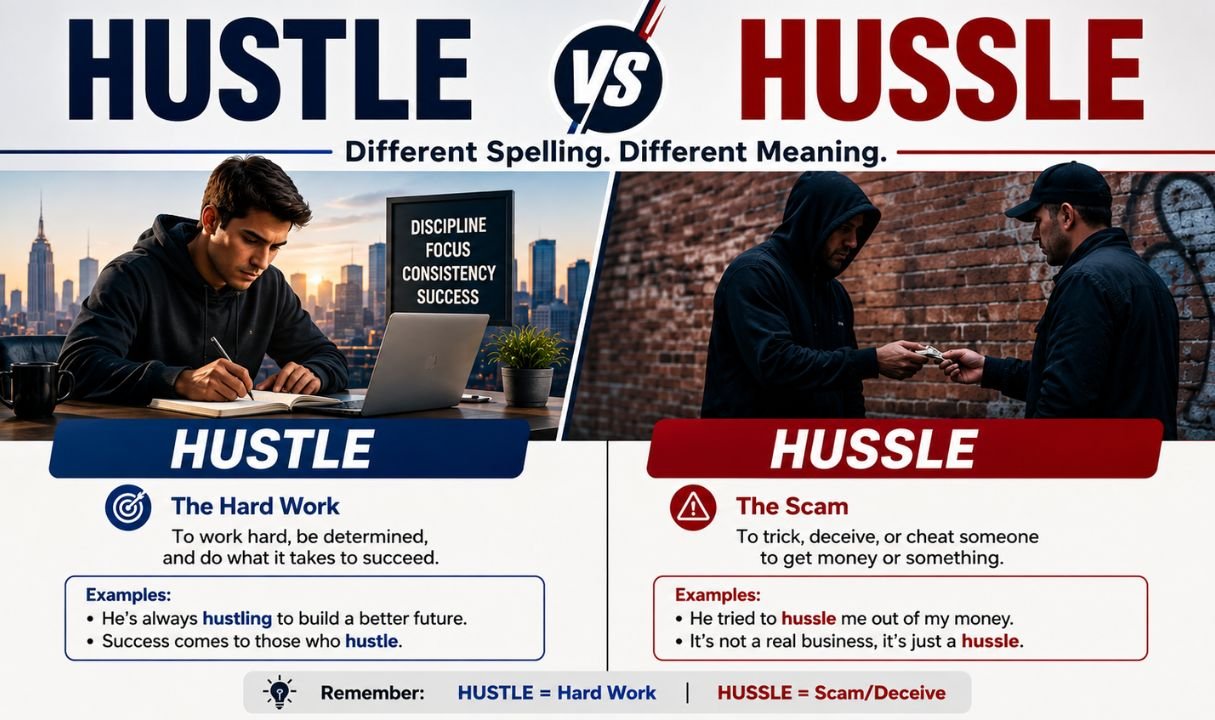
Hustle is the correct spelling. It means working hard, moving quickly, or hustling toward a goal with energy and determination. Hussle is not a standard English word — it’s a common misspelling, though it survives as a proper name (most famously the late rapper Nipsey Hussle).
If you’re writing an email, a resume, a caption, or a school assignment, use hustle. Save hussle for the one context where it actually belongs: someone’s name.
Examples:
- ✅ She hustled across the parking lot to catch the bus.
- ❌ She hussled across the parking lot to catch the bus.
- ✅ His side hustle brings in an extra $500 a month.
- ✅ Nipsey Hussle’s music still influences a generation of entrepreneurs.
Hustle vs Hussle Meaning
1. Hustle
Hustle dates back centuries and carries several related meanings depending on how it’s used. At its core, it describes energetic, purposeful effort — pushing yourself physically or mentally to get something done, often against time pressure.
As a verb, it can mean:
- To work with speed and energy
- To move quickly or urgently
- To push, shove, or jostle someone
- To obtain something through aggressive or sometimes shady means (an older, slang sense)
As a noun, it refers to the energy or determination itself — “she’s got hustle” — or to a scheme, side job, or hard grind.
Examples:
- The waiter hustled between tables during the dinner rush.
- Building a business from nothing takes serious hustle.
- Don’t fall for his hustle — it’s a scam.
- The team’s defensive hustle won them the game.
2. Hussle
Hussle has no independent meaning in standard dictionaries. Merriam-Webster, Cambridge, and Oxford all list hustle, not hussle, as the recognized entry. When people type “hussle,” they almost always mean “hustle” and simply misspelled it.
The one exception is proper names. Nipsey Hussle chose that spelling deliberately for his stage identity, and it now functions as a name rather than a common word. Outside of names, brands, or intentional stylistic choices, hussle is treated as an error.
Hustle vs Hussle Difference
| Feature | Hustle | Hussle |
|---|---|---|
| Standard dictionary word | Yes | No |
| Correct in formal writing | Yes | No |
| Part of speech | Verb and noun | Not applicable (proper name only) |
| Common usage | Work ethic, speed, effort, side jobs | Names, branding, informal typos |
| Origin | Dutch “husselen” | Variant spelling, not a true word |
| Recommended for essays, resumes, business writing | Yes | No |
The short version: hustle carries the meaning, and hussle carries the confusion.
You May Also Like: Ect or Etc? Why “Ect” Is Wrong and “Etc.” Is Correct
Grammar Rule Depth
Hustle as a Verb
When hustle functions as a verb, it follows regular conjugation rules. It describes an action — moving with urgency, working hard, or pressuring someone.
- “I hustle every morning before work.”
- “They hustled the intruder out of the building.”
Hustle as a Noun
As a noun, hustle refers to the quality of energetic effort or to a specific money-making activity.
- “Coaches love to see hustle on the court.”
- “Freelance writing is her hustle on weekends.”
Verb Forms
| Form | Spelling |
|---|---|
| Base form | hustle |
| Third person singular | hustles |
| Past tense | hustled |
| Past participle | hustled |
| Present participle | hustling |
Notice that none of these forms ever add a second “s.” That extra letter is exactly where the hussle mistake creeps in.
The Origin of Hustle
The word traces back to the Dutch term husselen, meaning to shake or toss together. English speakers borrowed it in the 1600s, and it originally described a physical shaking or jostling motion. Over the following centuries, the meaning shifted toward pushing or hurrying someone along, then broadened further into the modern sense of working with speed, energy, and grit.
By the 20th century, American slang had stretched hustle to also describe con artistry — “running a hustle” — while jazz and street culture used it to praise resourcefulness and drive. Today both threads still exist: hustle as honest hard work, and hustle as a scheme.
Why People Write Hussle Instead of Hustle
1. Pronunciation Confusion
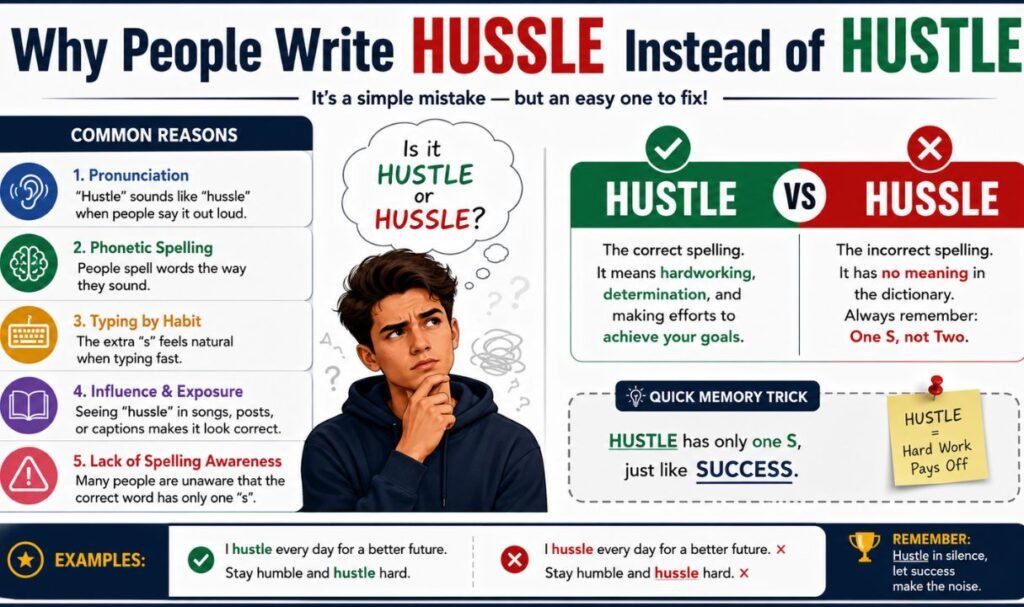
Hustle is pronounced “HUH-suhl,” with a silent “t.” Because the “t” disappears in speech, some writers assume the spelling should match what they hear, and they add an extra “s” instead.
2. Fast Typing
On phones and social media, people type quickly and rarely proofread captions or comments. A double letter is an easy slip, especially when autocorrect doesn’t flag it.
3. Social Media Influence
Nipsey Hussle’s name appears constantly in music, tribute posts, and hashtags. Seeing “Hussle” repeatedly in a cultural context can make the spelling feel familiar and correct, even outside that specific use.
4. Lack of Awareness
Many people simply haven’t been taught the distinction. Since both spellings look plausible and sound identical, the error spreads through habit rather than intention.
Real World Usage of Hustle
Hustle shows up constantly in modern conversation, from casual texts to boardroom pitches. Below are some of the related questions people search for, along with quick answers.
Hustle vs hassle pronunciation
The two words look similar on the page but sound different. Hustle is “HUH-suhl” (silent t), while hassle is “HASS-uhl,” meaning a bother or inconvenience. They’re unrelated in meaning — one is about effort, the other about annoyance.
Hussle or hustle synonym
Common synonyms for hustle include grind, drive, hard work, effort, scramble, and rush. There’s no separate synonym list for “hussle” since it isn’t a standalone word.
Hussle urban dictionary
Informal slang sites sometimes list “hussle” as a playful or alternate spelling of hustle, often tied to Nipsey Hussle references. These entries reflect internet slang, not standard English.
Hussle in Tagalog
Filipino speakers commonly borrow the English word “hustle” directly, sometimes writing it informally online as “hussle.” The intended meaning stays the same: working hard or grinding for money.
Hussle pronunciation
It’s pronounced the same as hustle — “HUH-suhl.” The spelling difference doesn’t change how the word sounds.
Less hustle meaning
“Less hustle” typically means reducing the pace of constant work or stress, choosing calm and balance over nonstop grinding. It shows up often in wellness and lifestyle content as a counterpoint to hustle culture.
You May Also Like: Preform or Perform? The One-Letter Mistake That Changes Everything
Business, Career, and Daily Life
Business: Entrepreneurs describe the early days of a startup as pure hustle — long hours, tight budgets, and constant problem-solving.
Career: Recruiters and managers praise employees who “show hustle,” meaning initiative, speed, and a willingness to go beyond the minimum.
Daily Life: People talk about hustling to catch a train, hustling kids out the door for school, or hustling through a to-do list before a deadline.
Hustle in Different Contexts
Positive Meaning
Hustle signals ambition, work ethic, and resourcefulness. “I love her hustle” is a compliment about drive and determination.
Neutral Meaning
Sometimes hustle simply describes speed or urgency without any judgment attached — “We hustled to the gate before boarding closed.”
Negative Meaning
In older or streetwise usage, a hustle can mean a con, scam, or manipulative scheme — “Watch out, that’s just a hustle to get your money.”
Hustle in Everyday Examples
| Setting | Example Sentence |
|---|---|
| Emails | “Appreciate the hustle on getting this proposal out early.” |
| News | Reporters covering small business often note the hustle behind a founder’s success. |
| Social Media | Captions like “Grind mode. #hustle” appear constantly on entrepreneurship and fitness accounts. |
| Formal Writing | Academic or business reports typically favor “diligence” or “effort” over the casual word “hustle,” though it does appear in profiles and feature writing. |
Hustle in Modern Culture
Entrepreneurship
Startup founders and freelancers often describe their journey as one long hustle — juggling multiple roles, chasing clients, and building something from limited resources.
Social Media
Platforms like Instagram, TikTok, and LinkedIn are full of hustle-themed content: morning routines, productivity tips, and motivational quotes centered on grinding toward success.
Motivation
Coaches, speakers, and authors use “hustle” as shorthand for relentless effort, framing it as the difference between people who dream and people who act.
Hustle Culture Explained
“Hustle culture” refers to a mindset that glorifies constant work, treating rest as weakness and busyness as a badge of honor. It became especially visible in startup and influencer circles over the past decade.
Advantages
- Encourages discipline and consistent effort
- Can accelerate skill-building and early career growth
- Rewards resourcefulness over waiting for perfect conditions
Disadvantages
- Increases risk of burnout and chronic stress
- Can normalize skipping rest, sleep, or personal relationships
- Often ignores the role of luck, privilege, and access to resources
Common Mistakes with Hustle vs Hussle
Mistake 1: Using Hussle
Writing “hussle” in place of “hustle” is the most frequent error, usually caused by phonetic spelling or fast typing.
Mistake 2: Wrong Verb Form
Some writers incorrectly double letters in conjugated forms, such as writing “hustleing” instead of “hustling,” or misplacing the silent “t.”
Mistake 3: Overusing the Word
In formal writing, repeating “hustle” too often can feel casual or clichéd. Swapping in synonyms like effort, drive, or diligence keeps the tone professional.
Related Words and Expressions
Similar Words
- Grind
- Scramble
- Push
- Drive
- Bustle
Related Expressions
- Side hustle — a job or project done alongside a main income source
- Hustle and bustle — busy, lively activity, often describing a city
- Hustle hard — a motivational phrase encouraging maximum effort
Example: “Between her full-time job and her side hustle selling handmade candles, she barely has a free evening.”
Usage Trends
Search interest in “side hustle” has climbed steadily over the past several years as freelancing, gig work, and remote income options have grown more common. Meanwhile, “hussle” searches spike mainly around anniversaries and tributes connected to Nipsey Hussle, showing that the misspelling is often tied to a name rather than genuine uncertainty about the word.
Exercise 1: Choose the Correct Word
- She had to (hustle / hussle) to make the flight on time.
- His side (hustle / hussle) pays for his car insurance.
- The coach praised the team’s (hustle / hussle) after the win.
- Don’t fall for that street (hustle / hussle).
Answers: 1. hustle, 2. hustle, 3. hustle, 4. hustle
Exercise 2: Correct the Sentence
- “I hussled to finish my homework before dinner.”
- “Her hussle is baking cupcakes for local coffee shops.”
- “He’s got real hussle when it comes to sales.”
Corrected: hustled, hustle, hustle
Frequently Asked Questions
What is the meaning of hussle?
Hussle isn’t a standard English word; it’s usually a misspelling of hustle, except when used as a proper name.
Is it side hustle or hussle?
It’s side hustle. Hussle is not the accepted spelling in this phrase.
What is hustle slang for?
In slang, hustle can mean hard work and drive, or, in older usage, a scam or hard sell.
Is it hastle or hassle?
It’s hassle. Hastle is a misspelling; hassle means a bother or inconvenience.
Conclusion
The confusion between hustle and hussle comes down to sound, not sense. They’re pronounced the same way, but only one is a real, dictionary-recognized word. Stick with hustle for everyday writing, business communication, and anything formal — and reserve hussle for names and branding where it’s used on purpose. Get that one detail right, and the rest of your writing will read as confident and polished as the hustle it’s describing.