
You’re typing a message about your neighbor who keeps peeking through the curtains, and you stop halfway through the word. Nosy? Nosey? Both look right, and both look slightly wrong at the same time. That small pause is more common than most people admit, and it happens to native speakers just as often as learners.
This guide settles the question for good. You’ll get the short answer first, then the grammar behind it, the regional split between British and American English, real sentence examples, and a few practice exercises so the spelling actually sticks.
Quick Answer
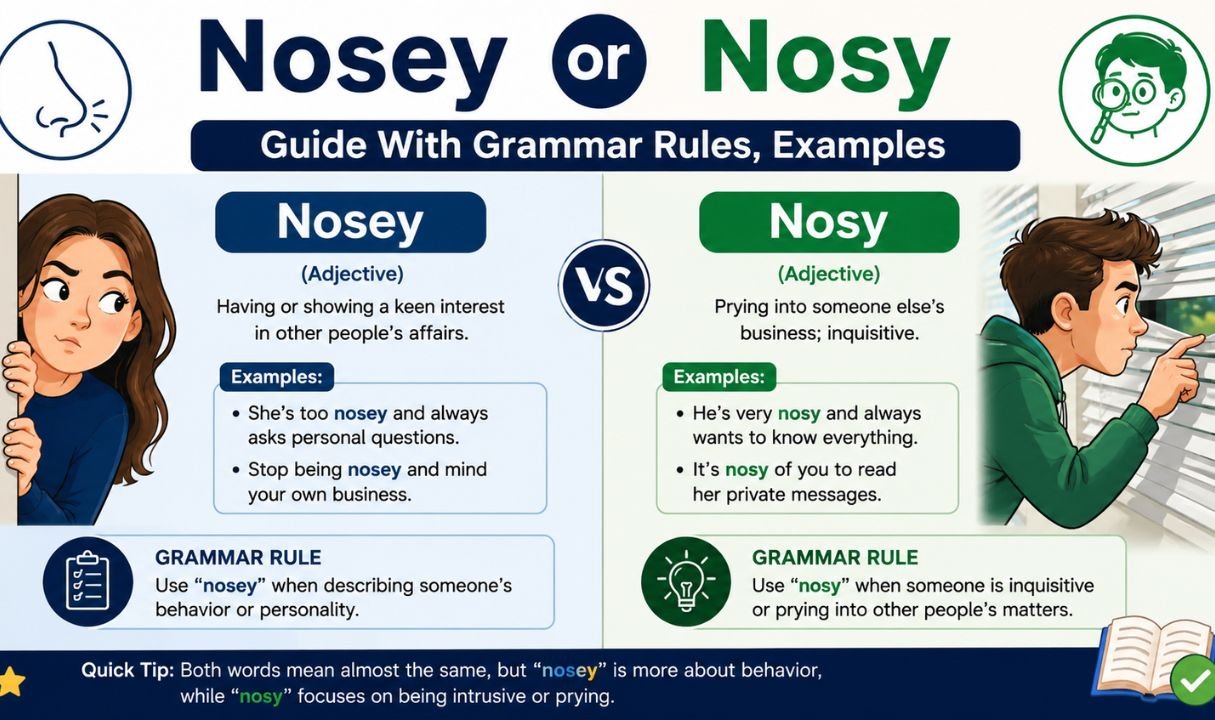
Nosy is the standard spelling in modern English, used in both American and British writing. Nosey is a variant spelling, still correct and still common, particularly in the UK and in casual writing everywhere else.
Neither word is a typo. They’re two accepted forms of the same adjective, describing someone who is overly curious about things that aren’t their business.
Simple Examples
- My coworker is so nosy she read the memo before it was even sent to her.
- The nosey old man next door watches every car that pulls into the driveway.
- Stop being nosy about my phone.
Quick Tip
If you’re not sure which one to pick, default to nosy. It’s the version dictionaries list first, the version style guides recommend, and the one that reads correctly to the widest audience, American or British.
Grammar Rules Explained
Meaning of Nosy and Nosey
Both spellings describe a person who asks too many personal questions, listens in on conversations that aren’t theirs, or tries to dig up information that doesn’t concern them. It usually carries a mildly negative or teasing tone. A “nosy” person isn’t necessarily malicious, just intrusive.
The word traces back to nose, built on the old image of someone sticking their nose into other people’s affairs. That root is exactly why the spelling keeps causing hesitation: writers instinctively want to keep the full word “nose” visible, which is where “nosey” comes from, while others drop the extra letter for a cleaner, shorter adjective form.
Why Two Spellings Exist
English has a habit of trimming silent letters when it turns nouns into adjectives. “Nose” plus the suffix “-y” should technically produce “nosy,” the same pattern you see in words like “icy” from “ice” or “spicy” from “spice.” “Nosey” broke that pattern by keeping the “e,” likely because early writers felt the word looked clearer or more balanced with it left in.
Once a variant gets used often enough in print, it doesn’t disappear. Both forms were common in 19th and early 20th century writing, and both survived into today’s dictionaries.
Preferred Modern Usage
| Spelling | Status | Common Region | Typical Use |
|---|---|---|---|
| Nosy | Standard, dictionary-preferred | American English, global writing | Formal and informal |
| Nosey | Accepted variant | British English | Mostly informal |
For anything you’re publishing, submitting, or sending to a wide audience, nosy is the safer bet.
Why People Make Mistakes With Nosy or Nosey
Same Pronunciation
Both words sound identical when spoken aloud. There’s no audio clue to help a listener figure out which spelling was intended, so the confusion carries straight into writing.
Visual Logic
Because the word comes from “nose,” some writers assume the “e” has to stay for the meaning to make sense. It’s a reasonable guess, just not the one most dictionaries settled on.
Exposure to Both Spellings
Readers encounter nosy in American books, nosey in British ones, and a mix of both across social media, blogs, and forums. That constant back-and-forth exposure makes it hard to lock in a single “correct” version in memory.
People searching for clarity on this word usually type in variations like these:
- Nosy or nosey meaning
- Nosy or nosey synonyms
- Nosy or noisy
- Nosey or nosy uk
- Nosy or nosey oxford dictionary
- Nosy or nosey in a sentence
- Nosey or nosy pronunciation
- Nosy or nosey scrabble
Worth clearing up two of those quickly. “Nosy” and “noisy” are unrelated words that just share letters — nosy means curious, noisy means loud. And for word games like Scrabble, both nosy and nosey are valid entries in most standard dictionaries, so neither will cost you a challenge.
Lack of Clear Teaching
Most grammar classes never touch this word at all. Spelling lessons cover homophones and commonly confused pairs like “affect” and “effect,” but a simple accepted variant like nosy/nosey rarely gets a mention, so people are left to guess based on what they’ve seen most recently.
Informal Writing Habits
Texting, chatting, and casual social posts don’t get proofread the way an email or an essay does. Once a writer types “nosey” a few times without correction, the spelling feels normal, even in contexts where “nosy” would be expected.
You May Also Like: Appendices vs Appendixes: Which Plural Is Actually Correct
Nosy or Nosey in Real Life Usage
Daily Conversation
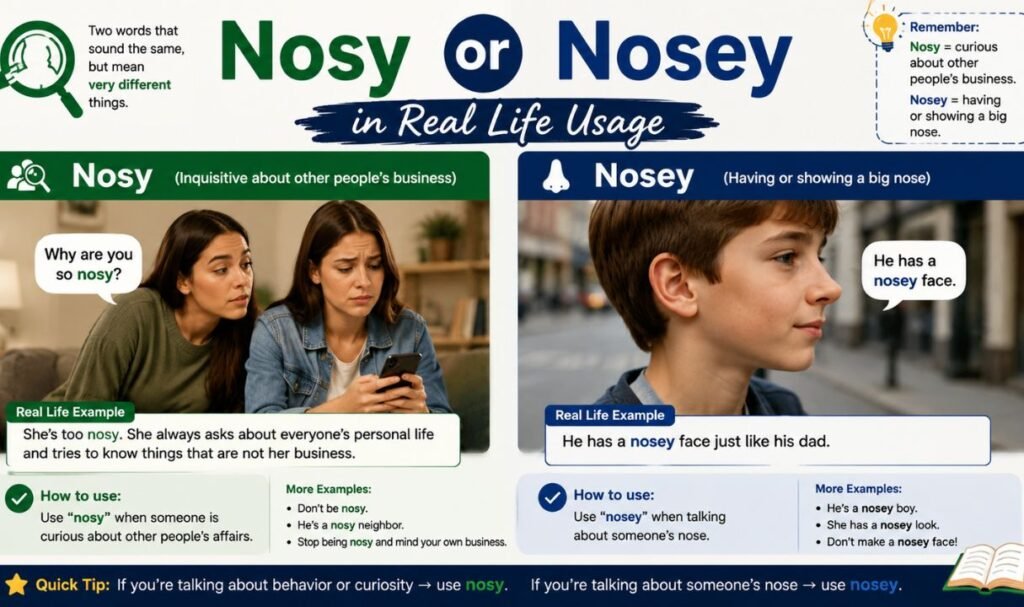
Spoken English doesn’t care about spelling, so both forms work fine in casual talk. “Don’t be so nosy” and “don’t be so nosey” mean exactly the same thing to a listener.
Emails
Professional emails lean toward nosy. It reads as slightly more polished and matches what most spell-checkers and style guides expect.
Social Media
Captions, comments, and casual posts use both spellings freely. Nosey shows up often here, especially from UK-based accounts or in playful, informal captions.
Books and Storytelling
Fiction writers pick whichever spelling suits the voice of their characters or their setting. A British-set novel might lean on nosey for authenticity, while an American thriller sticks with nosy throughout.
Professional Writing
Reports, business communication, and academic papers should stay with nosy. It’s the form editors expect, and consistency matters more in formal documents than it does in a text message.
British and American English Usage
American English
American dictionaries and style guides list nosy as the primary spelling. It’s the version taught in U.S. schools and the one that appears in American newspapers, style manuals, and published fiction.
British English
British English accepts both, but nosey carries more weight there than it does anywhere else. UK newspapers, novels, and everyday writing use it comfortably, alongside nosy.
Which One Should You Use
Ask yourself three quick questions before you type:
- Who’s reading this? American or international audience → nosy. British audience → either works, nosey is fine.
- How formal is the writing? Business, academic, or published content → nosy. Texts, casual posts, personal messages → either.
- Do you need consistency across a document? Pick one spelling and use it throughout. Mixing both in the same piece looks careless.
When in doubt, nosy is the default that fits almost every situation.
Common Mistakes and Corrections
| Mistake | Why It’s a Problem | Correction |
|---|---|---|
| Mixing “nosy” and “nosey” in the same document | Looks inconsistent and unedited | Pick one spelling and stick with it |
| Using “nosey” in a formal report | Dictionaries and style guides favor “nosy” for formal writing | Use “nosy” |
| Confusing “nosy” with “noisy” | Different words, different meanings | “Nosy” = curious; “noisy” = loud |
| Assuming “nosey” is a typo | It’s a legitimate variant, not an error | Both spellings are correct in context |
| Writing “nosyness” instead of “nosiness” | Incorrect noun formation | The noun form is “nosiness” |
Nosy or Nosey in More Sentences
Simple Sentences
- She’s a nosy neighbor.
- He asked a nosey question.
- Don’t be nosy.
Medium Sentences
- My aunt is famously nosy about everyone’s relationship status at family dinners.
- The nosey clerk kept glancing at the customer’s paperwork.
- Being nosy isn’t always a bad thing — sometimes it means someone actually cares.
Formal Sentences
- The committee found the reporter’s questions to be intrusive and unnecessarily nosy.
- Colleagues described him as nosey, often inserting himself into conversations that didn’t involve his department.
- Excessive curiosity about a client’s private affairs can come across as nosy and unprofessional.
You May Also Like: Seeing or Seing: Which Spelling Is Correct?
Related Words and Similar Confusions
Related Words
- Curious
- Prying
- Inquisitive
- Snoopy
- Intrusive
- Meddlesome
Similar Spelling Confusions
English has plenty of other words that trip people up the same way:
- Grey vs. Gray
- Judgment vs. Judgement
- Color vs. Colour
- Analyze vs. Analyse
- Traveling vs. Travelling
Each pair follows a similar pattern: one American-favored form, one British-favored form, same meaning either way.
Why Nosy Became More Popular
Shorter Spellings Win
English has a long history of trimming extra letters over time. Shorter spellings tend to spread faster once they catch on, and nosy fit that trend better than nosey.
Dictionary Preference
Major dictionaries, including Merriam-Webster, list nosy as the main entry, with nosey noted as a variant. That listing order shapes what students and writers learn as “correct.”
Publishing Standards
Editors and style guides across newspapers, magazines, and publishing houses standardized on nosy decades ago, which pushed it further ahead in everyday use.
Digital Writing
Spell-checkers, autocorrect tools, and grammar software mostly default to nosy, which nudges writers toward it even when they didn’t consciously choose it.
Tone and Context Differences
Nosy
Feels slightly more neutral and modern. It shows up in professional writing, journalism, and everyday American speech without drawing attention to itself.
Nosey
Carries a more old-fashioned or regional feel, especially outside the UK. It can sound folksy or informal depending on where the reader is from.
Practice Exercises
Fill in the Blanks
- Her ______ neighbor always asks about her weekend plans. (nosy/nosey)
- Please stop being so ______ about my personal life. (nosy/nosey)
- The ______ reporter pushed for details the family didn’t want to share. (nosy/nosey)
Choose the Correct Word
- For a formal business report, use: nosy / nosey
- For a British newspaper column, either is acceptable, though many readers expect: nosy / nosey
- For an international blog post, the safer choice is: nosy / nosey
(Answer key: 1. nosy is preferred, 2. nosey, 3. nosy)
Writing Tips to Remember the Correct Spelling
Use the Shorter Version
When you’re unsure, default to nosy. It’s shorter, it’s the dictionary-preferred form, and it fits nearly every audience.
Think of Digital Writing
Most spell-checkers, apps, and content platforms are built around American spelling conventions, so nosy will pass review more consistently.
Stay Consistent
Whichever spelling you choose for a piece of writing, keep it the same throughout. Switching mid-document is the most common mistake people make with this word.
Follow Common Usage
Pay attention to your specific audience. A UK-based blog can lean into nosey without issue; a global or American-facing one should stick with nosy.
Extra Real Life Examples
Workplace
A manager might describe a coworker as nosy for constantly asking about salaries during meetings, or note that being nosey about a project’s status is different from having a genuine reason to ask.
Family Situations
Family gatherings are where the word gets used the most. An aunt who wants to know about your relationship status, a sibling who reads your messages, a grandparent who asks about your paycheck — all of them earn the label nosy or nosey, depending on who’s telling the story.
Online Communities
Forum threads and comment sections use both spellings constantly, often in the same conversation. It’s one of the clearest real-world examples of how the two forms coexist without confusing anyone about the actual meaning.
Both nosy and nosey describe the same thing: someone who can’t help but ask, peek, or pry into business that isn’t theirs. The spelling you pick depends less on right and wrong and more on where you’re writing for and how formal the piece needs to be.
Default to nosy when you want the safest, most widely recognized choice, and don’t worry too much if nosey slips into a casual message. Either way, your reader will know exactly what you mean.
Frequently Asked Questions
How do you spell “I’m nosy”?
Write it as “I’m nosy.” It’s the standard spelling and works correctly in almost any context, formal or casual.
How do you spell nosey person?
Both “nosey person” and “nosy person” are correct. “Nosy person” is more standard, while “nosey person” is common in British English.
Is it nosy or nosey in the UK?
Both are used in the UK, but “nosey” is more commonly seen there than in American English, where “nosy” dominates.
What does nosey mean?
It means overly curious about other people’s private affairs, asking too many personal questions, or prying into matters that don’t concern you.
Conclusion
Neither spelling is “wrong” on a global scale. The real difference comes down to region and formality. American audiences expect nosy. British audiences will accept either, though nosey feels more natural to many UK readers. When your audience is mixed or unknown, nosy is the choice that won’t raise eyebrows anywhere.