
Picture this: you’re wrapping up an email to your boss, and you type “there are to many errors in this report.” Something feels off, but you can’t quite name it. That tiny gap between “to” and “too” trips up native speakers and English learners alike, and it happens more often than most people admit.
This guide breaks down exactly when to use too many, why to many is almost never the phrase you want, and how to keep the two straight for good.
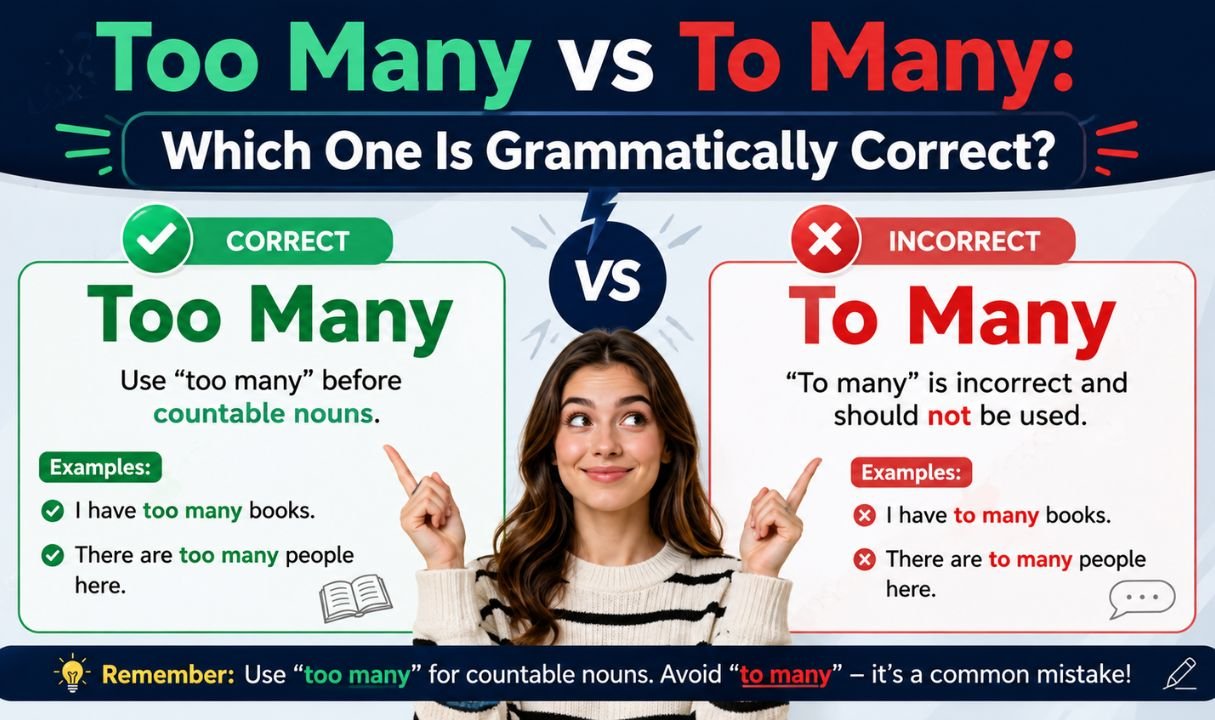
Too Many vs To Many
At a glance, these two phrases look nearly identical. They differ by a single letter, yet they belong to completely different grammatical categories.
- Too many is a quantifier. It pairs the intensifier “too” with the word “many” to describe an amount that goes past what’s needed or wanted.
- To many is not a fixed phrase at all. Here, “to” works as a preposition, and it usually shows up right before a plural noun that receives an action — as in “she sent the invite to many colleagues.”
The confusion exists because both phrases sound the same out loud. In writing, though, only one of them expresses quantity. If your sentence is about “how much” or “how many,” you almost always need too many.
Grammar Rule Behind “Too Many”
“Too” belongs to a small group of adverbs called intensifiers. It adds emphasis, and in this case, that emphasis signals excess. Pair it with “many,” a quantifier reserved for countable plural nouns, and you get a phrase built specifically to describe an amount beyond what’s acceptable.
Here’s the pattern:
Too + many + plural countable noun
- Too many meetings
- Too many mistakes
- Too many people
Drop the second “o” and swap in the preposition “to,” and the sentence structure breaks. “To” needs a destination, a recipient, or a point of reference — not a bare quantity word sitting next to a noun. That’s why “to many people came” reads as wrong the moment you slow down and look at it.
Difference Between Too Many, Too Much, and Too Few
English splits its quantity words by countability, and that’s where a second layer of confusion creeps in. Writers who get “too” and “to” right still sometimes reach for the wrong quantifier.
| Phrase | Used With | Example |
|---|---|---|
| Too many | Countable plural nouns | Too many chairs in the room |
| Too much | Uncountable nouns | Too much noise in the room |
| Too few | Countable plural nouns (opposite meaning) | Too few chairs in the room |
A quick way to remember it: if you can count the items one by one — chairs, cars, emails, students — reach for “many.” If the noun can’t be split into individual units — water, advice, traffic, patience — “much” is the correct partner.
“Too few” flips the direction entirely. Instead of excess, it points to a shortage, but it still only works with countable nouns, just like “too many.”
How to Identify Countable and Uncountable Nouns
Getting “too many” versus “too much” right depends entirely on recognizing what kind of noun you’re working with. Here’s a simple way to test it.
- Try putting a number in front of the noun. “Three books” works. “Three water” doesn’t. Books are countable; water isn’t.
- Check if the noun has a plural form. Chairs, ideas, and problems all take an “-s.” Furniture, information, and rice generally don’t.
- Ask whether you’d measure it or count it. You count apples one at a time. You measure sugar in cups or grams.
A few nouns cause trouble because they seem countable but grammatically aren’t — advice, information, luggage, homework, and news are common offenders. None of these take “many.” All of them pair with “much” or “little.”
Common Real-Life Usage of Too Many
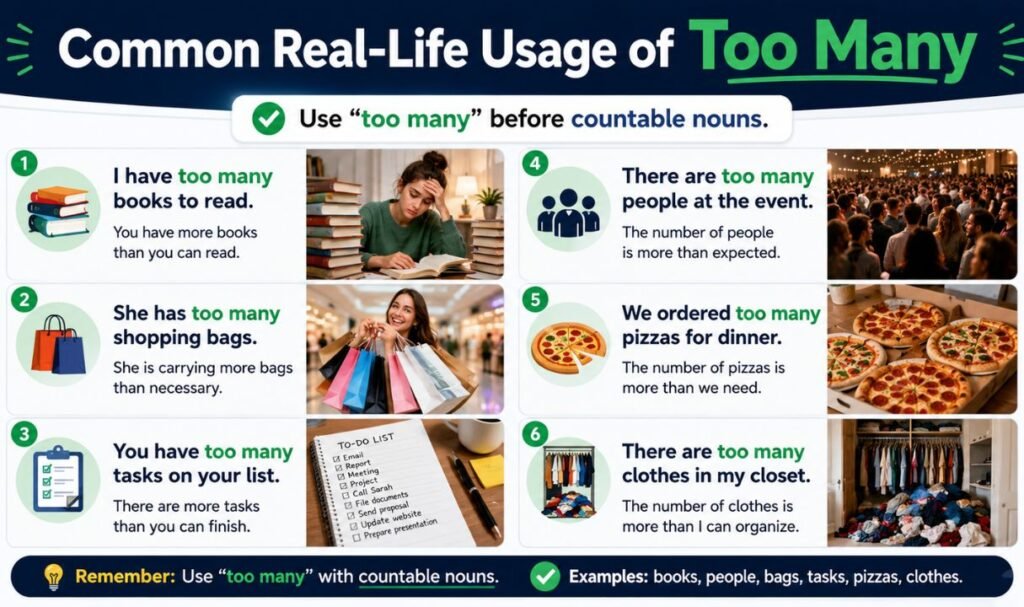
You’ll run into “too many” constantly, in casual chats and formal writing alike:
- “There are too many cooks in the kitchen.”
- “I’ve had too many cups of coffee today.”
- “The app sends too many notifications.”
- “She’s juggling too many projects at once.”
- “We received too many complaints about the delay.”
Compare that to real, correct uses of “to many,” where the meaning is about direction, not amount:
- “The manager forwarded the memo to many departments.”
- “This offer applies to many customers, not just new sign-ups.”
- “The award was given to many contestants this year.”
Notice that in every “to many” example above, you could swap in “to several” or “to a number of” and the sentence would still make sense. That substitution test works well for checking your own writing.
Related searches people also ask
- Too many vs to many worksheet
- Too many vs to many meaning
- Too many vs to many grammar
- Too many vs to many examples
- Too much and too many examples
- To many more or too many more
- Too many or too much
- To many or too many times
Most of these searches point back to the same core question: is the sentence about quantity, or about sending something to a group? Once you answer that, the correct phrase follows automatically.
Tips to Avoid Confusing Too Many and To Many
A handful of habits will stop this mistake before it ever reaches your final draft.
- Read the sentence aloud slowly. If it describes an amount, “too” is almost certainly correct.
- Check what follows the word. A plural noun with no verb of motion nearby usually calls for “too many.”
- Substitute “excessive” for the phrase. “There are excessive people in the room” confirms you need “too many.” If the substitution sounds wrong, you likely need “to many” or another structure entirely.
- Watch for direction verbs. Words like send, give, deliver, distribute, or apply often signal that “to” is doing its normal preposition job.
- Proofread with fresh eyes. Autocorrect won’t catch this error because both spellings are valid words — just not always in the right place.
You May Like: Hoodie or Hoody: Which Spelling Is Actually Correct?
What Does Too Many Mean?
“Too many” means a quantity has gone past a reasonable, comfortable, or acceptable limit. It carries a mild sense of complaint or concern — you’re not just stating a number, you’re saying that number is a problem.
Compare “there are five people in the meeting” (a neutral fact) with “there are too many people in the meeting” (a judgment that five, or however many, is more than the room or the situation can handle). The phrase adds a layer of opinion on top of the raw count.
Should I Write To Many or Too Many?
In the vast majority of everyday sentences, the answer is too many. Ask yourself one question: does this sentence describe an amount that’s excessive? If yes, use “too many.”
Reserve “to many” for the rare case where “to” is functioning as a preposition of direction, and “many” is simply describing the size of the group receiving something. If you’re not sending, giving, or addressing something to a group of people or things, “to many” almost certainly doesn’t belong in your sentence.
Too Many Sentence Examples
- Too many students missed the deadline this semester.
- The kitchen has too many pots for such a small space.
- He asked too many personal questions during the interview.
- There were too many typos in the final draft.
- The store ordered too many umbrellas before the dry season started.
To Many Sentence Examples (Why They’re Wrong)
- ❌ “There are to many cars on this street.” — This describes quantity, so it needs “too many.”
- ❌ “She gave to many opinions during the call.” — Again, this is about an excessive amount, not direction.
- ❌ “We have to many bills this month.” — Correct version: “We have too many bills this month.”
Now compare those with a genuinely correct use of “to many”:
- ✔️ “The newsletter goes out to many subscribers every Friday.” — Here, “to” points toward the recipients, and “many” simply describes their number. No excess is implied.
Comparison Table: Too Many vs To Many
| Feature | Too Many | To Many |
|---|---|---|
| Part of speech | Adverb (too) + quantifier (many) | Preposition (to) + quantifier (many) |
| Meaning | Excessive amount | Direction toward a group |
| Works with | Countable plural nouns | Plural nouns as a target or recipient |
| Common verbs nearby | have, be, cause | send, give, apply, distribute |
| Example | Too many cooks spoil the broth | Sent to many recipients at once |
| Frequency in writing | Very common | Rare, and often mistyped |
Common Grammar Mistakes Learners Make
- Swapping “too” and “to” simply because they sound alike in speech.
- Using “too many” with uncountable nouns, as in “too many money” instead of “too much money.”
- Forgetting the plural form after “many,” writing “too many mistake” instead of “too many mistakes.”
- Overcorrecting and avoiding “to many” entirely, even in sentences where it’s genuinely needed for direction.
- Confusing “too many” with “so many,” which carries a different emotional tone (often positive or neutral rather than critical).
Linguistic Insight: Why This Confusion Happens
English homophones and near-homophones cause a specific kind of writing error linguists call an “eye dialect” slip — the ear hears one sound, but the brain has to choose between multiple spellings that carry different grammatical jobs. “To,” “too,” and “two” form one of the most well-known trios in this category, and pairing “to” or “too” with “many” only adds another layer.
Fast typing, texting habits, and voice-to-text tools all make this worse. None of these methods force a writer to slow down and check word function, so the more common spelling — “to” — tends to autopilot its way into sentences where “too” belongs. Recognizing this as a processing habit, rather than a knowledge gap, can make the fix feel less frustrating and more mechanical.
Expert Opinion on Correct Usage
Style guides and grammar references are unanimous here: when a sentence expresses excess, “too many” is the only accepted form for countable nouns. Editors flag “to many” as a typo in nearly every context outside of genuine directional phrasing, and formal writing — academic papers, business reports, published journalism — treats the distinction as non-negotiable.
Writing instructors often recommend reading a sentence backward, word by word, as a proofreading trick. Removed from its usual left-to-right flow, “to many people” versus “too many people” becomes easier to judge on function alone, since your brain stops autocompleting the sentence from memory.
Wrapping Up: Should I Use Too Many or To Many?
Nine times out of ten, if your sentence is about an amount that feels excessive, you want too many. Save “to many” for the specific cases where “to” is pointing toward a group of recipients, not counting them. Run through the quick checks in this guide — the substitution test, the countable-noun check, the direction-verb scan — and this mix-up will stop showing up in your writing.
Write Better Perfectly
Small grammar fixes like this one add up. Sharpening the details of your writing, one phrase at a time, is what separates rushed drafts from polished, professional content.
Product
Explore tools built to catch mix-ups like “too many” versus “to many” before they reach your reader.
Resources
Browse grammar guides, style references, and writing tips covering similar word-choice questions.
Blog
Read more breakdowns of commonly confused English phrases and grammar rules.
Company
Learn more about the team behind this writing guidance.
Self Assessment
Test yourself with these quick fill-in-the-blank prompts. Choose “too many” or “to many” for each sentence.
- The teacher assigned _____ pages of homework this week.
- The coupon was mailed _____ households in the area.
- He has _____ tabs open on his browser right now.
- The invitation went out _____ guests who never RSVP’d.
- There are _____ empty seats for this to be a full house.
Answer key: 1. too many · 2. to many · 3. too many · 4. to many · 5. too many
Frequently Asked Questions
Which is correct, to many or too many?
“Too many” is correct when describing an excessive amount of countable things. “To many” only works when “to” points toward a group receiving something.
Do you say too much clothes or too many clothes?
“Too many clothes” is correct, since clothes are counted as individual items in this context.
Is it 1 to many or 1 too many?
“One too many” is the correct idiom, used to describe having slightly more of something than is wise or appropriate.
What does too many mean?
It means an amount has gone beyond what’s needed, comfortable, or acceptable.
Conclusion
In short, “too many” is the grammatically correct phrase when you mean an excessive number of something. “To many” is usually incorrect because “to” serves a different grammatical purpose. Remember: use “too many” for more than is needed or wanted.