
You type a text to a friend, pause, and stare at the word on your screen. Is it “homey” or “homie”? Autocorrect isn’t helping, and both spellings look weirdly correct. If you’ve ever hit this wall, you’re in good company. These two words sit so close in sound and spelling that even confident writers second-guess themselves mid-sentence.
The short version: one word describes a feeling, the other describes a person. But the full story is a little more interesting than that, and getting it right matters more than you’d think, especially if you write for work, school, or an audience that notices small slips.
This guide breaks down exactly where each word came from, how native speakers actually use them, and the mistakes that trip people up most often.
Homey or Homie – Quick Answer
Here’s the fastest way to remember it:
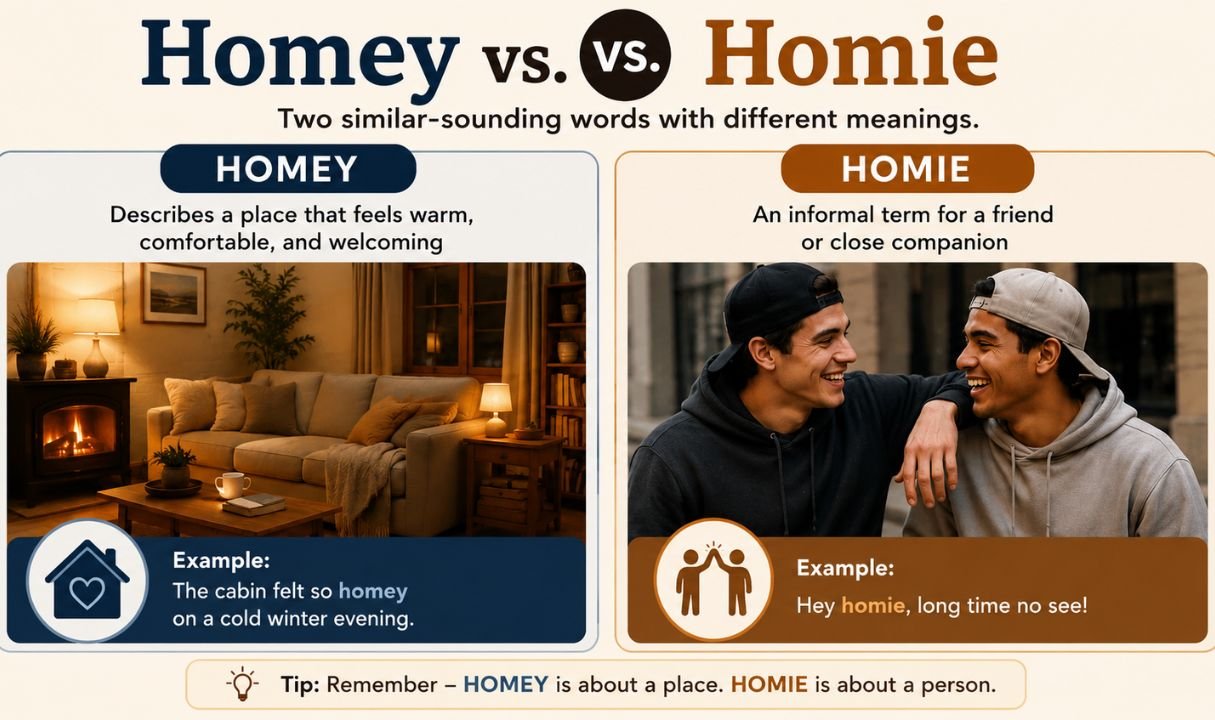
- Homey = an adjective describing something that feels warm, cozy, and familiar, like a place that reminds you of home.
- Homie = a noun, slang for a close friend, buddy, or someone from your neighborhood.
A simple memory trick: places are homey, people are homies.
If you’re describing a kitchen, a café, a sweater, or a vibe, reach for “homey.” If you’re talking about a person you trust and hang out with, “homie” is the word you want.
Is it homie or homey
Both spellings exist and both are correct, just for different jobs. The confusion isn’t really about spelling rules; it’s about function. People often ask “is it homie or homey” when they actually mean “which word fits this sentence,” and that’s a different question entirely.
Say the sentence out loud. If you’re picturing a room, a mood, or a familiar setting, you need “homey.” If you’re picturing a specific person standing next to you, you need “homie.” Once you separate meaning from sound, the spelling sorts itself out.
You May Like: 22th or 22nd: Which One Is Correct? Grammar Guide (2026)
What Does Homey Mean?
Homey is an adjective. It describes a quality, usually of a place, object, or atmosphere, that feels comfortable, welcoming, and reminiscent of home. Think soft lighting, familiar smells, worn-in furniture, and the sense that you can relax without trying.
Common ways people use it:
- A homey kitchen — warm colors, open shelving, the smell of something baking.
- A homey little restaurant — small, unpretentious, run by people who remember your order.
- A homey atmosphere — no formal rules, no pressure to perform, just ease.
- A homey sweater — soft, worn, the kind you reach for without thinking.
Homey can occasionally act as a noun too, functioning as an alternate spelling of “homie” to mean a friend. That usage exists, but it’s far less common in writing, and most style guides and dictionaries treat the adjective form as the primary meaning. If you want your writing to read clearly, save “homey” for describing comfort and warmth, not people.
Synonyms that land close to the same feeling include cozy, welcoming, homelike, comfortable, and unpretentious. Opposites would be cold, sterile, impersonal, or formal.
What Does Homie Mean?
Homie is a noun. It’s informal slang for a close friend, someone you trust, or a person from your neighborhood or hometown. The word grew out of “homeboy” and “homegirl,” terms rooted in African American Vernacular English (AAVE), and it later spread widely through hip-hop culture, film, and everyday youth slang.
Examples of how it shows up in real conversation:
- “This is my homie, Marcus. We’ve been tight since middle school.”
- “Text your homies and see who’s free tonight.”
- “She’s not just a coworker, she’s a homie.”
Because it’s slang, “homie” belongs in casual speech, texting, social media, and informal writing. It’s not appropriate for résumés, business emails, academic papers, or anything meant to sound polished or professional. Save it for the group chat, not the cover letter.
You’ll also notice people searching for homey or homie slang, which makes sense, because “homie” really is the slang half of this pair. “Homey” is a standard English adjective; “homie” is the informal, culturally rooted term. That distinction alone answers a lot of the confusion people bring to this topic.
If you’ve looked up homey or homie urban dictionary, you’ve probably noticed both spellings listed with overlapping definitions there. Crowdsourced slang dictionaries reflect how people actually type online, where spelling gets loose fast. That’s useful for spotting trends, but it’s not the place to learn formal usage.
Homey person meaning
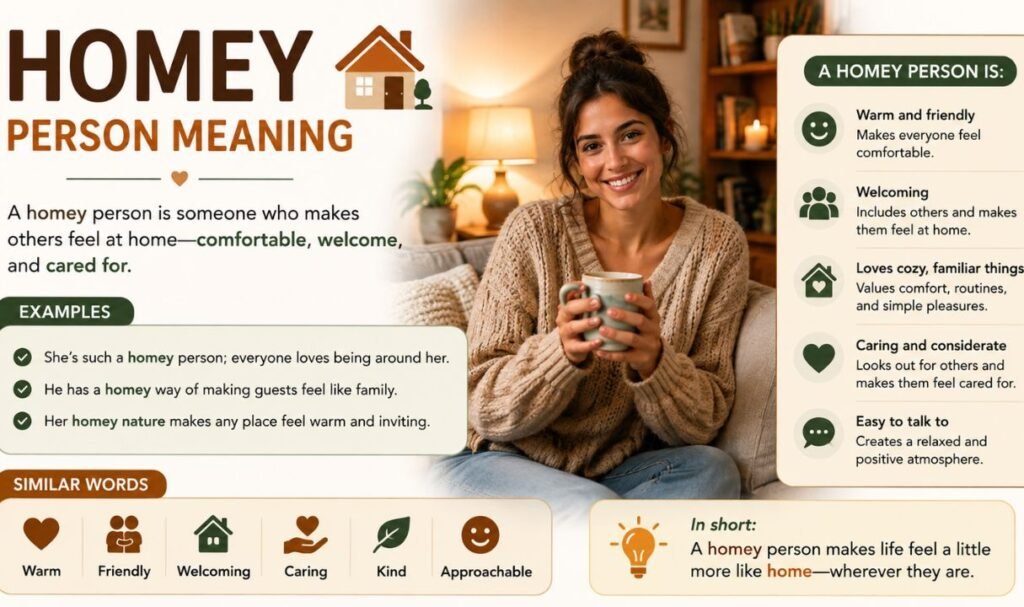
When someone calls another person “a homey,” they usually mean a close friend, someone from their crew or hometown. This overlaps with “homie” directly, since both spellings can refer to a person in casual speech. The cleaner and more widely recognized spelling for referring to a person, though, is “homie.” Reserve “homey” as a description of a person only in relaxed, informal contexts where the overlap won’t confuse your reader.
Homie meaning in love
In romantic or relationship contexts, calling someone your “homie” usually signals a close, easy friendship rather than a romantic partnership. Phrases like “my homie for life” or “ride or die homie” describe deep platonic loyalty. Some couples use it playfully between partners to signal that their romance is also built on genuine friendship, but the core meaning stays rooted in trust and companionship, not romance itself.
Homey or homely
These two are a separate mix-up entirely. “Homely” describes something plain, simple, or, in some regional uses (especially British English), unattractive when applied to a person’s appearance. In American English, “homely” more often describes an unpretentious, modest setting, similar to “homey” but with a slightly more old-fashioned or plain connotation.
So while “homey” carries warmth and comfort, “homely” can carry either mild plainness or, in British contexts, an unflattering description of looks. It’s worth keeping these separate, since using “homely” to compliment someone’s appearance in the UK can land very differently than intended.
How do you spell homies
The plural of “homie” is spelled homies. You’ll occasionally see “hommies” floating around in casual text or social posts, but that spelling isn’t standard and won’t show up in dictionaries. Stick with “homies” for the plural form.
You May Like: Winner or Winer: Which Spelling Is Correct? (2026 Guide)
The Origin of Homey or Homie
The word “homey” traces back to a straightforward pattern in English: take the noun “home,” add the suffix “-y,” and you get an adjective meaning “like home.” This kind of word formation isn’t unusual (think “salty,” “chatty,” or “sunny”), and “homey” has been used this way in English for well over a century.
“Homie,” on the other hand, has a very different lineage. It emerged as a shortened, informal version of “homeboy,” a term with deep roots in African American Vernacular English describing a male friend or someone from one’s home community. Over the twentieth century, “homie” spread from AAVE into hip-hop lyrics, films, television, and eventually mainstream youth slang across the English-speaking world. By the 1990s, it was firmly part of everyday casual speech in the United States and had started appearing internationally as American pop culture traveled.
So while both words trace back to the concept of “home,” they took entirely different paths, one through standard adjective formation, the other through cultural slang, and that’s exactly why their meanings never merged despite sounding almost identical.
British English vs American English Usage
“Homie” is overwhelmingly an American English term, and its use in British English remains rare and largely borrowed through American media, music, and film. British speakers who use it usually do so knowingly, as a nod to American slang, rather than as part of everyday vocabulary.
“Homey,” by contrast, works in both American and British English as a standard adjective, though British writers sometimes prefer “homely” to describe a cozy space, a usage that carries none of the negative connotation it can carry when applied to appearance. This creates a small trap for learners: a British text calling a cottage “homely” is giving a compliment about coziness, not commenting on looks.
| Term | American English | British English |
|---|---|---|
| Homey (adjective) | Common, means cozy/warm | Common, though “homely” often preferred |
| Homie (noun, friend) | Very common in casual speech | Rare, mostly used as borrowed slang |
| Homely (appearance) | Rarely used this way | Can mean plain/unattractive |
Which One Should You Use?
The choice comes down to what you’re describing and how formal the setting is.
- Use homey when you’re describing a place, object, atmosphere, or feeling of comfort. It works fine in both casual and semi-formal writing, like blog posts, product descriptions, or travel articles.
- Use homie when you’re referring to a friend in a casual, conversational setting. Keep it out of professional writing, academic work, and formal communication.
A quick gut check: if you could swap in “cozy” or “welcoming” without changing the meaning, you want “homey.” If you could swap in “friend” or “buddy,” you want “homie.”
More homey or homie questions usually come from people trying to describe increasing warmth in a space (“Can I make this room more homey?”) versus people trying to expand their friend group (“I want more homies in this city”). Once you know which category your sentence falls into, the word choice becomes obvious.
Common Mistakes with Homey or Homie
- Using “homey” to describe a friend in writing. It’s technically accepted as a rare alternate spelling, but it reads as inconsistent or unclear to most readers. Use “homie” instead.
- Using “homie” in professional or formal writing. It’s slang through and through, and it undercuts a polished tone instantly.
- Confusing “homey” with “homely.” Remember that “homely” can shift meaning depending on regional usage, especially around appearance.
- Misspelling the plural as “hommies.” The correct plural is “homies,” no double M.
- Relying on autocorrect. Phones frequently swap one spelling for the other mid-sentence, so a quick proofread before hitting send saves you from an awkward mix-up.
Homey or Homie in Everyday Examples
Homey in a sentence:
- The bed and breakfast had a homey feel, with quilts on every bed and coffee always brewing.
- After redecorating, the office finally felt homey instead of sterile.
- Her cooking has a homey quality that reminds everyone of their grandmother’s kitchen.
Homie in a sentence:
- “What’s up, homie? Long time no see.”
- He brought a few homies along to help move the couch.
- “Thanks for having my back, homie. I owe you one.”
Homey for house
When people specifically search homey or homie for house, they’re almost always looking for the adjective. A house, apartment, or room is described as “homey,” never “homie.” Real estate listings, interior design articles, and travel reviews all lean on “homey” to signal warmth and comfort in a space.
Homey Homey Saipan
This search doesn’t connect to the grammar question at all. It typically refers to a specific local business or place name on Saipan that happens to include the word “Homey” in its title, unrelated to the language distinction covered in this article. If you’re searching for that specific location, a local business directory or map search will serve you better than a grammar guide.
Homey or Homie – Google Trends & Usage Data
Search interest for “homey or homie” climbs steadily each year, driven mostly by English learners, content writers, and casual users double-checking their texts before sending. Search data consistently shows people asking variations like “is it spelled homey or homie” and “homies or homie” far more often than they ask about pronunciation, which confirms something worth noting: the real confusion isn’t how these words sound. It’s which one fits the sentence.
Interest in “homie” spikes around slang-heavy cultural moments, new music releases, and viral social media trends, while searches for “homey” stay fairly steady year-round, tied more to home decor, real estate, and lifestyle content than to any cultural moment.
Comparison Table: Homey vs Homie
| Feature | Homey | Homie |
|---|---|---|
| Part of speech | Adjective (occasionally noun) | Noun |
| Meaning | Cozy, warm, comfortable | Close friend, buddy |
| Origin | Home + “-y” suffix | Shortened from “homeboy” (AAVE) |
| Tone | Neutral to informal | Informal slang only |
| Common use | Describing places, objects, feelings | Referring to a person |
| Plural form | Homeys (rarely used) | Homies |
| Formal writing? | Acceptable in casual/semi-formal writing | Avoid entirely |
| Region | American and British English | Mostly American English |
| Example | “A homey little cabin in the woods.” | “My homie drove me to the airport.” |
Frequently Asked Questions
Is it spelled homie or homey?
Both spellings exist. “Homie” means a close friend, and “homey” describes something cozy or comfortable.
What is homey slang for?
“Homey” isn’t primarily slang; it’s a standard adjective meaning cozy or homelike. In rare informal use, it can also mean “friend,” overlapping with “homie.”
Is homie a racial slur?
No. “Homie” is a friendly slang term with roots in African American Vernacular English, used to describe a close friend, not a slur.
Is it hommies or homies?
The correct plural spelling is “homies.” “Hommies” is a common misspelling and isn’t standard.
Conclusion
The gap between “homey” and “homie” is small on the page but real in meaning. One word wraps around a feeling, warmth, comfort, familiarity. The other points straight at a person, a friend you trust enough to call by an informal name. Once you separate the two by function rather than sound, you’ll never second-guess the spelling again.