
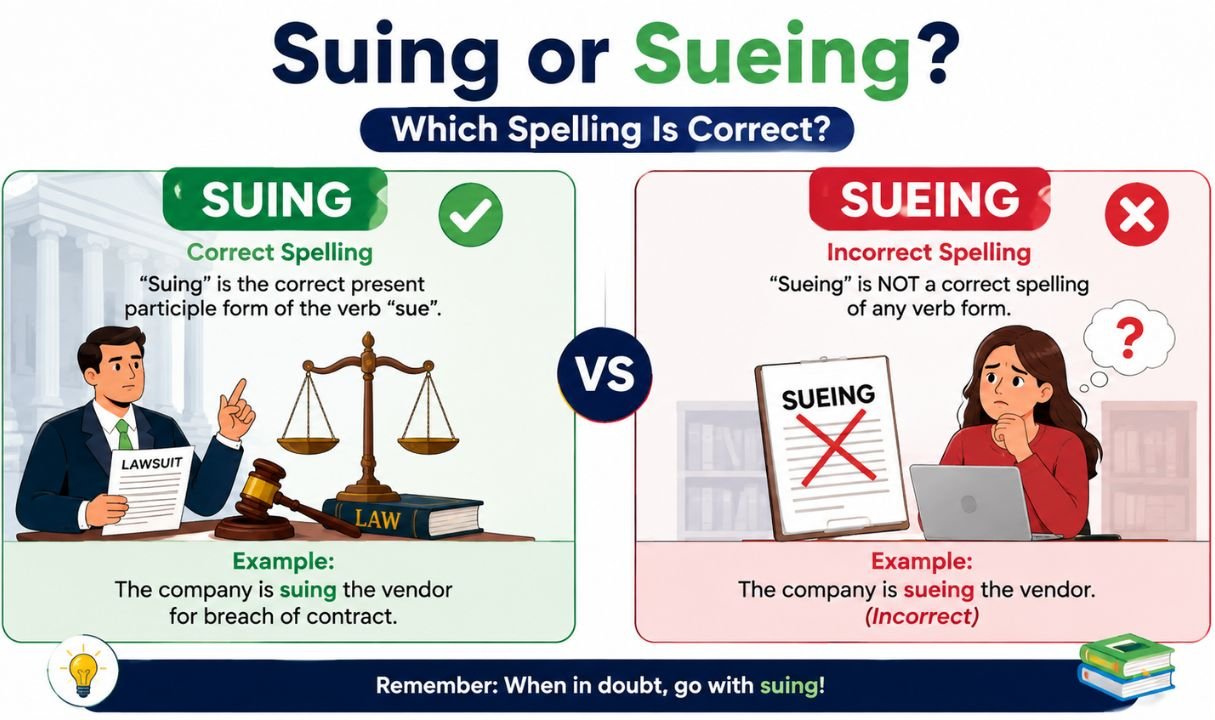
You’re halfway through an email, a complaint letter, or a Twitter rant about your landlord, and your fingers freeze on one word. Is it “suing” or “sueing”? The verb looks like it should keep its “e” — after all, “sue” ends with one — but something about “sueing” also looks off once it’s sitting on the page in front of you.
You’re not imagining things. This is one of the more common spelling stumbles in English, and it trips up students, journalists, and even lawyers who should probably know better. The good news is that the answer is short, the rule behind it is easy to remember, and by the end of this guide you won’t have to pause over this word again.
Suing or Sueing – Quick Answer
Suing is correct. Sueing is a misspelling.
- ✅ She is suing her former employer.
- ❌ She is sueing her former employer.
“Suing” is the present participle (and gerund) form of the verb “sue,” meaning to bring a legal action against a person, business, or other party in court. When you attach “-ing” to “sue,” the silent “e” at the end of the base word drops away, which is why the correct form has only one “e” — the one already built into the “su” sound.
No dictionary — not Merriam-Webster, not Oxford, not Cambridge — lists “sueing” as an accepted spelling. It shows up constantly in casual writing and search queries, but that popularity doesn’t make it correct. It just makes it a very common typo.
The Origin of Suing or Sueing
The verb “sue” has a longer history than most people expect. It traces back through Anglo-Norman French “suer” (or “sivre”) to the Latin “sequi,” meaning “to follow.” In its earliest English use, “to sue” meant to pursue or follow after something — a petition, a claim, a person. Over several centuries, that sense of “pursuing a claim” narrowed into the specific legal meaning we use today: taking formal action against someone in a court of law.
That Latin root also explains why “sue” behaves the way it does when suffixes get added. Like thousands of other English verbs that end in a silent “e” — “make,” “hope,” “write,” “argue” — “sue” loses that final letter before “-ing” is attached. The spelling isn’t an exception to a rule; it’s a textbook example of one.
Here’s the pattern laid out plainly:
| Base verb | Add “-ing” | Result |
|---|---|---|
| sue | drop the silent e | suing |
| make | drop the silent e | making |
| hope | drop the silent e | hoping |
| argue | drop the silent e | arguing |
| write | drop the silent e | writing |
The confusion usually starts because of a different, smaller group of verbs — words like “see,” “agree,” and “flee” — where the “e” sticks around and even doubles: “seeing,” “agreeing,” “fleeing.” Those verbs don’t end in a silent e, though. Their final “e” is part of a vowel sound that needs to stay put for the word to make sense on the page. “Sue” doesn’t work that way, so it follows the more common rule instead: drop the silent e, add “-ing,” done.
You May Like: Truely or Truly: What is the Difference & Which is Correct?
British English vs American English Spelling
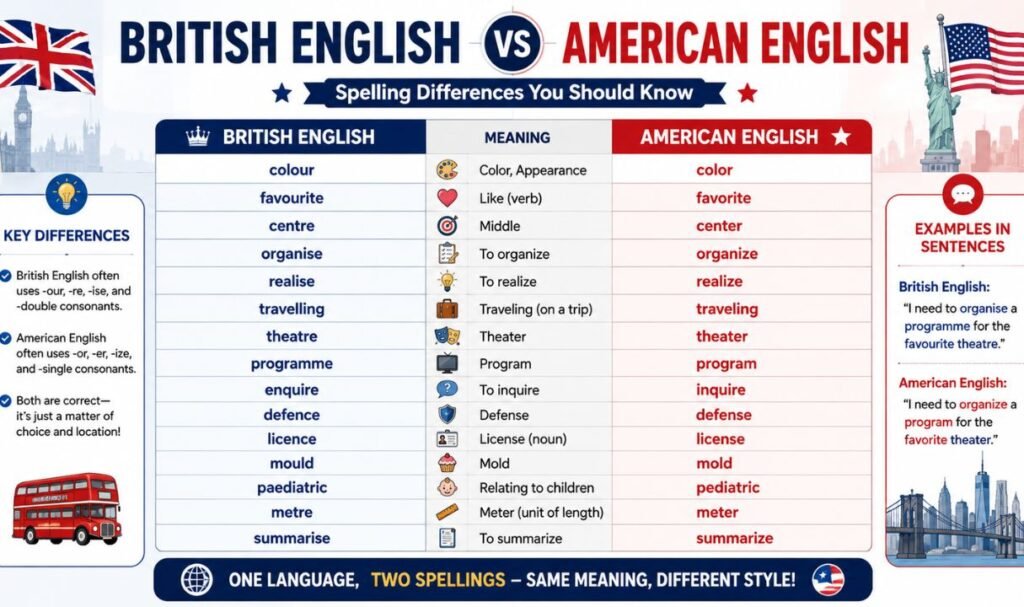
If you’re used to hunting for U.S.-versus-U.K. differences in words like “colour/color” or “organise/organize,” you can relax here. This isn’t one of those cases.
Suing is correct in both British and American English. There’s no regional variant, no alternate accepted spelling in legal documents from London versus New York, and no style guide on either side of the Atlantic that endorses “sueing.” Court filings, news reports, and academic writing all converge on the same spelling regardless of where they’re published.
| Feature | British English | American English |
|---|---|---|
| Correct spelling | Suing | Suing |
| Accepted alternative | None | None |
| Pronunciation | SOO-ing | SOO-ing |
| Use in legal writing | Standard | Standard |
| “Sueing” accepted? | No | No |
This consistency is actually useful to remember: when a spelling question does have a genuine UK/US split, most native speakers already sense it (think “-ise” vs “-ize”). The fact that nobody treats “sueing” as a legitimate British spelling is itself a clue that the word is simply a mistake, not a regional choice.
Which Spelling Should You Use?
Always use suing. There’s no context — formal, informal, legal, casual, academic — where “sueing” is the right call. If you’re drafting a court document, writing a news story, texting a friend about a dispute with a contractor, or filling out a school assignment, the spelling doesn’t change.
A simple way to lock it in: say the word out loud. It sounds like “SOO-ing,” with one long “oo” sound. There’s no second “e” sound hiding in there, so there’s no reason for a second “e” to appear in the spelling.
Suing or sueing meaning
“Suing” means initiating a lawsuit — taking formal legal action against a person, company, or organization, usually to recover damages, enforce a right, or resolve a dispute through the court system. “Sueing” carries no separate meaning of its own; it’s simply the wrong way to spell the same word.
Suing or sueing synonym
Common alternatives to “suing” include:
- Taking legal action
- Filing a lawsuit
- Bringing a claim
- Taking someone to court
- Litigating
- Prosecuting a claim (in the civil sense)
- Bringing an action against
These phrases work well when you want variety in a piece of writing without repeating “suing” every sentence.
Suing or sueing in a sentence
- The tenant is suing the landlord over unsafe living conditions.
- After months of delays, the couple decided suing the contractor was their only option.
- The magazine is suing a former employee for leaking confidential files.
- She considered suing but settled out of court instead.
1. Suing meaning
To sue means to start a legal case against someone, typically in a civil court, in order to seek compensation, enforce a contractual right, or resolve a formal grievance.
2. Suing someone
“Suing someone” describes the act of formally accusing another party — an individual, a business, or an institution — of wrongdoing and asking a court to provide a remedy, such as monetary damages or a specific action.
2. Suing meaning in law
In legal terminology, suing refers to initiating civil litigation. The person who files the suit is the plaintiff; the person or entity being sued is the defendant. The process typically begins with filing a complaint and can end in a settlement, a dismissal, or a trial verdict.
Suing synonym
See the synonym list above — “filing a lawsuit,” “taking legal action,” and “bringing a claim” are the most commonly used alternatives in both everyday and professional writing.
Suing pronunciation
Suing is pronounced SOO-ing, with stress on the first syllable. The “u” carries a long “oo” sound, and the word has two syllables total.
You May Like: Inter Vs Intra: The Complete Guide to Two Prefixes That Trip Up Even Careful Writers
Common Mistakes with Suing or Sueing
Most people who write “sueing” aren’t guessing randomly — the mistake usually comes from one of a few predictable habits:
- Assuming every “e”-ending verb keeps its e. Words like “seeing,” “agreeing,” and “freeing” keep a double e, so writers assume “sue” should follow suit. It doesn’t, because those verbs end in a different kind of vowel sound.
- Typing on autopilot. Fast typing and muscle memory often insert an extra letter that a slower, more deliberate write-up wouldn’t include.
- Trusting autocorrect too much. Not every spellchecker flags “sueing” immediately, especially in casual apps or older software, which lets the error slip through unnoticed.
- Assuming it’s a British/American difference. As covered above, it isn’t. Some writers guess there might be a regional variant and pick the wrong one.
- Overcorrecting for pronunciation. Because “sue” has a long vowel sound, some writers assume an extra letter is needed to preserve that sound in “suing.” It isn’t; the long sound survives just fine without the second e.
A quick proofreading tip: if you’ve typed “sueing” anywhere in a document, search for it directly using Ctrl+F (or Cmd+F on a Mac) and replace every instance with “suing” before you hit send.
Suing or Sueing in Everyday Examples
Seeing the correct form used across different situations helps the spelling stick. Here are a few realistic scenarios:
- Workplace dispute: “He’s suing his former company for wrongful termination after being let go without notice.”
- Consumer complaint: “The customer is suing the airline for lost luggage and the cost of replacing everything inside it.”
- Property dispute: “Several homeowners are suing the developer over cracks that appeared just months after construction finished.”
- Entertainment news: “The songwriter is suing a streaming platform, claiming royalties were never paid out correctly.”
- Everyday conversation: “I’m not suing anyone, I just want my deposit back.”
Notice that the spelling stays fixed no matter how formal or casual the sentence is. That consistency is part of what makes this an easy rule to keep once it clicks.
Suing or Sueing – Google Trends & Usage Data
Search interest in this exact question tends to spike around high-profile lawsuits — celebrity disputes, corporate scandals, or major consumer cases that get wide media coverage. When a big legal story breaks, more people type out sentences involving the word “suing” for the first time in a while, and the spelling question resurfaces.
Even so, search data consistently shows “suing” earning far more monthly search volume than “sueing,” which lines up with its status as the dictionary-standard spelling. “Sueing” still gets meaningful search traffic, but that traffic reflects people checking the spelling, not evidence that the form is accepted.
Keyword Comparison Table
| Term | Status | Typical Use |
|---|---|---|
| Suing | Correct | Legal writing, news, everyday speech |
| Sueing | Incorrect | Common typo, informal writing |
| Sue | Correct (base verb) | “I will sue the company” |
| Sued | Correct (past tense) | “They sued last year” |
| Suit / Lawsuit | Correct (related noun) | “She filed a lawsuit” |
Keeping this table in mind is a fast way to check any related word in the same family — the rule about dropping the silent “e” only applies when you’re adding “-ing.” Past tense (“sued”) and the noun form (“suit”) follow their own separate patterns.
Frequently Asked Questions
What does sueing mean?
Nothing on its own — it’s simply a common misspelling of “suing,” which means taking legal action against someone in court.
How do you spell suing as in “I’m suing you”?
S-U-I-N-G. Drop the silent “e” from “sue” before adding “-ing.”
How do you spell “I am suing you”?
The sentence is spelled exactly as written: “I am suing you,” using the correct present participle form “suing.”
How do you spell sue as in “I’ll sue you”?
S-U-E. The base verb keeps its “e” in this form; the “e” only drops when “-ing” is added.
Conclusion
The rule behind “suing or sueing” is simple: when a verb ends in a silent “e,” English usually drops the “e” before adding “-ing.” That’s why “sue” becomes “suing,” just like “write” becomes “writing,” “hope” becomes “hoping,” and “make” becomes “making.”
The result is “suing,” and that spelling holds true whether you’re writing a legal brief, a news article, a text message, or a school essay — there’s no British-versus-American split to worry about and no context where “sueing” becomes acceptable.