
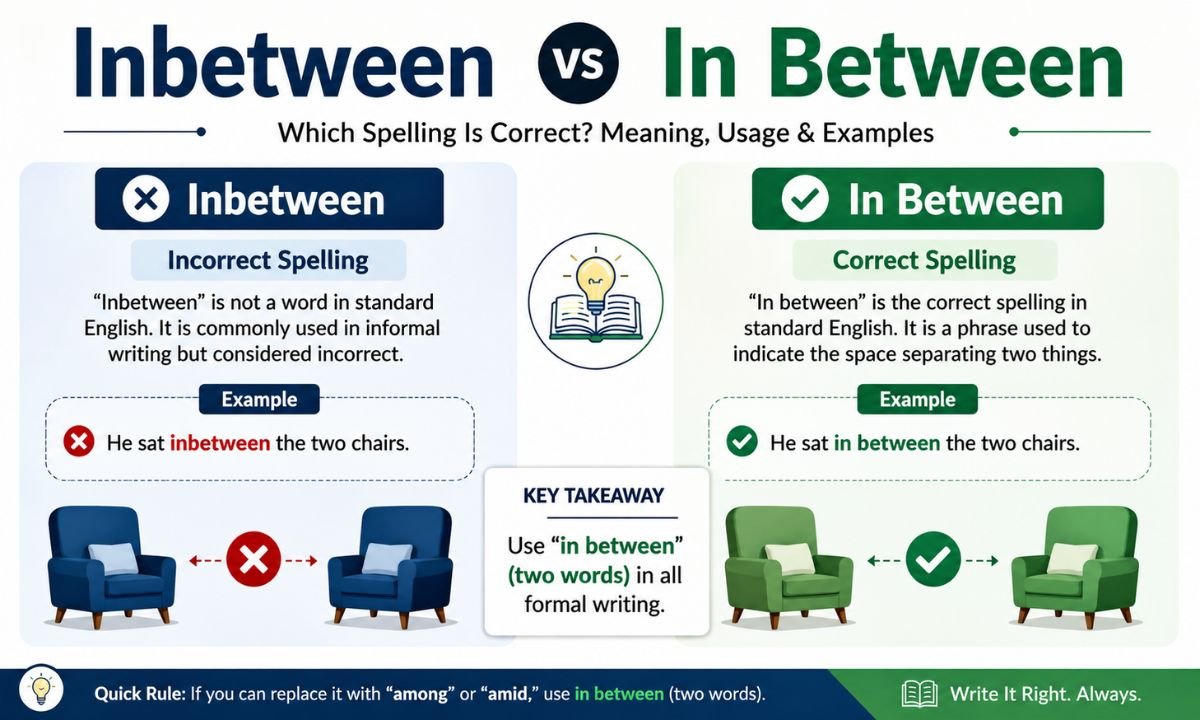
If you have ever paused mid-sentence wondering whether to type “inbetween” or “in between,” you are not alone. This is one of the most common spelling mix-ups in English, and it trips up native speakers just as often as learners. The confusion makes sense — both forms sound identical when spoken aloud, and one of them shows up constantly online despite not being a real dictionary word.
This guide breaks down exactly what separates “inbetween” from “in between,” when each one belongs in your writing, and how to stop second-guessing yourself every time the word comes up. By the end, you will have a simple rule you can apply without needing to think twice.
Comparison Overview
Before going deep into grammar rules, here is a quick side-by-side look at both terms.
| Feature | Inbetween | In Between |
|---|---|---|
| Word count | One word | Two words |
| Dictionary status | Not recognized | Recognized |
| Formal writing | Avoid | Preferred |
| Common usage | Casual, branding, informal text | Everyday speech and writing |
| Part of speech | None (misspelling) | Preposition, adverb, or adjective (hyphenated) |
| Example | “She stood inbetween them.” | “She stood in between them.” |
The short version: “in between” is the correct, standard form. “Inbetween” is a spelling error that has spread because it looks tidy and saves a keystroke. Keep that table in mind as a reference point, because everything below builds on it.
Definition of Inbetween
“Inbetween” refers to the same idea as “in between” — occupying a middle position, time, or state between two things. The meaning is not in question. What’s in question is the spelling.
Search engines, social media captions, and product names use “inbetween” fairly often, which is exactly why it feels familiar. A skincare brand might call a product an “inbetween” moisturizer, or a caption might read “living in that inbetween phase.” None of this makes it grammatically correct. It simply means the word has drifted into casual, unedited writing where spelling checks are looser.
Style guides and major dictionaries, including Merriam-Webster and Oxford, do not list “inbetween” as a standalone entry. If you search for it in a grammar checker, it will almost always get flagged. So while people understand what you mean when you write it, it signals that the text wasn’t proofread carefully.
Definition of In Between
“In between” is the accepted, dictionary-supported version. It functions in a few different ways depending on the sentence:
- As a preposition of place: “The chair is in between the sofa and the window.”
- As a preposition of time: “I’ll call you in between meetings.”
- As an adverb: “You can eat a snack in between if you get hungry.”
- As a hyphenated adjective or noun (in-between): “It’s an in-between size” or “There’s no in-between with him.”
Notice that last point, because it’s where a lot of the confusion actually starts. When “in between” acts as a describing word before a noun, or stands in as a noun itself, it gets hyphenated to “in-between.” That’s a separate rule from the “inbetween vs in between” question, but the two often get mixed up together.
Main Differences Between Inbetween and In Between
Here’s where the two terms really part ways:
- Spelling and structure. “In between” is always two separate words in its basic form. “Inbetween” merges them into one, which is not supported by any major English dictionary.
- Acceptability. “In between” is grammatically correct in every register — casual conversation, business writing, academic papers. “Inbetween” is only tolerated in very informal or stylistic contexts, like branding or social captions.
- Reader perception. A reader who spots “inbetween” in a resume, email, or article may assume the writer skipped proofreading, even if the rest of the piece is polished.
- Search and dictionary recognition. Type “inbetween” into most grammar tools and you’ll get an underline. “In between” passes clean.
- Flexibility. “In between” can shift into the hyphenated “in-between” when needed as an adjective or noun. “Inbetween” has no equivalent flexible form — it’s simply treated as an error regardless of role in the sentence.
Grammar Guide
This section covers the practical side: how the phrase behaves in real sentences, where people slip up, and how to lock in the rule for good.
How each term is used in sentences
Inbetween vs in between sentences almost always look the same in meaning but differ in spelling. Compare:
- Incorrect: “The bakery is inbetween the two banks.”
- Correct: “The bakery is in between the two banks.”
- Incorrect: “We stopped for coffee inbetween flights.”
- Correct: “We stopped for coffee in between flights.”
Inbetween vs in between examples show up constantly in daily conversation because the phrase describes something so common — a middle point, a pause, a gap. The grammar itself is not complicated once you accept the two-word rule; the challenge is just breaking the habit of typing it as one word.
For inbetween vs in between grammar purposes, remember that “in” and “between” are two separate prepositions working together for emphasis. “Between” alone often works fine (“the cat sat between the pillows”), but “in between” adds a slightly softer, more conversational tone (“the cat sat in between the pillows”). Both are grammatically valid; “inbetween” as a single word is not.
Take the phrase everything in between or in between — you’ll see this used to describe a full range: “We serve breakfast, lunch, dinner, and everything in between.” Here, “in between” caps off a list, showing that all the middle options are included too. It should never be squeezed into one word in this context.
An in-between in a sentence example, using the hyphenated adjective form, looks like this: “She’s at that in-between stage of her career, no longer junior but not yet senior.” Here the hyphen matters because the phrase is modifying “stage” directly.
For in between or in between jobs, the phrase “in between jobs” is a very common expression meaning someone is currently unemployed but searching, as in: “He’s in between jobs right now.” Note there’s no hyphen here — it’s functioning as a prepositional phrase, not a compound adjective.
If you’re teaching grammar basics, an in between sentence for class 1 might be as simple as: “The ball is in between the two boxes.” Short, visual sentences like this work well for beginners because they show the physical meaning clearly.
Common mistakes learners make
- Writing “inbetween” as a single word out of habit, especially when typing quickly.
- Forgetting the hyphen when using “in-between” as an adjective or noun.
- Using “in between” when a single word like “between” would be more concise and just as correct.
- Assuming that because “inbetween” appears often online, it must be an accepted variant.
- Overusing “in between” in formal writing when “between” alone reads cleaner.
Simple rules to remember
- If it functions as a preposition showing position or time, write it as two words: in between.
- If it functions as an adjective or noun, add a hyphen: in-between.
- Never write it as a single word. There is no context where “inbetween” is the correct choice in standard English.
- When in doubt, try swapping in “between” by itself. If the sentence still makes sense, you’re safe using either form.
Quick tips for writing and speaking
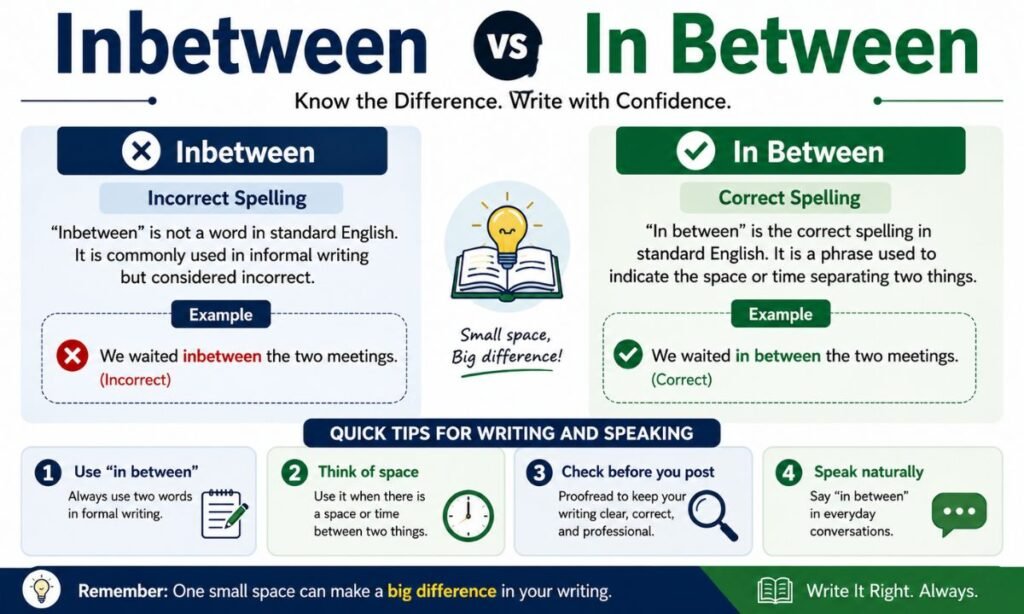
- Read your sentence aloud. If you can’t tell whether it’s one word or two just by hearing it, double-check the spelling before publishing.
- Run formal documents through a grammar checker, since many will flag “inbetween” automatically.
- In speech, nobody will notice the spelling, so don’t stress over pronunciation. The distinction only matters in written form.
- When texting or writing casually, “inbetween” won’t cause major problems, but building the correct habit early saves you from mistakes in professional writing later.
When to Use Each One
Use in between when:
- Describing a physical position between two objects or people.
- Referring to a time gap between two events.
- Writing formally, professionally, or academically.
- Creating a sentence a teacher, editor, or hiring manager will read.
Use in-between (hyphenated) when:
- The phrase acts as an adjective directly before a noun.
- The phrase stands alone as a noun representing a middle state.
There isn’t really a scenario where “inbetween” as one solid word is the recommended choice, but it does appear in:
- Casual social media captions.
- Informal branding or product names, where spelling rules are sometimes bent for style.
- Quick personal notes where correctness isn’t the priority.
When NOT to Use Each One
Avoid inbetween (one word) in:
- Resumes, cover letters, and job applications.
- School and college essays.
- Business emails and reports.
- Any content meant to be indexed by search engines, since it can read as a typo to both readers and editors.
Avoid in between (unhyphenated) when the phrase is clearly modifying a noun as an adjective. For example, “She wore an in between outfit” should actually be “in-between outfit,” since the hyphen is needed to connect the compound adjective smoothly.
Avoid between alone only when the sentence genuinely needs the softer, more conversational rhythm that “in between” provides, such as in dialogue or storytelling. In strict academic or legal writing, plain “between” is often the sharper choice.
Which One to Use (Decision Guide)
Ask yourself these questions in order:
- Is this formal writing? If yes, always use “in between” or the hyphenated “in-between” — never the one-word version.
- Is the phrase describing a noun directly? If yes, hyphenate it: “in-between.”
- Is the phrase showing position, time, or range? If yes, keep it as two words: “in between.”
- Am I just texting a friend or writing something throwaway? Then the one-word spelling won’t cause real harm, though building the correct habit is still worth it.
If you remember nothing else from this guide, remember this: two words for the standard phrase, a hyphen when it’s describing something, and never one solid word in anything you want taken seriously.
Real-World Practical Examples
Inbetween Examples
These show how the (incorrect) single-word spelling typically appears in casual or unedited writing:
- “I feel like I’m stuck inbetween two decisions.”
- “The color is inbetween blue and green.”
- “There’s a small gap inbetween the fence panels.”
- “She’s inbetween sizes, so the medium fits better.”
- “We grabbed a snack inbetween classes.”
Each of these should technically be corrected to “in between” for accurate spelling.
In Between Examples
These show the correct usage across different contexts:
- “The mailbox sits in between the driveway and the garden.”
- “There was an awkward pause in between his sentences.”
- “She likes to stretch in between workout sets.”
- “The negotiation left them stuck in between two offers.”
- “He spent an hour in between appointments catching up on emails.”
- “It’s an in-between size — not quite small, not quite medium.” (hyphenated, adjective use)
- “There’s no in-between with her; she either loves it or hates it.” (hyphenated, noun use)
Self-Assessment (Fill in the Blanks)
Test what you’ve learned. Choose the correct form: inbetween, in between, or in-between.
- The park bench sits _______ the two oak trees.
- She’s going through an _______ phase in her career.
- We stopped for lunch _______ our meetings.
- He served snacks, drinks, and everything _______.
- The dress size is _______, neither small nor large.
- There’s no _______ with him; it’s yes or no.
- My sister is _______ jobs at the moment.
- The cat curled up _______ the two pillows.
Answers
- in between
- in-between
- in between
- in between
- in-between
- in-between
- in between
- in between
Notice that “inbetween” as one solid word never appears in the answer key. That’s intentional, and it’s the entire point of this guide.
Frequently Asked Questions
How to use inbetween?
Avoid it. Use “in between” (two words) for position or time, and “in-between” (hyphenated) when it functions as an adjective or noun.
What does “inbetween” mean?
It carries the same meaning as “in between” — being in the middle of two things — but it is not a standard or dictionary-recognized spelling.
Is “inbetween all” one word?
No. It should be written as “in between all,” using two separate words, such as “in between all the meetings.”
How do we write “in between”?
Always as two separate words in its standard form, or hyphenated as “in-between” when it acts as an adjective or noun before or in place of a subject.
Conclusion
“In between” is the correct, dictionary-recognized form for describing a middle position, time, or range. “In-between” is its hyphenated cousin, used when the phrase functions as an adjective or noun. “Inbetween,” written as a single word, is a common misspelling that has spread through casual writing and branding but has no place in formal or professional English.