
You’re typing a sentence, you get to that word describing movement from one side to another, and your fingers pause. Is it “accross” or “across”? Both look plausible on the page, and that split second of doubt is more common than most writers admit.
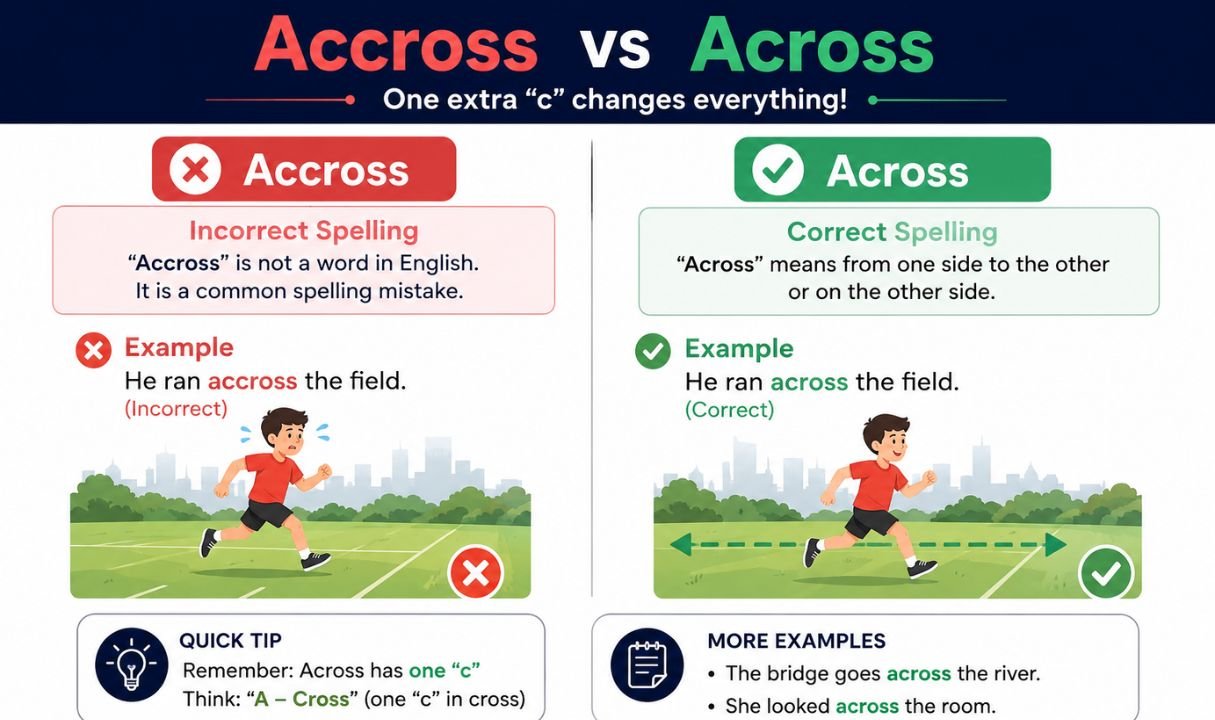
Here’s the short answer: across is correct. Accross is a misspelling, full stop. No dictionary recognizes it, no style guide accepts it, and no professional editor will let it slide.
But knowing the answer isn’t the same as knowing why the mistake happens or how to stop making it. This guide walks through the correct spelling, the meaning, the grammar rules, and the small habits that will make this word automatic instead of a guessing game.
The Correct Spelling Explained
Across has one “c.” That’s it. That’s the whole rule.
The confusion makes sense once you say the word out loud. “Across” carries a hard “k” sound in the middle, and English speakers often associate that sound with doubled consonants — think “accompany,” “accomplish,” or “accurate.” Your ear hears a double sound, so your hand wants to write a double letter. The word simply doesn’t work that way.
Break the word down and the spelling becomes obvious:
- a- (a prefix meaning “on,” “in,” or “to”)
- cross (the verb meaning to move from one side to the other)
Put them together and you get a + cross = across. One prefix, one root word, one “c.” There’s no second “c” hiding anywhere in that equation, which is exactly why “accross” doesn’t hold up.
Every major dictionary — Merriam-Webster, Oxford, Cambridge — lists only one spelling. Spell-checkers in Word, Google Docs, and Grammarly will flag “accross” instantly. If you’ve ever seen red squiggly lines under that word, now you know why.
What Does Across Mean in English?
Across describes movement or position from one side of something to the other. It’s one of the most frequently used prepositions in everyday English, showing up in directions, stories, news reports, and casual conversation alike.
At its core, across answers the question “from where to where?” It points to a path that crosses a space, a line, or a boundary.
Common meanings include:
- Movement from one side to another — “She walked across the bridge.”
- Position on the opposite side — “The bakery is across the street.”
- Extending over an area — “The news spread across the country.”
- Distribution among a group — “Responsibilities are shared across the team.”
Picture a river with two banks. When something moves from Bank A to Bank B, it moves across the river. That mental image works for almost every use of the word, whether the “river” is literal or figurative.
Accross vs Across Meaning Explained
Here’s the part that trips people up: accross has no meaning at all. It isn’t a variant spelling, a regional form, or an old-fashioned version of the word. It’s simply an error.
| Word | Status | Meaning |
|---|---|---|
| Across | Correct | Movement or position from one side of something to the other |
| Accross | Incorrect | None — not a recognized English word |
Compare this to genuine spelling variations, like “colour” versus “color” or “realise” versus “realize,” where both forms are valid depending on whether you’re writing British or American English. Across doesn’t have that flexibility. There’s exactly one accepted spelling worldwide, which actually makes this easier than most tricky English words — you only need to remember one rule, not two competing standards.
Why Is Across Spelled With One “C”?
The single “c” traces back to the word’s history. Across evolved from Middle English acrosse, which itself came from the Old French phrase a croix or en croix, meaning “in the form of a cross.” Follow the trail further back and you land on the Latin word crux, meaning cross.
At no point in that chain does a double “c” appear. The word has always carried one “c” in “cross,” and adding the prefix “a-” never changed that.
English does double consonants often enough to cause genuine confusion — words like “accommodate,” “occasion,” and “occur” all carry double letters that mirror their pronunciation. Across simply isn’t one of them. The prefix “a-” attaches directly to “cross” without altering its spelling, the same way “a-” attaches to “board” to form “aboard,” or to “wake” to form “awake.” Nobody writes “awwake” or “abboard,” and across deserves the same treatment.
Why Do People Spell Across Wrong?
A few patterns explain most instances of this mistake, and they’re worth understanding because recognizing the cause makes the fix stick better.
Pronunciation misleads the ear. The “cr” sound in the middle of across can feel weighty enough to suggest a doubled letter, especially when the word is spoken quickly in casual conversation.
Pattern matching from similar words. Writers who’ve internalized “according,” “accompany,” or “accurate” sometimes apply that same double-c pattern automatically, without checking whether it actually belongs.
Typing speed and autocorrect gaps. Fast typing on a phone keyboard increases the odds of an extra letter sneaking in, and not every autocorrect system catches it before the message sends.
Limited reading exposure. Spelling accuracy tends to improve with reading volume. Writers who see the correct form less often are more likely to rely on how a word sounds rather than how it’s actually built.
None of these reasons make the mistake acceptable in formal writing, but they do explain why it’s so persistent — even among people who read and write constantly.
Accross vs across synonym
If you’re looking for words that carry a similar meaning to across, options include over, through, past, and beyond, depending on context. None of these are interchangeable in every sentence, but they can often stand in for across when you want to vary your phrasing.
Accross vs across adverb
Across functions as an adverb when it doesn’t take a direct object tied to a specific noun phrase — for example, “The river is two miles across.” Here, across describes a measurement or extent rather than pointing to a specific object being crossed.
Accross or across
This is the exact question most searchers are asking, and the answer stays the same no matter how the question is phrased: across is correct, accross is not.
Accross vs across examples
Seeing the words side by side in real sentences makes the difference concrete:
- Correct: They ran across the yard.
- Incorrect: They ran accross the yard.
- Correct: The plane flew across the ocean.
- Incorrect: The plane flew accross the ocean.
Accross vs across grammar
Grammatically, across works as a preposition or an adverb. It never functions as a noun, adjective, or verb, which limits the kinds of sentences it can appear in — but within those roles, it’s remarkably versatile.
Accross vs Across Grammar Rules Explained
Understanding how across behaves grammatically helps you use it with more confidence, especially in longer or more complex sentences.
As a preposition, across connects to a noun and shows the relationship between two points:
- “The cat jumped across the fence.”
- “Her office is across the hall.”
As an adverb, across modifies a verb without a direct object attached:
- “He looked across and waved.”
- “The field stretches half a mile across.”
A simple test: if across is immediately followed by a noun phrase describing the thing being crossed, it’s working as a preposition. If it stands more independently, describing distance or general direction, it’s functioning as an adverb.
One more rule worth remembering — across is never used as a verb. You wouldn’t say “I accrossed the street.” The verb form of the underlying idea is simply “cross” or “crossed.”
How to Use Across in a Sentence Correctly
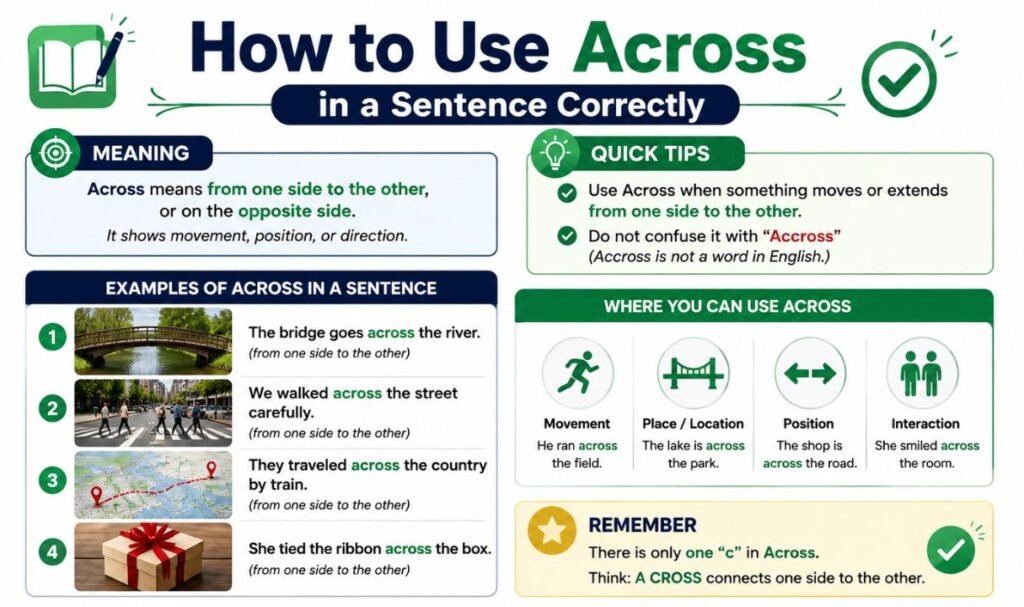
Across fits naturally into a wide range of sentence structures. Here are several patterns to model your own writing on:
- Describing physical movement: “The dog sprinted across the park.”
- Describing location: “The coffee shop sits across from the library.”
- Describing spread or reach: “The policy applies across all departments.”
- Describing measurement: “The table is four feet across.”
- Describing communication or shared understanding: “The teacher’s point came across clearly.”
Notice how the meaning shifts slightly with each use, even though the spelling never changes. That flexibility is part of why across appears so often in both casual speech and formal writing.
Across vs Through vs Over: Key Differences
These three prepositions often get grouped together because they all describe movement relative to a space, but they aren’t interchangeable.
| Word | Typical Use | Example |
|---|---|---|
| Across | Movement from one side to the other, usually over a flat or open surface | She walked across the field. |
| Through | Movement within or inside something, often involving entry and exit points | He walked through the tunnel. |
| Over | Movement above something, often implying a barrier or elevation | The bird flew over the fence. |
The distinction usually comes down to the shape of the space involved. Across suits open, flat areas like fields, rooms, or bodies of water. Through fits enclosed spaces you move within, like a forest, a crowd, or a building. Over implies something above or higher than the object being passed.
Context can blur these lines occasionally — “she walked through the park” and “she walked across the park” are both grammatically valid, just with slightly different mental images attached. Choosing between them is more about precision than strict correctness.
Synonyms and Similar Words to Across
Depending on the sentence, several words can substitute for across without losing much meaning:
- Over
- Through
- Past
- Beyond
- Athwart (rare, mostly literary)
- Crosswise
Each carries a slightly different shade of meaning, so swapping them isn’t always a clean one-to-one replacement. “Beyond,” for instance, suggests something further along than the immediate crossing point, while “over” often implies elevation. Choosing the right synonym depends on the physical or figurative relationship you’re describing.
Across Spelling UK vs US: Any Difference?
No. This is one of the rare English words where British and American spelling agree completely. Unlike “colour/color” or “travelling/traveling,” across stays identical on both sides of the Atlantic, and in Australian, Canadian, and Indian English as well.
That consistency actually simplifies things for international writers and ESL learners — there’s no need to check which regional spelling applies. Across is across, everywhere English is written.
Is Accross Ever Correct to Use?
No, not in standard English writing. Accross doesn’t appear in any recognized dictionary, isn’t accepted by academic or professional style guides, and won’t pass a spell-check.
Occasionally you might spot it in old, informal, or handwritten text where the writer simply made an error that was never corrected. That’s not the same as it being an accepted variant — it’s just a mistake that happened to survive. In business writing, academic papers, resumes, or any content meant for a public audience, accross should always be corrected to across.
The Impact of Spelling Errors on Writing
A single misspelled word rarely ruins a piece of writing on its own, but errors add up, and readers notice patterns.
Spelling mistakes affect writing in a few concrete ways:
- Credibility takes a hit. Readers often equate accurate spelling with careful, trustworthy work, especially in professional or academic contexts.
- Clarity suffers. A misspelled word can momentarily distract a reader from the actual message, breaking the flow of a sentence.
- First impressions matter more than expected. Resumes, emails, and business proposals with spelling errors are frequently judged more harshly, sometimes without the reader consciously registering why.
- Search visibility can be affected. Content published online with consistent spelling errors may perform worse in search rankings and appear less authoritative to readers.
None of this means one typo defines a writer’s ability. But building the habit of catching common mix-ups like accross versus across pays off across every kind of writing you do — emails, reports, essays, and everything in between.
Practice Session
Test what you’ve learned with the exercises below.
Fill in the Blanks
- She walked _______ the room to greet her guest.
- The new policy will apply _______ all departments.
- He swam _______ the lake before breakfast.
- Our house is just _______ from the park.
- The bridge stretches nearly a mile _______.
(Answer: across, for all five.)
Multiple Choice Questions
1. Which spelling is correct? a) Accross b) Across c) Acrosse d) Accros
2. Across can function as which parts of speech? a) Noun and verb b) Preposition and adverb c) Adjective only d) Conjunction and pronoun
3. Which sentence is spelled correctly? a) They drove accross the bridge. b) They drove across the bridge. c) They drove acrosse the bridge. d) They drove accros the bridge.
Answers: 1-b, 2-b, 3-b
Frequently Asked Questions
Why do people say accrost?
“Accrost” is a nonstandard, dialectal pronunciation sometimes heard in casual speech, but it isn’t a recognized word or accepted spelling in any form of English writing.
Which is correct: “a cross” or “across”?
They mean different things. “A cross” refers to the physical or symbolic object (a cross shape), while “across” is the preposition or adverb describing movement or position from one side to another.
When to use the preposition “across”?
Use “across” when describing movement, position, or spread from one side of something to the other, such as crossing a street, room, or open space.
How do you pronounce “across”?
It’s pronounced uh-KRAWS (/əˈkrɒs/ in British English or /əˈkrɔːs/ in American English), with stress on the second syllable.
Conclusion
The rule behind accross vs across is simpler than the confusion suggests. Across carries one “c,” built from the prefix “a-” and the verb “cross,” and no dictionary or style guide recognizes any other version. The mix-up happens because of pronunciation habits and pattern matching from other double-consonant words, not because the spelling itself is genuinely ambiguous.