
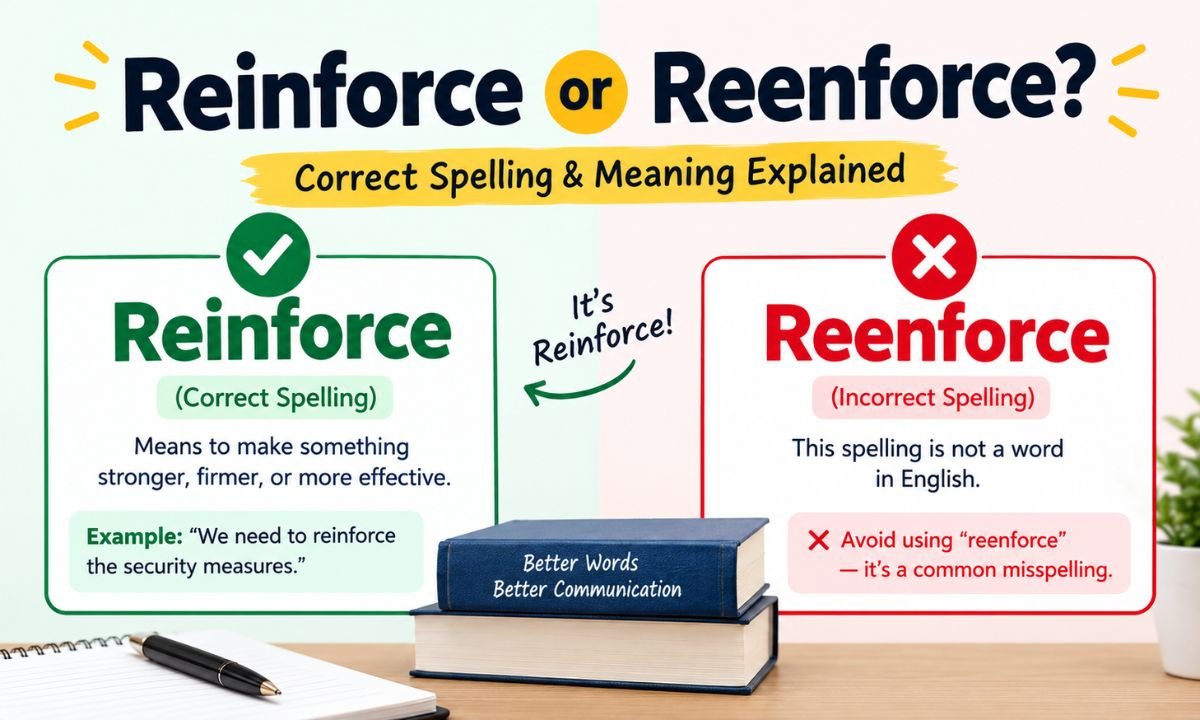
Reinforce is the correct spelling, and reenforce is a rare, dated variant that modern dictionaries barely recognize. If you’re unsure whether to write reinforce or reenforce, choose reinforce every time, whether you’re writing an essay or a quick email.
Plenty of writers still type reenforce and wonder if they’ve made a mistake. This guide covers the meaning, the spelling history, regional differences, and a simple memory trick that keeps the word straight for good.
Quick Answer
Reinforce is the standard spelling in American and British English. Reenforce shows up occasionally, but it’s treated as an outdated variant or a simple error, and spellcheck tools usually flag it. Choose reinforce and you’re safe anywhere.
Nothing changes about the meaning. Both spellings point to the same idea of adding strength or support, so the only real question is which form readers will trust. Editors trust reinforce, and so do search engines.
Example: The engineers used steel beams to reinforce the bridge.
Meaning of Reinforce vs Reenforce
Both words carry one meaning: to make something stronger by adding support. The difference is purely spelling, and only one form is considered standard in modern dictionaries and professional editing. Think of it as one word wearing two outfits.
Example: “The crew reinforced the roof” and “the crew reenforced the roof” mean the same thing, but only the first looks right.
Reinforce
Reinforce is a verb meaning to strengthen something with extra support or evidence. It’s the form you’ll find as the main entry in standard dictionaries and the one style guides expect. Writers use it for physical objects and abstract ideas.
Example: A good teacher will reinforce new vocabulary with short daily quizzes.
Reenforce
Reenforce is an older variant built by attaching re- straight onto enforce. You may spot it in old print, but current usage treats it as either obsolete or a typo, so avoid it in professional writing.
Example: “Reenforce the fence” would likely get a red squiggle in your word processor, while “reinforce the fence” won’t.
Why Reinforce Is the Preferred Spelling
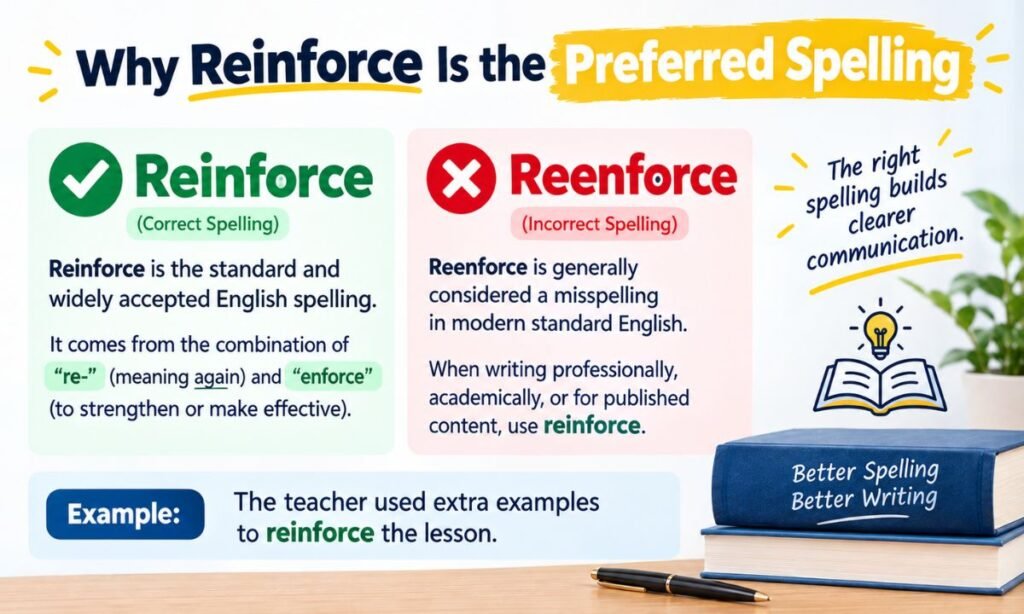
Reinforce is preferred because dictionaries and everyday writers have settled on it over the years. Consistency helps readers, and a familiar spelling never distracts them from your message. Reenforce, by contrast, makes some people pause.
The word also traces back to the prefix re- plus an older form, inforce, which was a variant of enforce. Over time the reinforce form won out in print, and the alternatives faded. That’s why the spelling feels settled today.
Example: You’ll find reinforce far more often than reenforce in published news writing about troops and budgets.
Comparison Table: Reinforce vs Reenforce
The table below puts both spellings side by side. Reinforce wins on every practical measure, from dictionary status to reader trust. Scan it if you need a fast verdict before you hit publish. Each row is explained further below.
| Feature | Reinforce | Reenforce |
|---|---|---|
| Standard spelling | Yes | No |
| Dictionary status | Main entry | Variant at best |
| Reader trust | High | Low |
| Spellcheck | Passes | Usually flagged |
| Modern usage | Very common | Rare |
| Professional writing | Safe | Avoid |
Example: On a résumé, “Reinforced team training” reads polished, while “Reenforced team training” invites doubt.
Common Mistakes Writers Make
The most common mistake is treating reenforce as a valid alternative. Others include hyphenating the word and mixing up reinforce with related terms like enforce. Each slip is small, yet each one can cost credibility in polished writing.
- Writing reenforce because it looks phonetic
- Adding a hyphen to make re-enforce
- Confusing reinforce with enforce
- Dropping the e in reinforcement and typing reinforcment
Example: “We need to re-enforce the rules” should read “We need to reinforce the rules” or, if you mean applying them, “We need to enforce the rules.”
American vs British English Differences
There’s no American versus British split here. Both varieties use reinforce as the standard spelling, and reenforce isn’t a regional variant in either one. Regional spelling debates, such as color and colour, simply don’t apply.
Older typography sometimes used a diaeresis, as in reënforce, or a hyphen, as in re-enforce. Those habits belong to earlier eras, and current style guides on both sides of the Atlantic generally favor the plain form.
Example: A London paper and a New York paper would spell “reinforce” the same way, though they’d still differ on defence versus defense.
When to Use Reinforce (Real-Life Contexts)
Use reinforce whenever something needs added strength, whether it’s a physical structure or an idea. The word fits construction, psychology, the military, and everyday conversation. Context changes the flavor slightly, but the spelling never does.
In building work, engineers reinforce concrete with steel bars so it can handle heavy loads. In psychology, reinforcement means a consequence that makes a behavior more likely to repeat, an idea linked to B. F. Skinner.
In news and military writing, reinforcements are extra troops sent to support a position. In classrooms, teachers reinforce lessons through repetition and practice, which helps new ideas stick. Each setting uses that same spelling without exception.
Example: The city will reinforce the seawall before storm season.
Synonyms of Reinforce (LSI Keywords)
Common synonyms include strengthen, fortify, bolster, and buttress. Pick the one that matches your tone, since some feel technical while others sound more casual. Swapping in a synonym also keeps repeated phrasing from feeling stale.
- Strengthen: the plain, all-purpose choice
- Fortify: suggests defense, like walls or immune systems
- Bolster: fits morale or arguments
- Buttress: formal, often used for backing a case
- Shore up: informal, for fixing weak points
- Prop up: implies temporary or shaky support
Example: New data helped bolster her argument, and extra funding helped fortify the program.
Memory Trick to Avoid Confusion
Spot the word rein hiding inside reinforce. Reins guide and steady a horse, which matches the idea of holding something firm, and that hidden rein reminds you the correct form has no double e. Simple, but it sticks.
This is a mnemonic, not etymology, since the word actually comes from re- and inforce. Still, a silly picture beats a rule you have to look up again. Try picturing a rider gripping the reins tight.
Example: Typed “We must reenforce the plan”? Picture the reins, spot the missing double e, and fix it to reinforce.
Example Sentences Showing Correct Usage
These sentences show reinforce in several settings. Read them aloud and the pattern will feel natural, since the spelling stays identical across every context. Notice how the verb takes regular endings, as in reinforces or reinforced, without any spelling change.
- The coach used video clips to reinforce good habits.
- Volunteers reinforced the riverbank before the flood.
- Her latest results reinforce the original findings.
- Reinforcing the message in every email keeps it memorable.
- The contractor recommended reinforced glass for the storefront.
- The reinforcements arrived by dawn.
Example: “Reinforced concrete” is a fixed technical term, and no one writes “reenforced concrete” in engineering.
Reinforce vs Reenforce Synonym
Neither spelling has its own set of synonyms, because they’re the same word. Any synonym for reinforce, such as strengthen or bolster, also works for reenforce. The real choice is between the spellings, not between their meanings.
Example: If you can’t decide on a spelling, write “They strengthened the fence” and skip the debate entirely.
Reinforce vs Reenforce Examples
Side-by-side sentences make the difference obvious. The correct version appears first in each pair, and the second shows the outdated variant you should avoid. Only the spelling changes, so the meaning stays intact each time.
| Correct | Avoid |
|---|---|
| The bridge needs to be reinforced. | The bridge needs to be reenforced. |
| Praise can reinforce good behavior. | Praise can reenforce good behavior. |
| We reinforced the argument with data. | We reenforced the argument with data. |
| Reinforcements are on the way. | Reenforcements are on the way. |
Example: Fixing one line is easy: swap reenforce for reinforce and check that the surrounding grammar still works.
Reinforce vs Reenforce Grammar
Reinforce is a regular verb, mostly transitive, so it usually takes an object. Its forms are reinforce, reinforces, reinforced, and reinforcing, and the noun is reinforcement. Reenforce would follow the same pattern, yet you’ll rarely need it.
Reinforced also works as an adjective, as in reinforced concrete or a reinforced door. Because the word is regular, you won’t face tricky spelling rules like doubling consonants. Just add the ending and move on.
Example: “The rain reinforced her decision to stay home” shows the verb with a direct object.
Reinforce vs Reenforce Reddit
Community threads on Reddit and similar forums usually land on the same verdict: reinforce is right, and reenforce looks like a typo or an old variant. Opinions vary in tone, but the consensus rarely shifts.
Forum answers are opinions, not sources, so treat them as a starting point. A quick check in a dictionary such as Merriam-Webster or Oxford settles the question with real authority. That habit saves a lot of second-guessing.
Example: A typical thread might ask, “Is reenforce a real word?” and draw replies pointing out that reinforce is the standard form.
Reinforce Meaning
To reinforce means to strengthen something by adding support, whether physical or abstract. It can also mean to make an idea or habit stronger through repetition. Modern dictionaries list these senses under one main entry.
The word also works in a figurative sense. You can reinforce a point with evidence or a friendship with regular effort. The core idea of adding strength stays the same in both uses, which is why one spelling covers everything.
Example: Regular check-ins reinforce trust between coworkers.
Frequently Asked Questions
Here are quick answers to the questions writers ask most about this spelling. Each one is short, so you can find the fix and get back to writing.
Is reenforce ever acceptable to use?
Rarely. It’s an outdated variant, so use reinforce in nearly all writing. Keep reenforce only when you’re quoting an older text exactly as printed.
Does British English spell it differently?
No. British and American English both use reinforce. Reenforce isn’t a regional spelling in either one.
What part of speech is reinforce?
It’s mainly a verb. The noun is reinforcement, and reinforced works as an adjective.
Will spellcheck catch reenforce?
Usually, yes. Most word processors flag it, but settings and dictionaries vary, so proofread anyway.
Why did reenforce exist in the first place?
Writers simply added re- to enforce, which seemed logical. Reinforce, built on the older inforce, ended up winning in standard usage.
Is there a meaning difference between the two spellings?
No. The meaning is identical, and only the spelling differs.
So is it reinforce or reenforce, once and for all?
Reinforce. It’s the standard spelling in both American and British English.
Conclusion
Reinforce or reenforce? Go with reinforce every time. It’s the standard spelling in American and British English, and it keeps your writing clean and credible. Nothing about the meaning changes, only the way readers judge you.
Keep the rein in reinforce in mind, and the double e won’t sneak in again. Now you can write with confidence, whether you’re strengthening a wall or an argument. That’s all it takes.