
You just typed a text to a friend, a comment under a photo, or the first line of a work email. Then you paused. Should it read “Goodmorning” or “Good Morning”? That half-second hesitation happens to millions of people every single day, and the answer is simpler than most writing guides make it sound.
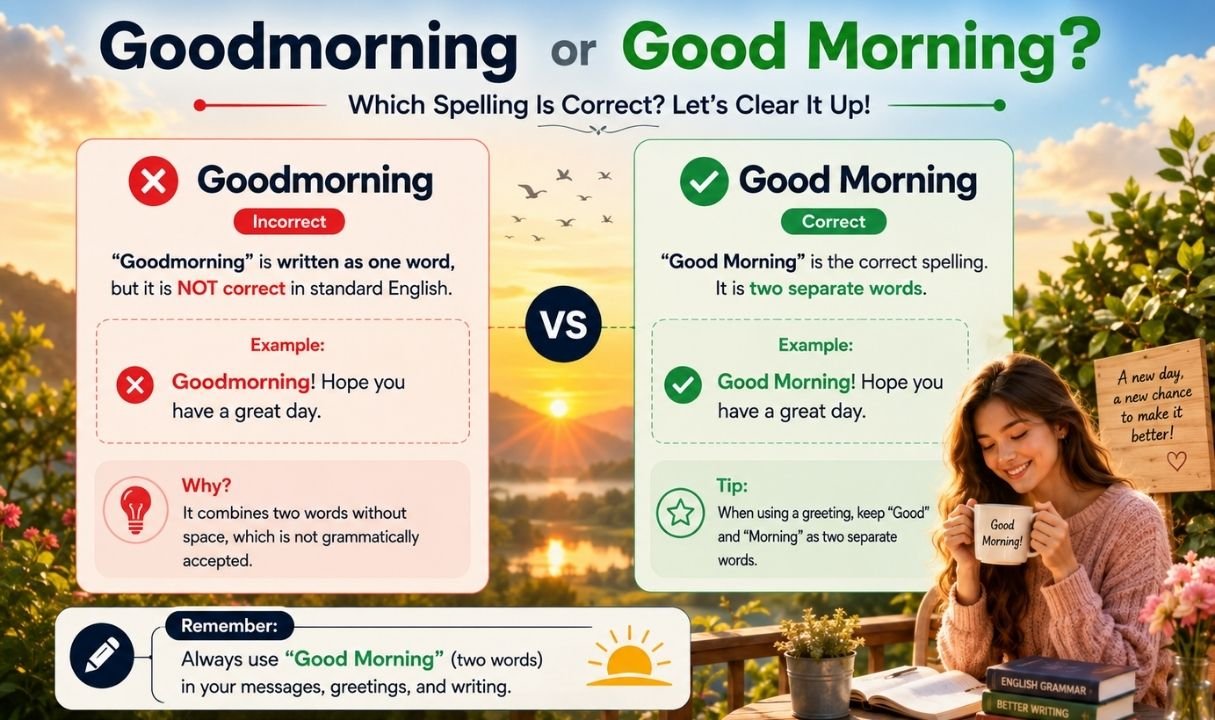
“Good morning” is the correct form. Two words, always. “Goodmorning” is a spelling error that has spread because of fast typing, texting habits, and autocorrect that doesn’t always catch it.
This guide walks through the grammar reasoning, shows real examples of correct and incorrect usage, explains why the mistake keeps happening, and gives you simple tricks to remember the rule for good. By the end, you won’t need to second-guess this greeting again.
What Is the Correct Form: Goodmorning or Good Morning?
“Good morning” is a two-word greeting phrase. It is not a compound word, and dictionaries do not list “goodmorning” as an accepted spelling. The phrase works because “good” describes “morning” — one word modifies the other, and English keeps that kind of pairing separated by a space.
Think about how many similar phrases exist in English: “good afternoon,” “good evening,” “good day,” “nice weather,” “happy birthday.” None of these collapse into single words, and “good morning” follows the same pattern.
Why “Goodmorning” Is Incorrect
The word “goodmorning” doesn’t appear in Merriam-Webster, Oxford, or Cambridge dictionaries. That alone settles the matter for formal writing. But the grammar reasoning matters too:
- “Good” is an adjective.
- “Morning” is a noun.
- Adjective-noun pairs in English generally stay as separate words unless they’ve gone through a long process of merging, like “blackboard” or “sunrise” once did.
- “Good morning” never went through that merging process because it functions as a spoken greeting, not a single named object or concept.
Writing it as one word doesn’t create a new compound noun. It just creates a typo that readers will notice, even if they still understand what you meant.
Examples of Correct Usage
- Good morning, everyone. Let’s get started with today’s agenda.
- I woke up early and had a good morning walk with my dog.
- She said good morning to the whole office before sitting down.
- Good morning, Mr. Patel. Your 9 a.m. appointment is confirmed.
Examples of Incorrect Usage
- Goodmorning everyone, hope you slept well.
- I said goodmorning to my neighbor on my way out.
- Goodmorning team, quick update before lunch.
- Wishing you a goodmorning full of energy.
Each incorrect example reads fine out loud, which is part of why the mistake is so easy to miss while typing quickly.
Why Do People Write “Goodmorning” Instead of “Good Morning”?
If the rule is this clear, why does the error show up constantly on social media, in texts, and even in some workplace chats? A few habits explain most of it.
Fast Digital Communication
Texting and instant messaging reward speed over precision. When your thumbs are moving quickly across a keyboard, spacing between short, familiar words is one of the first things to slip. “Goodmorning” gets typed the same way people accidentally type “cant” instead of “can’t” — not because they don’t know the rule, but because speed takes priority in the moment.
Influence of Compound Words
English is full of words that used to be two separate terms and eventually merged into one: “notebook,” “sunflower,” “keyboard,” “weekend.” Because this pattern is common, some writers assume “good morning” followed the same route. It didn’t. The difference is that those merged words became fixed nouns describing a single object or concept, while “good morning” remains a spoken phrase used in the moment of greeting someone.
Autocorrect and Informal Habits
Autocorrect tools are trained to fix obvious misspellings, but they don’t always flag spacing errors in casual messages, especially on mobile keyboards where predictive text sometimes suggests the merged version out of habit. Add in years of seeing “goodmorning” used casually online, and the incorrect spelling starts to feel normal even though it never became grammatically accepted.
Understanding the Grammar Behind “Good Morning”
Grammar rules can feel abstract, so it helps to break “good morning” down into its working parts.
“Good” Functions as an Adjective
In this phrase, “good” describes the quality of the morning being wished upon someone. It behaves exactly the way it does in “good food,” “good weather,” or “good news.” None of those phrases merge into single words, and “good morning” is no exception.
Greeting Phrases Usually Stay Separate
English greetings almost always stay as multi-word phrases:
- Good afternoon
- Good evening
- Good night (used as a farewell, discussed below)
- Nice to meet you
- Take care
There isn’t a linguistic reason for “good morning” to behave differently from “good afternoon” or “good evening,” and no major style guide treats it differently either.
Why “Goodnight” Is Different
This is where a lot of confusion creeps in. Many people notice that “goodnight” is often written as one word and assume “goodmorning” should follow the same rule. The comparison doesn’t quite hold up.
“Goodnight” is widely accepted as a single word specifically when used as a farewell or a sign-off before sleep, such as ending a phone call or a bedtime story. Even then, many style guides still prefer “good night” as two words in formal writing, and both forms appear in dictionaries with slightly different usage notes. “Good morning,” on the other hand, has no dictionary entry as a single word in either casual or formal contexts. The two phrases simply took different paths, and only one of them supports a one-word spelling with any real acceptance.
When Should You Use “Good Morning”?
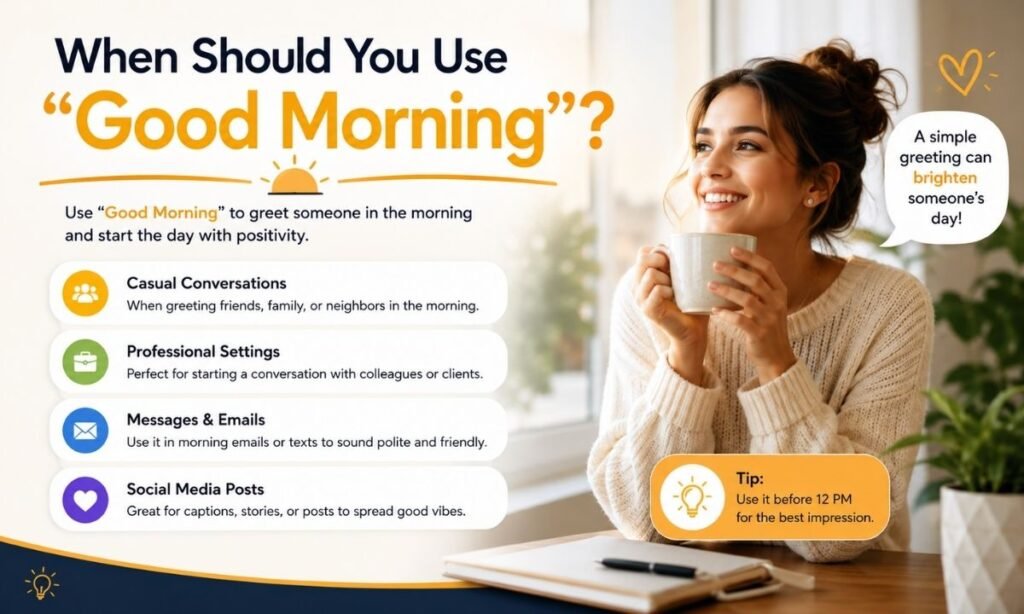
“Good morning” fits a wide range of situations, but the tone and context shift depending on where you’re using it.
Professional Situations
In workplace emails, meetings, and formal messages, “good morning” sets a polite, respectful tone. It signals attention to detail before the reader even gets to the main content of your message.
Casual Conversations
Among friends and family, “good morning” still works perfectly well, though people often shorten it or pair it with something warmer, like “good morning, sunshine” or “morning!” The two-word spelling rule still applies even in relaxed texting.
Time Range for “Good Morning”
There’s no strict legal cutoff, but most English speakers treat “good morning” as appropriate from sunrise until around 11 a.m. or noon. After that, “good afternoon” takes over. Cultural habits vary slightly, but this general window holds across most English-speaking regions.
Capitalization Rules
- At the start of a sentence: capitalize only the first word — “Good morning, everyone.”
- In a title or heading: capitalize both words if using title case — “Good Morning, Team.”
- Mid-sentence: lowercase both words unless starting a new sentence — “She always says good morning before checking her email.”
Common Mistakes Related to “Good Morning”
Beyond the one-word spelling error, a few other small mistakes show up often.
Writing It as One Word
Already covered above, but worth repeating because it’s the most frequent error by far, especially in fast-typed messages.
Using Incorrect Punctuation
Some writers skip the comma before a name: “Good morning John” instead of “Good morning, John.” The comma matters here because it separates the greeting from the person being addressed, a rule known as direct address.
Overcapitalization
Writing “Good Morning” in the middle of a casual sentence, where only sentence case is needed, makes the text look like a heading rather than natural writing. Save full capitalization for titles, headings, or banners.
Confusing It With Email Subject Styles
Email subject lines sometimes use title case for style, which leads people to capitalize “Good Morning” inside the body text too. Keep subject-line formatting separate from sentence formatting in the actual message.
Good Morning in Professional Writing and Emails
Why Correct Greetings Matter
A greeting is the first thing a reader sees, and small errors at the very start of a message can shape how the rest of the email gets read. A misspelled or oddly formatted “goodmorning” doesn’t ruin communication, but it can make a message look rushed, especially in client-facing emails, job applications, or formal reports where precision reflects on credibility.
Professional Email Examples
| Situation | Correct Greeting Example |
|---|---|
| Client email | Good morning, Ms. Alvarez. I wanted to follow up on our call from yesterday. |
| Internal team update | Good morning, team. Here’s a quick summary of today’s priorities. |
| Job application follow-up | Good morning, Mr. Chen. Thank you again for the opportunity to interview. |
| Customer support reply | Good morning! Thanks for reaching out — happy to help with your order. |
Should You Use “Hi” or “Good Morning”?
Both are acceptable, and the choice depends on tone and relationship:
- Use “Good morning” for a warmer, slightly more formal or time-specific opening, especially in first messages of the day.
- Use “Hi” or “Hello” when the exact time of day doesn’t matter or when messages go back and forth quickly throughout the day.
- Avoid mixing both in the same line, such as “Hi, good morning,” which reads as repetitive.
Real-Life Example: How a Small Grammar Mistake Affected Professional Communication
A hiring manager once shared a story about reviewing two nearly identical cover letters for the same entry-level position. Both candidates had similar experience and qualifications. One letter opened with “Goodmorning, my name is…” while the other opened with “Good morning, my name is…”
The manager admitted the spelling mistake wasn’t a dealbreaker on its own, but it stood out immediately and raised a small doubt about attention to detail — a quality that mattered for the role being filled. The candidate with the correct spelling moved forward to the interview stage. This kind of story repeats itself often in hiring, client communication, and academic writing: greetings sit at the very top of a document, so errors there get noticed first and remembered longest.
Good Morning vs Similar Greeting Expressions
Comparison Table
| Greeting Phrase | Correct Spelling | Common Incorrect Spelling | Typical Time of Use |
|---|---|---|---|
| Good morning | Good morning | Goodmorning | Sunrise to ~11 a.m. |
| Good afternoon | Good afternoon | Goodafternoon | ~12 p.m. to 5 p.m. |
| Good evening | Good evening | Goodevening | ~5 p.m. to 9 p.m. |
| Good night | Good night / Goodnight (as farewell) | Good-night | Before sleep or as a sign-off |
| Good day | Good day | Goodday | Formal, any daytime hour |
Why English Greetings Can Be Confusing
English borrows structure from many sources, and greetings developed over centuries of spoken use before written standards caught up. Because “goodnight” and “good night” both appear in dictionaries depending on context, learners reasonably wonder why “good morning,” “good afternoon,” and “good day” don’t follow the same flexible rule. The honest answer is that language doesn’t always apply logic evenly — some phrases merge, others don’t, and the only reliable way to know is checking usage rather than assuming a pattern applies everywhere.
Data and Trends: How Common Is the “Goodmorning” Mistake?
Grammar checking tools and writing platforms consistently list “goodmorning” among the more frequently flagged spacing errors in casual digital text, alongside similar issues like “alot” instead of “a lot” and “thankyou” instead of “thank you.”
2025–2026 Writing Trend Insights
Recent writing and language trend reports point to a few patterns worth noting:
- Mobile messaging continues to drive more spacing errors than desktop typing, largely due to smaller keyboards and faster thumb-typing.
- AI writing assistants and grammar checkers have made it easier to catch these mistakes before publishing, which is slowly reducing the error’s visibility on professional websites and business communication.
- Social media captions and casual messaging remain the most common places the mistake still appears, since users often skip proofreading in low-stakes posts.
- Search interest in “goodmorning or good morning” stays consistently steady year-round, showing that this is an ongoing point of confusion rather than a passing trend.
How to Remember the Correct Spelling Easily
Simple Rule
If you can replace “good” with another describing word and it still sounds natural — “nice morning,” “beautiful morning,” “rough morning” — then “good” and “morning” stay separate too.
Memory Trick
Say the phrase slowly in your head and picture a tiny gap between the words, the same gap you’d picture in “good food” or “good news.” That mental pause is your reminder that a real space belongs there.
Read It Naturally
Read your sentence out loud before sending it. If it sounds like two distinct words when spoken, it should look like two distinct words when written.
Use Grammar Checking Tools
Built-in spell checkers, browser extensions, and writing apps will usually flag “goodmorning” as an error. Turning on this kind of check for emails and documents catches the mistake before it reaches a reader.
Step-by-Step Guide to Using “Good Morning” Correctly
Step 1: Keep the Words Separate
Always type “good” and “morning” as two distinct words with a space between them, no matter how casual the message is.
Step 2: Add Proper Punctuation
When addressing someone by name, place a comma after the greeting: “Good morning, Alex,” not “Good morning Alex.”
Step 3: Match the Tone
Adjust capitalization and phrasing to fit the setting — full sentence case for emails and messages, title case only for headings or banners.
Step 4: Proofread Before Sending
Give your message one quick read-through before hitting send, especially for job applications, client emails, or anything formal where first impressions count.
Mini Quiz: Goodmorning or Good Morning
Quiz 1: Spot the Correct Greeting
Which is correct — “Goodmorning, team” or “Good morning, team”? Answer: “Good morning, team.”
Quiz 2: One Word or Two?
Is “good morning” one word or two words? Answer: Two words, always.
Quiz 3: Find the Mistake
“Goodmorning everyone, hope you’re doing well.” What’s wrong? Answer: “Goodmorning” should be split into “Good morning.”
Quiz 4: Professional Email Test
Which opening line fits a client email best — “Goodmorning Mr. Lee” or “Good morning, Mr. Lee”? Answer: “Good morning, Mr. Lee,” with the comma included.
Quiz 5: Correct the Sentence
Fix this: “She always says goodmorning before starting work.” Answer: “She always says good morning before starting work.”
Quiz 6: Morning Greeting Challenge
True or false — “goodmorning” appears in standard English dictionaries. Answer: False.
Quiz 7: Quick Grammar Check
What part of speech is “good” in “good morning”? Answer: An adjective describing the noun “morning.”
Quiz 8: Casual vs Correct
Is it acceptable to write “goodmorning” in a casual text to a friend? Answer: It’s understood, but it’s still technically incorrect — “good morning” remains the proper spelling in any context.
Frequently Asked Questions
Is it spelled goodmorning or good morning?
It’s spelled “good morning,” as two separate words. “Goodmorning” is a common spelling mistake, not an accepted form.
Is goodmorning a single word?
No. Standard dictionaries do not recognize “goodmorning” as a single word; it should always be written as “good morning.”
What’s a flirty way to say good morning?
Try something personal and warm, like “Good morning, gorgeous” or “Woke up thinking about you — good morning!” The key is pairing the correct two-word greeting with a genuine, personal touch.
Is it correct to say “good mornings”?
It’s uncommon and generally avoided in standard greetings, since “good morning” is treated as a fixed phrase rather than something that takes a plural form.
Conclusion
The rule behind “goodmorning” versus “good morning” isn’t complicated once you see the grammar clearly. “Good” is an adjective, “morning” is a noun, and English keeps that pairing as two separate words — the same way it does with “good afternoon,” “good evening,” and countless other descriptive phrases. “Goodmorning” spread mainly through fast typing and casual habits, not because it earned a place in the dictionary.
Whether you’re writing a text to a friend, opening a client email, or starting a job application, taking the extra second to type “good morning” as two words makes your writing look more careful and polished. It’s a small detail, but small details are often what readers notice first.