
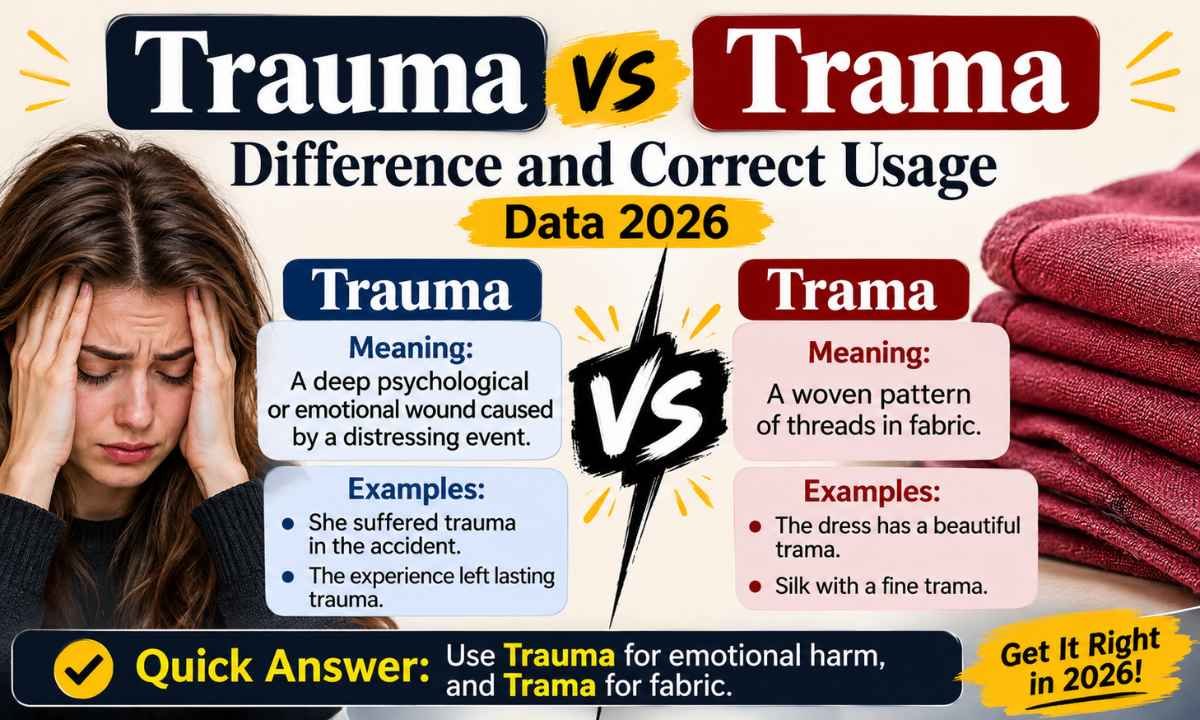
If you have typed “trama” and wondered whether it is a real English word, you are not alone. The two spellings look close, they sound close, and one of them is a perfectly good word in other languages. Only one is correct in English, though, and that word is trauma.
This guide settles the spelling question first, then goes deeper into what trauma actually means: its medical and psychological definitions, its types, symptoms, causes, and the ways people recover. You will also find practice exercises and a short checklist so the correct spelling sticks.
Trauma vs Trama The Clear and Correct Answer
Trauma is the correct English spelling. “Trama” is a misspelling.
| Trauma | Trama | |
|---|---|---|
| Valid in English? | Yes | No |
| Meaning | A deep emotional shock or a physical injury | None in standard English |
| Part of speech | Noun | None |
| Example | “She still carries the trauma of the accident.” | Not usable |
The word comes from the Greek trauma, meaning “wound.” It has an “au” in the middle, and that pair of letters is the whole difference. Drop the “u” and you no longer have the English word.
One caution: “trama” is a real word in Spanish, Italian, and Portuguese, where it means a plot, a storyline, or the weft threads of a woven fabric. If you are writing in one of those languages, it is correct. In English, it is not.
What Is Trauma? (Simple and Clear Explanation)
Trauma is the lasting effect of an experience that overwhelmed a person’s ability to cope. The event itself might be brief or long, but the mark it leaves is what people usually mean by the word.
There are two main senses:
- Physical trauma: an injury to the body, such as a broken bone, a head injury, or a burn.
- Psychological trauma: an emotional and mental response to a deeply distressing event.
In daily conversation, most people mean the second sense. When someone says a car crash left them with trauma, they rarely mean the cracked ribs. They mean the fear, the flashbacks, and the way the road now feels different.
Trauma Meaning in Everyday Language
People use the word loosely. A friend might say a bad breakup was “traumatic,” and another might use it about a stressful exam. Some of that usage is accurate and some of it stretches the term too far.
In everyday speech, trauma points to an experience that shook a person’s sense of safety and left a lasting emotional response behind. The key idea is that the experience was not just unpleasant. It was overwhelming.
Trauma Explanation in Simple Words
Think of the mind as having a coping capacity, like a bucket that holds a certain amount of water. Normal stress adds a few cups. A traumatic event pours in a flood, and the bucket overflows. The overflow shows up later as nightmares, jumpiness, numbness, or avoiding anything that reminds you of what happened.
Two people can live through the same event and respond differently. One may recover within weeks. The other may struggle for years. Neither reaction is a character flaw. Past experiences, support at the time, and even sleep and health all shape the outcome.
Trauma Definition in Different Contexts
The word shifts slightly depending on who is using it. Doctors, psychologists, and ordinary speakers each stress a different part of it.
Medical Definition of Trauma
In medicine, trauma means physical injury caused by an external force. Emergency departments use the term this way every day. A trauma center treats severe injuries from road collisions, falls, assaults, and similar events. Medical staff sort these into blunt trauma, where force hits the body without breaking the skin, and penetrating trauma, where an object pierces the body.
This is the original sense of the word, tied to its Greek root for “wound.”
What Is Trauma in Psychology?
In psychology, trauma is an emotional response to an event that involved actual or threatened death, serious injury, or violation, or that otherwise overwhelmed a person’s capacity to cope. Clinicians look at both the event and the reaction. An event alone does not equal trauma; what matters is how it registered in the person’s mind and body.
Psychologists also separate trauma from the diagnosis of post-traumatic stress disorder (PTSD), which is a specific condition with defined criteria. More on that distinction below.
Emotional Trauma Meaning
Emotional trauma is the psychological wound left after a distressing experience, with or without any physical injury. It can follow a single shocking event, such as a sudden loss, or a long pattern of harm, such as years of neglect or emotional abuse.
The Cambridge Dictionary, in paraphrase, describes trauma as a severe emotional shock and the mental condition that can follow it, and also recognizes the medical sense of a bodily injury. It is worth reading the full entry on the Cambridge Dictionary site to see how the word is used in example sentences.
Trauma and Mental Health Why It Matters
Unresolved trauma does not stay in the past. It tends to leak into sleep, relationships, work, and physical health. That is why mental health professionals take it seriously and why understanding the word properly is more than a spelling exercise.
Mental Health Connection and Trauma
Trauma is linked with several conditions. These include PTSD, anxiety disorders, depression, and substance use problems. Not everyone who experiences trauma develops one of them, and many people recover well, especially with support. Still, a history of trauma raises the odds of mental health difficulties, which is why clinicians often ask about it during assessment.
Trauma also affects trust. People who were hurt by someone they depended on may find it hard to rely on anyone, even decades later.
Trauma Impact on the Brain
Research points to three brain areas that play a central part in how trauma is processed:
- Amygdala: the alarm system. After trauma it can become overactive, so ordinary sounds or situations set off a fear response.
- Hippocampus: involved in forming and placing memories in time. Trauma can disrupt this, which is one reason traumatic memories feel vivid and present rather than like something that happened long ago.
- Prefrontal cortex: supports planning and calming emotional reactions. Stress can weaken its control over the amygdala.
This is a simplified picture. Neuroscience is still refining how these regions interact, and the changes are not necessarily permanent. The brain can adapt, and treatment is associated with measurable shifts in how these areas respond.
Insightful Perspective
A useful way to think about trauma: it is less about what happened and more about what the nervous system did in response. The body prepares for survival, and sometimes it keeps that preparation switched on long after the danger has passed. Seen that way, many trauma symptoms are not signs of weakness. They are protective reactions that have outlasted their purpose.
This view also explains why logic alone rarely fixes the problem. Telling yourself “I am safe now” is true, but the body may not believe it yet. Healing often means helping the body learn that the danger is over.
Types of Trauma (Clear and Practical Breakdown)
Professionals commonly group trauma by how long it lasted and how often it happened.
Acute Trauma
Acute trauma follows a single distressing event. A serious accident, a violent assault, a natural disaster, or an unexpected death can all qualify. The reaction often begins right away or within days and may include shock, fear, and difficulty sleeping. For many people it eases over time, though some go on to develop longer-term problems.
Chronic Trauma
Chronic trauma comes from repeated or prolonged exposure to distressing events. Ongoing domestic violence, long-term bullying, living in a war zone, or enduring a serious illness over many years are common examples. Because the stress never fully lets up, the nervous system has little chance to settle.
Complex Trauma
Complex trauma results from multiple traumatic events, usually within relationships and often starting in childhood. Repeated abuse or neglect by a caregiver is the classic example. It tends to affect a person’s sense of self, their ability to regulate emotions, and how they form close bonds.
Types of Trauma Table
| Type | Cause | Duration |
|---|---|---|
| Acute | One event | Short-term event |
| Chronic | Repeated events | Ongoing or long |
| Complex | Multiple events, often with caregivers | Often from childhood |
Trauma Symptoms Recognizing the Signs
Symptoms vary a great deal. Some people feel everything at once, while others feel almost nothing, which is its own kind of symptom. Signs may appear immediately or surface months or years later.
Emotional Symptoms
- Persistent fear or anxiety
- Sudden anger or irritability
- Guilt or shame, often without clear reason
- Emotional numbness
- Sadness that does not lift
- Feeling detached from yourself or from others
Physical Symptoms
The body keeps its own record. Common signs include racing heart, headaches, stomach trouble, muscle tension, fatigue, and being easily startled. Sleep problems are especially common, including insomnia and nightmares.
Behavioral Signs
Behavior often changes before a person can put feelings into words. Watch for avoiding places, people, or topics linked to the event. Others withdraw from friends, lose interest in things they used to enjoy, or turn to alcohol or other substances to dull the discomfort. Some people overwork to stay distracted.
Common Symptoms List
| Category | Examples |
|---|---|
| Emotional | Fear, guilt, numbness, irritability |
| Physical | Fatigue, tension, racing heart, poor sleep |
| Behavioral | Avoidance, withdrawal, substance use |
| Mental | Flashbacks, intrusive memories, poor focus |
If several of these have lasted beyond a few weeks and are interfering with daily life, speaking with a qualified professional is a sensible next step.
What Causes Trauma?
Trauma comes from experiences that threaten safety, dignity, or a person’s sense of control. The cause is not always dramatic from the outside. What matters is how overwhelming it felt to the person living it.
Several factors shape whether an event becomes traumatic for someone: its severity, whether it was expected, how long it lasted, whether the person felt helpless, and what support was available afterward.
Common Causes Include
- Serious accidents, including car crashes
- Physical, sexual, or emotional abuse
- Neglect in childhood
- Natural disasters such as floods and earthquakes
- Sudden or violent loss of a loved one
- War, conflict, and displacement
- Medical emergencies and difficult hospital experiences
- Witnessing violence or severe harm to another person
- Bullying and sustained harassment
- Childbirth complications, in some cases
Examples of Trauma in Real Life
Concrete examples help separate trauma from ordinary hardship.
A driver after a collision. Months after a crash, a driver still tenses at the sound of screeching tires. She avoids the highway where it happened, even though it adds forty minutes to her commute.
A child in an unstable home. A boy who grew up with unpredictable anger in the house becomes an adult who reads every raised voice as a threat. He does not connect it to his childhood until a therapist points to the pattern.
A survivor of a flood. After losing her home, a woman finds that heavy rain brings back panic. She sleeps badly every storm season.
A medical patient. A man who spent weeks in intensive care develops nightmares about helplessness. He is surprised, because he thought surviving meant the hard part was finished.
None of these people are “overreacting.” Their responses are understandable given what they lived through.
Trauma vs Stress: Key Differences
Stress and trauma overlap, but they are not the same.
| Factor | Stress | Trauma |
|---|---|---|
| Trigger | Everyday pressure | Overwhelming event |
| Sense of safety | Usually intact | Often shaken |
| Duration | Fades when pressure ends | Can linger for years |
| Examples | Deadlines, busy schedules | Assault, disaster, abuse |
| Recovery | Rest and routine often help | Often needs support or therapy |
Stress is the body’s response to a demand. Trauma is the aftermath of an event that exceeded what a person could absorb. A tough week at work is stress. Surviving a violent attack is trauma. Chronic stress can wear a person down, but it is a different problem from trauma and is handled differently.
Trauma vs PTSD: Not the Same Thing
This is one of the most common mix-ups. Trauma is the experience and the reaction. PTSD is a specific diagnosis.
A person can be traumatized without having PTSD. Many people go through a frightening event, feel shaken for a while, and then recover. PTSD is diagnosed when certain symptoms persist: intrusive memories, avoidance, negative changes in mood and thinking, and heightened reactivity. Under the criteria in the DSM-5, these symptoms generally need to last more than a month and cause real distress or disruption.
| Trauma | PTSD | |
|---|---|---|
| What it is | An experience and response | A diagnosed disorder |
| Who gets it | Many people | A smaller share of those exposed |
| Needs formal criteria? | No | Yes |
| Can resolve on its own? | Often | Less likely without treatment |
Only a qualified clinician can diagnose PTSD. If you suspect it, a professional assessment is the right path.
Does Trauma Go Away?
Short Answer
Sometimes, yes. Often it fades with time and support. For some people, it stays until it is treated.
Detailed View
Many people recover naturally after a single frightening event, especially when they have caring people around and can return to normal routines. Distress that is strong in the first weeks often softens.
Other cases do not resolve alone. When trauma is repeated, begins in childhood, or happens without support, the effects can last for years and may even deepen. Avoidance can keep the wound open, because the person never gets the chance to learn that the memory is survivable.
A realistic goal is not erasing the memory. It is changing your relationship to it, so it stops controlling your daily life. Many people reach that point and describe it as the memory feeling like something that happened to them, rather than something still happening.
Can Trauma Be Healed?
Yes. Healing is well documented, and there are treatments with a strong evidence base. It rarely follows a straight line. Good weeks and hard weeks are normal, and a setback does not mean the work has failed.
Effective Approaches
- Trauma-focused cognitive behavioral therapy (CBT): helps a person work through the memory and challenge unhelpful beliefs about it.
- EMDR (eye movement desensitization and reprocessing): guided processing of traumatic memories using bilateral stimulation.
- Prolonged exposure therapy: gradual, supported contact with avoided memories and situations.
- Cognitive processing therapy: focuses on how the trauma changed a person’s thoughts about safety, trust, and blame.
- Medication: certain antidepressants may help with symptoms such as anxiety and low mood, usually alongside therapy.
- Body-based practices: yoga, breathing work, and similar methods can help some people feel safer in their bodies.
The right approach depends on the person, the type of trauma, and what is available. A therapist trained in trauma care can help match treatment to the situation.
How to Deal With Trauma (Practical Tips)
Professional help is the most reliable path for serious trauma. These steps can support it or help in the meantime.
- Prioritize safety. If you are still in a harmful situation, safety comes before everything else.
- Talk to someone you trust. You do not have to share every detail. Even saying “something hard happened” can ease the weight.
- Keep a simple routine. Regular meals, sleep, and movement give your nervous system steady ground.
- Move your body. A walk or light exercise can reduce tension and lift mood.
- Limit alcohol and other numbing habits. They may dull feelings briefly but often make symptoms worse.
- Learn your triggers. Knowing what sets off a reaction makes it less frightening and easier to manage.
- Try grounding techniques. Name five things you can see, or press your feet into the floor and notice the contact.
- Seek a qualified therapist. Look for someone with specific training in trauma.
- Be patient with yourself. Recovery takes the time it takes.
If you ever feel unsafe or think about harming yourself, contact local emergency services or a crisis line in your country right away.
Trama Meaning: Why It Creates Confusion
So why does “trama” keep appearing? The answer sits in language, not in any hidden meaning.
What Is Trama?
In English, “trama” has no standard meaning. It is simply “trauma” with a missing letter.
In Spanish, “trama” means the plot of a story or the weft of a fabric. In Italian it carries similar senses of plot and weave, and Portuguese uses it the same way. Or In some technical or niche contexts it may appear as a name or brand, but none of that changes English spelling.
Is Trama a Word?
It is a word in other languages, but not in standard English. Spell-checkers will flag it, and style guides and dictionaries of English do not list it as a variant of trauma.
Why Do People Write “Trama”?
Misspellings rarely come from carelessness alone. They usually have a pattern behind them.
Common Reasons
- Sound shortcuts. In fast speech, the “au” in trauma is easy to slur, so the word can sound like “trah-ma.”
- Typing speed. Letters sitting next to each other get dropped, especially on a phone.
- Influence from other languages. Speakers of Spanish, Italian, or Portuguese may carry over a familiar word.
- Vowel pairs are easy to miss. Words with adjacent vowels, like “au,” are a classic place for spelling slips.
- Autocorrect gaps. Some devices do not catch it, particularly when set to another language.
Trauma vs Trama Difference (Quick Comparison)
| Feature | Trauma | Trama |
|---|---|---|
| English word | Yes | No |
| Spelling | T-R-A-U-M-A | T-R-A-M-A |
| Meaning | Wound or deep distress | Plot or weft (other languages) |
| Use in English writing | Correct | Incorrect |
| Spell-check result | Accepted | Flagged |
In short, if you mean emotional shock or injury, write trauma.
How to Spell Trauma Correctly
Simple Rule
Trauma has six letters and the “au” sits in the middle: T-R-A-U-M-A. Break it into two parts, “trau” and “ma.” If you can see the “u,” you have it right.
Memory Trick
Think of the phrase: “Trauma needs a U, because it hurts YOU.” The “u” is the part people forget, and the phrase puts it back in your mind.
Another angle: the word “trauma” and the word “auto” both contain “au.” Picture a car accident (auto) and the shock that follows (trauma). It is a small link, but links like this help spelling hold.
How to Use Trauma in a Sentence
“Trauma” is usually a noun. It can be countable (a trauma, many traumas) or uncountable (trauma in general). Its adjective is traumatic, and the verb is traumatize.
Examples
- Years after the fire, she still struggled with the trauma of that night.
- The hospital’s trauma unit treated twelve patients after the collision.
- Childhood trauma can shape how adults handle conflict.
- He found the experience traumatic, even though he looked calm.
- The news story traumatized several witnesses.
- Therapy gave her tools to work through old trauma.
- Collective trauma can affect whole communities after a disaster.
- Trauma is not a sign of weakness.
Case Study: Small Error, Big Impact
A small spelling slip can cost credibility, especially in professional or sensitive writing.
Consider a mental health clinic that publishes a service page offering support for survivors of abuse. One line reads as follows.
Incorrect
Our counselors specialize in helping clients heal from trama and rebuild their lives.
A reader scanning this page may question whether the clinic is careful enough to be trusted with something as serious as their recovery. Search engines can also struggle to connect the page with people searching the correct word, which weakens visibility. The mistake is tiny, but on a page about care and expertise it undercuts the message.
Correct
Our counselors specialize in helping clients heal from trauma and rebuild their lives.
One letter, and the sentence now reads as professional and trustworthy. For anyone writing about health, law, or education, this kind of accuracy is part of earning the reader’s confidence.
Common Mistakes to Avoid
Using “trama” instead of “trauma”
This is the main slip. Always check the middle of the word for the “u.” Proofread any content that deals with mental health, since the error stands out most there.
Overusing “trauma” casually
People sometimes say “I was traumatized by that movie” or “my commute is a trauma.” Casual speech allows this, but in careful writing it can dilute the word. Reserve it for experiences that truly overwhelmed someone. Using it too loosely can make real trauma sound smaller than it is.
Confusing trauma with drama
The words look alike and end in similar sounds, but they mean different things. Drama refers to theatrical performance or heightened emotional conflict. Trauma refers to a wound. A “family drama” is a story or conflict. A “family trauma” is lasting harm. Swapping them changes the meaning entirely.
How to Avoid Spelling Mistakes Like Trama
Practical Strategies
- Read your text aloud. Slowing down makes missing letters easier to hear and see.
- Use spell-check, then proofread anyway. Tools catch “trama” but may miss other errors, such as “drama” used where “trauma” belongs.
- Check your language settings. A keyboard set to Spanish may quietly accept “trama.”
- Keep a personal list. Write down the words you tend to misspell and review it now and then.
- Copy from trusted sources. When you are unsure, look up the word in a reputable dictionary.
- Read your work backward. Going word by word from the end breaks your habit of reading what you meant instead of what you typed.
Quick Checklist
- Does “trauma” have the “u” after the “a”?
- Am I using the right word, trauma and not drama?
- Is my writing in English, not another language?
- Did I use “traumatic” for the adjective?
- Is the word used seriously and accurately?
Practice Section (Apply What You’ve Learned)
Fill in the Blank
Choose trauma or trama for each blank.
- The survivor spoke openly about her childhood ______.
- The doctor works in a ______ center.
- In Spanish, the ______ of the novel was gripping.
- Emotional ______ can show up years later.
Answers: 1. trauma, 2. trauma, 3. trama (Spanish context), 4. trauma.
Correct the Sentence
Fix the error in each sentence.
- He is still dealing with the trama of the accident.
- Therapy helped her heal from past trama.
- The clinic treats patients with trama.
Answers: Replace “trama” with “trauma” in each.
Choose the Correct Word
Pick the right option in each pair.
- A (trauma / trama) can follow a serious accident.
- The movie had too much (drama / trauma) for my taste.
- The experience was (traumatic / tramatic).
Answers: 1. trauma, 2. drama, 3. traumatic.
Rewrite for Clarity
Rewrite this sentence so it is clearer and correctly spelled:
“I had a big trama and it was really bad and I feel sad and scared and it keeps happening in my head.”
Sample answer: “After the accident, I experienced trauma. I still feel sad and afraid, and the memory keeps returning.”
Mini Challenge
Write three sentences of your own, one using the noun “trauma,” one using the adjective “traumatic,” and one using the verb “traumatize.” Check the spelling of each one against the rule above.
Quick Reminder
Trauma has a “u.” If you can see the “au,” you are right.
Reference Cambridge Dictionary Definitions
For an authoritative check, look up “trauma” on the Cambridge Dictionary website. In paraphrase, it lists the word as a noun describing severe emotional shock and distress following a disturbing event, and also covers the sense of a physical injury. It also gives related forms such as “traumatic” and “traumatize,” along with example sentences. Reading the entry directly is a quick way to confirm the correct form and see natural usage.
Frequently Asked Questions
What is trauma?
Trauma is a lasting emotional or physical response to an overwhelming or distressing event. In everyday use it usually refers to psychological harm.
What is trama?
“Trama” is a misspelling of trauma in English. In Spanish, Italian, and Portuguese it is a real word meaning plot or weft.
Can I use “trama” instead of “trauma”?
No. In English writing, “trama” is incorrect and should always be replaced with “trauma.”
What are the types of trauma?
The three main types are acute (a single event), chronic (repeated or prolonged events), and complex (multiple events, often within relationships).
Does trauma go away?
Often it fades with time and support, but some trauma persists without treatment. Therapy can help people heal and reduce its hold on daily life.
Conclusion
“Trama” is not an English word, and the correct spelling is always trauma. The one-letter gap matters, especially when the subject is as serious as emotional injury or mental health.
Beyond spelling, it helps to remember what the word carries. Trauma is a response to an overwhelming experience, not a weakness, and recovery is possible with time, support, and the right treatment. If you or someone you know is struggling, reaching out to a qualified professional is a strong first step.