
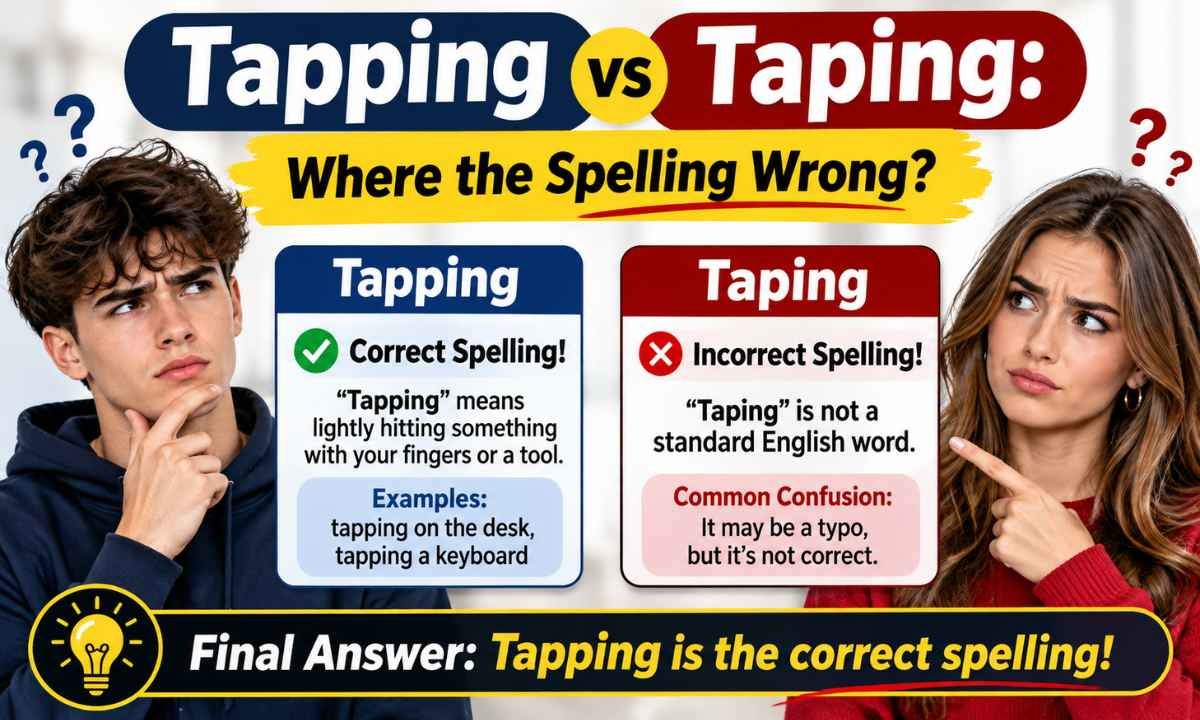
Tapping means lightly hitting something or drawing on a resource, while taping means fastening something with tape or recording on tape. They come from two different verbs, tap and tape, and the vowel sound tells you which is which.
Writers confuse the two because they look almost identical and sound close. Spell checkers rarely flag the mistake either, since both are real words. Only the meaning of your sentence tells you which one fits.
This guide gives you plain definitions, grammar rules, pronunciation help, and examples from everyday life, medicine, sports, and media. It ends with a short quiz so you can test yourself before you leave.
Tapping vs Taping The Core Difference Explained
The difference between tapping and taping
Tapping is the -ing form of the verb tap. It covers light strikes, touchscreen touches, drawing from a source, and cutting threads inside a hole. Taping is the -ing form of tape, and it covers sticking, wrapping, or recording.
The quickest test is to ask what the action involves. If a finger, a tool, or a pipe is making light contact or drawing something out, you want tapping. If a roll of tape or a recorder is involved, you want taping.
The two words also differ in their vowel. Tapping has a short “a” like the word “cap.” Taping has a long “a” like the word “cake.” That single sound explains why the spelling changes.
Both words work as verbs and as nouns. You can say “the tapping of rain” or “the taping of the show.” In each case, the root verb still decides the meaning.
Quick Comparison Table
| Feature | Tapping | Taping |
|---|---|---|
| Base verb | tap | tape |
| Core meaning | Light hit or touch; drawing on a source | Sticking with tape; recording |
| Vowel sound | Short “a” | Long “a” |
| Past tense | tapped | taped |
| Typical objects | Screen, table, keg, phone line | Box, ankle, interview, show |
| Common fields | Technology, music, machining | Sports, medicine, media |
| Example | She kept tapping the desk. | He was taping his wrist. |
What Is Tapping? (Meaning, Contexts, and Real Uses)
Tapping meaning in English
Tapping is the present participle of the verb tap. Major dictionaries define tap first as striking something lightly, often with a small sound. A pencil on a desk and a foot on a floor are classic cases.
The verb has other senses too. It can mean piercing something to let a fluid out, such as tapping a maple tree. It can also mean drawing from a supply, as in tapping a market or a source of funding.
A further sense comes from electronics and surveillance. To tap a phone line means to connect to it and listen in. This is where the word “wiretap” comes from.
Tapping can also name a tool operation. A tap is a tool that cuts internal screw threads, so tapping a hole means threading it. That meaning matters in workshops and engineering.
Common Uses of Tapping
The word shows up across many fields. Each use traces back to the same idea of light contact or controlled access. The groups below cover the situations readers meet most often.
Everyday Actions
Most people use tapping for small physical gestures. You tap a friend on the shoulder to get attention. You tap your fingers when you are bored or nervous. The action is quick, light, and usually repeated.
Here are common everyday phrases that use the word:
- Tapping a foot to the beat of a song
- Tapping on a window to get someone’s attention
- Tapping a pen against a notebook while thinking
- Tapping someone gently on the arm
Tapping also describes sound. The tapping of rain on a roof is a familiar example. In that sense the word names the noise itself, not only the motion that makes it.
Technology: Tapping in Touchscreen Devices
On phones and tablets, tapping is the main way you interact with the screen. A tap is a brief touch with one finger. It differs from a swipe, which slides, and from a long press, which holds.
Apps rely on this vocabulary. You tap an icon to open an app, tap a button to confirm a choice, and double tap to zoom in. Payment systems use the same word, as in “tap to pay.”
The word has become so common in tech that many people now learn it as a screen gesture first. That makes the spelling easy to remember: a tap is a quick touch, so the action is tapping.
Resource Access
Tapping also means getting access to something stored or available. The phrase “tap into” is the most common form. A company can tap into a new market, and a writer can tap into childhood memories.
The idea comes from the old practice of tapping a cask or keg. You open a way for the contents to flow out. A bar serves beer “on tap” for the same reason.
Phone tapping belongs here as well. The tapper connects to a line to draw out the conversation. Law enforcement uses the term wiretapping, and it carries legal rules that vary by country.
Industrial and Mechanical Use
In machining, tapping is the process of cutting threads inside a drilled hole so a screw or bolt can fit. The machinist drills a hole first, usually a little smaller than the thread’s major diameter, then runs a tap through it.
A hole made this way is called a tapped hole. Hand taps are common in small jobs, while CNC machines handle high-volume work. Tapping differs from threading, which usually cuts external threads on a bolt or pipe.
Electrical work uses the term too. A tap on a transformer or circuit is an intermediate connection point where power can be drawn off. The word keeps its basic sense of drawing from a source.
Therapeutic Use
Some wellness practices use the word as well. Emotional Freedom Techniques, often called EFT tapping, involves tapping fingertips on certain points of the body while focusing on a stressful thought.
Supporters say the method helps with stress and anxiety. Research is still limited and results are mixed, so it should not replace professional care. Anyone dealing with serious distress should speak with a licensed therapist or doctor.
Percussion massage and tapotement, a light tapping stroke used in massage, also fall under this heading. Here again, the action is repeated light contact with the hands.
Tapping Definition and Examples
Tapping (noun or verb form): the act of striking, touching, or drawing from something lightly or in a controlled way. The past tense of the verb is tapped.
These sentences show the range:
- The tapping on the window woke her at dawn.
- He kept tapping his phone, waiting for the app to load.
- The brewery is tapping a new keg for the party.
- She is tapping into her savings to cover the repairs.
- The machinist spent the morning tapping holes in the steel plate.
What Is Taping? (Meaning, Uses, and Practical Applications)
Taping meaning in English
Taping is the present participle and gerund of the verb tape. The verb has two main senses. The first is to fasten, cover, or support something with tape. The second is to record sound or video.
Merriam-Webster lists both senses, along with a third meaning of measuring with a tape measure. The adhesive sense is the one most readers meet daily, such as taping a box shut.
Taping can also work as a noun. A taping of a television show is the event where it is recorded. Wiktionary gives that sense and the sense of sticking tape to something.
The word is tied to the object. If a strip of tape, real or figurative, sits at the center of the action, you are talking about taping.
Taping Definition and Uses
Taping: the act of attaching, wrapping, or supporting something with tape, or of recording on tape or another medium. The past tense of the verb is taped.
The practical uses divide into physical work, health care, and media. The next sections cover each.
In daily life, taping means joining or securing things. You tape a poster to a wall, tape a box before shipping it, or tape a note to the fridge. Painters tape edges so paint stays where it belongs.
Different jobs call for different tapes. Masking tape peels away cleanly. Duct tape is strong and waterproof. Electrical tape insulates wires. Each task has a matching product, and the verb stays the same.
Taping is also common in repairs. A cracked handle, a loose cable, or a torn page can all be held together for a short time with a strip of tape.
Medical and Sports Use
Health care uses tape for several jobs. Medical tape holds dressings in place on the skin. Surgical tape secures bandages and tubes. A nurse might tape an IV line so it stays in position.
Sports medicine uses tape to support joints and muscles. Athletic trainers tape ankles, wrists, and fingers before competition. A common first-aid habit is taping an injured finger to the one beside it.
Oxford’s learner dictionary even includes a medical example: to tape up an ankle means to bind it firmly with a bandage or tape.
Some people react to the adhesive. Anyone with sensitive skin or a known adhesive allergy should check with a clinician before using tape on the skin.
Taping Bandage Technique (Sports Insight)
Athletic trainers describe two broad families of tape. Rigid athletic tape, often made of cotton with a zinc oxide adhesive, does not stretch. It limits joint movement and protects ligaments.
Kinesiology tape is elastic. It was developed in the 1970s by Dr. Kenzo Kase, a chiropractor, and it allows normal movement while giving light support. It can stay on for several days.
A typical ankle taping with rigid tape follows a set order. Trainers often apply a thin underwrap first, then anchor strips, then stirrup and figure-eight strips that limit sideways movement.
Technique matters. Tape applied too tightly can restrict circulation, and tape applied too loosely may not limit the joint at all. For a significant injury, a trained athletic therapist or physiotherapist should apply it.
Media and Recording
Taping has a second life in media. For decades, to tape something meant to record it on magnetic tape. People taped songs off the radio and taped TV shows to watch later.
The meaning survived the technology. Today a talk show is still taped before a live audience, even when the recording is digital. The word now means recording in a general sense.
A related idea shows up in the phrase “on tape,” which means recorded. Sports analysts say a player looks better “on tape” when they review game footage.
Taping Examples Sentences
Here are clear examples of the word in use:
- The trainer is taping her ankle before the match.
- They are taping the interview for tomorrow’s podcast.
- He spent the weekend taping boxes for the move.
- The studio is taping two episodes this week.
- Taping the wire stopped the exposed ends from touching.
Tapping vs Taping Grammar Why People Get Confused
The confusion is understandable. Both words end in -ing, both start with “tap” or “tape,” and both describe quick hand actions. Add similar sounds, and the mix-up becomes easy.
Tapping vs Taping Pronunciation
Tapping is pronounced /ˈtæpɪŋ/, with a short “a” as in “cap.” It rhymes with “napping” and “wrapping.” The “p” sound is strongly held in the middle.
Taping is pronounced /ˈteɪpɪŋ/, with a long “a” as in “cake.” It rhymes with “shaping” and “draping.” The vowel is stretched, and the “p” is lighter.
Spelling Confusion Tapping Taping
Spelling follows two standard rules. A short verb that ends in one vowel and one consonant doubles the final consonant before -ing. That is why tap becomes tapping, with a double p.
A verb that ends in a silent e drops the e before -ing. That is why tape becomes taping, with one p. The long vowel sound is shown by the silent e in the base form.
Other pairs follow the same pattern. Hop becomes hopping, while hope becomes hoping. Scrap becomes scrapping, while scrape becomes scraping. So a double p signals a short vowel, and a single p signals a long vowel. That small rule fixes most errors.
Tap vs Tape Verb Difference
The base verbs also differ in their past forms. Tap becomes tapped, and tape becomes taped. The same doubling and dropping rules apply.
| Form | tap | tape |
|---|---|---|
| Base | tap | tape |
| Third person | taps | tapes |
| Past | tapped | taped |
| -ing form | tapping | taping |
How to Use Each Correctly
When to Use Tapping
Use tapping when the action is a light strike, touch, or draw. This includes tapping a table, tapping a screen, tapping a keg, and tapping into a resource.
Use it also for mechanical threading, for phone tapping, and for therapeutic tapping. If the action involves a tool cutting threads, the word is tapping.
Use it when sound is the focus. The tapping of a branch on glass, or the tapping of a keyboard, describes a noise. A quick check: if you can replace the word with “lightly hitting” or “drawing on,” tapping is correct.
When to Use Taping
Use taping when adhesive tape or a recording is central. Taping a poster to a wall, taping a sprained ankle, and taping a podcast all qualify.
Use it for recording sessions and show production days. A “taping” is also a noun, as in “We attended the taping of a game show.” Use it for sports and medical support wherever tape is applied. Taping a finger or a wrist is a plain example.
Tapping vs Taping Examples (Clear and Practical)
1. Side-by-Side Examples
| Tapping | Taping |
|---|---|
| Tapping the box lightly | Taping the box shut |
| Tapping the table | Taping the table edge |
| Tapping the screen | Taping the screen protector |
| Tapping a phone line | Taping a phone call |
| Tapping his wrist | Taping his wrist |
The last row shows a case where context decides everything. Tapping his wrist is a light touch. Taping his wrist is a support wrap. The sentence around it makes the meaning clear.
2. Tapping vs Taping Examples Sentences
- At the studio, the host kept tapping the microphone to test it. Later, the crew began taping the first segment.
- The trainer was tapping her knee with a reflex hammer. Then she started taping the joint for support.
- He is tapping into his savings. She is taping the last box before the move.
- The child was tapping on the glass. His dad was taping a drawing to it.
Tapping vs Taping in Medical
1. Tapping in Medical Context
In medicine, tapping often means striking lightly to check a response or draining fluid. A doctor might tap a knee with a reflex hammer to test the nerve reflex.
Clinicians also use percussion, which is tapping on the chest or abdomen and listening to the sound. The pitch gives clues about what lies beneath.
A spinal tap is a procedure that collects cerebrospinal fluid from the lower back. Merriam-Webster gives this exact example of piercing to draw off fluid.
Doctors also speak of tapping a fluid buildup, which means draining it with a needle. In all of these uses, a tool or a hand makes controlled contact.
2. Taping in Medical Context
Taping in medicine refers to using tape on the body or on equipment. Nurses tape dressings, lines, and tubes so they stay in place. Surgical tape closes or supports small areas of skin.
Physiotherapists tape joints and muscles to support them. Kinesiology tape is the best-known type. It aims to ease pain and support tissue without limiting movement.
The evidence is mixed. A 2012 meta-analysis in Sports Medicine found little quality evidence that kinesio tape works better than other elastic tapings for treating or preventing sports injuries.
Skin care matters as well. Tape can irritate sensitive skin, and people with adhesive allergies should ask a clinician before using it.
Medical Comparison Table
| Aspect | Tapping | Taping |
|---|---|---|
| Purpose | Test or drain | Support or secure |
| Tool | Hand, hammer, needle | Medical or kinesiology tape |
| Example | Spinal tap | Taping a dressing |
| Contact | Brief, controlled | Lasting, adhesive |
| Risk | Procedure-specific | Skin irritation |
If a note says a patient had a “tap,” it means a fluid draw or a strike. If it says “taping,” it means tape was applied. Never swap them in a record.
Tapping vs Taping in Sports
Taping for Injury Support
Taping is the more common sports term. Athletes tape ankles, wrists, fingers, and knees to prevent injury or support a healing joint. Volleyball, basketball, and soccer players are frequent examples.
Rigid tape limits motion and gives firm support. Trainers often choose it for acute injuries or high-risk moments in a game. Kinesiology tape allows movement and suits longer rehab.
Some trainers combine them. A runner might use rigid tape on a toe to prevent blisters and elastic tape on a thigh to ease strain. The choice depends on the goal.
Poor technique can cause harm. Tape that is too tight may restrict circulation, so a trained professional should apply it for anything more than a minor problem.
Tapping in Sports
Tapping appears in sports in different ways. In basketball, a tap is a light touch of the ball, such as a tip-off tap. In golf and soccer, a tap-in is an easy finishing touch.
And in martial arts, a fighter taps out by tapping the opponent or the mat to signal surrender. The tap is a clear, quick signal that the match is over.
Dancers tap their feet in tap dance, and drummers tap rhythms with sticks. The word suits any light, rhythmic strike. Athletes may also practice tapping drills, such as quick foot taps for agility. Those drills have nothing to do with tape.
Key Difference in Sports
| Aspect | Tapping | Taping |
|---|---|---|
| Action | Light strike or signal | Applying tape |
| Goal | Play, signal, rhythm | Support, protect |
| Example | Tapping out | Taping an ankle |
| Tool | Hand, foot, stick | Athletic tape |
In short, tapping is part of the play, and taping is part of the care. A trainer taping an ankle prepares you for the game, while a player tapping out ends a match.
Case Studies (Why This Matters)
These two short scenarios are illustrative examples, not reports of real events. They show how one wrong letter can change what a reader understands.
Sports Injury Scenario
A high school trainer writes in an injury log: “Ankle tapping, both feet, before practice.” A new assistant reads the note and wonders whether it means a reflex test or a support wrap.
The assistant asks the trainer, which costs ten minutes before the session. The correct entry was “ankle taping,” meaning rigid tape for stability.
The fix is simple. Clear records use taping for tape and tapping for strikes. A single letter keeps the log accurate and saves time. The lesson applies beyond sports. Any workplace that logs treatments, from a clinic to a gym, benefits from consistent wording.
Media Production Confusion
A producer sends a call sheet that reads “Tapping of episode four, Studio B, 2 p.m.” A freelance editor reads the word and assumes the team will be tapping into archive footage.
The editor arrives with the wrong files. The real plan was a recording session, so the call sheet should have said “taping.”
Easy Way to Remember Tapping vs Taping
A memory trick helps when you write in a hurry. The best one links the letter count to the vowel sound.
Think of the double p as two quick strikes. Tapping has two p’s, like two light taps on a desk. Taping has one p, like one long strip of tape.
You can also remember the vowel. A short “a” gives a quick tap, and a long “a” gives a stretched piece of tape, so the long sound goes with the long strip.
Another trick is the silent e. Tape carries an e that “holds” the long vowel, and when you add -ing, that e leaves. Tap has no e, so the p doubles to protect the short vowel.
Common Mistakes (And How to Avoid Them)
Mistake 1: Wrong letter count. Writers often type “taping” when they mean tapping, or the reverse. Fix it by counting the p’s: double p for a short vowel, single p for a long vowel.
2 Mistake: Ignoring Context
Some writers use tapping where the sentence needs taping, and they trust that the reader will guess. A sentence like “He was tapping his ankle” has two possible readings.
Check the object and the tool. If tape is involved, use taping. If a finger or tool makes contact, use tapping. When both are possible, rewrite the sentence to remove doubt.
3 Mistake: Pronunciation Confusion
Speakers sometimes use the short “a” in taping or the long “a” in tapping. This shifts the word into another one, which can confuse listeners in meetings or on calls.
Practice with minimal pairs: tap and tape, tapped and taped, tapping and taping. Say each pair slowly and notice the change in vowel length. If you teach English, record your students saying these words. Listening back often shows the problem faster than correction alone.
Quick Decision Checklist
- Is a roll of tape or a bandage involved? Use taping.
- Is something being recorded on tape or another medium? Use taping.
- Is a finger, tool, or object making a light strike? Use tapping.
- Is someone drawing on a resource or source? Use tapping.
- Is a hole being threaded with a tool? Use tapping.
Practice Section (Make It Stick)
Fill in the Blank: Choose the Correct Word
Choose tapping or taping for each sentence.
- The trainer is ______ her wrist before the game.
- He kept ______ his fingers on the desk.
- The studio is ______ the interview tomorrow.
- The company is ______ into a new market.
- She spent the morning ______ boxes shut.
- The machinist is ______ holes in the steel plate.
- The rain was ______ against the window.
- They are ______ the show before a live audience.
Multiple Choice
Pick the best answer for each question.
- Which word means recording a show?
- a) Tapping
- b) Taping
- c) Both
- d) Neither
- Which word fits “tapping into a market”?
- a) Tapping
- b) Taping
- How do you spell the -ing form of tape?
- a) Tapeing
- b) Tapping
- c) Taping
- d) Tappeing
- Which is the past tense of tap?
- a) Taped
- b) Tapped
- c) Tapt
- d) Tapeed
- A nurse secures a dressing with medical tape. Which word describes this?
- a) Tapping
- b) Taping
- Which sound does “tapping” have in its first vowel?
- a) Long “a”
- b) Short “a”
Answer Key:
Fill in the blank:
- taping
- tapping
- taping
- tapping
- taping
- tapping
- tapping
- taping
Multiple choice:
- b) Taping
- a) Tapping
- c) Taping
- b) Tapped
- b) Taping
- b) Short “a”
Key Takeaways (Remember This and You’re Set)
- Tapping means lightly striking, touching, or drawing from something.
- Taping means using tape on something or recording on tape.
- Tapping has a short “a” and a double p; taping has a long “a” and a single p.
- Medicine and sports use both words, but they describe different actions.
- When in doubt, ask whether tape is involved.
Both words are simple once you link them to their root verbs. Tap points to a quick strike or a draw. Tape points to adhesive or a recording. Keep that pair in mind, and your writing will stay clear.
Reference Cambridge Dictionary Definitions
Standard English dictionaries agree on the core meanings. The verb tap means to hit or touch something lightly, and the phrase “tap into” means to use a source or supply. The verb tape means to fasten something with tape or to record something.
For the most current wording, check the entries for “tap” and “tape” on the Cambridge Dictionary website. The definitions above are paraphrased from standard dictionary sense and follow the same division between touching and taping.
Frequently Asked Questions
What is the difference between tapping and taping?
Tapping means lightly hitting, touching, or drawing from something. Taping means using adhesive tape or recording on tape.
Is tapping the same as taping?
No. They come from different verbs, tap and tape, and have different meanings and pronunciations.
When should you use tapping vs taping?
Use tapping for light strikes, touchscreens, threading, and drawing on resources. Use taping for adhesive tape or recording.
What does tapping mean in English?
Tapping means lightly striking something or accessing a source, as in tapping a screen or tapping into savings.
What does taping mean in English?
Taping means fastening or supporting something with tape, or recording audio or video.
Is taping used for injuries?
Yes. Athletic trainers and clinicians tape ankles, fingers, and joints for support, using rigid or elastic tape.
Can tapping be used in technology?
Yes. Tapping is the standard word for touching a phone or tablet screen, and for contactless payments.