
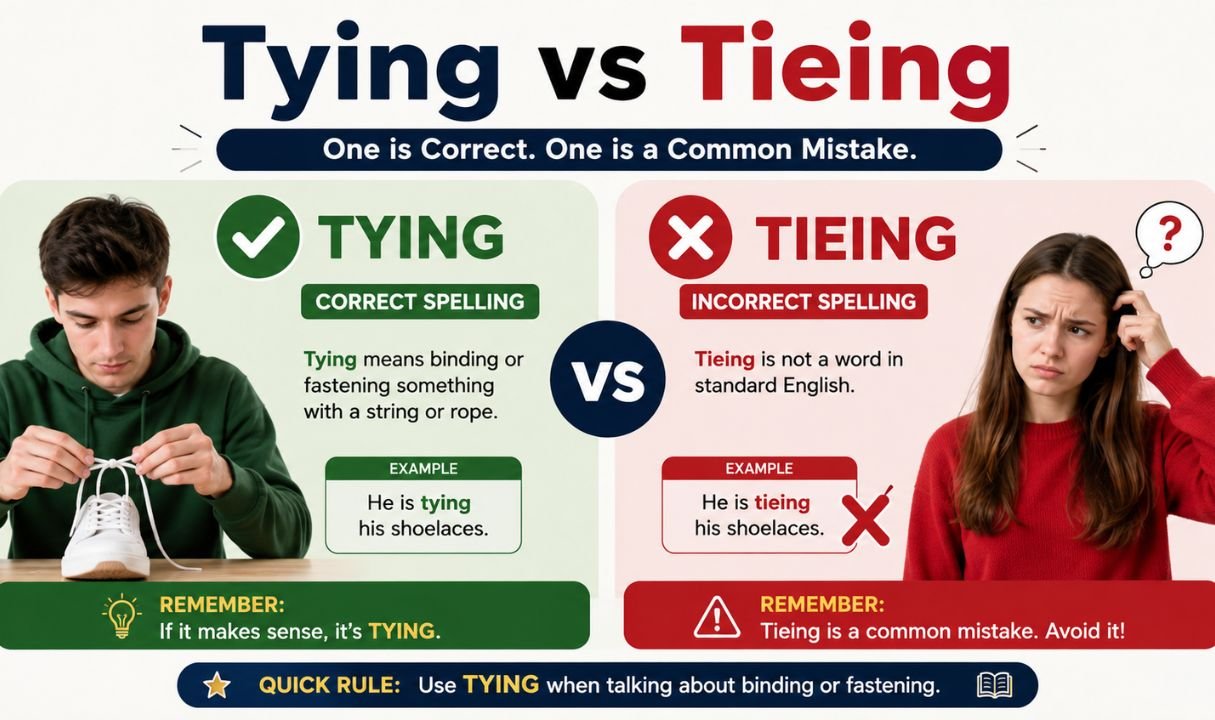
Most people pause at least once while typing this word. You start with “tie,” add “-ing,” and suddenly two spellings look plausible on the screen. Only one of them is actually correct in standard English, and this guide explains exactly why, using the grammar rule behind it and real examples you can apply immediately.
By the end, you’ll know the rule so well that you’ll never need to second-guess this word again.
Tying vs Tieing: Which Spelling Is Correct Today
Tying is the correct spelling. Tieing is not a recognized word in modern English, in either American or British usage. Dictionaries, style guides, and grammar checkers all agree on this point, and no reputable publication uses “tieing” as a standard spelling.
The confusion happens because “tie” already ends in “ie,” and adding “-ing” directly feels like the natural next step. English, however, has a specific rule for verbs that end this way, and that rule overrides the instinct to simply tack letters on.
Why Tying Always Beats Incorrect Tieing Spelling Today
Search engines, word processors, and grammar tools consistently flag “tieing” as an error because it violates a well-established spelling pattern. Writers who use “tying” signal attention to detail, which matters in resumes, emails, academic papers, and any content meant to look polished.
There’s also a practical readability reason. Three vowels in a row (“ieing”) slow down a reader’s eye and look unfamiliar. English spelling generally avoids these awkward vowel clusters, and “tying” fixes that problem cleanly.
Simple Grammar Rule Behind Tying and Tieing Confusion
The rule is straightforward once you see it laid out:
- Verbs ending in -ie replace the -ie with -y before adding -ing.
- This applies whether the verb is short or long, common or rare.
- The rule exists purely for spelling consistency, not meaning.
You May Also Like: Laying or Lying? The Simple Rule That Ends the Confusion for Good
| Base Verb | Incorrect “-ing” Form | Correct “-ing” Form |
|---|---|---|
| Tie | Tieing | Tying |
| Die | Dieing | Dying |
| Lie | Lieing | Lying |
| Vie | Vieing | Vying |
Notice the pattern repeats across every verb ending in “-ie.” This isn’t a one-off exception for “tie” — it’s a small but consistent family of words that all follow the same transformation.
Tying or Tieing Explained With Easy Everyday Examples
Seeing the correct form in real sentences makes the rule stick faster than memorizing it in isolation.
- She spent ten minutes tying her shoelaces before the race.
- He is tying a knot at the end of the rope.
- The two teams ended up tying the match at two goals each.
- Grandma is tying ribbons around the party favors.
- The sailors were tying the boat to the dock before the storm hit.
Every one of these sentences would look wrong with “tieing” in place of “tying,” even to someone who has never studied the rule directly. That’s a useful test: if the word looks unfamiliar or clunky, it’s probably not standard.
Common Mistakes People Make Writing Tying and Tieing
Most people don’t misspell this word out of carelessness. The mistake usually comes from one of a few habits:
- Preserving the base word. Writers want “tie” to stay visible inside the new form, so they keep the “e.”
- Autocorrect gaps. Some basic text fields don’t flag the error, so the mistake slips through.
- Mixing it up with other “-e” verbs. Words like “make” or “write” simply drop the final “e” (making, writing), and people sometimes assume “tie” follows the same drop-the-“e” pattern instead of the change-to-“y” pattern.
- Speed typing. In fast, informal writing — texts, chats, social posts — spelling accuracy naturally drops, and “tieing” slips through unnoticed.
Recognizing which habit applies to you makes it easier to catch the mistake before it becomes automatic.
When Should You Write Tying Instead of Tieing
Use “tying” in every context where you need the present participle or gerund form of “tie.” That covers:
- Formal writing: reports, essays, business documents, academic papers
- Casual writing: texts, emails, social media captions
- Instructional content: recipes, DIY guides, knot-tying tutorials
- Everyday speech transcribed into text: dialogue, quotes, scripts
There is no context — formal, informal, historical reference aside — where “tieing” is the preferred or accepted choice in current English.
Easy Trick for Remembering Correct Tying Spelling Every Time
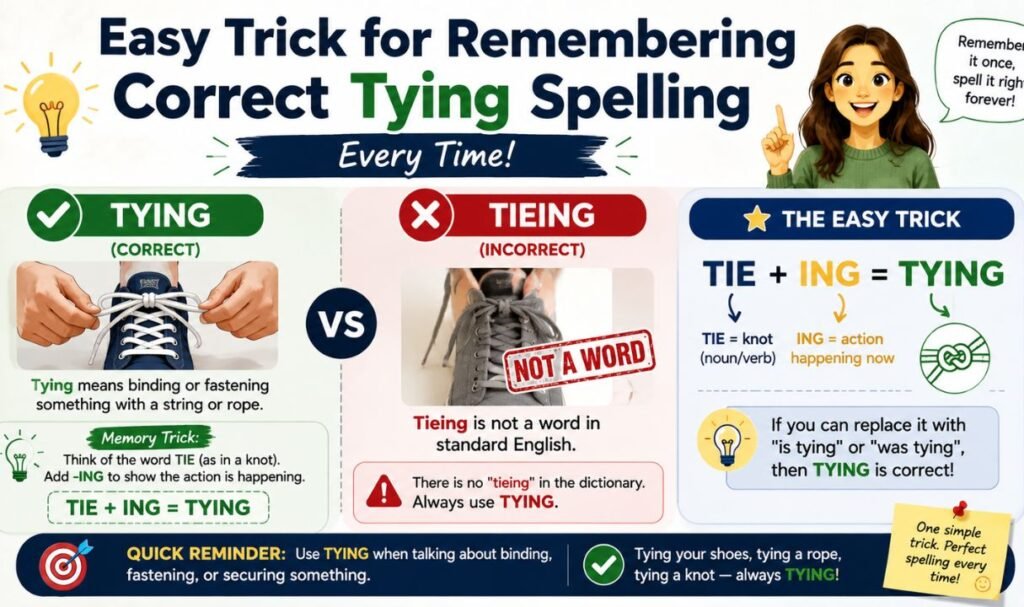
A few memory tricks make this rule permanent:
- Rhyme it: “Tying” rhymes with “flying,” “trying,” and “crying” — all common “-y” plus “-ing” words.
- Group it: Remember tie, die, lie, and vie together. If you know one, you know all four.
- Say the rule out loud: “Change ie to y before ing.” Repeating this a few times builds automatic recall.
- Spot the pattern visually: Notice that correct forms never contain three vowels in a row. If your spelling has “ieing,” stop and fix it.
Pick whichever trick fits how you learn best. Visual learners tend to respond well to the vowel-cluster check, while auditory learners benefit more from the rhyme method.
Tying vs Tieing: Differences Every Writer Should Understand
| Feature | Tying | Tieing |
|---|---|---|
| Correct in modern English | Yes | No |
| Follows standard spelling rule | Yes | No |
| Accepted by dictionaries | Yes | No |
| Used in formal writing | Yes | Never |
| Flagged by grammar checkers | No | Yes |
| Found in historical texts | Rarely needed | Occasionally, in older documents |
This table sums up the entire comparison in one glance. There’s no ambiguity here — the two forms aren’t stylistic alternatives like “gray” and “grey.” One is simply correct, and the other is a spelling error.
You May Also Like: Seeing or Seing: Which Spelling Is Correct?
Correct Tying Usage in Formal and Casual Writing
In formal writing, precision matters because small errors can undercut credibility. A resume that includes “tieing” instead of “tying” may create an unfavorable impression, even if the rest of the writing is strong.
In casual writing, the stakes are lower, but the habit still carries over. If you consistently write “tying” in texts and social posts, you’re less likely to make the mistake when it counts — in a job application, a school assignment, or a professional email.
Formal example: The committee is tying the new policy to next quarter’s budget review.
Casual example: Can you help me with tying this bow? I always mess it up.
Both sentences use the same correct spelling, regardless of tone.
Why English Uses Tying Instead of Tieing Today
English spelling often prioritizes pronunciation clarity over preserving a word’s original letters. The “-ie” to “-y” swap exists because “ieing” would create an unusual vowel sequence that doesn’t match normal English pronunciation patterns.
This same logic applies across the small group of “-ie” verbs. Rather than treating “tie” as a special exception, it helps to see it as part of a consistent, predictable pattern that has existed in English for a long time. Once you accept the pattern, the “why” becomes far less important than simply applying the rule correctly.
Sentence Examples Showing Correct Tying in Daily Writing
- I’m tying my hair back before the workout.
- The nurse was tying the bandage carefully around the wound.
- We’re tying loose ends before the project deadline.
- He kept tying and untying the same knot, unsure if it would hold.
- The two candidates are tying in the latest poll numbers.
These examples cover several different contexts — physical, professional, and figurative — showing that “tying” applies consistently no matter the setting.
Tying Spelling Rule Every English Learner Should Know
For English learners, this rule is worth memorizing early because it appears in common vocabulary: tying shoelaces, tying knots, tying scores, and tying up plans are all everyday phrases.
A simple study method:
- Write the base verb (tie, die, lie, vie).
- Remove the last two letters (“ie”).
- Add “y.”
- Add “ing.”
Following these four steps consistently removes the guesswork, even for learners who are still building confidence with English spelling rules.
Is Tieing Ever Correct in Modern English Usage
No. “Tieing” is not listed as a standard or alternative spelling in current dictionaries, and no major style guide recommends it. It occasionally appears in older texts from the 19th or early 20th century, sometimes in technical or industrial writing, but this is considered outdated and should not be used as a model for contemporary writing.
If you see “tieing” in a modern source, it’s almost always a typo rather than an intentional or accepted spelling choice.
Quick Comparison Between Tying and Tieing Spellings Explained
| Question | Answer |
|---|---|
| Which spelling is correct? | Tying |
| Which spelling is a mistake? | Tieing |
| Does the rule apply to other verbs? | Yes — die, lie, vie follow the same pattern |
| Is there a British/American difference? | No, both use “tying” |
| Is “tieing” ever historically valid? | Rarely, in older or technical texts only |
This side-by-side comparison works well as a quick reference if you ever need to double-check the spelling in the middle of writing something.
Frequently Asked Questions
What is correct, tieing or tying?
“Tying” is correct. “Tieing” is a common misspelling and isn’t recognized in modern English dictionaries or style guides.
Is it tieing up or tying up?
It’s “tying up.” The same -ie to -y spelling rule applies regardless of the phrase or context surrounding the word.
What is the meaning of tieing?
“Tieing” isn’t a valid word — it’s simply a misspelling of “tying,” which means fastening, securing, or binding something together.
Is it tieing the knot or tying the knot?
It’s “tying the knot,” both literally (fastening rope or string) and figuratively (referring to getting married).
Conclusion
“Tying” is the only correct spelling for the present participle and gerund form of “tie,” and it applies across formal, casual, and instructional writing alike. The rule behind it — replacing “-ie” with “-y” before adding “-ing” — is simple, consistent, and shared by a small group of related verbs like die, lie, and vie. Once this pattern clicks, you’ll spell it correctly without hesitation every time, whether you’re tying a knot, tying up a project, or tying the score in a game.